Whatsapp

PM Modi Unveils Postage Stamp on Gujarat High Court’s Diamond Jubilee Celebrations
Introduction
On February 6, 2021, Prime Minister Narendra Modi virtually released a commemorative postage stamp marking the Diamond Jubilee celebrations of the Gujarat High Court, an institution that completed sixty years of its establishment on May 1, 2020. [1] The event, conducted through video conferencing due to the COVID-19 pandemic, brought together distinguished members of the legal fraternity including Union Minister of Law and Justice Ravi Shankar Prasad, Supreme Court judges, the Chief Justice of Gujarat High Court, and the Chief Minister of Gujarat. This historic occasion not only celebrated six decades of judicial excellence but also highlighted the institution’s remarkable adaptability during challenging times and its pioneering role in embracing digital transformation within India’s judicial system. [2]
The Gujarat High Court stands as one of India’s premier judicial institutions, established under constitutional mandate and statutory provisions that reflect the country’s commitment to federal judicial governance. The Diamond Jubilee celebrations represented more than just a milestone anniversary; they symbolized the evolution of justice delivery in India’s western region and recognized the court’s contributions to constitutional jurisprudence, public interest litigation, and innovative judicial administration.
Historical Foundation and Legal Framework
Constitutional and Statutory Establishment
The Gujarat High Court was established on May 1, 1960, pursuant to the Bombay Reorganisation Act, 1960, which provided for the bifurcation of the erstwhile State of Bombay into two separate states based on linguistic lines. [3] The establishment of this judicial institution finds its constitutional foundation in Article 214 of the Constitution of India, which mandates that “There shall be a High Court for each State.” This constitutional provision ensures that every state in the Indian Union possesses an independent and competent judicial authority to uphold the rule of law within its territorial jurisdiction. [4]
The Bombay Reorganisation Act, 1960, was enacted by Parliament under Act No. 11 of 1960, which came into force on the appointed day of May 1, 1960. The Act specifically addressed the creation of separate High Courts for the newly formed states. Under the provisions of this legislation, the Gujarat High Court was constituted as a distinct entity from the Bombay High Court, with jurisdiction extending over all territories included in the State of Gujarat. The first Chief Justice of the Gujarat High Court was Justice Sunderlal Trikamlal Desai, who assumed office on May 1, 1960, accompanied by four puisne judges: Justice K.T. Desai, Justice J.M. Shelat, Justice N.M. Miabhoy, and Justice V.B. Raju. [3]
The legislative framework for the reorganization was carefully crafted to ensure continuity of judicial proceedings while establishing independent state-level judiciary. The Bombay Reorganisation Act made provisions for the transfer of judges, allocation of pending cases, and distribution of assets between the two newly formed High Courts. This meticulous planning reflected the importance placed on maintaining judicial stability during the transition period.
Jurisdictional Powers and Constitutional Mandate
The Gujarat High Court derives its extensive powers from Chapter V of Part VI of the Constitution of India, which deals with High Courts in the States. These constitutional provisions grant the court original, appellate, and supervisory jurisdiction over all subordinate courts within the state. The court functions as a court of record under Article 215, meaning all its proceedings and judgments are preserved for perpetual testimony and carry precedential value. [4]
Under Article 226 of the Constitution, the Gujarat High Court possesses the power to issue writs including habeas corpus, mandamus, prohibition, quo warranto, and certiorari for enforcement of fundamental rights and for any other purpose. This writ jurisdiction makes the High Court a crucial institution in protecting constitutional liberties and ensuring that state actions conform to constitutional mandates. The court also exercises superintendence over all subordinate courts under Article 227, enabling it to oversee the administration of justice throughout the state and correct any errors or irregularities in judicial proceedings below it.
The jurisdiction of the Gujarat High Court extends comprehensively across civil, criminal, and constitutional matters. In its original jurisdiction, the court can hear cases involving substantial questions of law, significant monetary values, and matters requiring immediate constitutional intervention. Its appellate jurisdiction encompasses appeals from district courts, tribunals, and specialized forums across diverse areas of law including taxation, service matters, land disputes, and commercial controversies.
Regulatory Framework for Commemorative Stamps
India Post Guidelines and Philatelic Policy
The issuance of commemorative postage stamps in India follows a structured regulatory framework established by the Department of Posts under the Ministry of Communications. The Minister of Communications and Information Technology approves the issue of commemorative postage stamps based on recommendations from the Philatelic Advisory Committee (PAC) or its Sub-Committee. [5] This approval process ensures that stamps are issued only for subjects, themes, institutions, personalities, or events that possess national or international stature and have made significant contributions to their respective fields.
The guidelines for issuing commemorative stamps stipulate that proposals must be submitted at least one year in advance in the prescribed format available on the official India Post website. The proposals undergo rigorous examination by the PAC or its Sub-Committee before receiving approval from the competent authority. According to the current regulations under Post Office Regulations 2024, not more than 50 issues (maximum 100 stamps) of commemorative postage stamps may be issued per annum, with stamps on personalities not exceeding 20 percent of the annual issue program. [5]
Commemorative stamps are issued specifically on apex institutions or organizations marking milestone anniversaries such as their 50th, 75th, 100th, 125th, or 150th anniversary. The institution or organization must demonstrate national or international stature with significant and well-recognized contributions in their respective fields. The theme or subject must be capable of being depicted on stamps in a visually appealing manner to attract philatelic collectors’ interest.
For the Gujarat High Court’s Diamond Jubilee, the issuance of a commemorative stamp was particularly appropriate as the institution completed sixty years of establishment, falling within the milestone anniversary criteria. As a constitutional institution of immense national importance, the High Court clearly met the stature requirements for commemorative stamp issuance. The proponents for stamps relating to institutions are required to make a mandatory purchase of a minimum number of one lakh stamps, ensuring that there is genuine interest and commitment behind the proposal. [5]
The annual stamp issue program is announced in the last week of December preceding the calendar year of issue, and dates once fixed are generally not changed except with approval of the Minister of Communications. Proponents may hold presentation functions on any day on or after the date of issue, allowing flexibility in organizing celebratory events. The Department of Posts determines all aspects including subject matters, prohibited subjects, procedures for proposal consideration, period of sale, and archival policies for commemorative stamps.
The Diamond Jubilee Commemoration Event
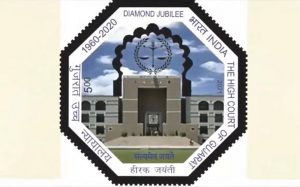
PM Modi to unveil Postage Stamp On Gujarat High Court’s Diamond Jubilee Celebrations
Virtual Release and Distinguished Attendees
The commemorative postage stamp marking the Diamond Jubilee celebrations of the Gujarat High Court was released on February 6, 2021, through video conferencing, with Prime Minister Narendra Modi as the chief guest. Although originally planned as an in-person event, the celebrations were postponed and later adapted to a virtual format due to the COVID-19 pandemic outbreak in Gujarat. [1] This modification demonstrated the adaptability that had become characteristic of judicial proceedings during the pandemic period.
The event witnessed the participation of eminent legal luminaries and government officials including Union Minister of Law and Justice Ravi Shankar Prasad, Justice M.R. Shah of the Supreme Court of India, Justice Vikram Nath who served as Chief Justice of Gujarat High Court at that time, Gujarat Chief Minister Vijay Rupani, and members of the legal fraternity from across the state. [1] Advocate General Kamal Trivedi and Solicitor General of India Tushar Mehta also graced the occasion, highlighting the significance of the event for the legal community.
In his address, Prime Minister Modi praised the judiciary for its positive and creative interpretation of the Constitution to strengthen it further. He emphasized that the judiciary has always performed its duty whether safeguarding citizens’ rights or prioritizing national interest when situations demanded. [2] The Prime Minister particularly commended the Gujarat High Court for its pioneering initiatives in digital transformation, noting that it became the first court in India to live stream court proceedings. [1]
Recognition of Digital Innovation
During the Diamond Jubilee celebrations, Prime Minister Modi highlighted the Gujarat High Court’s exemplary adoption of technology-enabled justice delivery mechanisms. The court demonstrated remarkable adaptive capability by implementing early video conferencing for hearings, SMS call-out systems, e-filing of cases, and email case status updates. The court also initiated streaming of its display board on YouTube and uploaded judgments and orders on its website on a daily basis. [2]
These digital initiatives positioned the Gujarat High Court at the forefront of judicial modernization in India. The Prime Minister noted with satisfaction that the digital infrastructure created by the Law Ministry’s e-Courts Integrated Mission Mode Project was adopted swiftly by courts across India, with over 18,000 courts having been computerized by that time. He proudly stated that India’s Supreme Court had heard the greatest number of cases via video conferencing among all supreme courts globally during the pandemic period. [2]
The Gujarat High Court’s embrace of technology reflected a broader transformation in India’s justice delivery system, making courts more accessible and transparent. The facility to stream court proceedings live enhanced public access to justice while maintaining the dignity and decorum of judicial proceedings. The e-filing system and digital case status updates reduced the need for physical presence, thereby decreasing litigation costs and making the judicial process more litigant-friendly.
Legal Significance of Judicial Milestones
High Courts as Constitutional Guardians
High Courts in India serve as constitutional guardians at the state level, playing a pivotal role in maintaining the rule of law and protecting fundamental rights. The establishment of the Gujarat High Court under Article 214 reflected the constitutional vision of creating an independent judiciary capable of checking executive and legislative excesses while ensuring justice for all citizens. [4] The Diamond Jubilee celebration was therefore not merely commemorating an institution’s longevity but recognizing six decades of constitutional commitment.
The significance of High Courts in India’s federal structure cannot be overstated. They function as intermediate appellate courts between district judiciary and the Supreme Court, thereby reducing the burden on the apex court while ensuring quality justice delivery at the state level. High Courts also exercise original jurisdiction in significant matters, making them the first forum for constitutional challenges, public interest litigations, and writs petitions.
Throughout its sixty-year journey, the Gujarat High Court has contributed substantially to the development of jurisprudence in diverse areas including constitutional law, administrative law, service law, tax law, and criminal law. The court has delivered numerous landmark judgments that have been cited with approval by other High Courts and the Supreme Court of India. Several distinguished judges who began their judicial careers at the Gujarat High Court have subsequently been elevated to the Supreme Court of India, bringing with them the rich judicial experience and wisdom gained during their tenure.
Judicial Independence and Accountability
The constitutional framework ensures judicial independence through various safeguards including security of tenure, fixed emoluments, and protection from arbitrary removal. Judges of High Courts are appointed by the President of India in consultation with the Chief Justice of India and the Governor of the state concerned, following recommendations from the Supreme Court Collegium. [4] This appointment mechanism, while subject to ongoing debates about reform, has generally ensured the selection of competent and independent-minded judges.
The Gujarat High Court, like other High Courts in India, has maintained its independence despite occasional challenges. The court’s ability to issue directions to state government authorities, scrutinize administrative actions, and protect individual liberties demonstrates the effectiveness of constitutional safeguards. The Diamond Jubilee celebrations served as a reminder of this institutional independence and the importance of preserving it for future generations.
Judicial accountability operates through multiple mechanisms including the hierarchical appellate system, public scrutiny of judgments, and the ultimate accountability through the impeachment process provided under the Constitution. High Courts publish their judgments regularly, making them accessible to legal professionals and citizens, thereby ensuring transparency in judicial decision-making. The Gujarat High Court’s initiative to upload judgments and orders on its website enhanced this transparency significantly.
Evolution of Judicial Administration
From Navrangpura to Sola: Physical Infrastructure Development
The Gujarat High Court commenced its operations near Akashwani in Navrangpura, Ahmedabad, with modest infrastructure suited to its initial workload inherited from the parent Bombay High Court. [3] As the state developed economically and the volume of litigation increased, the need for expanded infrastructure became apparent. On January 16, 1999, the High Court shifted to its new, purpose-built campus at Sarkhej-Gandhinagar Highway in Sola, Ahmedabad. This relocation marked a significant milestone in the court’s physical development, providing modern facilities conducive to efficient judicial work.
The new campus offered spacious courtrooms, improved library facilities, better advocates’ chambers, and enhanced administrative offices. The architectural design reflected both functionality and dignity appropriate for a constitutional institution. The expanded infrastructure enabled the court to handle increasing caseloads while maintaining quality and efficiency in judicial proceedings.
The sanctioned judge strength has grown considerably from the original five judges in 1960 to 52 posts (including 39 permanent and 13 additional posts) by 2023. [3] However, the actual working strength has often remained below sanctioned levels, a challenge faced by many High Courts across India. Addressing judicial vacancies remains crucial for timely justice delivery and reducing pendency of cases.
Technological Transformation and E-Courts Project
The Gujarat High Court’s adoption of information and communication technology represents one of its most significant contributions to judicial modernization. The court embraced the e-Courts Integrated Mission Mode Project launched by the Department of Justice with enthusiasm and innovation. Services such as e-filing of cases, virtual case status inquiry, SMS notifications for hearings, and online availability of cause lists transformed the experience of litigants and lawyers.
The court’s decision to live stream proceedings marked a historic development in Indian judicial transparency. This initiative, implemented during the COVID-19 pandemic, allowed citizens to observe court proceedings remotely, enhancing public confidence in the judicial system. The live streaming maintained proper decorum while making justice visible and accessible to all.
The e-Courts project also facilitated the creation of the National Judicial Data Grid, which provides comprehensive statistics on cases filed, disposed, and pending across courts in India. This data-driven approach enables better resource allocation, identifies bottlenecks, and supports evidence-based judicial reforms. The Gujarat High Court’s active participation in these initiatives demonstrated its commitment to modernization and efficiency.
Commemorative Stamps as Cultural Artifacts
Philatelic Significance and Historical Documentation
Commemorative postage stamps serve as miniature ambassadors of a nation’s heritage, achievements, and values. They document significant events, personalities, and institutions, preserving them in a format that reaches millions of people through ordinary postal communication. The issuance of a stamp on the Gujarat High Court’s Diamond Jubilee thus elevated the institution’s recognition beyond legal circles to the general public consciousness.
Philately, the study and collection of postage stamps, has a dedicated following in India and worldwide. Collectors value commemorative stamps for their historical significance, artistic merit, and limited availability. The Gujarat High Court stamp, issued on a milestone anniversary of a constitutional institution, possesses particular significance for philatelists interested in Indian legal history and institutional development.
The design of commemorative stamps typically incorporates symbolic elements representing the subject being commemorated. While specific design details of the Gujarat High Court Diamond Jubilee stamp were not extensively publicized, such stamps generally feature the institution’s emblem, architectural representation, or other imagery associated with its identity and functions. The stamp serves as a permanent record in India’s philatelic history, ensuring that future generations remember this important institutional milestone.
Conclusion
The unveiling of the commemorative postage stamp by Prime Minister Narendra Modi on the Gujarat High Court’s Diamond Jubilee represented a significant moment in India’s judicial and philatelic history. The event celebrated sixty years of constitutional commitment, judicial excellence, and institutional evolution. From its establishment under the Bombay Reorganisation Act, 1960, in accordance with Article 214 of the Constitution, the Gujarat High Court has grown into a premier judicial institution recognized for its jurisprudential contributions and technological innovations.
The regulatory framework governing commemorative stamp issuance, administered by the Department of Posts under established guidelines, ensured that only institutions of genuine national importance receive such recognition. The Gujarat High Court clearly met these criteria, having served as the constitutional guardian of Gujarat for six decades while contributing significantly to the development of Indian jurisprudence.
The Diamond Jubilee celebrations, though conducted virtually due to pandemic constraints, successfully highlighted the court’s achievements including its pioneering role in digital transformation of justice delivery. Prime Minister Modi’s participation and his acknowledgment of the judiciary’s positive contributions reinforced the importance of judicial independence and innovation in strengthening constitutional governance.
As the Gujarat High Court moves forward beyond its Diamond Jubilee, the commemorative stamp remains a tangible reminder of its historical journey and institutional significance. It serves both as recognition of past achievements and as inspiration for continued excellence in delivering justice, upholding constitutional values, and adapting to future challenges facing India’s judicial system.
References
[1] Press Information Bureau, Government of India. (2021, February 6). PM addresses event marking Diamond Jubilee of Gujarat High Court. Retrieved from https://www.pib.gov.in/Pressreleaseshare.aspx?PRID=1695769
[2] Prime Minister’s Office, Government of India. (2021, February 6). PM addresses event marking Diamond Jubilee of Gujarat High Court. Retrieved from https://www.pmindia.gov.in/en/news_updates/pm-addresses-event-marking-diamond-jubilee-of-gujarat-high-court/
[3] Official Website of Gujarat High Court. (n.d.). About Us – History. Retrieved from https://gujarathighcourt.nic.in/aboutus
[4] Constitution of India. (1950). Article 214: High Courts for States. Retrieved from https://www.constitutionofindia.net/articles/article-214-high-courts-for-states/
[5] India Post – Department of Posts. (n.d.). Rules for Issue of Commemorative Stamps. Retrieved from https://postagestamps.gov.in/Rulesforissueofcommemorativestamp.aspx
[6] The Bombay Reorganisation Act, 1960 (Act No. 11 of 1960). Retrieved from https://www.indiacode.nic.in/handle/123456789/1535
[7] Business Standard. (2021, February 5). PM Modi to unveil postage stamp on Gujarat High Court on Saturday. Retrieved from https://www.business-standard.com/article/current-affairs/pm-modi-to-unveil-postage-stamp-on-gujarat-high-court-on-saturday-121020500981_1.html
[8] Zee News. (2021, February 6). PM Narendra Modi unveils postage stamp on Gujarat High Court’s Diamond Jubilee event. Retrieved from https://zeenews.india.com/india/pm-narendra-modi-unveils-postage-stamp-on-gujarat-high-courts-diamond-jubilee-event-2340064.html
[9] India TV News. (2021, February 6). PM Modi releases commemorative postage stamp on Diamond Jubilee of Gujarat High Court. Retrieved from https://www.indiatvnews.com/news/india/gujarat-high-court-postage-stamp-pm-narendra-modi-683076
Published and Authorized by Prapti Bhatt