Whatsapp

NDPS Appeal against Conviction: Process and Timeline

A conviction under the Narcotic Drugs and Psychotropic Substances Act, 1985 (NDPS Act) in a commercial quantity case can result in a mandatory minimum sentence. An NDPS appeal against conviction is therefore a critical legal remedy, and its preparation can determine whether the appellate court can effectively examine errors in the trial court’s judgment, evidence, procedure, or sentence.
Where the NDPS Appeal Against Conviction Lies
NDPS offences are tried by Special Courts constituted under Section 36 of the Act.
Section 36B provides that an appeal shall lie from any judgment, sentence or order, not being an interlocutory order, of a Special Court to the High Court, both on facts and on law. So for a conviction by a Special Court in Gujarat, the appeal lies to the High Court of Gujarat.
The appeal is a full appeal. The High Court may re-appreciate the evidence, and is not confined to questions of law — which is why the record matters as much as the argument.
Where the trial was conducted by a court other than a Special Court in the circumstances the Act contemplates, the appellate forum follows the ordinary provisions of the criminal procedure law.
Limitation for an NDPS Appeal
The period for an appeal against conviction is governed by the Limitation Act, 1963 read with the applicable provisions of the criminal procedure law — the Bharatiya Nagarik Suraksha Sanhita, 2023 for offences committed on or after 1 July 2024, and the Code of Criminal Procedure, 1973 for earlier offences. The period runs from the date of the sentence or order.
Because the applicable period depends on the forum and the nature of the order, it should be read from the current provisions rather than assumed. Where an appeal is filed beyond time, an application for condonation of delay must accompany it, explaining the delay with dates and material. A convicted person in custody is entitled to present an appeal through the jail authorities, and time so occupied is a relevant consideration on condonation.
The practical discipline is the same as in any appeal: apply for the certified copy of the judgment immediately on pronouncement.
Suspension of Sentence and Bail Pending Appeal
This is usually the most urgent question.
An appellate court has power to suspend the execution of the sentence and to release the appellant on bail pending appeal. But Section 37 of the NDPS Act continues to apply. Section 37(2) provides that its limitations are in addition to those under the general criminal procedure law on the grant of bail, and courts have applied the twin conditions at the appellate stage in commercial-quantity cases.
So an application for suspension of sentence in such a case must satisfy the court that there are reasonable grounds for believing the appellant is not guilty and that he is not likely to commit any offence while on bail.
Two considerations carry particular weight at this stage:
Demonstrable defects in the trial court’s reasoning — a finding resting on inadmissible material, or on a procedural breach the trial court did not address.
The period already undergone against the length of the sentence, coupled with the likely time before the appeal is heard. Where an appellant has served a substantial part of the sentence and the appeal is not likely to be heard soon, that is a distinct ground grounded in Article 21.
Grounds for Appeal Against NDPS Conviction
Because the High Court re-appreciates evidence, appellate grounds in NDPS matters are typically evidentiary and procedural rather than doctrinal.
Quantity misclassification. Whether the case was correctly placed in the commercial band. Following Hira Singh v. Union of India, (2020) 20 SCC 272, decided 22 April 2020, the weight of neutral substances mixed with the drug is counted, E. Micheal Raj having been overruled. But a carrier — packaging or an article of concealment — does not count, and misapplication of that distinction is a live ground.
Reliance on inadmissible material. Tofan Singh v. State of Tamil Nadu, (2021) 4 SCC 1, decided 29 October 2020, held that Section 67 statements are inadmissible. Convictions resting on such statements have been set aside, including long after the trial, and this remains one of the most effective appellate grounds.
Non-compliance with mandatory safeguards — Sections 42, 50, 52 and 57. Where a personal search was conducted without informing the accused of the right under Section 50, the recovery cannot be relied upon to convict: State of Punjab v. Baldev Singh, (1999) 6 SCC 172, and Vijaysinh Chandubha Jadeja v. State of Gujarat, (2011) 1 SCC 609, which required strict rather than substantial compliance.
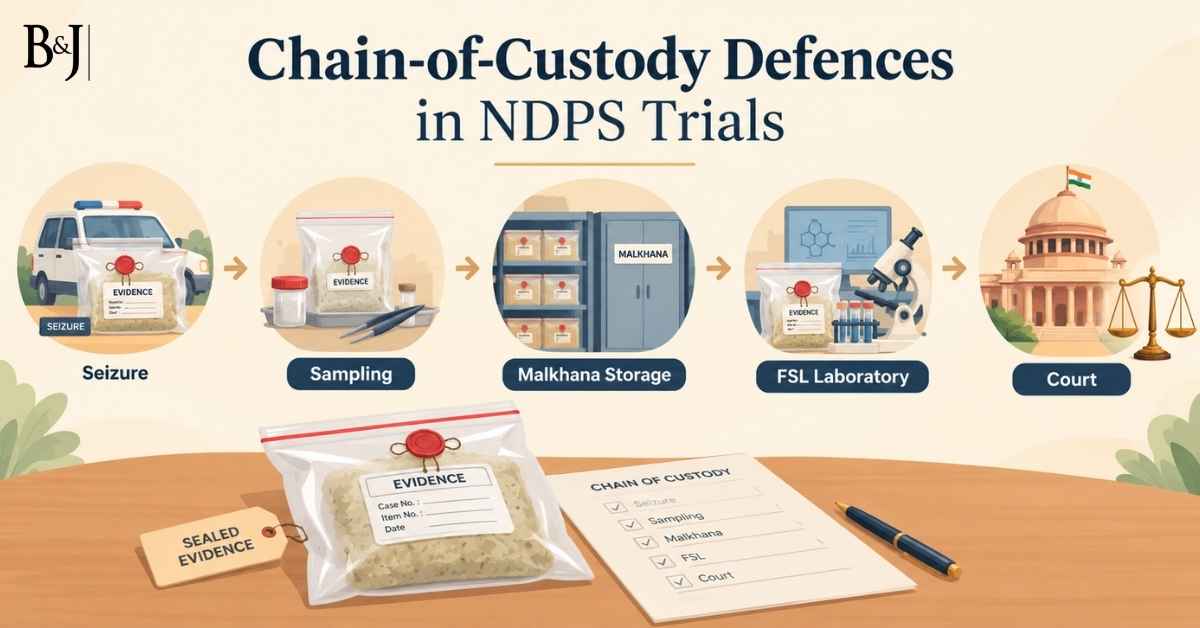
Defects in sampling and chain of custody, so that the identity of the analysed substance with the seized substance is not established.
Absence of conscious possession, where physical control and knowledge were not established and the presumptions under Sections 35 and 54 were applied without the foundational facts being proved. In Gangadhar alias Gangaram v. State of Madhya Pradesh, decided 5 August 2020, the Supreme Court held those presumptions to be rebuttable and not to dispense with the prosecution’s obligation to prove the charge beyond reasonable doubt.
Sentence. Where the conviction stands but the sentence exceeds what the band requires, or where the factors in Section 32B were misapplied.
What is not a Ground
The mere fact that the NDPS trial court accepted the prosecution witnesses is not, by itself, sufficient ground for an appeal against conviction. Although the appellate court can re-appreciate the evidence, it will not ordinarily interfere merely because another view is possible on the same evidence.
A ground not raised before the NDPS trial court may face difficulty on appeal if it depends on facts that were never examined during the trial. However, pure questions of law, such as the admissibility of evidence or a procedural violation apparent from the trial record, may be raised for the first time in an NDPS appeal.
Beyond the High Court
An NDPS appeal from the High Court to the Supreme Court may lie where the Narcotic Drugs and Psychotropic Substances Act, 1985 or applicable criminal procedure law provides for it. In other cases, the accused may approach the Supreme Court under Article 136 of the Constitution by filing a Special Leave Petition (SLP).
Practical Guidance
Obtain the certified copy immediately, and the complete trial record — the seizure memo and panchnama, the Section 50 notice and response, the sampling record, the malkhana entries, the forwarding memo, the FSL report, and the depositions.
Frame the grounds around the record: what the documents show, where they contradict each other, and what the judgment failed to deal with.
File the application for suspension of sentence with the appeal rather than later, and address Section 37 in it expressly.
And check the material the conviction actually rests on. Where it rests on Section 67 statements, that is the first ground, and it is one on which the Supreme Court has set aside convictions many years after trial.
Frequently Asked Questions
Can I appeal an NDPS conviction?
Yes. A conviction by an NDPS Special Court can generally be challenged before the High Court under Section 36B of the NDPS Act.
Can I get bail during an NDPS appeal?
Yes, the appellate court can suspend the sentence and grant bail, but Section 37 NDPS Act conditions may apply in commercial-quantity cases.
What are common grounds for an NDPS appeal?
Common grounds include illegal recovery, Section 50 violations, inadmissible Section 67 statements, sampling defects, broken chain of custody, and failure to prove conscious possession.
How important is the FSL report in an NDPS appeal?
The FSL report and the chain of custody can be crucial where the prosecution must establish that the substance analysed is the same substance allegedly seized from the accused.
Can the High Court reconsider evidence in an NDPS appeal?
Yes. An appeal from a Special Court conviction can involve re-appreciation of evidence on facts as well as questions of law.
Legal Information Disclaimer
This article is published for general legal information and educational purposes only. It reflects the position of Indian law as researched up to 10 August 2026 and may not account for subsequent amendments, notifications or judicial developments. Limitation periods and appellate forums should be verified against the current provisions applicable to the case. It is not legal advice, does not take into account any individual’s particular facts or circumstances, and no advocate-client relationship arises from reading it. Readers dealing with an actual matter should obtain independent professional advice from a qualified advocate of their own choosing before acting on any information contained here. Statutory provisions, notified figures, rules and case citations referred to in this article have been compiled from published legal materials and may contain errors or omissions, and may have changed since the date stated; no representation or warranty, express or implied, is given as to their accuracy, completeness or currency, and each should be independently verified against the official text or the official record before being relied upon. No liability is accepted for any loss arising from reliance on this article.
Sources / Authorities
- Narcotic Drugs and Psychotropic Substances Act, 1985 — Sections 35, 36, 36A, 36B, 37, 42, 50, 52, 54, 57, 67 and 32B — India Code, https://www.indiacode.nic.in
- Bharatiya Nagarik Suraksha Sanhita, 2023 — appellate provisions and suspension of sentence pending appeal
- Code of Criminal Procedure, 1973 — for offences committed on or before 30 June 2024
- Limitation Act, 1963
- Hira Singh v. Union of India, (2020) 20 SCC 272, decided 22 April 2020 — https://indiankanoon.org/doc/128615827/
- Tofan Singh v. State of Tamil Nadu, (2021) 4 SCC 1, decided 29 October 2020 — https://indiankanoon.org/doc/143202244/
- State of Punjab v. Baldev Singh, (1999) 6 SCC 172 — reference as reported; verify against the official record
- Vijaysinh Chandubha Jadeja v. State of Gujarat, (2011) 1 SCC 609 — reference as reported; verify against the official record
- Gangadhar alias Gangaram v. State of Madhya Pradesh, decided 5 August 2020 — reference as reported; verify against the official record
- Constitution of India, Articles 21 and 136