Whatsapp

What is a 7/12 extract and how to correct errors

Anyone who has bought, sold, inherited or borrowed against agricultural land in Gujarat is likely to have encountered the 7/12 extract, also known as the Satbara Utara. This important Gujarat land record contains key details about a property, yet it is often misunderstood—particularly its role in recording land rights and ownership.
What the document is
The name comes from two village forms maintained under the Gujarat Land Revenue Code, 1879 and the Gujarat Land Revenue Rules, 1972.
Village Form VII is the record of rights for a survey number or block. It records the survey or block number, the area, the assessment, the names of the occupants or holders, the tenure, and encumbrances and other rights entered against the land, along with cross-references to the mutation entries that produced the current position.
Village Form XII is the crop register. It records, season by season, the crops grown, the area under each, and the source of irrigation.
The two are issued together as a single extract — hence “7/12”. Related records include Village Form VI, the register of mutations, known as the pherfar register, and Village Form 8-A, the holding account for a person across survey numbers.
What it proves, and what it does not
The Code gives entries in the record of rights and mutation register a rebuttable presumption of correctness. However, a 7/12 extract does not by itself establish ownership of agricultural land. The Gujarat High Court has repeatedly held that revenue entries serve fiscal purposes, that a mutation entry does not confer title, and that a revenue record cannot replace a registered deed when ownership is disputed.
The 7/12 extract is therefore evidence of what the revenue records show, but it is not conclusive proof of title. For buyers and landowners, it should be treated as a starting point for land title and property due diligence, rather than the final evidence of ownership.
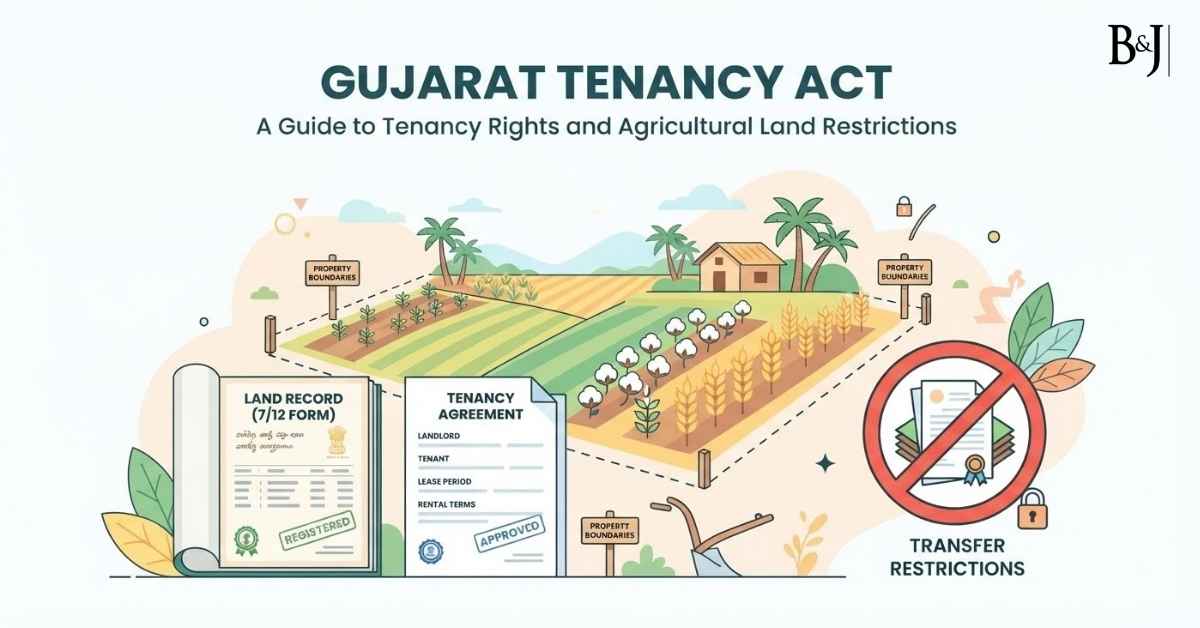
When properly examined, the document is an important tool for land-record due diligence. Mutation references can show how the current entry arose—through a registered sale deed, succession, court decree or another transaction. The tenure details may indicate restrictions on transfer, while the “other rights” column may reveal a mortgage, tenancy, charge or other recorded interest.
Common Errors in Gujarat 7/12 Records
Errors in a 7/12 extract in Gujarat generally fall into recognised categories, and the appropriate remedy depends on the nature of the error.
Clerical and transcription errors — a misspelt name, a wrong father’s name, a wrong survey or block number, an incorrect area, a digit dropped from a share.
Errors carried forward from an earlier entry, repeated in every extract since.
Omissions — a name that should have been added on succession or partition but was not; an encumbrance that was discharged but never removed.
Entries made without notice — a mutation certified without intimation to a person interested, under the procedure the Code requires.
Substantive disputes dressed up as record errors — where the real question is who owns the land, or whether a transaction was valid.
How to Correct Errors in a 7/12 Extract
If a 7/12 extract correction is required in Gujarat, the appropriate remedy depends on the nature of the error and whether the disputed entry affects anyone’s rights. The process may involve obtaining the relevant records, seeking correction, and, where necessary, pursuing an appeal, revision or judicial remedy.
Step one: obtain certified copies. The 7/12 extract, the relevant mutation entries from Village Form VI, and the order certifying the entry complained of. An application for correction that does not identify the entry number and date is difficult to process.
Step two: apply to the Talati or Mamlatdar for correction. For a clerical or transcription error where no one’s rights are affected — an obviously misspelt name, a manifest typographical error — an application to the village accountant or the Mamlatdar, with supporting documents, is often sufficient. Where the correction affects rights, a fresh mutation entry follows, and the procedure under Chapter X-A applies, including the entry of the mutation in the register, posting of the copy, intimation to interested persons, and disposal of objections.
Step three: appeal against a certified entry. Where the entry has been certified and the correction is refused, the appellate remedy lies to the Deputy Collector under Rule 108 of the Gujarat Land Revenue Rules, 1972, and Rule 108(5) prescribes a limitation period of sixty days. Delay requires an application for condonation with an explanation.
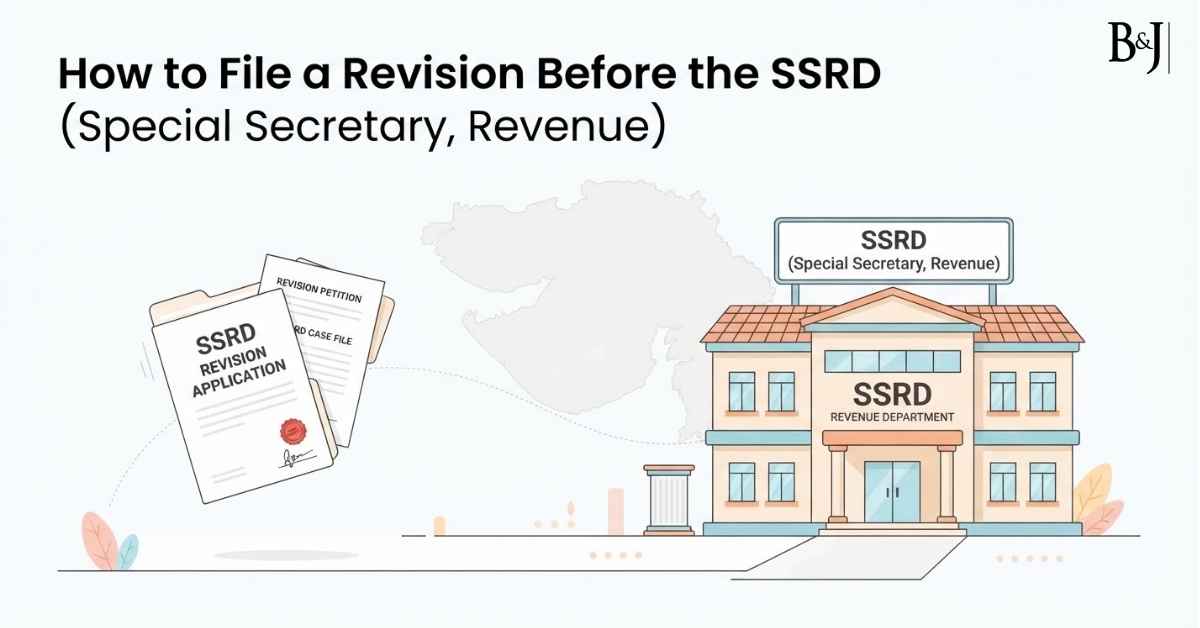
Step four: revision. Further remedies within the revenue hierarchy lie under Sections 203, 204 and 211 of the Code, with the revisional power exercised by the Special Secretary, Revenue Department (Appeals) — the SSRD — under Section 211 and under Rule 108(6A) of the Rules.
Step five: the High Court. After the revenue remedies are exhausted, an order may be challenged before the High Court of Gujarat by a Special Civil Application.
When correction is not the remedy
If the “error” is that someone else’s name appears as the holder and you say the land is yours, that is not a record-correction problem. It is a title dispute, and it belongs in the civil court — by a suit for declaration, for cancellation of the document under which the other party claims, or for partition, as the facts require.
Revenue authorities cannot decide that question, and an order in your favour on the entry will not settle it. Where the ownership question is genuinely contested, the civil suit is the substantive remedy and the revenue proceeding is, at best, ancillary.
Practical points for buyers
Read the mutation history, not just the current entry. An entry that traces back to a registered sale deed is on a different footing from one that traces back to an oral arrangement or an unregistered document.
Check the tenure and the “other rights” columns. Restrictions on transfer, and subsisting encumbrances or tenancies, appear there.
Verify the extract against the original records rather than relying on a copy supplied by the other side, and take a fresh certified copy close to the transaction date.
Treat the 7/12 as one document among several. The registered deeds, the search of the sub-registrar’s records, the mutation file and the relevant permissions together tell the story. The 7/12 alone does not.
FAQ
What is a 7/12 extract in Gujarat?
A 7/12 extract, or Satbara Utara, is a revenue record containing information about a parcel of land, including rights, tenure, cultivation and recorded interests.
Does a 7/12 extract prove ownership?
No. A 7/12 extract is a revenue record and does not by itself establish title or ownership. Ownership generally has to be established through the relevant title documents and other evidence.
Can a 7/12 extract be corrected?
Yes. Clerical, transcription and other record errors may be corrected through the appropriate revenue procedure. Where an entry affects rights, the applicable mutation and objection procedure may be required.
How can I challenge a mutation entry in Gujarat?
A certified mutation entry can generally be challenged through the applicable appellate remedy under Rule 108 of the Gujarat Land Revenue Rules, 1972. Further revisionary and judicial remedies may be available depending on the circumstances.
Is a 7/12 extract enough before buying agricultural land?
No. Buyers should also examine the title documents, mutation history, encumbrances, tenure restrictions, permissions and relevant registration records before completing a transaction.
Legal Information Disclaimer
This article is published for general legal information and educational purposes only. It reflects the position of Indian law as researched up to 10 August 2026 and may not account for subsequent amendments, notifications, rule changes or judicial developments. It is not legal advice, does not take into account any individual’s particular facts or circumstances, and no advocate-client relationship arises from reading it. Outcomes in litigation depend on the specific facts of each case and on procedural requirements in force at the relevant time. Readers dealing with an actual dispute should obtain independent professional advice from a qualified advocate of their own choosing before acting on any information contained here. Statutory provisions, notified figures, rules and case citations referred to in this article have been compiled from published legal materials and may contain errors or omissions, and may have changed since the date stated; no representation or warranty, express or implied, is given as to their accuracy, completeness or currency, and each should be independently verified against the official text or the official record before being relied upon. No liability is accepted for any loss arising from reliance on this article.
Sources / Authorities
- Gujarat Land Revenue Code, 1879 (Bombay Act V of 1879, as applicable in Gujarat) — Chapter X-A on the record of rights, including Sections 135C and 135D and the provision on presumption of correctness of entries; Sections 203, 204 and 211 — Revenue Department, Government of Gujarat, https://revenuedepartment.gujarat.gov.in/downloads/act_BLRC_1879_n.pdf
- Gujarat Land Revenue Rules, 1972 — village forms maintained under the Rules, and Rule 108, including sub-rule (5) and sub-rule (6A)
- Registration Act, 1908
- Constitution of India, Articles 226 and 227