 Whatsapp


Depreciation on Goodwill: The Finance Act 2021, Its Transition and Its Fallout
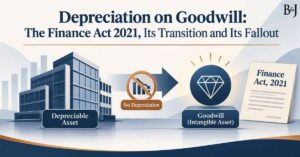
Suppose that in December 2018 a listed company, Beta Limited, buys a small software business as a going concern for Rs. 100 crore. The identifiable assets it acquires – computers, receivables, a lease – are worth Rs. 70 crore. The remaining Rs. 30 crore is not attributable to anything Beta can point to and touch: it represents the customer relationships, the reputation and the assembled workforce that make the acquired business worth more than the sum of its parts. Beta records that Rs. 30 crore in its books as goodwill, and for the assessment years 2019-20 and 2020-21 it claims depreciation on that goodwill at 25 per cent, as the Supreme Court had permitted. It expects to go on doing so until the balance is written off. The Finance Act, 2021 fundamentally changed the treatment of depreciation on goodwill by excluding goodwill of a business or profession from the category of depreciable intangible assets.
This article examines depreciation on goodwill under the Finance Act, 2021, the reasons behind its withdrawal, the treatment of claims relating to earlier assessment years and the subsequent position under the Income-tax Act, 2025. It is written on the law as it stands on 31 August 2026, by which date the Income-tax Act, 2025 has replaced the 1961 Act for tax years beginning on or after 1 April 2026.
How Goodwill Came To Be Depreciable In The First Place
Goodwill, in the classical formulation, is the benefit and advantage of the good name and connection of a business – the attractive force that brings in custom. For most of the life of the Income-tax Act, 1961 it had no place in the depreciation scheme at all, because depreciation was confined to buildings, machinery, plant and furniture. That changed with the Finance (No. 2) Act, 1998, which with effect from assessment year 1999-2000 inserted into section 32(1) a new clause (ii) allowing depreciation on intangible assets, and an Explanation 3 defining them as “know-how, patents, copyrights, trade marks, licences, franchises or any other business or commercial rights of similar nature”. The rate prescribed was 25 per cent on the written down value.
Goodwill was not named, so the question became whether it answered the residual description, “any other business or commercial rights of similar nature”. One reading applied the rule of ejusdem generis – that a general expression following a list of specific items takes its colour from them – to confine the residual words to identifiable legal rights capable of separate transfer, of which goodwill, a residual accounting figure, is not one. The competing reading treated the six named items as illustrative of a broad genus of commercial advantage into which goodwill comfortably fits. The Supreme Court took the second view in CIT v. Smifs Securities Ltd. (2012) 348 ITR 302 (SC), holding that goodwill is an asset under Explanation 3(b) and that the excess of consideration over the value of net assets acquired on amalgamation was goodwill on which depreciation was allowable. The decision deserves to be read for what it is: a short order at final disposal, in which the respondent did not appear though served, and in which the question whether anything had actually been paid for goodwill was resolved by declining to disturb a concurrent factual finding the Revenue had not challenged. That does not diminish its authority on the construction of Explanation 3(b), but it explains why the Revenue went on litigating for a decade afterwards whether, on the facts of a given scheme, goodwill had genuinely been purchased at all.
The High Courts extended the principle. In Areva T&D India Ltd. v. DCIT (2012) 345 ITR 421 (Del), a slump sale case concerning business claims, contracts and know-how, the Delhi High Court applied ejusdem generis in the direction opposite to the Revenue’s argument, holding that the residual words extended to assets of the same genus and that the legislature had not intended depreciation only for specified assets. In Triune Energy Services (P.) Ltd. v. DCIT (Delhi High Court, ITA 40/2015, decided 19 November 2015) the Court accepted that valuing slump-sale goodwill as the excess of consideration over net tangible assets is an acceptable accounting practice. In Gujarat, PCIT v. Zydus Wellness Ltd. [2017] 87 taxmann.com 82 (Guj) allowed depreciation on goodwill arising on amalgamation, and the Revenue’s special leave petition was reported as dismissed. By 2020 the Ahmedabad Tribunal, in Urmin Marketing (P.) Ltd. v. DCIT (ITA 1806/Ahd/2019, order dated 21 October 2020), rejected the contention that claiming depreciation on goodwill generated in a sanctioned amalgamation was by itself a colourable device.
The Finance Act, 2021: Statutory Changes to Depreciation on Goodwill
The amendment is often described in shorthand as a provision declaring that “goodwill of a business or profession shall not be considered as an asset”. It is worth being precise, because no such sentence exists in the Act. That formulation is the language of the Memorandum explaining the Finance Bill, 2021, not of the enacted text. What Parliament in fact did, by the Finance Act, 2021 (Act 13 of 2021, which received assent on 28 March 2021 and whose relevant sections came into force on 1 April 2021), was to make four surgical insertions and one substitution.
First, in the definition of “block of assets” in section 2(11), after the words “or commercial rights of similar nature”, the words “not being goodwill of a business or profession” were inserted. Second, the same negative words were inserted into section 32(1)(ii) and into clause (b) of Explanation 3 to section 32(1). Explanation 3 was amended, not deleted: intangible assets remain depreciable; goodwill is simply carved out of the class. Third, section 43(6)(c)(ii) was recast to provide, in a new sub-item (B), that where goodwill formed part of a block of intangible assets the written down value of that block is to be reduced by the actual cost of the goodwill as decreased by depreciation actually allowed before 1 April 1988 and by the depreciation that would have been allowable had the goodwill been the only asset in the block – the reduction not to exceed the written down value. Fourth, a proviso was inserted in clause (2) of section 50 stating that where goodwill formed part of a block for AY 2020-21 and depreciation had been obtained on it, the written down value of the block and the short-term capital gain, if any, shall be determined in such manner as may be prescribed.
Fifth and separately, section 55(2)(a) was substituted so that the cost of acquisition of goodwill is the purchase price where it was bought from a previous owner, the previous owner’s purchase price in the specified succession cases, and nil in any other case – with a proviso requiring that any depreciation obtained on the goodwill under section 32(1) before assessment year 2021-22 be deducted from the purchase price. The cut-off date in section 55(2)(a) is 1 April 2021. The date 1 April 2020 appears only in the section 50 proviso, and confusing the two is a common source of error in secondary commentary.
The stated rationale, in the Memorandum, was that goodwill is generally not a depreciating asset and, depending on how a business runs, may appreciate rather than decline in value – so that allowing a wasting-asset allowance on it was conceptually unsound. The Memorandum expressly noted the decision in Smifs. The amendments were stated to take effect from 1 April 2021 and to apply to assessment year 2021-22 and subsequent years.
Rule 8AC, And The Gap That Had To Be Closed Retrospectively
The section 50 proviso conferred a rule-making power, and the Central Board of Direct Taxes exercised it by Notification No. 77/2021 dated 7 July 2021 (G.S.R. 472(E)), the Income-tax Amendment (19th Amendment) Rules, 2021, which inserted Rule 8AC into the Income-tax Rules, 1962. The rule prescribes the arithmetic of the one-time adjustment. Where the reduction required by section 43(6)(c)(ii)(B) exceeds the aggregate of the opening written down value of the intangible block computed without that reduction and the actual cost of intangible assets other than goodwill acquired during the previous year 2020-21, sub-rule (3) deems the excess to be capital gains arising from the transfer of a short-term capital asset. Sub-rule (4), which operates without prejudice to sub-rule (3) and to section 55, provides that where goodwill was the only asset in the block and the block consequently ceases to exist, there is no capital gain or loss on account of the cessation. Sub-rule (5) routes any subsequent transfer of goodwill to sections 48, 49 and 55(2)(a) in the ordinary way.
There was an obvious structural difficulty. Sub-rule (3) charged tax on a deemed short-term capital gain, yet nothing in the Finance Act, 2021 deemed the reduction of goodwill from a block to be a transfer, and section 45 charges capital gains only on a transfer. A rule cannot supply a charge that the parent Act does not contain. Parliament recognised the problem. By section 15 of the Finance Act, 2022 an Explanation was inserted in section 50 – expressly deemed to have been inserted with effect from 1 April 2021 – providing that the reduction of goodwill from a block of assets in accordance with section 43(6)(c)(ii)(B) shall be deemed to be a transfer. The amendment was retrospective to the very first year of the new regime.
Two views of that sequence are tenable, and both deserve to be stated. On the Revenue’s side, the Explanation is clarificatory: the whole architecture of the 2021 amendments plainly contemplated that a taxpayer who had already absorbed depreciation on goodwill should account for it, the section 50 proviso showed Parliament’s intention to charge a short-term gain, and the 2022 amendment merely put beyond doubt what the scheme already assumed. On the taxpayer’s side, the necessity of a retrospective deeming provision is itself the admission: had the charge existed in 2021, nothing would have needed to be deemed a year later, and in the interval a subordinate rule was purporting to tax a receipt that the Act did not charge. As matters stand, no High Court or Supreme Court decision testing Rule 8AC(3) as ultra vires could be located, and the reason is very likely that the retrospective Explanation removed the ground from under the challenge before it ripened.
The Position By Period
| Period | Depreciation on goodwill of a business or profession | Governing provisions |
|---|---|---|
| Up to AY 1987-88 | No block-of-assets scheme; intangibles were not a listed depreciable class. Goodwill was not depreciable, and self-generated goodwill was outside the capital gains charge for want of a cost. | Section 32 pre-1988; CIT v. B.C. Srinivasa Setty (1981) 128 ITR 294 (SC) |
| AY 1988-89 to AY 1998-99 | Block of assets introduced, but depreciation still confined to tangible assets. Goodwill acquired a statutory cost of acquisition for capital gains: purchase price if bought, nil otherwise. | Section 2(11) and section 55(2)(a) as substituted by the Finance Act, 1987, w.e.f. 1 April 1988 |
| AY 1999-2000 to AY 2020-21 | Intangible assets became depreciable at 25 per cent. Goodwill was held to fall within “any other business or commercial rights of similar nature” in Explanation 3(b) and so to be depreciable. | Section 32(1)(ii) and Explanation 3 inserted by the Finance (No. 2) Act, 1998; CIT v. Smifs Securities Ltd. (2012) 348 ITR 302 (SC) |
| AY 2021-22 onwards | Goodwill expressly carved out of the block of assets and out of the definition of intangible assets. No depreciation. A one-time reduction of the intangible block, and in defined cases a deemed short-term capital gain. | Sections 2(11), 32(1)(ii), Explanation 3(b), 43(6)(c)(ii)(B), 50 and 55(2)(a) as amended by the Finance Act, 2021; Rule 8AC of the Income-tax Rules, 1962 |
| Tax year 2026-27 onwards | Position carried forward without change of substance under the new Act. | Sections 2(17), 33(1)(b), 33(12)(a)(ii)(G) and 90(3) of the Income-tax Act, 2025, in force 1 April 2026 |
Depreciation on Goodwill Before AY 2021-22: What Survives?
The amendments are prospective. Section 1(2)(a) of the Finance Act, 2021 brought the relevant sections into force on 1 April 2021, and the Memorandum tied them to assessment year 2021-22 and subsequent years. It follows that for assessment year 2020-21 and earlier the law is what it was before the amendment, and Smifs and the decisions following it continue to govern. Tribunals have applied that proposition repeatedly since 2021 – for instance, appeals decided on pre-amendment years have proceeded on Smifs and on the finality of the written down value of a block under section 43(6) once depreciation has been allowed and not disturbed. It is important to read such orders for what they are. A Tribunal applying pre-amendment law to a pre-amendment year is deciding a question of commencement; it is not, and cannot be, ruling on the vires or the retrospectivity of the amendment. Reports headlined as the Tribunal having “held the amendment prospective” frequently overstate what was decided.
Nor does prospectivity make pre-2021 claims safe from scrutiny on their own terms. The Revenue’s objections to goodwill depreciation in amalgamations never rested only on Explanation 3(b). They rested equally on whether goodwill was genuinely acquired at a cost, on the sixth proviso to section 32(1) and Explanation 7 to section 43(1), which cap the amalgamated company’s depreciation at what the amalgamating company would have obtained, and on whether the goodwill figure was an artefact of the accounting method chosen for the scheme rather than the price of anything. Those arguments are untouched by the Finance Act, 2021 and continue to be litigated for the open years, including through reassessment notices under section 148 seeking to withdraw goodwill depreciation for earlier years.
The Fallout: What The Change Costs, And What it Does Not
The practical effect of the amendment is a shift in timing rather than an outright denial of relief, at least where goodwill was purchased. Depreciation is an annual deduction; cost of acquisition is a deduction taken once, on transfer. A taxpayer who bought goodwill for Rs. 30 crore and can no longer depreciate it retains, under section 55(2)(a), a cost of acquisition of Rs. 30 crore reduced by the depreciation it had already obtained up to assessment year 2020-21. If it later sells the business or the goodwill, that reduced cost is deductible in computing the capital gain. What the taxpayer loses is the time value of a deduction spread over the life of the asset, and the certainty that the deduction will ever be usable – a company that never sells the goodwill never gets the relief at all. For self-generated goodwill the cost remains nil, so the position is the same as it was under B.C. Srinivasa Setty and its statutory sequel in 1987.
The transactional consequences have been larger than the arithmetic suggests. Purchase price allocation now matters far more, because the difference between an amount allocated to an identifiable intangible – a trade mark, a licence, a non-compete right – and an amount left in residual goodwill is the difference between a depreciable asset and a non-depreciable one. That has increased both the rigour of valuation exercises and the Revenue’s scrutiny of them, and it revives, in a new setting, the older question Areva and Triune addressed: what genuinely is a business or commercial right of a similar nature, and what is goodwill relabelled.
The case for the amendment is not weak. Goodwill is the one intangible that a business can build up rather than consume; a wasting-asset allowance sits awkwardly on an asset that may appreciate. The pre-2021 regime also produced a real asymmetry, in that goodwill arising on an amalgamation of group entities could generate a depreciable base with no corresponding tax cost anywhere in the group, and much of the litigation before 2021 was the Revenue’s attempt to police that asymmetry case by case with the blunt instruments of colourable device and Explanation 7. The case against it is equally respectable. Goodwill acquired for real money in an arm’s length purchase is a genuine business cost, and every other commercial jurisdiction of comparable size permits some amortisation of it; converting a certain annual deduction into a contingent one on sale is, for a going concern, close to a denial. Whether the resulting regime is coherent is a policy question on which reasonable people differ; what is not in doubt is that the text now says what it says.
Under The Income-tax Act, 2025
The Income-tax Act, 2025 (Act 30 of 2025, assented to on 21 August 2025) came into force on 1 April 2026 and, by section 536, repeals the 1961 Act while saving it for tax years beginning before that date. The goodwill exclusion is carried forward without change of substance. The definition of “block of assets” in section 2(17) retains the words “not being goodwill of a business or profession”; sections 33(1)(b) and 33(12)(a)(ii)(G), corresponding to section 32(1)(ii) and Explanation 3(b), carry the same carve-out; and section 90(3), the successor to section 55(2)(a), preserves the purchase-price-or-nil rule, with a write-back in section 90(4) of depreciation obtained under the 1961 Act. Section 74 replaces section 50 and contains no “prescribed manner” proviso, and the Income-tax Rules, 2026, notified by Notification No. 22/2026 dated 20 March 2026, contain no successor to Rule 8AC – unsurprisingly, since Rule 8AC prescribed a one-time transitional adjustment for the intangible block as it stood in the previous year 2020-21, which had spent itself long before the new Act commenced. For tax years still governed by the 1961 Act, section 536(2)(j) keeps the old rules alive so far as they are not inconsistent.
Frequently Asked Questions
Can depreciation on goodwill still be claimed for assessment year 2020-21 or earlier? Yes in principle. The amendments operate from assessment year 2021-22 and the pre-amendment law, including CIT v. Smifs Securities Ltd. (2012) 348 ITR 302 (SC), governs the earlier years. But prospectivity answers only the question whether the amendment applies. The Revenue’s independent objections – that no cost was in truth incurred, or that the sixth proviso to section 32(1) and Explanation 7 to section 43(1) cap the amalgamated company’s claim at the amalgamating company’s written down value – survive and are decided on the facts of each scheme.
Is the goodwill on the books simply lost? Not necessarily. Where the goodwill was purchased, section 55(2)(a) preserves the purchase price, reduced by depreciation already obtained up to assessment year 2020-21, as the cost of acquisition on a later transfer. What is lost is the annual deduction and its time value, not the entire cost. Where the goodwill was self-generated, the cost is nil and there is nothing to preserve.
Did the removal of goodwill from the block itself trigger tax in assessment year 2021-22? It could, in a defined situation. Where the amount to be removed under section 43(6)(c)(ii)(B) exceeded the opening written down value of the intangible block plus the cost of non-goodwill intangibles acquired in the previous year 2020-21, Rule 8AC(3) deemed the excess to be a short-term capital gain. Where goodwill was the only asset in the block, Rule 8AC(4) provides that the cessation of the block gives rise to no gain or loss. The deeming of the reduction as a “transfer” was supplied by the Explanation inserted in section 50 by the Finance Act, 2022 with retrospective effect from 1 April 2021.
Sources & Citations
- Income-tax Act, 1961, sections 2(11), 32(1)(ii) and Explanation 3, 43(6)(c)(ii)(B), 50 and 55(2)(a), as amended by the Finance Act, 2021 (Act 13 of 2021), sections 3, 8, 10, 20 and 23, in force from 1 April 2021.
- Finance Act, 2022 (Act 6 of 2022), section 15, inserting the Explanation to section 50 with retrospective effect from 1 April 2021.
- Income-tax Rules, 1962, Rule 8AC, inserted by the Income-tax Amendment (19th Amendment) Rules, 2021, Notification No. 77/2021 dated 7 July 2021, G.S.R. 472(E).
- Memorandum explaining the provisions of the Finance Bill, 2021, item “Depreciation on Goodwill”, Part D (Rationalisation of various provisions).
- Finance (No. 2) Act, 1998, inserting section 32(1)(ii) and Explanation 3, with effect from 1 April 1999.
- Finance Act, 1987, substituting section 55(2)(a) to provide a cost of acquisition for goodwill, with effect from 1 April 1988.
- CIT v. Smifs Securities Ltd. (2012) 348 ITR 302 (SC) – goodwill is an asset within Explanation 3(b) to section 32(1).
- CIT v. B.C. Srinivasa Setty (1981) 128 ITR 294 (SC) – charging and computation provisions form an integrated code; self-generated goodwill of a newly commenced business had no cost of acquisition.
- Areva T&D India Ltd. v. DCIT (2012) 345 ITR 421 (Del) – the residual words in Explanation 3(b) are not confined to the six named categories.
- Triune Energy Services (P.) Ltd. v. DCIT, Delhi High Court, ITA 40/2015, decided 19 November 2015 – goodwill on a slump sale valued as the excess of consideration over net tangible assets.
- PCIT v. Zydus Wellness Ltd. [2017] 87 taxmann.com 82 (Guj) – depreciation on goodwill arising on amalgamation; special leave petition reported dismissed at [2020] 113 taxmann.com 154 (SC).
- Urmin Marketing (P.) Ltd. v. DCIT, ITAT Ahmedabad, ITA 1806/Ahd/2019, order dated 21 October 2020 – claiming depreciation on goodwill from a sanctioned amalgamation is not by itself a colourable device.
- Income-tax Act, 2025 (Act 30 of 2025), sections 1(3), 2(17), 33(1)(b), 33(12)(a)(ii)(G), 74, 90(3) and (4) and 536; Income-tax Rules, 2026, notified by Notification No. 22/2026 dated 20 March 2026.
Related Reading
- Depreciation on Goodwill in Amalgamations: From Smifs Securities to the Finance Act, 2021
- Is Goodwill an “Asset” for Depreciation? Smifs Securities and Explanation 3(b)
- The Cost-Step-Up Cap on Amalgamation: The Sixth Proviso to Section 32(1) and Explanation 7 to Section 43(1)
- Pooling of Interests vs Purchase Method: Can Goodwill Arise on Amalgamation?