 Whatsapp


Global In-house Centre and Ancillary Service in GIFT IFSC
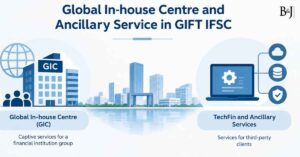
GIFT IFSC provides a regulated framework for global financial institutions to establish back-office and support operations in India. The IFSCA (Global In-house Centre) Regulations, 2025 govern captive services provided to entities within a financial institution group, while the IFSCA (TechFin and Ancillary Services) Regulations, 2025 cover eligible service providers serving third-party clients. Understanding the scope of each framework helps businesses identify the appropriate registration, eligibility requirements and compliance obligations for their operations in GIFT IFSC.
The GIC Regime
A Global In-house Centre in GIFT IFSC is a unit providing services in relation to financial products and financial services to entities of its own Financial Institution Group. The IFSCA (Global In-house Centre) Regulations, 2025 govern registration and operation.
Eligibility and form. The applicant must be connected with a Financial Institution Group, whose group entities are defined to include financial institutions in an IFSC. Where the framework permits a third-party model, the application may be made by the third party with the prior authorisation of the Financial Institution Group, evidenced by an authorisation letter furnished to IFSCA. Promoters or partners must be from jurisdictions not identified in the FATF public statement.
The unit may be a company or LLP incorporated in the IFSC, a branch of a company or LLP incorporated outside the IFSC, or another form IFSCA permits.
Registration. Operations may not commence without a certificate of registration. Applications go through the SWIT portal. IFSCA communicates deficiencies and allows thirty days to rectify, and may not reject without a reasonable opportunity to make written submissions. IFSCA may grant in-principle approval, after which the applicant has 180 days, extendable, to comply with the regulations and the conditions. The certificate then remains valid unless suspended or cancelled, or surrendered and accepted, and the unit must immediately inform IFSCA of material changes.
What a GIC may do, and for whom. A GIC Unit provides services in relation to financial products and services, to entities of its group located in jurisdictions that are not FATF-listed. A proviso permits services to Indian entities of the group, for the purpose of delivering GIC services from the IFSC, not exceeding 10% of the GIC Unit’s total revenue for the relevant financial year. That 10% cap is the boundary between an export-facing captive and a domestic outsourcing operation, and it must be monitored annually.
A separate restriction states that a GIC Unit shall not be set up by transferring existing operations. This mirrors conditions found elsewhere in the IFSC framework, including in the 2024 notification of book-keeping and related services and in the anti-splitting condition for the income-tax deduction (Article 5). The policy is consistent: the IFSC is intended to attract new activity rather than to relocate existing Indian activity for concessional treatment.
People and currency. The GIC Unit must have a principal officer responsible for overall activities and a compliance officer responsible for policies, procedures, records and applicable laws, reporting to the board or head of the organisation. Both must be full-time employees based in the IFSC. Operations and the balance sheet must be in specified foreign currencies, and reporting to IFSCA is in US dollars unless otherwise specified.
Relaxation. IFSCA may relax strict enforcement on application with a non-refundable fee, and must process a complete application within thirty days, recording reasons.
The Ancillary Services Regime
Where the services are provided to persons outside the provider’s own group, the relevant framework is the IFSCA (TechFin and Ancillary Services) Regulations, 2025 (Article 38). Its First Schedule permits a wide range of services that support financial activity, including fund administration and fund accounting, compliance management support, enterprise governance support, risk management support, auditing, actuarial services, valuation, secretarial services, insolvency professional and liquidation support, knowledge and legal process outsourcing, human resources and payroll, customer care, marketing support, family office support, and global mobility services.
Its Third Schedule excludes core activities that a home regulator does not permit to be outsourced, activities regulated under other IFSCA frameworks, facility management, transport and logistics, and anything that does not constitute making arrangements for carrying on the financial services listed in the IFSCA Act.
Choosing the Right Registration
Choosing the right registration in GIFT IFSC requires distinguishing between the IFSCA (Global In-house Centre) Regulations, 2025, which govern eligible captive operations, and the IFSCA (TechFin and Ancillary Services) Regulations, 2025, which cover eligible services provided to third-party clients.
| Question | GIC Regulations | TechFin and Ancillary Services Regulations |
|---|---|---|
| Who is served | Entities of the applicant’s own Financial Institution Group | Clients generally, subject to the Schedules |
| Indian-facing work | Permitted for group entities in India up to 10% of total revenue | Governed by the Schedules and by the nature of the service |
| Legal form | Company or LLP in the IFSC, or a branch of one incorporated outside | Company, LLP or as permitted, per reg. 5 |
| Key personnel | Principal officer and compliance officer, full-time and IFSC-based | Fit and proper requirements and code of conduct |
| Prohibition on relocation | Express: not to be set up by transferring existing operations | Third Schedule exclusions apply |
An entity that begins as a captive and later wishes to serve third parties, or vice versa, is changing regime, not merely expanding. That change should be planned as a fresh authorisation question.
An AML Point that is Easy to Misread
Under clause 1.2.3 of IFSCA’s AML, CFT and KYC Guidelines, a GIC registered under the IFSCA Global In-house Centres Regulations is exempt from those Guidelines, as is a Financial Crime Compliance Services Provider registered under the 2024 book-keeping regulations. The exemption is conditional: exempt entities must still undertake and document a business risk assessment, and any financial institution transacting through third-party service providers remains subject to that requirement (Article 35).
Exempt status also does not remove the obligations of the group entities being served, which remain subject to their own regulators’ AML requirements, nor the cyber security obligations that apply to regulated entities, where GICs and small entities received a conditional three-year relief in March 2026 (Article 36).
Practical Checklist
- Fix the service perimeter first, since it determines which regulation applies.
- Model the 10% Indian-revenue cap for a GIC and build the reporting to evidence it annually.
- Do not build on transferred operations. Both the GIC regulations and other IFSC instruments contain anti-relocation conditions.
- Staff the IFSC office genuinely. The principal officer and compliance officer must be full-time and based in the IFSC.
- Plan the 180-day window between in-principle approval and registration, since it drives premises, hiring and systems timelines.
Frequently Asked Questions
1. What is a Global In-house Centre (GIC) in GIFT IFSC?
A GIC provides services related to financial products and financial services to entities within its own Financial Institution Group.
2. Which regulations govern GICs in GIFT IFSC?
The IFSCA (Global In-house Centre) Regulations, 2025 govern the registration and operation of GICs.
3. Can a GIC provide services to Indian group entities?
Yes. Services to Indian group entities are permitted, subject to the limit of 10% of the GIC Unit’s total revenue for the relevant financial year.
4. What regulations apply to third-party ancillary service providers?
The IFSCA (TechFin and Ancillary Services) Regulations, 2025 govern eligible providers serving clients beyond their own group, subject to the applicable schedules.
5. Can an existing operation be transferred to GIFT IFSC to establish a GIC?
No. The GIC Regulations expressly prohibit setting up a GIC by transferring existing operations.
Sources / Authorities
- IFSCA (Global In-house Centre) Regulations, 2025, regs. 3–13 — IFSCA legal database (Regulations): https://ifsca.gov.in/Legal/Index/ogGPf3wx5GE=
- IFSCA, FAQs on the IFSCA (Global In-house Centres) Regulations, 2025 (13 February 2026) — IFSCA legal database (FAQs): https://ifsca.gov.in/Legal/Index/sJuO5ldyNL0=
- IFSCA (TechFin and Ancillary Services) Regulations, 2025, First and Third Schedules
- IFSCA (Anti Money Laundering, Counter-Terrorist Financing and Know Your Customer) Guidelines, 2022, updated 3 August 2026, clause 1.2.3
- Central Government notification dated 16 October 2020 notifying Global In-house Centres as a financial service under s. 3(1)(e) of the IFSCA Act, 2019
Disclaimer: This article is published for general informational and educational purposes only. It does not constitute legal advice and is not a substitute for advice obtained on the specific facts of any matter. Publication or reading of this article does not create an advocate–client relationship.

Advocate Aaditya Bhatt
Senior Standing Counsel Income Tax Department, Advocate Gujarat High Court. Aaditya combines his technical and legal expertise to deliver strategic counsel in litigation, constitutional, and regulatory matters. He represents clients before High Courts and Tribunals with a technology-driven approach.