 Whatsapp


Indian Banks, Finance Groups and Insurers Setting Up in GIFT IFSC: The Home Regulator’s Consent
Almost every discussion of setting up in GIFT IFSC concentrates on IFSCA: which registration, what capital, which permitted activities. For a regulated financial group that is only half the problem. IFSCA decides whether the IFSC entity may exist and what it may do. The group’s own regulator decides whether the group may set it up at all — and, in the banking case, continues to have a say in how it is run afterwards.
The Structural Idea: A “Home Regulator”
The IFSCA (Banking) Regulations, 2020 define “Home Regulator” as the regulatory authority responsible for regulating the Parent Bank in the jurisdiction where the Parent Bank is incorporated, licensed or established. For an Indian bank, that is the Reserve Bank of India; for a foreign bank, its own supervisor. The same idea, expressed differently, runs through the Finance Company and insurance frameworks.
The consequence is that an IFSC licence is not a way around the home regime. It is a second permission layered on the first.
Banks: Two Structures, Two Consents
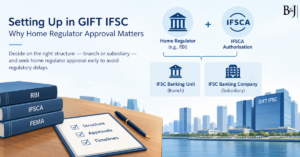
The banking framework allows two structures for GIFT IFSC operations: an IFSC Banking Unit (IBU), established as a branch of the parent bank, and an IFSC Banking Company (IBC), established as a subsidiary. Home regulator approval depends on the structure chosen, with a No Objection Letter required for the proposed branch or subsidiary, as applicable.
| IFSC Banking Unit (IBU) | IFSC Banking Company (IBC) | |
|---|---|---|
| Legal nature | A branch of the Parent Bank | A subsidiary company of the Parent Bank |
| Parent capital | Minimum USD 20 million, maintained at the Parent Bank as specified by IFSCA | Minimum USD 50 million, calculated and maintained as specified |
| Home-regulator consent | No Objection Letter for setting up the Banking Unit in the IFSC as a branch | No Objection Letter for setting up it as a subsidiary company |
| Liquidity undertaking | Parent Bank undertakes to provide liquidity to the IBU whenever needed | — |
A foreign bank that has no presence in India must comply with such additional requirements as IFSCA specifies.
The more significant feature is what happens after the licence is granted. As substituted in July 2023, the regulations provide that a Banking Unit operating as an IBU shall also comply with the directions and instructions issued by the Home Regulator of its Parent Bank, unless otherwise specified by the Authority. That is not a formality: it means an Indian bank’s IBU carries RBI’s directions with it into the IFSC, subject to IFSCA’s power to displace them.
The permitted-activity provision reinforces the point. An IBU may undertake activities under section 3(1)(e) of the IFSCA Act and section 6 of the Banking Regulation Act, 1949 except those expressly prohibited either by the Home Regulator of the Parent Bank or by the Authority. A prohibition at home is a prohibition in the IFSC (Article 16).
Prudentially, the branch form is also permitted to lean on the parent: the Liquidity Coverage Ratio and, when made applicable, the Net Stable Funding Ratio may be maintained by the Parent Bank in the case of an IBU, with IFSCA’s prior approval.
Finance Companies and Finance Units
The Finance Company Regulations distinguish between a Finance Company — a subsidiary, joint venture or newly incorporated company under the Companies Act — and a Finance Unit, which is a presence established by an entity incorporated in its home jurisdiction (Article 17).
For a Finance Company, the proviso to regulation 3(2) requires that where the parent carries out a regulated financial activity in its home jurisdiction, it shall obtain a No-objection Certificate from its home country regulator, wherever applicable. An Indian NBFC, a bank or an insurer promoting an IFSC finance company therefore starts at its own regulator.
For a Finance Unit intending to undertake core activities, the requirement is stricter: the applicant must be engaged in financial services, regulated by a financial sector regulator in its home jurisdiction, and hold that regulator’s NOC, wherever applicable.
There is one express carve-out. Those conditions do not apply to an incorporated entity setting up a Global or Regional Corporate Treasury Centre as a Finance Unit for treasury activities. A corporate group that is not itself financially regulated can therefore establish a treasury centre without producing a regulator’s consent it could never obtain.
Insurers and Reinsurers
The insurance framework is the most explicit of the three. An Indian insurer or re-insurer wishing to set up a place of business in unincorporated form in an IFSC must:
- be duly registered with IRDAI for insurance or re-insurance business in India;
- have been granted a No Objection Certificate by IRDAI to set up a place of business in an IFSC;
- submit the reporting structure of officials required by the regulations;
- have a satisfactory track record of regulatory and supervisory compliance; and
- have its Board undertake to meet all liabilities arising out of the IIO’s business, and to comply with assigned capital, solvency and other requirements specified by IFSCA.
The Board undertaking deserves attention. It places the liabilities of the IFSC operation squarely on the Indian insurer’s balance sheet, which is the counterpart of allowing an unincorporated presence.
A foreign insurer, foreign re-insurer or Lloyd’s must be registered or licensed at home, hold a home-country NOC, and, for re-insurance business, satisfy the Net Owned Fund requirement under section 6(3) of the Insurance Act, 1938. A branch office of a foreign insurer, or Lloyd’s India, must likewise hold an NOC from the supervisor of its country of incorporation. The framework was amended by the IFSCA (Managing General Agents) Regulations, 2026 with effect from 12 June 2026, which omitted certain provisions relating to managing general agents.
The Money Still has to Get There
Consent is one thing; capital is another. Because an IFSC entity is treated as being outside India for exchange-control purposes, an Indian parent’s capital contribution is an overseas investment, governed by the Overseas Investment Rules and Directions, 2022 with their own conditions for financial services activity, the IFSC-specific deemed-approval mechanism and reporting obligations (Article 13). A group that has obtained its regulator’s NOC has not thereby satisfied FEMA, and vice versa.
A Realistic Sequence
A smooth GIFT IFSC setup requires early home-regulator approval, clarity on capital and activity restrictions, parallel FEMA compliance, and clear arrangements for dual reporting and supervision.
- Approach the home regulator first, with the structure — branch or subsidiary — already decided, because the NOC is issued for a specific form.
- Map which home-regulator directions will follow the entity into the IFSC, and which activities are prohibited at home.
- Model the capital at the right level — parent-maintained for an IBU, entity-level for an IBC or Finance Company.
- Run the FEMA overseas-investment analysis in parallel, not afterwards.
- Plan for dual reporting and dual supervision from day one, including who owns the relationship with each regulator.
The Standing Tension
Two supervisors with overlapping mandates is a design choice, not an accident: it lets India open a financial centre without loosening prudential control of the institutions that populate it. But it produces genuine questions that the instruments answer only in outline — which regulator’s limit governs where both apply, how a home-regulator prohibition interacts with an IFSCA permission granted later, and what happens to an IBU if its parent is resolved at home. Those questions have not, so far as traced, been addressed by any published clarification as at 17 September 2026, and groups should expect to resolve them case by case with both authorities.
Frequently Asked Questions
1. What is a home regulator in GIFT IFSC?
A home regulator supervises the parent institution in its home jurisdiction, such as the RBI for Indian banks.
2. Is a home regulator NOC mandatory for setting up in GIFT IFSC?
It depends on the entity type and applicable IFSCA regulations. Banks, finance units and insurers may need specific home-regulator approval or an NOC.
3. Does IFSCA approval replace home-regulator approval?
No. IFSCA authorisation does not automatically satisfy the parent institution’s home-regulatory requirements.
4. Do GIFT IFSC capital contributions require FEMA compliance?
Yes. Capital contributions by Indian parents may qualify as overseas investment and must comply with applicable FEMA rules and reporting requirements.
5. Should a financial group approach its home regulator before IFSCA?
A financial group should assess home-regulator approval requirements early, after deciding whether to establish a branch or subsidiary, to avoid regulatory delays when setting up in GIFT IFSC.
Sources / Authorities
- IFSCA (Banking) Regulations, 2020, regs. 2(ea), 2(eb), 4, 5 and 22 (as amended, including by Notification No. IFSCA/2023-24/GN/REG041 dated 6 July 2023) — IFSCA legal database (Regulations): https://ifsca.gov.in/Legal/Index/ogGPf3wx5GE=
- IFSCA (Finance Company) Regulations, 2021, reg. 3(2) and (3), as amended to 7 May 2026
- IFSCA (Registration of Insurance Business) Regulations, 2021, reg. 5(1) to (3), consolidated to 10 July 2026; IFSCA (Managing General Agents) Regulations, 2026
- Insurance Act, 1938, s. 6(3); Banking Regulation Act, 1949, s. 6; IFSCA Act, 2019, s. 3(1)(e)
- Foreign Exchange Management (Overseas Investment) Rules, 2022 and the Overseas Investment Directions, 2022
Disclaimer: This article is published for general informational and educational purposes only. It does not constitute legal advice and is not a substitute for advice obtained on the specific facts of any matter. Publication or reading of this article does not create an advocate–client relationship.