Whatsapp

Joint Property Disputes in Gujarat: Partition Suit Procedure, Family Settlement Deed & Mediation Guide (2026)
Disputes over ancestral and joint family properties remain a significant segment of civil litigation in Gujarat. As land valuations scale and urban areas expand into formerly agricultural zones (such as those covered under Town Planning Schemes by AUDA, SUDA, and VUDA), resolving co-ownership deadlocks becomes commercially and legally critical.
The legal framework governing the division of joint properties—whether Hindu Undivided Family (HUF) assets, intestate successions, or jointly purchased commercial real estate—relies on a tiered approach: mutual settlement, alternative dispute resolution (mediation), and formal civil litigation (partition suit). This publication delineates the procedural intricacies of resolving joint property disputes in Gujarat, reflecting statutory mandates and recent jurisprudential developments through 2025-2026.
Family Settlement Deeds: The Preferred Mechanism
A Family Settlement Deed (Arrangement) is a mutual agreement among family members aimed at avoiding litigation and amicably dividing joint property. The Supreme Court of India has consistently favored family settlements to preserve familial peace, a principle heavily reiterated in recent 2025-2026 jurisprudence.
Legal Validity and the Registration Conundrum
The most heavily litigated aspect of a Family Settlement is the requirement for its registration under Section 17 of the Registration Act, 1908.
- The Memorandum Exception: Relying on the landmark precedent of Kale v. Deputy Director of Consolidation, and consistently upheld by High Courts through 2025-2026, a mere “Memorandum of Family Settlement”—which simply records a partition that has already taken place orally in the past—does not require mandatory registration or stamp duty. It merely acts as corroborative evidence of a pre-existing arrangement.
- Creation of New Rights: Conversely, if the Family Settlement Deed itself creates, declares, assigns, or extinguishes rights in immovable property in praesenti (at the moment of execution), it must be mandatorily stamped and registered. An unregistered deed operating in praesenti is legally inadmissible in evidence to prove title.
Binding Nature
Once validly executed and acted upon, a family settlement operates as an estoppel. A co-owner cannot subsequently file a partition suit attempting to reopen the settlement unless they can conclusively prove fraud, coercion, or severe misrepresentation of title at the time of execution.
Mediation: The Statutory Buffer
With the operationalization of the Mediation Act, 2023, and the mandates under Section 89 of the Code of Civil Procedure (CPC), 1908, mediation has transitioned from a voluntary alternative to a critical pre-litigation or mid-litigation filter for resolving Joint Property Disputes in Gujarat.
- Commercial and Civil Mandate: For joint properties held for commercial or developmental purposes, pre-litigation mediation is often mandated under the Commercial Courts Act, 2015.
- Court-Annexed Mediation: In partition suits filed before Civil Courts in Gujarat, judges routinely refer the parties to the High Court or District Court Mediation Centers. The mediation process focuses on collaborative resolution, supervised by a neutral, court-appointed mediator. If successful, the settlement terms are reduced to writing, and the court passes a consent decree (compromise decree) under Order XXIII Rule 3 of the CPC, which is non-appealable, ensuring immediate finality.
The Partition Suit Procedure (Order XX Rule 18 CPC) In Joint Property Disputes In Gujarat
When mutual settlement and mediation fail, a formal Partition Suit is the ultimate legal remedy. The suit is filed in the civil court possessing the appropriate territorial and pecuniary jurisdiction over the disputed property.
Drafting the Plaint and Legal Notice
Prior to filing, it is standard practice to issue a formal legal notice demanding partition by metes and bounds. The civil plaint must explicitly detail the genealogical tree, the exhaustive schedule of joint properties (both movable and immovable, to avoid the legal defect of a “partial partition” suit, which is generally not maintainable), and the specific statutory share claimed by the plaintiff under the applicable succession laws (e.g., the Hindu Succession Act, 1956, as amended).
The Two-Tier Decree System
Partition suits are uniquely structured, culminating in two distinct decrees:
- Preliminary Decree: The court first adjudicates the substantive rights of the parties, determining who is legally entitled to a share and the exact quantum of that share (e.g., 1/4th or 1/3rd).
- Appointment of Court Commissioner: Because the court cannot physically measure and divide the property, it appoints a Court Commissioner to physically inspect the property, evaluate its divisibility, and propose a physical partition by metes and bounds.
- Final Decree: Based on the Commissioner’s report and objections (if any) raised by the parties, the court passes the Final Decree, officially allocating specific physical portions to each co-owner. The stamping of the final decree is mandatory, as it operates as an instrument of partition.
Revenue Paying Estates (Section 54 CPC)
If the partition involves an undivided estate assessed to the payment of revenue to the government (agricultural land), the Civil Court declares the shares but delegates the actual physical partition to the District Collector or any gazetted subordinate (such as the DILR – District Inspector of Land Records), operating under the rules of the Gujarat Land Revenue Code, 1879.
Mutation Under the Gujarat Land Revenue Code
Obtaining a civil court decree or executing a family settlement is only the substantive half of the process. To perfect the title, the physical division must be legally mutated in the government revenue records.
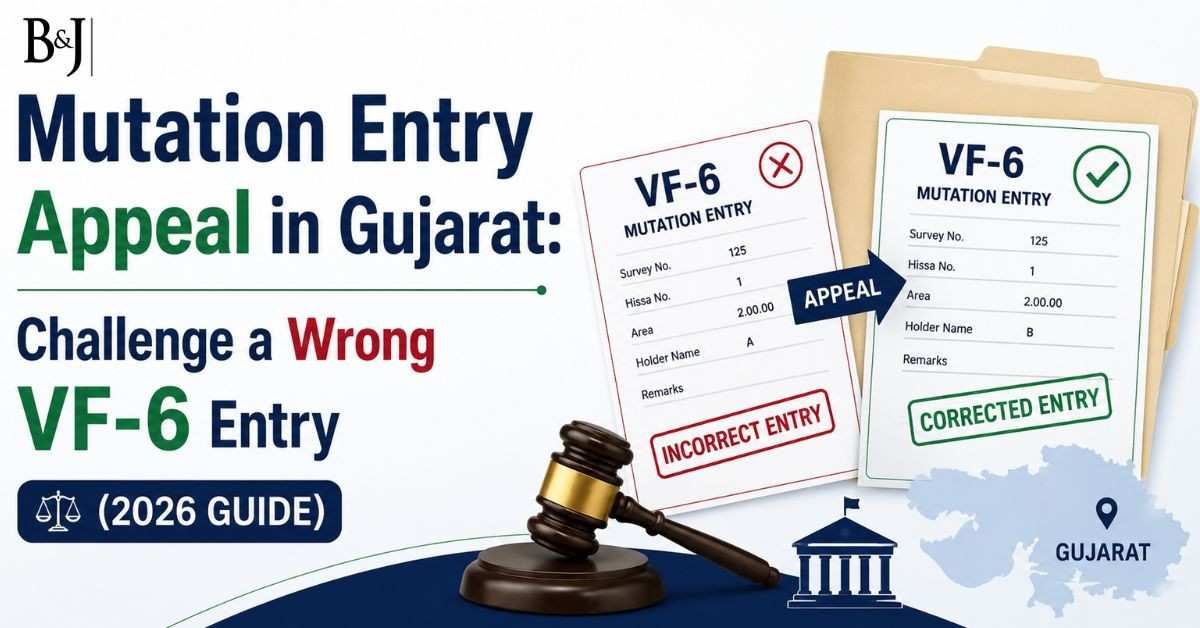
- Section 135D Procedure: Upon the finalization of the partition (via settlement or decree), an application along with the registered deed or court decree must be submitted to the Mamlatdar or e-Dhara center for mutation in Village Form No. 6 (Hakk Patrak).
- Notice and Certification: Under Section 135D of the Gujarat Land Revenue Code, a mandatory notice is issued to all interested parties. If no legal objections are raised within the statutory period (typically 30 days), the mutation entry is certified, and the names of the individual co-owners are reflected in separate 7/12 and 8-A extracts against their respective, newly defined physical shares.
Conclusion
Resolving joint property disputes in Gujarat requires a strategic election of legal remedies. While civil litigation via a partition suit provides a definitive, court-mandated division, it is inherently protracted and adversarial. For corporate entities handling real estate acquisitions and families seeking to preserve asset value, executing a comprehensively drafted, adequately stamped, and registered Family Settlement Deed—often facilitated through structured mediation—remains the most legally secure, cost-effective, and expeditious mechanism for property division in Gujarat.