Whatsapp

The Limits of Challenging a National Highways Arbitral Award under Section 34

When land is acquired for a National Highway, the landowner does not receive a court-determined compensation in the first instance. The Competent Authority fixes compensation under Section 3G of the National Highways Act, 1956, and if the landowner is dissatisfied, the dispute goes to an arbitrator appointed by the Central Government under Section 3G(5). The Arbitration and Conciliation Act, 1996 governs those proceedings by virtue of Section 3G(6). For a landowner seeking to challenge a National Highways arbitral award, Section 34 of the Arbitration and Conciliation Act, 1996 provides the only judicial remedy after the arbitrator has made an award—and that door is narrow. The consequence is decisive and frequently underappreciated.
This article explains, for the practitioner and the affected landowner alike, exactly how narrow. There are three constraints that together define the outer boundary of what a Section 34 court can do with a National Highways award: a strict and unforgiving limitation clock; a merits window confined to “patent illegality” rather than a re-hearing on evidence; and, most consequentially, a bar on modification — the court may set the award aside, but it cannot raise a low figure to a fair one. Understanding these limits is not an academic exercise. It dictates that the real battle over market value must be fought and won before the arbitrator, because the supervisory court will not repair an under-valuation for you.
This is the fourth spoke in a nine-part series on fair compensation in Indian land acquisition; see Fair Compensation in Indian Land Acquisition: LARR, Railways and National Highways — A Practitioner’s Map for the full map. This article’s central limit — the s.34 ceiling — is the flip side of the forum comparison in Three Forums for Enhancement — s.64 Reference, NH Arbitration and the Railways Act (Spoke 3).
Why Section 34 Is the Only Route to Challenge a National Highways Arbitral Award
Under the National Highways Act, compensation is determined by the Competent Authority under Section 3G, and a disagreement on the amount is referred to arbitration under Section 3G(5). Section 3G(6) makes the Arbitration and Conciliation Act, 1996 applicable to that arbitration. That single cross-reference imports the entire architecture — and the entire limitations — of Section 34 into highways compensation litigation.
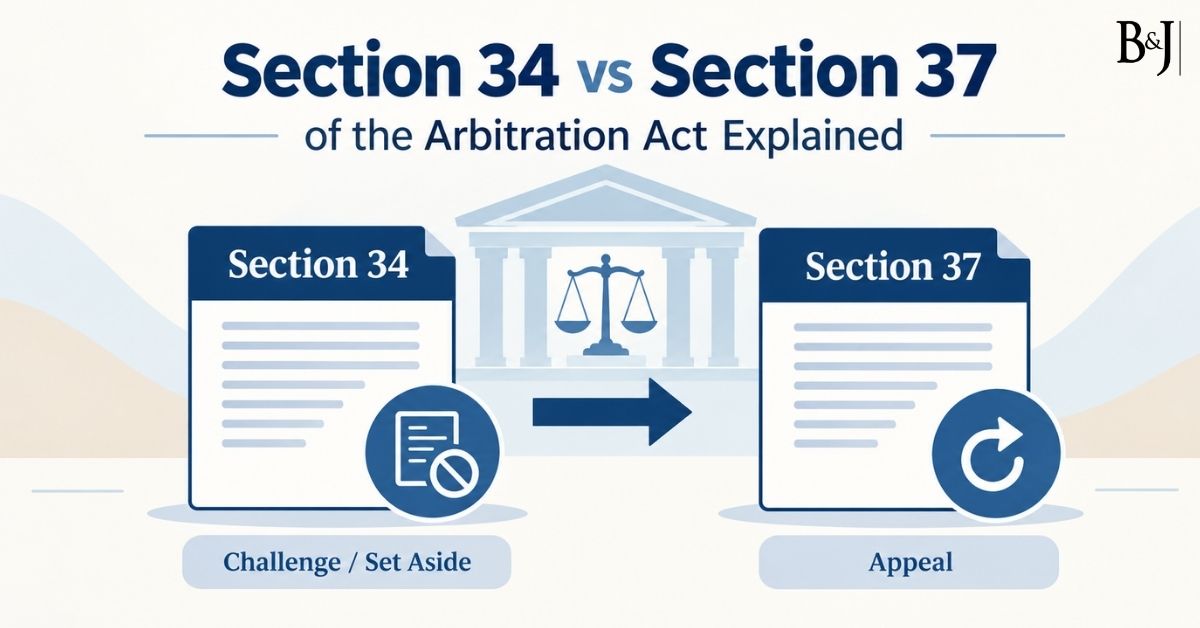
Section 34 is not an appeal. It is a supervisory jurisdiction to set aside an award on limited grounds. A litigant who approaches it expecting the court to re-open the valuation, re-weigh the sale deeds, and substitute a higher figure has misunderstood the remedy. The three sections that follow set out what the court will, and will not, do.
1. The limitation clock: strict, short, and “but not thereafter”
The first and most common reason why a challenge to a National Highways arbitral award under Section 34 fails is that it is filed too late. Section 34(3) prescribes a period of three months from the date on which the party received the arbitral award, extendable by a further thirty days on sufficient cause—and then adds the words “but not thereafter”.
Those three words have been read literally and repeatedly by the Supreme Court.
No extension beyond the thirty-day proviso. In Union of India v. Popular Construction Co., (2001) 8 SCC 470, the Supreme Court held that the phrase “but not thereafter” in Section 34(3) excludes the operation of Section 5 of the Limitation Act, 1963. Delay beyond the three months plus thirty days is not condonable. The outer limit is genuinely an outer limit.
Section 5 of the Limitation Act does not apply. This was reaffirmed in Simplex Infrastructure Ltd. v. Union of India, (2019) 2 SCC 455, where the Court confirmed that Section 5 of the Limitation Act does not apply to a Section 34 application and that the thirty-day proviso is the outer limit. There is no general power to condone delay on equitable grounds.
Neither does Section 17. A litigant who discovers a ground late — say, on learning of some concealment — cannot invoke Section 17 of the Limitation Act to postpone the starting point. In P. Radha Bai v. P. Ashok Kumar, (2019) 13 SCC 445, the Supreme Court held that there is no condonation beyond the further thirty days and that Section 17 of the Limitation Act does not extend the Section 34(3) period. The clock is not merely strict as to its length; it is strict as to when it starts.
The clock runs from the signed copy. And when does it start? Not from an informal intimation, a draft, or an unsigned communication. In State of Maharashtra v. ARK Builders Pvt. Ltd., (2011) 4 SCC 616, the Court held that limitation under Section 34(3) runs from receipt of the signed copy of the award under Section 31(5) of the 1996 Act. The signed copy is the trigger.
The practical lesson is unambiguous. The single most important date in a National Highways challenge is the date on which the claimant received the signed copy of the award. That date must be captured contemporaneously and diarised, because three months and thirty days later the remedy is gone, and no court can bring it back.FF
2. The merits window: patent illegality, not re-appreciation
Suppose the challenge is filed in time. What can the court actually examine? For a domestic award — which a Section 3G(5) highways award is — Section 34(2A) permits setting aside on the ground of “patent illegality” appearing on the face of the award.
The leading exposition is Ssangyong Engineering & Construction Co. Ltd. v. NHAI, (2019) 15 SCC 131. There the Supreme Court explained the scope of patent illegality under Section 34(2A): a finding based on no evidence at all, or one that ignores vital evidence, is patently illegal and may be set aside. But — and this is the boundary — the court cannot re-appreciate evidence. It cannot re-weigh the comparable sales, prefer one exemplar over another, or substitute its own valuation for the arbitrator’s merely because a different conclusion was possible.
The distinction matters enormously in valuation disputes. A challenge framed as “the arbitrator wrongly averaged the sale deeds” or “the arbitrator should have accepted our higher exemplar” is an invitation to re-appreciate evidence, and it will fail. A challenge framed as “the arbitrator fixed compensation on no evidence of market value at all,” or “the arbitrator ignored the registered sale deeds on record entirely,” engages the patent-illegality ground and has a fighting chance. The framing is often the difference between a maintainable petition and a hopeless one.
3. The killer limitation: the court cannot modify or enhance
Here is the constraint that reshapes strategy in every National Highways compensation matter. Even where a Section 34 court is persuaded that the award is patently illegal, it cannot rewrite the number.
In Project Director, NHAI v. M. Hakeem, (2021) 9 SCC 1, the Supreme Court held that under Section 34 a court may set aside an arbitral award but cannot modify or enhance it — and that this applies squarely to compensation fixed under Section 3G of the National Highways Act. The court has no power to take a grossly low award and simply raise it to what the evidence would justify.
The consequences follow directly. If the arbitrator has fixed compensation at, say, the jantri/guideline rate when registered sale deeds on record show a market value many times higher, the Section 34 court cannot correct that figure. The most a claimant can obtain is a set-aside, and — at best — a fresh arbitration in which the exercise begins again. The court will not hand the landowner the higher figure; it can only send the parties back to square one, with all the delay, cost, and uncertainty that implies.
The strategic fallout: win the valuation before the arbitrator
This is why the evidentiary case on market value must be built and won at the arbitration stage, not saved for the challenge. The tools for that fight — genuine, bona fide, proximate comparable sale deeds; adoption of the highest reliable exemplar rather than a mechanical average; and resistance to jantri/ready-reckoner rates being treated as compensation — are decisive precisely because Section 34 will not deploy them for the claimant afterwards.
The point cannot be overstated. A landowner who under-invests in the arbitration record — who does not file the best sale deeds, does not lead evidence on comparability and adjustments, does not object on the record to the arbitrator’s reliance on guideline rates — cannot expect the supervisory court to make up the difference. The court’s hands are tied by M. Hakeem. The evidentiary battle is won or lost before the arbitrator.
Contrast: the LARR Section 64 route re-determines on merits
It is instructive to compare the National Highways position with the reference mechanism under the Right to Fair Compensation and Transparency in Land Acquisition, Rehabilitation and Resettlement Act, 2013. Where an acquisition proceeds under the 2013 Act, a claimant dissatisfied with the Collector’s award may seek a reference under Section 64, and the Land Acquisition, Rehabilitation and Resettlement Authority determines the compensation afresh under Section 69. That is a determination on the merits: the Authority re-examines market value, applies the statutory parameters, and can enhance the award.
The National Highways claimant has no equivalent merits forum after the arbitrator. The arbitrator is the merits forum, and the only supervisory review — Section 34 — cannot re-determine value or enhance the figure. The structural difference between the two regimes is treated in detail in Three Forums for Enhancement — s.64 Reference, NH Arbitration and the Railways Act (Spoke 3). The practical takeaway is that the highways landowner carries a heavier evidentiary burden earlier, because there is no second bite on the merits.
A practitioner’s compliance checklist
- Capture the signed-copy date. Record, contemporaneously and in writing, the date the claimant received the signed copy of the award under Section 31(5). This is the limitation trigger under ARK Builders.
- Diarise three months plus thirty days — and treat it as absolute. Under Popular Construction, Simplex Infrastructure and Radha Bai, there is no condonation beyond the thirty-day proviso and no Section 5 or Section 17 relief. File within time or not at all.
- Build the record before the arbitrator. File the best comparable sale deeds, lead evidence on market value, and object on the record to any reliance on jantri/guideline rates. Because the court cannot modify under Hakeem, the arbitration record is the whole game.
- Frame the challenge as patent illegality / no evidence — never as re-appreciation. Under Ssangyong, plead that the award rests on no evidence or ignores vital evidence on record. Do not ask the court to re-weigh exemplars; it will not.
- Advise the client realistically on the outcome. The best-case result of a successful Section 34 petition is a set-aside and a fresh arbitration — not a court-enhanced figure. Set expectations accordingly.
Key takeaways
- A NHAI compensation award is made by an arbitrator under Section 3G(5); the only challenge is Section 34 of the Arbitration and Conciliation Act, 1996, and it is a narrow supervisory remedy, not an appeal.
- Limitation is strict: three months plus a further thirty days under Section 34(3), “but not thereafter,” running from receipt of the signed copy of the award. Section 5 and Section 17 of the Limitation Act do not extend it.
- On merits, the court may set aside only for patent illegality under Section 34(2A) — no evidence, or ignoring vital evidence — and cannot re-appreciate the evidence.
- Critically, under Hakeem the court cannot modify or enhance the award. A grossly low Section 3G figure cannot be corrected by the court; the most a claimant gets is a set-aside and, at best, a fresh arbitration.
- The valuation case must therefore be won before the arbitrator. Unlike the LARR Section 64 reference, there is no merits forum after the arbitrator to re-determine value.
Frequently asked questions
Can I appeal a National Highways arbitral award if I think the compensation is too low?
There is no appeal on merits. The only remedy is a Section 34 application to set aside the award, and it is confined to limited grounds. The court cannot simply re-value the land and award you more; under Project Director, NHAI v. M. Hakeem, (2021) 9 SCC 1, it cannot modify or enhance the award at all.
What is the time limit to challenge a National Highways arbitral award under Section 34?
Three months from receipt of the signed copy of the award, plus a further thirty days on sufficient cause — and no more. The words “but not thereafter” in Section 34(3) have been held to exclude any further extension: see Union of India v. Popular Construction Co., (2001) 8 SCC 470, and Simplex Infrastructure Ltd. v. Union of India, (2019) 2 SCC 455.
The clock started before I even had a proper copy of the award — is that fair?
Limitation runs from receipt of the signed copy of the award under Section 31(5), as held in State of Maharashtra v. ARK Builders Pvt. Ltd., (2011) 4 SCC 616. An informal or unsigned intimation does not start the clock; the signed copy does. Capture that date carefully, because P. Radha Bai v. P. Ashok Kumar, (2019) 13 SCC 445, confirms there is no relief for a late-discovered ground.
If the court sets the award aside, do I automatically get more compensation?
No. A successful challenge results, at best, in the award being set aside and the matter going back to fresh arbitration. The court will not itself award a higher figure. That is precisely why the evidentiary case on market value must be established before the arbitrator in the first place.
Sources & authorities
- National Highways Act, 1956 — Sections 3G, 3G(5), 3G(6) (arbitration and application of the 1996 Act)
- Arbitration and Conciliation Act, 1996 — Sections 31(5) (signed copy), 34 (setting aside), 34(2A) (patent illegality), 34(3) (limitation: three months plus thirty days, “but not thereafter”)
- RFCTLARR Act, 2013 — Sections 64 (reference) and 69 (determination by the Authority)
- Union of India v. Popular Construction Co., (2001) 8 SCC 470
- State of Maharashtra v. ARK Builders Pvt. Ltd., (2011) 4 SCC 616
- Simplex Infrastructure Ltd. v. Union of India, (2019) 2 SCC 455
- Radha Bai v. P. Ashok Kumar, (2019) 13 SCC 445
- Ssangyong Engineering & Construction Co. Ltd. v. NHAI, (2019) 15 SCC 131
- Project Director, NHAI v. M. Hakeem, (2021) 9 SCC 1

Advocate Aaditya Bhatt
Senior Standing Counsel Income Tax Department, Advocate Gujarat High Court. Aaditya combines his technical and legal expertise to deliver strategic counsel in litigation, constitutional, and regulatory matters. He represents clients before High Courts and Tribunals with a technology-driven approach.