 Whatsapp


Appeal Lawyers
If you’re looking for appeal lawyers in Ahmedabad, look no further than Bhatt & Joshi Associates, the top law firm in Gujarat, Ahmedabad. Our team of skilled and experienced lawyers specializes in civil and criminal appeals before the Gujarat High Court and the Supreme Court of India. With strong logistics, analytical, and persuasive abilities adept at pleadings, drafting of Suits, Agreements, Contracts, and vetting of Documents, our appeal lawyers provide litigation support to clients in all types of cases.
Understanding Appeals in India
At the conclusion of a proceeding in a lower court, a party may wish to get the decision reviewed by a higher court, such as the District Court, High Court or Supreme Court, depending upon the Legislative Scheme. An appeal is not a new trial, a hearing with witnesses or a jury, a chance to present new evidence or new witnesses to a new judge, except in exceptional circumstances, or a way to avoid complying with the trial court’s order. An appeal can result in one of the following outcomes: affirm the decision, modify the ruling in some way, consider new facts or evidence, or in extremely rare cases, throw out the case entirely.
Appeal Lawyers at Bhatt & Joshi Associates
Our firm has expertise in both civil and criminal appeals, with dedicated teams of lawyers handling each type of case.
Our Civil Appeal Lawyers have in-depth knowledge of all Substantive Laws such as Contract Law, Specific Relief Act, Land Revenue Act, and Civil procedures, as well as knowledge of Statutory Interpretation. They are adept at handling cases related to money recovery, recovery disputes, suits related to children, wards, guardianships, estate, property, custody, execution, claims, partitions, and others.
Our Criminal Appeal Lawyers are among the topmost experienced, handpicked & the best ones in Ahmedabad for practical Legal Advice and assistance. We offer a wide range of legal services in the area of White Collar and Blue Collar Crimes to both corporates and individuals.
Appeals before the High Court
Appeals arising out of Civil matters are Civil Appeals and are governed by the Code of Civil Procedure. The High Court may also frame rules and procedures for conducting these Appeals. It can be filed against an Order or Judgment. For Criminal Matters, an appeal can be filed against a Session Judge’s decision before the High Court of Gujarat. Also to note that any type of capital punishment cannot be executed unless it is confirmed by the High Court.
Our Appeal Lawyers excel at undertaking such tasks as well:
Civil Appeal, Revision Application and Writ Petition
- First Appeal: Under the Code of Civil Procedure (CPC), a First Appeal lies to the higher court against a decree passed by a lower court. Section 96 of the CPC provides for filing a First Appeal, which can be filed against any decree passed by a court after a trial on merits.
- Second Appeal: A Second Appeal lies to the High Court against the decree passed by the lower court in certain circumstances, as per Section 100 of the CPC. A Second Appeal can be filed when the lower court has passed an erroneous decision on a substantial question of law, which is a matter of public importance
- Appeal from Order: An Appeal from Order lies to the higher court against an interlocutory order passed by a lower court. Section 104 of the CPC provides for filing an Appeal from Order, which can be filed against any order, apart from a decree, passed by a court during the trial of a suit.
- Civil Revision Application: Under Section 115 of the CPC, a Civil Revision Application can be filed before the High Court against any order passed by a subordinate court, which involves a jurisdictional error or a material irregularity. The scope of a Civil Revision Application is limited to correcting jurisdictional errors and material irregularities and does not extend to errors of fact or law.
- Writ Petition: Under Articles 226 and 227 of the Constitution of India, the High Court can entertain a Writ Petition against the orders passed by any authority, including a court, within its territorial jurisdiction. A Writ Petition can be filed for enforcing fundamental rights or for any other purpose, as per the discretion of the court. There is can lie an appeal from a Writ Petition under Article 226 of the Constitution but there lies no appeal in a Supervisory Powers exercised by the High Court under Article 227 of the constitution of India, also note that a Review Petition can be filed against the order passed by the High Court. Also to note that, an appeal lies against the decision of a High Court in a writ petition before the Supreme Court of India under Article 136 of the Constitution of India, with a Special Leave to Appeal before the Supreme Court of India.
- Letters Patent Appeal: Letters Patent Appeal is a type of intra-court appeal filed before a High Court against the judgment passed by a single judge of that High Court. It is governed by the Letters Patent of that particular High Court. The scope of appeal in a Letters Patent Appeal is broader than a regular appeal, as it allows the appellant to challenge the judgment on both questions of fact and law. However, not all High Courts have provisions for Letters of Patent Appeals.
- Special Leave Petition (SLP): A Special Leave Petition (SLP) is a legal remedy available to a person to appeal against any order or judgment passed by a lower court, tribunal, or high court in India. It is filed before the Supreme Court of India, which has the discretionary power to grant or reject the petition. The grounds for filing an SLP can be a substantial question of law, a violation of fundamental rights, or other important questions of public interest. The Supreme Court may either grant the SLP and hear the appeal, or dismiss it and let the lower court’s judgment stand.
Criminal Appeal, Revision Application and Writ Petition
- Criminal Appeal – Criminal Appeal is a procedure for challenging a decision of a criminal court in a higher court. Section 374 of the Criminal Procedure Code (CrPC) provides for the right to appeal against a conviction, sentence, or order of acquittal by the High Court.
- Under the provisions of the Code of Criminal Procedure (CrPC), a victim can file an appeal against an order of the original court under Section 372. This section empowers the victim to file an appeal against an order of acquittal, discharge, conviction, or sentence passed by the trial court, subject to certain conditions. The victim needs to obtain prior permission from the court before filing the appeal, and the appeal needs to be filed within the stipulated time period.
- Criminal Revision Application – Criminal Revision Application is a remedy available to a person aggrieved by an order passed by a lower criminal court, which can be challenged before the High Court. Section 397 of the CrPC provides for the provision of revisional powers of the High Court
- Writ Petition: In cases where an appeal does not lie, a writ petition under Article 226 or 227 of the Constitution of India can be filed before the High Court. The scope of such a writ petition is wider than that of an appeal, and the High Court can issue directions, orders, and writs for the enforcement of fundamental rights or for any other purpose
- Ground of Appeal: The basis of an appeal must be a reversible error in the application of the law. In criminal cases, an appeal can target the conviction itself or just the sentencing portion of the decision without regard to the underlying conviction. An appeal may be filed only after a final judgment/order has been reached by the trial court.
Why Choose Bhatt & Joshi Associates?
- Expertise: Our team of appeal lawyers has extensive experience in handling a wide range of legal appeals, including civil and criminal appeals.
- Personalized Attention: We believe that every case is unique and requires a customized approach. We work closely with our clients to understand their specific needs and objectives and provide personalized attention throughout the entire appeals process.
- Results-Driven: We are committed to achieving the best possible outcome for our clients and have a proven track record of success in appellate court.
- Commitment to Client Satisfaction: At Bhatt & Joshi Associates, we prioritize client satisfaction and are dedicated to ensuring that our clients receive the highest level of service and support.
In conclusion, if you are looking for a team of experienced and dedicated appeal lawyers, look no further than Bhatt & Joshi Associates. Contact us today to schedule a consultation and learn how we can help you with your legal appeal.
The greatest glory in living lies not in never falling, but in rising every time we fall.
Our Publications



Get in touch with Best Appeal Lawyers in Ahmedabad
Frequently asked questions
1. What is an appeal in legal terms?
An appeal is a legal process wherein a party requests a higher court to review and change the decision made by a lower court.
2. When can I file an appeal?
Appeals can usually be filed after a final judgment or order has been issued by a lower court. Specific timelines and conditions might apply, which vary based on the jurisdiction and the nature of the case.
3. Do I always have the right to appeal a court's decision?
Not always. Some decisions can be appealed as a matter of right, while others require permission or have specific criteria that must be met.
4. What's the difference between an appeal and a trial?
A trial determines the facts of a case and applies relevant laws, while an appeal reviews the lower court’s application of the law and its decision-making process.
5. How long do I have to file an appeal?
The timeframe varies based on jurisdiction and the type of case. It’s crucial to consult with an appeal lawyer promptly as there are often strict deadlines.
6. Can new evidence be presented during an appeal?
Typically, appeals focus on legal errors made in the lower court, so new evidence is not generally admissible. Exceptions exist but are rare.
7. What are the possible outcomes of an appeal?
The appellate court can affirm the lower court’s decision, reverse it, modify it, or remand the case back to the lower court for further proceedings.
8. Are appeal lawyers different from trial lawyers?
Yes, while both are versed in legal principles, appeal lawyers specialize in appellate procedures, legal research, and crafting persuasive arguments to challenge or defend lower court decisions.
9. What is a 'grounds for appeal'?
Grounds for appeal refer to the specific legal reasons or errors cited to challenge the lower court’s decision.
10. Can I appeal a decision if I simply disagree with it?
Merely disagreeing with a decision is not enough. Valid legal grounds, such as errors in law application, must be identified to file an appeal.
11. How do BNS/BNSS 2023 and recent appellate jurisprudence affect criminal appeals?
BNSS 2023 (effective July 2024, replacing CrPC 1973) substantially restructured criminal appeals. Chapter XXX (Sections 415-435) governs appeals: Section 415 — appeal from acquittal; Section 419 — appeal in case of conviction; Section 421 — no appeal in petty cases; Section 422 — special right of appeal in certain cases; Section 427 — abatement of appeals. Time limits and forums largely mirror old CrPC but section numbers have changed. Importantly, Section 528 BNSS 2023 (formerly Section 482 CrPC) preserves the HC's inherent powers to quash/interfere — often used in tandem with appeal strategy. Recent Supreme Court decisions on bail pending appeal, suspension of sentence under Section 430 BNSS, and the standard of interference with acquittal continue to shape practice. Section 138 NI Act appeals remain under the NI Act 1881 — not migrated to BNS/BNSS.
12. What is the difference between appeal, revision, and review?
Three distinct remedies often confused: (1) Appeal — a substantive statutory right against a final order; the appellate court re-examines facts and law (in First Appeal) or only law (in Second Appeal under Section 100 CPC); statutory and time-bound. (2) Revision — supervisory jurisdiction; for example under Section 115 CPC or Section 438 BNSS 2023 (formerly Section 397 CrPC), the higher court examines whether the lower court exceeded jurisdiction, acted illegally, or with material irregularity; no right to a fresh decision on merits. (3) Review — a request to the same court that passed the order to reconsider it, on limited grounds under Order XLVII CPC (error apparent on face of record, discovery of new evidence not available earlier despite due diligence, or other sufficient reason). Choice of remedy depends on the order being challenged and the statute.
13. How long does an appeal take to decide and what are typical costs?
Timelines vary by forum and pendency. Typical decision times: civil First Appeal at HC — 3-7 years; criminal appeal at HC — 2-5 years (longer if undertrial appeals); ITAT — 1-3 years; NCLAT — 6-18 months (faster post-IBC reforms); SLP at Supreme Court — admission stage 6-12 months, final hearing 2-5 years if admitted; Section 37 arbitration appeals — 1-2 years under fast-track commercial procedure. Costs depend on complexity, record size, hearing length, and seniority of counsel briefed. For a fee estimate specific to your matter, contact +91 9824323743 or WhatsApp https://bit.ly/ChatWithUs-BJ.
14. What are the limitation periods for filing appeals in India?
Limitation periods vary by appeal type. Key ones: civil appeals to HC — 90 days (or 30 days for appeals from decrees in cases under Rs. 1 lakh) under the Limitation Act 1963 Articles 116-117; criminal appeals from conviction — 60 days for HC, 30 days for Sessions Court under BNSS 2023; Supreme Court SLP — 90 days from HC judgment; ITAT appeals — 60 days from CIT(A) order under Section 253 Income Tax Act; GST appeals to GSTAT — 3 months under Section 112 CGST Act; NCLAT appeals — 45 days under Section 421 Companies Act; arbitration Section 37 appeals — 30 days under Article 116-117 Limitation Act read with Section 37(3) A&C Act. Delay can be condoned on sufficient cause under Section 5 Limitation Act except where the statute expressly excludes condonation.
15. What types of appeals does Bhatt & Joshi Associates handle?
The firm handles the full spectrum of appellate matters across India: (1) Civil appeals — First Appeals, Second Appeals, LPAs before HC under CPC; (2) Criminal appeals — under Sections 415-435 BNSS 2023 before Sessions Court, HC, and Supreme Court; (3) Constitutional appeals — LPAs in HC, SLPs in Supreme Court; (4) Tax appeals — CIT(A), ITAT, GSTAT, CESTAT, Customs Appellate Tribunal; (5) Tribunal appeals — NCLAT (from NCLT), APTEL (electricity), SAT (SEBI), TDSAT (telecom), DRAT (DRT); (6) Arbitration appeals — Section 37 of the A&C Act 1996 before the Commercial Appellate Division; (7) Writ appeals — LPAs against single-judge writ orders; (8) Service appeals — CAT to HC, GAT to HC.
16. What is an appeal and how is the right of appeal conferred under Indian law?
An appeal is a substantive statutory right (not a constitutional right, except in limited circumstances) to have a higher court re-examine the decision of a lower court or tribunal. It is conferred only by statute — there is no inherent right of appeal. Civil appeals are governed by Order XLI CPC, criminal appeals by Chapter XXX BNSS 2023 (formerly CrPC). Each specialised statute (Income Tax Act, GST Act, Customs Act, A&C Act, Companies Act) creates its own appellate hierarchy and limits. The Supreme Court of India has discretionary appellate jurisdiction under Article 136 of the Constitution via Special Leave Petition (SLP).
17. Who are the best appeal lawyers in Ahmedabad?
Bhatt & Joshi Associates is a leading appellate practice in Ahmedabad with extensive experience before the Gujarat High Court, Supreme Court of India, and specialised appellate tribunals (NCLAT, ITAT, CESTAT, APTEL, SAT, GSTAT, DRAT). The firm handles civil appeals, criminal appeals under BNS/BNSS 2023, constitutional Letters Patent Appeals (LPAs), tax appeals, arbitration appeals under Section 37 of the A&C Act, and Supreme Court Special Leave Petitions. For appellate consultation, call +91 9824323743 or WhatsApp https://bit.ly/ChatWithUs-BJ.
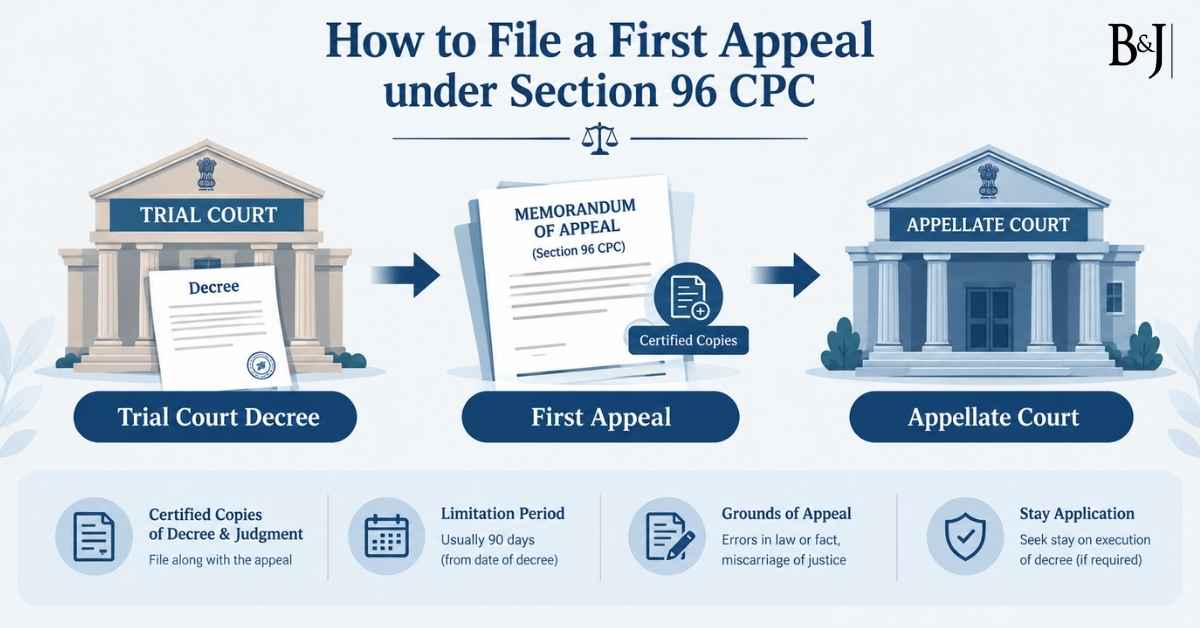
How to File a First Appeal under Section 96 CPC
A first appeal under Section 96 of CPC is the principal appellate remedy in civil litigation. It all
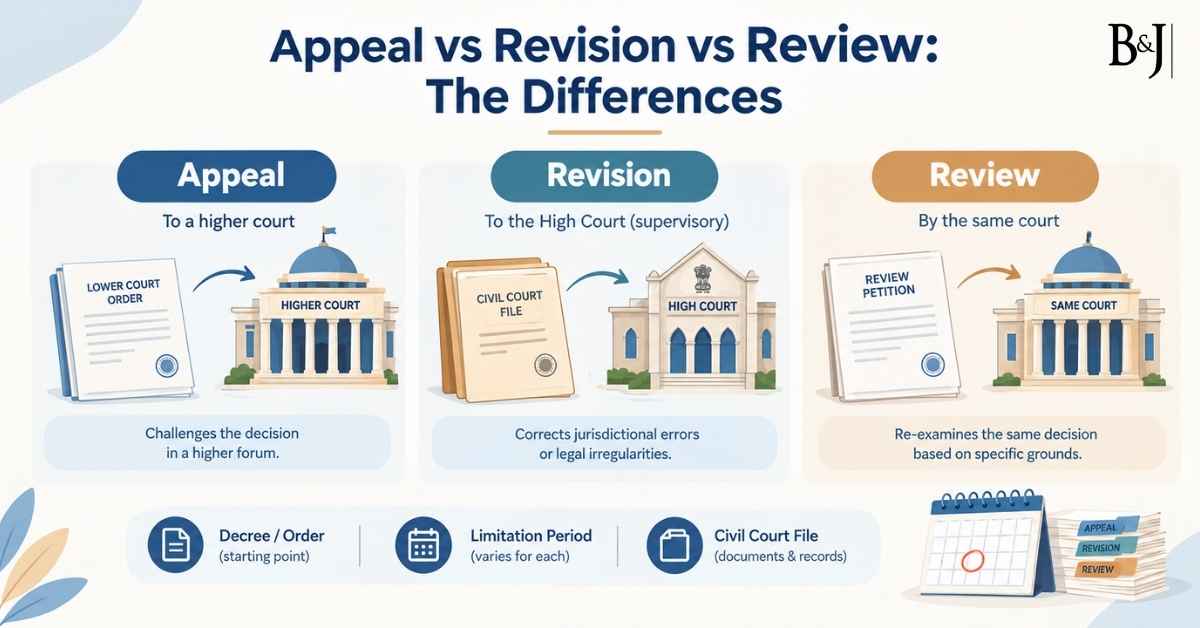
Appeal vs Revision vs Review: The Differences
Three remedies are commonly available against an adverse civil decision: appeal, review, and revisio
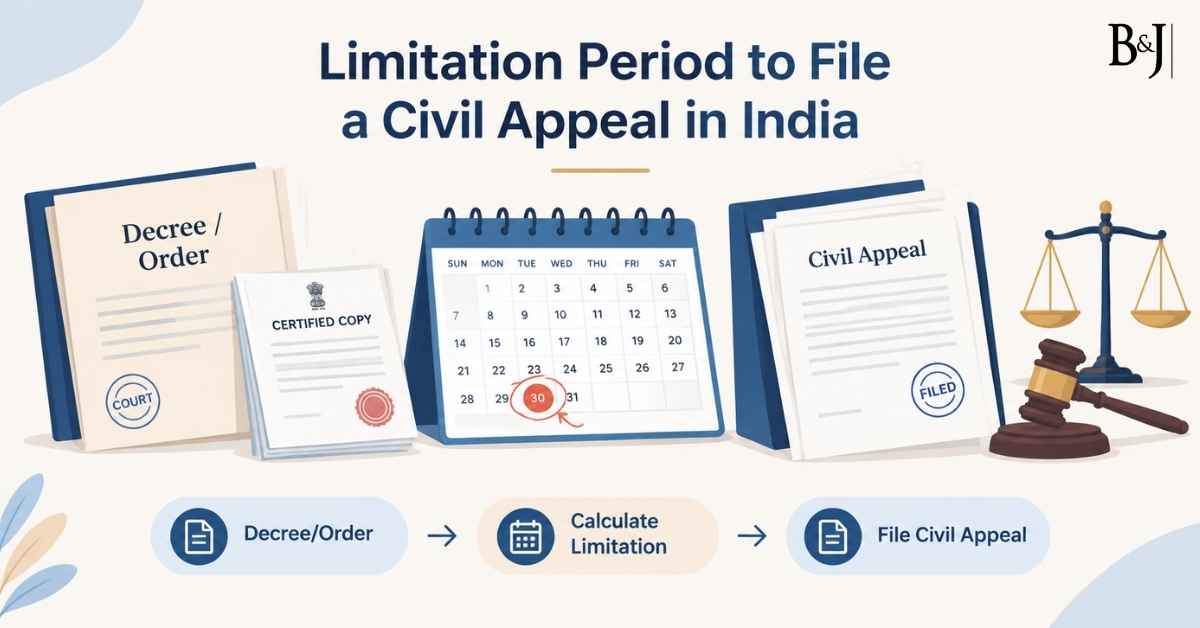
Limitation Period to File a Civil Appeal in India
An appeal filed even one day late may be barred unless the delay is properly explained and condoned.
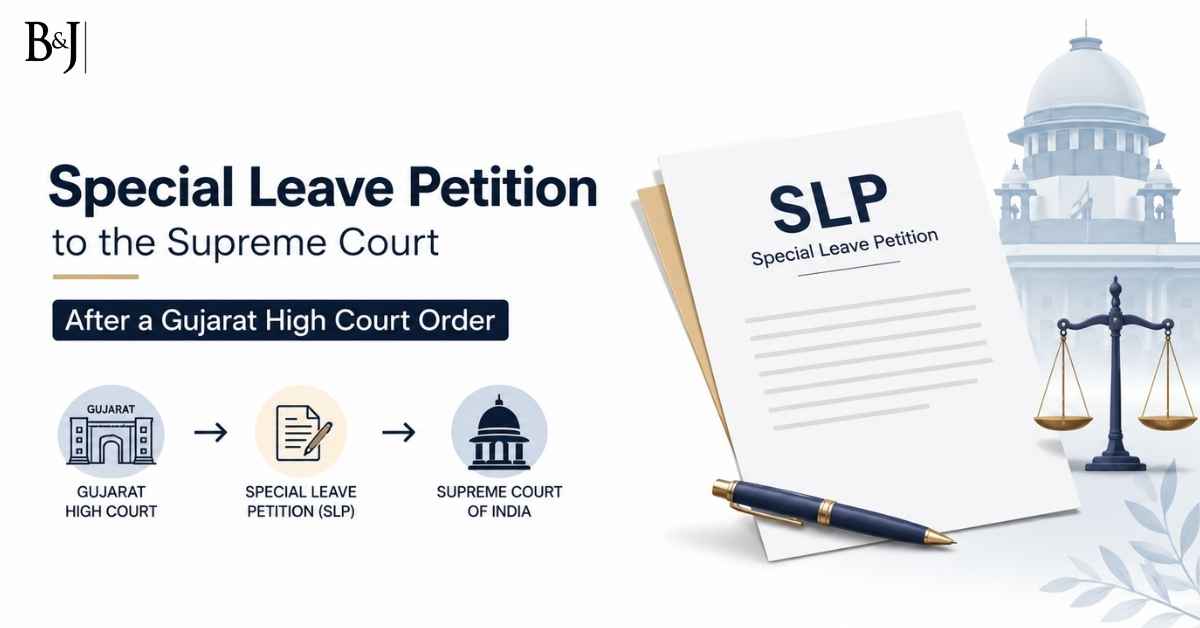
Special Leave Petition to the Supreme Court After a Gujarat High Court Order
When the Gujarat High Court decides against a litigant and no further remedy exists within that Cour
Challenging FEMA Orders: Understanding Appeal Provisions and Grounds for Review
Introduction When faced with an order under the Foreign Exchange Management Act, 1999 (FEMA), unders
SEBI’S UNFETTERED REGULATORY AUTHORITY AND CONSTRAINTS ON SAT’S APPELLATE JURISDICTION
INTRODUCTION The Securities and Exchange Board of India (SEBI) is the pivotal regulatory body overse
Framing Substantial Question of Law in a Second Appeal: An Examination of Section 100 of the Civil Procedure Code, 1908
Introduction The architecture of civil appellate justice in India reflects a carefully calibrated ba
The Right of a Third Party to Appeal a Judgment: An Examination of the “My Palace Mutually Aided Cooperative Society vs B. Mahesh” Case
Introduction The Indian judicial system operates on foundational principles that ensure every
High Court Appeals in India: Civil, Criminal, Tax Procedure 2026
Introduction The High Court occupies a central position in India’s judicial hierarchy, serving
