Whatsapp

Is Land Acquisition Compensation Taxable? Section 96, Interest & TDS Explained

A landowner who has fought for a fair award often assumes that the enhanced amount finally received is his to keep, in full. But is land acquisition compensation taxable? That assumption is largely—but not entirely—correct. The compensation itself carries a powerful statutory shield: Section 96 of the Right to Fair Compensation and Transparency in Land Acquisition, Rehabilitation and Resettlement Act, 2013 (the “RFCTLARR Act” or “2013 Act”) exempts an award or agreement compensation from income tax and stamp duty. But the award you receive is rarely a single number. It is a bundle—market value, solatium, and, very often, a substantial interest or “additional amount” component that accrues because payment was delayed. The tax treatment of that interest component is a materially harder question, and it is where landowners and their advisers most often come to grief.
This article explains when land acquisition compensation is taxable and when it is exempt under Section 96 of the RFCTLARR Act, 2013. It examines the settled position on compensation, including how the exemption extends to National Highways and Railways acquisitions, and then analyses the more difficult question of the tax treatment of the additional amount and interest. It also covers the relevant income-tax provisions, CBDT Circular 36/2016, TDS, the year of taxability, and the practical issues taxpayers should verify before filing their returns.
A word of scope at the outset. The exemption under s.96 of the 2013 Act is a matter of land-acquisition law, and we state it as verified law. The surrounding income-tax questions — whether the exemption reaches NH/Railways compensation, the year of taxability, the interaction with agricultural-land exemptions, TDS, and the treatment of the interest component — have been researched and are stated below with citations to CBDT Circular 36/2016, reported case law and specific Income-tax Act provisions.
This is the eighth spoke in a nine-part series on fair compensation in Indian land acquisition; see Fair Compensation in Indian Land Acquisition: LARR, Railways and National Highways — A Practitioner’s Map for the full map.
1. The core exemption: Section 96 of the RFCTLARR Act, 2013
Section 96 of the 2013 Act provides that no income tax or stamp duty shall be levied on any award or agreement made under the Act (other than under Section 46), and that no person claiming under such an award or agreement shall be liable to pay any fee for a copy of the same.
Three features of this exemption deserve emphasis.
(a) It is a statutory exemption, not a concession. The exemption operates by force of the 2013 Act itself. It attaches to compensation “made under this Act” — that is, to an award under s.23, or to a negotiated agreement, arrived at within the 2013 Act’s framework. The carve-out for s.46 (which deals with land purchased through private negotiation above the notified threshold, triggering R&R obligations) is the only stated exception.
(b) It covers both income tax and stamp duty. For the landowner, this means the compensation is not to be brought to tax as income by virtue of s.96, and the instrument recording it does not attract stamp duty. This is a real and valuable protection, particularly for agricultural landowners whose holdings have been compulsorily taken.
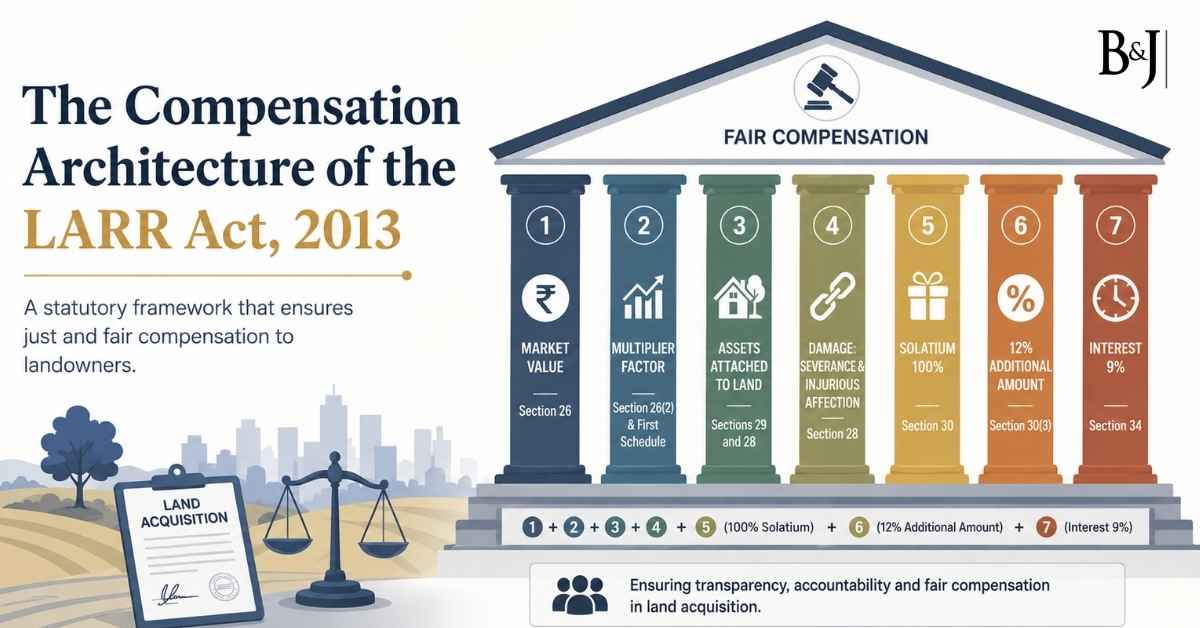
(c) It is the compensation that is exempt. Section 96 speaks of the “award or agreement.” The natural reading is that the components that make up the award — market value determined under s.26, the parameters under s.28 (severance, injurious affection, diminution of profits), the value of assets under s.29, and the 100% solatium under s.30 — are all within the shield, because they are all constituent parts of the award made under the Act. The question that s.96’s language does not answer cleanly is how the interest / additional-amount heads are to be treated for income-tax purposes. We return to that in Part 3.
Cross-reference — Spoke 1 (the heads of an award). For the anatomy of a 2013-Act award — market value (s.26), the s.28 parameters, s.29 assets, s.30 solatium and the s.30(3) additional amount, and s.80 interest — see The Compensation Architecture of the LARR Act, 2013 (Spoke 1). This article assumes that breakdown and focuses on how the tax shield maps onto it.
2. The exemption reaches National Highways and Railways acquisitions — via the 2015 Order
A recurring and important question is whether the s.96 exemption is confined to acquisitions made under the 2013 Act itself, or whether it also protects compensation paid under the special acquisition statutes — most importantly the National Highways Act, 1956 and the Railways Act, 1989.
The answer turns on the interaction between s.105, s.113 and the RFCTLARR (Removal of Difficulties) Order, 2015.
Section 105 of the 2013 Act carves the thirteen enactments listed in the Fourth Schedule (which include the National Highways Act, 1956 and the Railways Act, 1989) out of the general application of the Act, but s.105(3) required the Central Government to bring the beneficial provisions of the 2013 Act to bear on those enactments. To give effect to that mandate, and exercising the power to remove difficulties under s.113(1) read with s.105(3), the Central Government issued the RFCTLARR (Removal of Difficulties) Order, 2015, dated 28 August 2015, deemed effective 1 January 2015. That Order extended the compensation, rehabilitation and resettlement, and infrastructure benefits of the First, Second and Third Schedules of the 2013 Act to the thirteen Fourth-Schedule enactments, including the National Highways Act and the Railways Act.
The consequence for taxation is significant and, in our view, follows as a matter of coherence. Once the compensation payable for an NH or Railways acquisition is computed on the 2013-Act measure — the First Schedule market value, multiplier, solatium and additional amount — the compensation so paid is compensation determined by the standards of the 2013 Act. The s.96 exemption, which protects the award or agreement made under the Act’s framework, is best read as travelling with that compensation. A landowner whose land is taken for a national highway and paid on the First-Schedule scale is, on this reading, within the same exemption as a landowner acquired directly under the 2013 Act.
This reading has since been directly confirmed by the Chhattisgarh High Court in Sanjay Kumar Baid v. Income Tax Officer, 2025:CGHC:47243-DB (15 September 2025). The Court held that once compensation is determined under the RFCTLARR Act’s provisions (by virtue of the 2015 Order making them applicable to Fourth-Schedule enactments), the s.96 exemption follows “as a necessary corollary” — and that denying the benefit to landowners under Fourth-Schedule enactments (which include both the National Highways Act and the Railways Act) would be discriminatory and violative of Article 14, following Tarsem Singh. The ruling arose on facts involving compensation paid by NHAI, but its reasoning applies equally to Railways Act acquisitions, since both statutes occupy the same position in the Fourth Schedule. Bombay HC and Karnataka HC decisions on the related TDS question (Part 3.3 below) point the same way.
This is now well-supported authority rather than an open question, though it remains a High Court (not Supreme Court) decision and could in principle be tested further. A tax adviser should confirm there is no subsequent departmental circular or appellate development narrowing it before relying on it in a specific matter.
Cross-reference — Spoke 5 (the 2015 Removal of Difficulties Order). The mechanics, effective date and reach of the 2015 Order — and the parallel MoRTH guidelines of 28 December 2017 applying the First Schedule to National Highways acquisitions — are treated in detail in Harmonising Compensation across Special Acts: The 2015 Order and Tarsem Singh (Spoke 5). This article draws on that analysis for the taxation consequence.
3. The Harder Question: Are the Additional Amount and Interest on Land Acquisition Compensation Taxable?
Here we must be candid. The compensation is one thing; the interest on delayed payment is another, and courts and tax authorities have long drawn a distinction between the two.
3.1 The two interest heads under the 2013 Act
The 2013 Act itself creates two amounts that are, in economic substance, compensation for delay:
- Section 30(3) — the “additional amount”: an additional amount of 12% per annum on the market value, computed for the period from the date of the preliminary notification (s.11(1)) to the date of the award or of taking possession, whichever is earlier. This is described in the statute as an additional amount, and it is folded into the award itself.
- Section 80 — interest on delayed deposit: where the awarded amount is not paid or deposited on or before taking possession, interest at 9% per annum runs from the date of taking possession, rising to 15% per annum for any period beyond one year.
The s.30(3) additional amount and s.80 interest are conceptually different from the market value and solatium. The market value (s.26) and solatium (s.30) compensate for the land taken and the compulsory nature of the taking — they are, in the classic characterisation, capital receipts standing in place of the land. The s.30(3) additional amount and s.80 interest, by contrast, compensate for the time value of money withheld — they accrue with the passage of time and look, in substance, like a return on the delayed sum.
3.2 The distinction courts and tax authorities have drawn — at the level of principle
The following can now be said with reasonable confidence, drawing on CBDT guidance and reported case law:
- The compensation proper (market value, and the components that make up the value of what was taken) is treated as a capital receipt, and, for 2013-Act acquisitions, carries the 96 exemption on top.
- Interest on delayed payment has frequently been treated by the revenue as income — a receipt in the nature of a return for the deprivation of money over time — rather than as part of the capital compensation. On this view, the interest component may fall outside the capital-receipt characterisation and may be brought to tax as income, notwithstanding that the underlying compensation is exempt.
Two threshold points can now be stated with confidence. First, CBDT Circular No. 36/2016 (dated 25 October 2016) has settled that land acquisition compensation exempt under s.96 is not taxable under the Income-tax Act, 1961 even though the Income-tax Act contains no express exemption of its own — and this is binding on all subordinate tax authorities under s.119 of the Income-tax Act. Second, the exemption is wider than the Income-tax Act’s own agricultural-land exemptions: rural agricultural land already falls outside the definition of “capital asset” under s.2(14), and urban agricultural land has its own exemption under Section 10(37) (available to individuals/HUFs, conditional on two years’ prior agricultural use and compulsory acquisition on or after 1 April 2004) — but s.96, per the Circular, applies to both agricultural and non-agricultural land without distinction.
The genuinely unresolved question is narrower, and it concerns the interest / additional-amount component specifically:
- Two lines of authority exist, and the honest position is that this is genuinely unsettled for RFCTLARR-Act interest specifically. One line, addressing interest under the 1894 Act’s28/34 (analogous, but not the same provision as s.30(3)/s.80 of the 2013 Act), holds such interest taxable as “Income from Other Sources” under Section 56(2)(viii) (inserted by the Finance (No. 2) Act, 2009, with a 50% deduction under Section 57(iv)): the Delhi High Court in PCIT v. Inderjit Singh Sodhi (HUF), ITA 769/2023 (8 April 2024), and the Punjab & Haryana High Court in Mahender Pal Narang v. CBDT, (2020) 423 ITR 13 (whose SLP the Supreme Court dismissed on 4 March 2021), both so hold, and are now widely followed by ITAT benches. The older Supreme Court decision in CIT v. Ghanshyam (HUF), (2009) 315 ITR 1, which had treated such interest as part of enhanced compensation, is generally treated as superseded by the 2010 amendment for later years.
- The other line addresses RFCTLARR-Act interest directly — and reaches the opposite result. A Chennai ITAT ruling in October 2025 (following Malini v. ACIT on similar facts) held that interest on enhanced compensation under the 2013 Act “forms part of the compensation” and is exempt under s.96, reasoning that s.96’s language is broader than the general Income-tax Act interest provisions and displaces them for RFCTLARR-governed receipts. This is a single-member Tribunal decision — lower in the hierarchy than the High Court rulings above — but it is, on the research available to this firm, the only authority actually deciding this question for RFCTLARR-Act interest, rather than by analogy from the 1894 Act.
A reasonable argument can be made for the exempt position: given that the Sodhi and Narang line does not directly address the s.96 argument, and that the one decision squarely on RFCTLARR interest went the other way, a claimant should not simply concede that the interest is taxable. The case for treating s.96’s language as broad enough to cover interest as part of the compensation package draws support from the Chennai ITAT’s reasoning and from the CBDT’s own description of s.96 as wider than ordinary Income-tax Act exemptions — but this is one reading of a genuinely contested point, not a statement of settled law, and readers should treat it as a starting point for their own advice rather than a conclusion.
- The year of taxability is, by contrast, settled: under Section 145B(1) of the Income-tax Act, interest on compensation or enhanced compensation is deemed to be the income of the year in which it is received, not the year(s) to which it economically relates.
3.3 TDS: expect deduction at source on the interest
As a practical matter, the deducting authority (the Collector, the Competent Authority under the NH/Railways mechanism, or the arbitrator’s award-implementing office) will often apply tax deduction at source on disbursement, even where the compensation itself is treated as exempt. This can now be addressed with reasonable precision.
Compensation itself is governed by Section 194LA of the Income-tax Act — 10% TDS on compensation for compulsory acquisition of immovable property (other than agricultural land) exceeding the prescribed threshold (₹2,50,000 up to 31 March 2025; ₹5,00,000 thereafter). But the second proviso to s.194LA expressly excludes any payment made in respect of an award or agreement exempted under s.96 of the RFCTLARR Act. This exclusion has been enforced by the courts: the Bombay High Court has held that NH Act compensation under s.3G(5) cannot be subjected to TDS because s.96 exempts it; the Karnataka High Court has confirmed the same for NH Act compensation post-1 January 2014; and the reasoning aligns with the Chhattisgarh High Court‘s position in Sanjay Kumar Baid discussed in Part 2. In principle, therefore, no TDS should be deducted on s.96-exempt compensation under s.194LA.
In practice, deducting authorities frequently withhold anyway, out of administrative caution or uncertainty about the classification of a given acquisition — so a landowner should not assume the exemption will be self-executing at the point of payment. Where TDS is deducted under s.194LA despite s.96 applying, the amount is recoverable by claiming credit or refund in the income-tax return. Interest income (as distinct from the compensation) may separately attract TDS under other provisions applicable to “income from other sources”, consistently with the s.56(2)(viii) characterisation discussed in Part 3.2 — and, given the unresolved tension identified there, the correct TDS treatment of the interest component specifically should still be confirmed with a tax adviser on the facts of the disbursement. A landowner should not treat a TDS deduction as conclusive of taxability; nor should he assume the exemption automatically prevents deduction at source in practice.
4. Practical guidance: what to do, and what to verify
For a landowner or adviser receiving an enhanced award, the responsible sequence is:
- Identify the components. Break the receipt into market value, s.28/s.29 heads, s.30 solatium, s.30(3) additional amount, and s.80 interest (and, for pre-2015 NH acquisitions, solatium and interest flowing from the Tarsem Singh line — see Spoke 1). You cannot analyse taxability of a lump sum.
- Apply s.96 to the compensation. For a 2013-Act award (and, on the reasoning above, for NH/Railways compensation computed on the First-Schedule scale via the 2015 Order), the compensation proper carries the s.96 exemption from income tax and stamp duty.
- Understand the interest position — and that it is genuinely contested. The compensation, NH/Railways applicability, year of taxability and TDS position are addressed with citations above. On the s.30(3) additional amount and s.80 interest, authority is split between the Sodhi/Narang line (taxable under s.56(2)(viii)/57(iv), decided under the 1894 Act) and a Chennai ITAT ruling deciding the RFCTLARR-specific question the other way (exempt under s.96). Take a considered position on your facts rather than assuming either result by default.
- Reconcile TDS. Match any tax deducted at source against the correct legal position, and claim credit or refund accordingly.
Key takeaways
- Section 96 of the RFCTLARR Act, 2013 exempts an award or agreement compensation (other than under s.46) from income tax and stamp duty. This is verified land-acquisition law.
- Through 105(3), s.113 and the RFCTLARR (Removal of Difficulties) Order, 2015 (dated 28-08-2015, effective 01-01-2015), the compensation benefits of the 2013 Act’s First, Second and Third Schedules were extended to the Fourth-Schedule enactments, including the National Highways Act, 1956 and the Railways Act, 1989. Compensation for NH/Railways acquisitions computed on that scale is best read as travelling with the s.96 exemption.
- The interest / additional-amount component — the 30(3) 12% additional amount and s.80 interest (9%, rising to 15% after one year) — stands on a different footing. Courts and tax authorities have drawn a distinction between compensation (capital, exempt) and interest on delayed payment (often treated as income).
- The NH/Railways applicability, year of taxability, agricultural-land interaction and TDS position are addressed above with citations (CBDT Circular 36/2016, Sanjay Kumar Baid v. ITO (Chhattisgarh HC, 2025), Sections 145B(1), 10(37) and 194LA). On the interest component, authority is genuinely split: the Sodhi/Narang line (1894-Act interest, by analogy) treats Land Acquisition Compensation as taxable under Section 56(2)(viii)/57(iv), while a Chennai ITAT ruling decides the RFCTLARR-specific question the other way, treating it as exempt under s.96. Our reasoned view favours the latter; the point remains unsettled.
Frequently asked questions
Q1. Is my land acquisition compensation taxable?
For an acquisition under the RFCTLARR Act, 2013, land acquisition compensation is not taxable because Section 96 exempts the award or agreement compensation (other than under Section 46) from income tax and stamp duty. The land acquisition compensation proper—market value and the components valuing what was taken, including solatium—is within that exemption. The interest component is a separate question (see Q3).
Q2. I was acquired under the National Highways Act, not the 2013 Act. Do I still get the exemption?
Where your compensation was computed on the 2013 Act’s First-Schedule scale — which applies to National Highways acquisitions through the 2015 Removal of Difficulties Order (and the MoRTH guidelines of 28-12-2017) — yes. The Chhattisgarh High Court has directly held, in Sanjay Kumar Baid v. Income Tax Officer (2025), that the s.96 exemption follows the compensation once it is determined under RFCTLARR standards, and that denying it to NH Act or Railways Act acquisitions would be discriminatory under Article 14. This is now well-supported authority, though as a High Court (not Supreme Court) ruling it is sensible to have a tax adviser confirm there has been no subsequent narrowing before relying on it in a specific case.
Q3. What about the 12% additional amount and the interest on delay — are those exempt too?
Two lines of authority point in different directions, and this is honestly unsettled. Cases addressing interest under the 1894 Act — Sodhi (Delhi HC, 2024) and Mahender Pal Narang (P&H HC, SLP dismissed by the Supreme Court) — treat such interest as taxable “Income from Other Sources” under Section 56(2)(viii), with a 50% deduction under Section 57(iv). But the one ruling actually deciding this question for RFCTLARR Act interest specifically — a Chennai ITAT decision, October 2025 — held it exempt under s.96, as part of the compensation. A reasonable argument favours the latter, since s.96’s language is broader than the ordinary Income-tax Act exemptions and the Chennai ruling engages directly with the point the older cases don’t address — but this is one reasoned reading of a genuinely open question, not settled law, and it’s worth getting a second opinion before relying on it. The year of taxability, at least, is settled either way — interest is taxed in the year received, under Section 145B(1).
Q4. TDS Was Deducted from My Land Acquisition Compensation Award. Does That Mean It Is Taxable?
Not necessarily. The second proviso to Section 194LA of the Income-tax Act specifically exempts land acquisition compensation covered by Section 96 of the RFCTLARR Act from TDS, and the Bombay and Karnataka High Courts have both enforced that exemption against deducting authorities. If TDS was deducted from the compensation awarded for the compulsory acquisition of your land despite Section 96 applying, it is generally recoverable by claiming credit or a refund in your income-tax return. The position is different for the interest component. Whether TDS on interest is correctly deductible depends on the unresolved question of whether such interest is taxable or exempt under Section 96 (see Q3). If the interest is ultimately exempt, any TDS deducted from it should likewise be recoverable. If it is taxable income, the deduction may be correctly made. This is worth disputing on the facts if the amounts involved are significant.
Sources & authorities
Statutory provisions and instruments (from the verified authority set for this series):
- RFCTLARR Act, 2013 — s.11(1) (preliminary notification), s.23 (award), s.26 (market value), s.28 (parameters), s.29 (value of assets), s.30 (solatium) and 30(3) (additional 12% p.a.), s.80 (interest 9% p.a., 15% after one year), s.96 (income-tax and stamp-duty exemption), s.105 & s.105(3) (Fourth-Schedule enactments), s.113 (power to remove difficulties); Schedules — First, Second, Third, and Fourth (thirteen enactments).
- RFCTLARR (Removal of Difficulties) Order, 2015, dated 28-08-2015 (u/s 113(1) r/w s.105(3)), effective 01-01-2015 — extending First/Second/Third Schedule benefits to the Fourth-Schedule enactments, including the National Highways Act, 1956 and the Railways Act, 1989.
- MoRTH guidelines dated 28-12-2017 — First Schedule of the RFCTLARR Act to apply to National Highways acquisitions.
- National Highways Act, 1956 and Railways Act, 1989 — Fourth-Schedule enactments.
- Income-tax Act, 1961 — s.2(14) (capital asset), s.10(37) (urban agricultural land exemption), s.56(2)(viii) and s.57(iv) (interest on compensation, inserted by the Finance (No. 2) Act, 2009), s.119 (binding effect of CBDT circulars), s.145B(1) (year of taxability), s.194LA and its second proviso (TDS and s.96 exclusion).
- CBDT Circular No. 36/2016, dated 25 October 2016 — compensation exempt under s.96 of the RFCTLARR Act not taxable under the Income-tax Act, 1961, regardless of agricultural/non-agricultural classification.
- Sanjay Kumar Baid v. Income Tax Officer, Chhattisgarh High Court, 2025:CGHC:47243-DB (15 September 2025), TAXC No. 176 of 2025 — s.96 exemption applies to National Highways Act compensation via the 2015 Order; denial would violate Article 14.
- PCIT v. Inderjit Singh Sodhi (HUF), Delhi High Court, ITA 769/2023 (8 April 2024) — interest on compensation/enhanced compensation taxable under s.56(2)(viii)/57(iv); followed by numerous 2025-2026 ITAT benches.
- Mahender Pal Narang v. CBDT, (2020) 423 ITR 13 (P&H) — same position; SLP dismissed by the Supreme Court, 4 March 2021, (2021) 279 Taxman 74 (SC).
- CIT v. Ghanshyam (HUF), (2009) 315 ITR 1 (SC) — earlier position treating such interest as part of enhanced compensation (capital gains); generally treated as superseded for years after the 2010 amendment (s.56(2)(viii)/57(iv)/145A-145B) took effect.
- Chennai ITAT ruling (October 2025, following Malini v. ACIT) — interest on enhanced compensation held to form part of exempt compensation under s.96 of the RFCTLARR Act, contrary to the Sodhi line; single-member bench, RFCTLARR-specific.
All authorities independently verified on 20 July 2026.
This article is for general information only and does not constitute legal advice. It addresses the law as at the date of writing and may not reflect subsequent developments. The taxation of land acquisition compensation and interest is fact-specific: the correct treatment turns on the acquiring statute, the components of the particular award, and the income-tax provisions in force for the relevant assessment year, and requires the advice of a qualified tax adviser. For advice on a specific matter, please consult Bhatt & Joshi Associates or your tax adviser.

Advocate Aaditya Bhatt
Senior Standing Counsel Income Tax Department, Advocate Gujarat High Court. Aaditya combines his technical and legal expertise to deliver strategic counsel in litigation, constitutional, and regulatory matters. He represents clients before High Courts and Tribunals with a technology-driven approach.