Whatsapp

Cheque Bounce Case under Section 138 NI Act: The Process
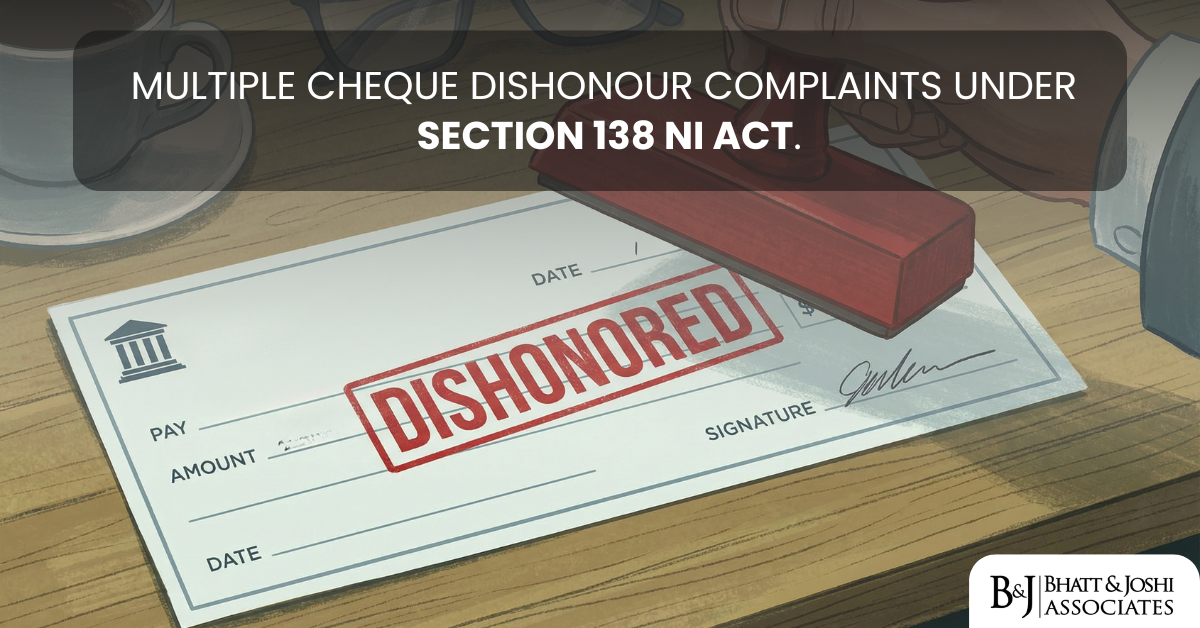
A cheque bounce under Section 138 of the Negotiable Instruments Act, 1881 can result in criminal proceedings when a cheque is dishonoured due to insufficient funds or because it exceeds the arrangement made with the bank. Section 138 provides a legal remedy for cheque dishonour and lays down specific requirements for initiating a cheque bounce case. The process is governed by strict timelines. These include the 30-day period for sending the cheque bounce notice, the 15-day period for making payment, and the one-month period for filing the complaint. Missing any of these deadlines can affect the maintainability of the case.
Requirements Under Section 138
Section 138 applies where a cheque drawn on an account maintained by the drawer is returned unpaid because of insufficiency of funds or because the amount exceeds the arrangement made with the bank.
The essential elements are that the cheque was drawn for the discharge, in whole or in part, of a legally enforceable debt or other liability; that it was presented within the period of its validity; that it was returned unpaid for one of the reasons the section covers; that a demand notice was served within the prescribed period; and that the drawer failed to pay within fifteen days of receiving it.
The requirement of a legally enforceable debt is where many defences are built. A cheque issued as security, or towards a debt that is itself unenforceable — because it is time-barred, or arises from an unlawful transaction — does not attract the section in the same way.
Time Limits in a Cheque Bounce Case
The key deadlines under Section 138 in a cheque bounce case must be followed in the prescribed sequence.
Presentation. The cheque must be presented to the bank within the period of its validity — currently three months from the date it bears, under Reserve Bank of India directions.
Demand notice — within thirty days. On receiving information from the bank that the cheque has been returned unpaid, the payee or holder in due course must make a demand for payment by giving a notice in writing to the drawer within thirty days of receipt of that information.
The drawer’s fifteen days. The drawer must make payment within fifteen days of receipt of the notice. The offence is complete only on failure to pay within that period — which is why a complaint filed before the fifteen days expire is premature and liable to be dismissed.
Complaint — within one month. Under Section 142, the complaint must be made within one month of the date on which the cause of action arises, that is, on expiry of the fifteen-day period. The proviso permits a court to take cognizance after that period if the complainant satisfies it that there was sufficient cause for not making the complaint within it — but this is discretionary and should not be built into a filing plan.
The Demand Notice
The notice is the document on which most cheque cases turn.
It should identify the cheque by number, date and amount; the bank and branch; the date of presentation and the date and reason of return; the underlying debt or liability; and a clear demand for payment of the cheque amount within fifteen days. It should be sent to the drawer’s correct address by a mode that produces proof of despatch and, so far as possible, of service.
Two recurring problems: a notice that demands the cheque amount together with interest, costs and damages in a single undifferentiated figure, which invites the argument that no valid demand for the cheque amount was made; and a notice sent to an address the complainant knows to be stale.
Filing a Cheque Bounce Complaint
The complaint is filed before the Magistrate having jurisdiction. Section 142(2) fixes territorial jurisdiction by reference to the location of the branch of the bank where the payee maintains the account in which the cheque was deposited — resolving what had previously been a heavily litigated question.
The complaint must be in writing and supported by the complainant’s sworn statement. Where the complainant is a company, it is filed through an authorised representative, and the authorisation should be produced with the complaint rather than later.
Section 143 provides for trial in a summary manner in the circumstances it specifies, with the object of expedition.
Presumptions Under Sections 118 and 139
Two provisions shift the burden decisively.
Section 118 raises presumptions as to negotiable instruments generally, including as to consideration.
Section 139 provides that unless the contrary is proved, the holder of a cheque received it for the discharge, in whole or in part, of a debt or other liability.
The effect is that once issuance of the cheque and the signature are admitted or proved, the law presumes it was given for a debt. The burden then lies on the drawer to rebut the presumption — which he may do on a preponderance of probabilities, by evidence or by material drawn from the complainant’s own case, rather than beyond reasonable doubt.
Liability of Companies and Directors
Section 141 extends liability to a company and to persons who, at the time the offence was committed, were in charge of and responsible to the company for the conduct of its business.
A complaint against a director must plead the specific role and responsibility relied upon. A bare assertion that a person was a director does not, by itself, sustain the prosecution — a point on which directors regularly succeed in obtaining quashing.
Interim Compensation and Appeal Deposits
The Negotiable Instruments (Amendment) Act, 2018 introduced two provisions that changed the commercial dynamics of these cases.
Section 143A empowers the court to direct the drawer to pay the complainant interim compensation not exceeding twenty per cent of the cheque amount during the pendency of the proceedings, in the circumstances the section specifies, with provision for repayment if the drawer is acquitted.
The power is discretionary, not mandatory — the Supreme Court has held that “may” in Section 143A(1) cannot be read as “shall”, since automatic interim compensation before any adjudication of guilt would be unjust and arbitrary, and that an order under the section must be reasoned. The Court has also held the provision to be prospective, applying to offences committed after its introduction.
Section 148 empowers the appellate court, in an appeal by the drawer against conviction, to order deposit of a sum which shall be a minimum of twenty per cent of the fine or compensation awarded by the trial court. That power arises only after conviction following a full trial, and the amount is in addition to any interim compensation paid under Section 143A.
Punishment for Cheque Bounce
A cheque bounce under Section 138 is punishable with imprisonment for up to two years, a fine of up to twice the cheque amount, or both.
The offence is also compoundable, meaning the parties can settle the cheque bounce case. Section 147 of the Negotiable Instruments Act, 1881 provides that offences under the Act are compoundable, notwithstanding the provisions of the criminal procedure law. Settlement is therefore possible at different stages of the proceedings and is commonly encouraged by the courts.
Practical Points
Keep track of all key deadlines under Section 138, starting from the date of the cheque return memo. Send the cheque bounce notice to the correct address and preserve proof of dispatch and delivery. Do not file the complaint before the 15-day payment period expires.
Where the complainant is a company, ensure that the authorisation of the representative is properly documented. If a company or director is involved, clearly plead the specific role and responsibility relied upon.
Finally, keep all documents relating to the underlying transaction, including invoices, ledgers and agreements, readily available. The presumption under Section 139 is rebuttable, and the existence of a legally enforceable debt or liability remains central to the case.
Legal Information Disclaimer
This article is published for general legal information and educational purposes only. It reflects the position of Indian law as researched up to 10 August 2026 and may not account for subsequent amendments, notifications, directions or judicial developments. It is not legal advice, does not take into account any individual’s particular facts or circumstances, and no advocate-client relationship arises from reading it. Readers dealing with an actual matter should obtain independent professional advice from a qualified advocate of their own choosing before acting on any information contained here. Statutory provisions, notified figures, rules and case citations referred to in this article have been compiled from published legal materials and may contain errors or omissions, and may have changed since the date stated; no representation or warranty, express or implied, is given as to their accuracy, completeness or currency, and each should be independently verified against the official text or the official record before being relied upon. No liability is accepted for any loss arising from reliance on this article.
Sources / Authorities
- Negotiable Instruments Act, 1881 — Sections 118, 138, 139, 141, 142, 143, 143A, 147 and 148 — India Code, https://www.indiacode.nic.in
- Negotiable Instruments (Amendment) Act, 2018 (Act No. 20 of 2018) — insertion of Sections 143A and 148
- G.J. Raja v. Tejraj Surana — Section 143A held to operate prospectively — reference as reported; verify against the official record
- Rakesh Ranjan Shrivastava v. State of Jharkhand — the power under Section 143A(1) is discretionary and not mandatory; a reasoned order is required — reference as reported; verify against the official record
- Bharatiya Nagarik Suraksha Sanhita, 2023 — procedure applicable to complaints and trials
- Reserve Bank of India — directions on the validity period of cheques