Whatsapp

Time Limit to Challenge an Arbitral Award under Section 34

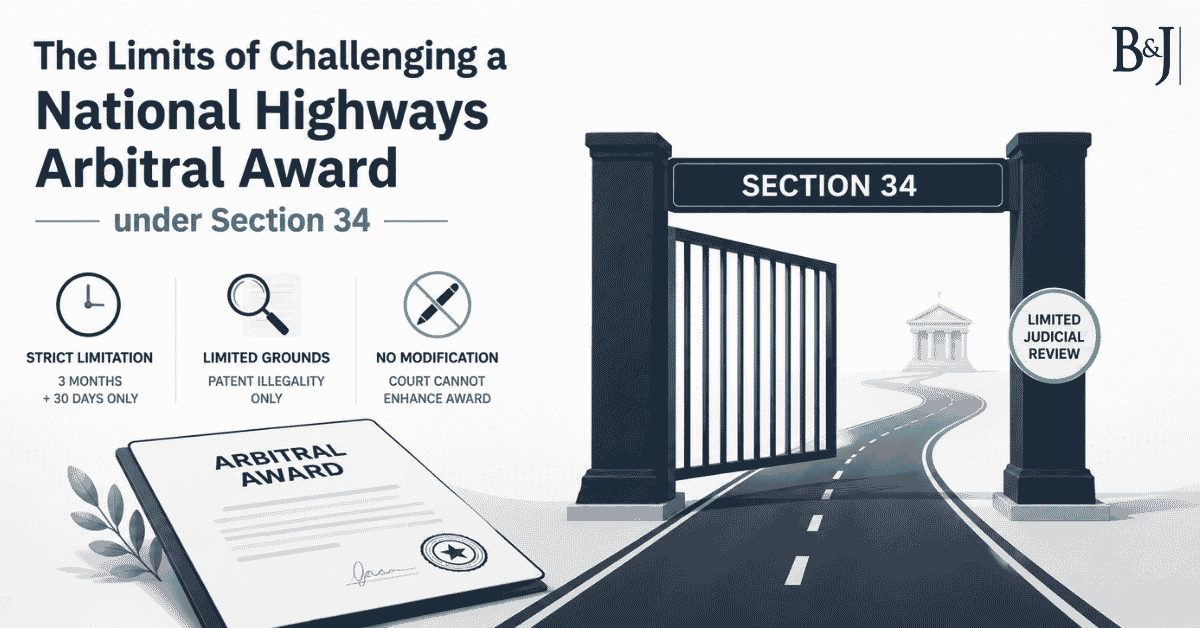
The time limit to challenge an arbitral award under Section 34 of the Arbitration and Conciliation Act, 1996 is one of the strictest in Indian law. It is short, computed from an event that parties frequently misidentify, and subject to a genuinely absolute outer limit.
Awards become unchallengeable through delay more often than through any deficiency in the grounds.
Section 34 of the Arbitration Act: The Provision
Section 34(3) of the Arbitration and Conciliation Act, 1996 provides that an application for setting aside an award may not be made after three months have elapsed from the date on which the party making the application had received the arbitral award; or, if a request had been made under Section 33, from the date on which that request had been disposed of by the arbitral tribunal.
The proviso permits the court, if satisfied that the applicant was prevented by sufficient cause from making the application within that period, to entertain it within a further period of thirty days — “but not thereafter“.
Why the Outer Limit is Absolute?
Those three words carry the weight of the provision.
The scheme is that three months is the Section 34 limitation period, thirty days is the maximum extension available on sufficient cause, and beyond 120 days there is no jurisdiction to entertain the application at all — however good the explanation.
This displaces the general power of condonation. Section 5 of the Limitation Act, 1963 permits an appeal or application to be admitted after the prescribed period on sufficient cause shown, but it does not operate where the special statute prescribes an outer limit and excludes further extension. Section 34(3), by the words “but not thereafter”, does exactly that.
The practical consequence is that an application filed on the 121st day is not merely a late Section 34 application; it is one the court cannot entertain.
When Does the Time Limit to Challenge an Arbitral Award Begin?
This is where most Section 34 limitation errors originate.
The time limit to challenge an arbitral award runs from the date on which the party received the signed award — not from the date the award was signed, pronounced, or merely communicated to the party’s advocate.
Section 31(5) requires a signed copy of the arbitral award to be delivered to each party. The date and mode of receipt should therefore be documented carefully, as disputes may arise over whether delivery to an agent, employee or representative constitutes valid receipt in the circumstances.
Where a Section 33 request has been made for correction of computation, clerical or typographical errors, interpretation of a specific point or part of the award, or an additional award, the Section 34 limitation period runs from the date on which that request is disposed of, rather than from the date of the original award. Section 33 also prescribes the applicable periods for making and disposing of such requests.
The practical point is simple: a genuine Section 33 request can affect when the limitation period begins to run. It should not, however, be used merely as a device to gain additional time.
The Related Requirements Introduced in 2015
Section 34(5) provides that a Section 34 application shall be filed by a party only after issuing a prior notice under Section 34(5) to the other party. The application must also be accompanied by an affidavit confirming compliance with this notice requirement.
Section 34(6) requires the court to dispose of the application expeditiously and, in any event, within one year from the date on which the notice under Section 34(5) is served on the other party.
The status of Section 34(5) — whether the requirement is mandatory or directory — has been considered by the courts. As a practical matter, the safer course is to comply with the requirement: issue the prior notice and file the endorsing affidavit along with the Section 34 application.
What the Delay Actually Costs?
Since the 2015 amendment, missing the period has consequences it did not previously have.
Under the unamended Section 36, the mere filing of a Section 34 application operated as an automatic stay on enforcement of the award. That is no longer the position. Section 36 as substituted requires a separate application for stay, and the court may grant it subject to such conditions as it deems fit, recording reasons — and in the case of an award for money, the provisions of the Code of Civil Procedure, 1908 relating to stay of a money decree apply.
In Board of Control for Cricket in India v. Kochi Cricket Pvt. Ltd., (2018) 6 SCC 287, decided on 15 March 2018, the Supreme Court held that the substituted Section 36 is procedural and applies to pending Section 34 applications even in arbitrations commenced before 23 October 2015, so that the rule of automatic stay on filing a Section 34 application is no longer applicable.
So an award holder may proceed to enforce unless a stay is obtained. Time lost is not neutral.
Where to File a Section 34 Application?
The application goes to the “court” as defined in Section 2(1)(e), which identifies the principal Civil Court of original jurisdiction in a district, and the High Court in exercise of its ordinary original civil jurisdiction where it has such jurisdiction — with a separate definition for international commercial arbitration. Where the dispute is a commercial dispute of specified value, the Commercial Courts Act, 2015 affects the forum.
Filing in the wrong forum is a recurring cause of applications becoming time-barred, though Section 14 of the Limitation Act may permit exclusion of time spent bona fide prosecuting proceedings in a court unable to entertain them.
A Computation Checklist
- Establish the date a signed copy of the award was received by the party, and document it.
- Note whether a Section 33 request was made, and if so, the date it was disposed of.
- Compute three months from the applicable date.
- If that period has passed, determine whether the further thirty days is still running and whether sufficient cause exists.
- Confirm that the total does not exceed the outer limit.
- Issue the prior notice under Section 34(5) and prepare the endorsing affidavit.
- File, together with a separate application for stay under Section 36, since filing alone does not stay enforcement.
Practical Guidance
Diarise the time limit for challenging an arbitral award from the date of receipt, and record that date on the day the signed award is received.
Do not make a Section 33 request merely to gain time; use it where the award genuinely requires correction, interpretation or an additional determination.
Do not assume that the general law of condonation of delay can extend the Section 34 limitation period beyond the statutory outer limit.
Prepare the Section 36 stay application at the same time as the Section 34 challenge, because filing the challenge alone does not automatically stay enforcement of the arbitral award.
Frequently Asked Questions
1. What is the time limit to challenge an arbitral award?
A Section 34 application must generally be filed within 3 months from receipt of the signed award, subject to a further 30 days for sufficient cause.
2. Can the Section 34 limitation period be extended beyond 120 days?
No. The court cannot entertain the application beyond the statutory outer limit under Section 34(3).
3. When does the limitation period for Section 34 begin?
It begins when the party receives the signed copy of the arbitral award under Section 31(5).
4. Does a Section 33 request affect the limitation period?
Yes. Where a valid Section 33 request is made, the limitation period runs from the date on which that request is disposed of.
5. Does filing a Section 34 application automatically stay the award?
No. A separate stay application under Section 36 is required; filing the Section 34 application alone does not automatically stay enforcement.
Legal Information Disclaimer
This article is published for general legal information and educational purposes only. It reflects the position of Indian law as researched up to 10 August 2026 and may not account for subsequent amendments, notifications or judicial developments. The application of the 2015, 2019 and 2021 amendments depends on when the arbitral proceedings and the related court proceedings commenced, and should be checked for a particular case. It is not legal advice, does not take into account any individual’s particular facts or circumstances, and no advocate-client relationship arises from reading it. Readers dealing with an actual matter should obtain independent professional advice from a qualified advocate of their own choosing before acting on any information contained here. Statutory provisions, notified figures, rules and case citations referred to in this article have been compiled from published legal materials and may contain errors or omissions, and may have changed since the date stated; no representation or warranty, express or implied, is given as to their accuracy, completeness or currency, and each should be independently verified against the official text or the official record before being relied upon. No liability is accepted for any loss arising from reliance on this article.
Sources / Authorities
- Arbitration and Conciliation Act, 1996 — Sections 2(1)(e), 31(5), 33, 34 (including sub-sections (3), (5) and (6)) and 36 — India Code, https://www.indiacode.nic.in
- Arbitration and Conciliation (Amendment) Act, 2015 — substitution of Section 36; insertion of Sections 34(5) and (6)
- Board of Control for Cricket in India v. Kochi Cricket Pvt. Ltd., (2018) 6 SCC 287, Supreme Court of India (R.F. Nariman and Navin Sinha, JJ.), decided 15 March 2018 — substituted Section 36 applies to pending Section 34 applications; automatic stay no longer applicable — https://indiankanoon.org/doc/64244161/
- Limitation Act, 1963 — Sections 5 and 14
- Code of Civil Procedure, 1908 — provisions relating to stay of a money decree
- Commercial Courts Act, 2015