 Whatsapp


Section 29A Arbitration: When the Arbitrator’s Mandate Expires, and How to Get It Extended
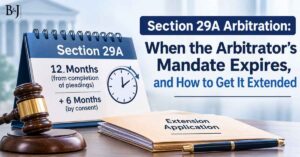
Most arbitration clauses promise speed. Section 29A of the Arbitration and Conciliation Act 1996 is the provision that tries to enforce the promise, by putting a clock on the tribunal. Anyone in a domestic arbitration needs to understand section 29A arbitration timelines, because a missed deadline does not just irritate the parties: it can end the arbitrator’s authority and leave a half-heard case in limbo. This article explains how the clock runs, what the Supreme Court has said about extension and substitution, and what each side should do.
In short: Section 29A arbitration requires a domestic arbitral tribunal to make its award within twelve months of completing pleadings, extendable by consent by six months. After that the arbitrator’s mandate terminates unless the court extends the time, which it may do before or after expiry, for sufficient cause and on terms.
What this Means for You
If your arbitration is running late, find out the date the clock started and the date it runs out, today. Agree a consensual extension in writing if the other side will, but remember it buys only six months. If the deadline has passed or is about to, apply to the court for extension promptly and explain the delay. You are not automatically shut out by being late, but you should not count on the court being generous.
Key Takeaways
- The twelve-month period runs from the completion of pleadings under section 23(4); the parties may add up to six months by consent under section 29A(3).
- After that, the mandate terminates unless the court extends the period, “either prior to or after” expiry (section 29A(4)).
- The Supreme Court confirmed in Rohan Builders (2024 INSC 686) that an application filed after expiry is maintainable, but extension is not granted mechanically.
- Extension needs “sufficient cause” and may carry conditions: reduced fees for tribunal delay and costs.
- Where the mandate has ended, the court substitutes the arbitrator under section 29A(6), and the new tribunal continues from the stage already reached.
- The section does not apply in this form to international commercial arbitration, where the Act only asks for an endeavour to finish within twelve months.
Section 29A Arbitration Time Limit: When Does the Clock Start?
Section 29A(1) provides that in an arbitration other than an international commercial arbitration, the award must be made within twelve months from the date the pleadings are completed under section 23(4). Section 29A(2) rewards speed: if the award is made within six months from the date the tribunal enters on the reference, the arbitrator may receive additional fees as the parties agree. Section 29A(3) lets the parties extend the period by consent by up to six months.
For international commercial arbitrations, the Act asks that the award be made as expeditiously as possible and endeavours to dispose of the matter within twelve months; the termination consequence discussed below is written for the domestic case.
Termination of the Arbitrator’s Mandate under Section 29A
Section 29A(4) says that if the award is not made within the period under sub-section (1) or the extended period under sub-section (3), the mandate of the arbitrator or arbitrators terminates, unless the court has extended the period either before or after its expiry. Three provisos matter. The court may reduce the arbitrator’s fees by up to five per cent for each month of delay attributable to the tribunal, after hearing the arbitrator. The mandate continues until an extension application is disposed of. And the extension itself is on the application of any party, for sufficient cause and on terms the court thinks fit (section 29A(5)).
“Court” here has the meaning given in section 2(1)(e) of the Act: broadly, the principal civil court of original jurisdiction in the district, or the High Court exercising ordinary original civil jurisdiction, and in an international commercial arbitration, the High Court.
Can I Apply after the Mandate has Expired?
Whether a party can seek an extension of time under section 29A after the arbitral tribunal’s mandate has expired was the central controversy before the Supreme Court. The Calcutta High Court had held that an application had to be filed before the period ran out, because a tribunal whose mandate had terminated could not be revived. Other High Courts took the opposite view. On 12 September 2024 the Supreme Court, in Rohan Builders (India) Pvt. Ltd. v. Berger Paints India Ltd., 2024 INSC 686 (Khanna and Mahadevan JJ.), settled it: an application under sections 29A(4) and (5) can be filed even after the twelve-month period, or the extended six-month period, has expired.
The Court’s reasoning rests on the text. The word “unless” and the phrase “either prior to or after the expiry” show that termination is conditional on no extension being obtained. The tribunal becomes functus officio, but, in the Court’s words, not in absolute terms. The Court also declined to read in a limitation period the legislature had not prescribed.
The Court was equally clear that the door is not open without conditions. Extension “is not granted mechanically on filing of the application”: the court exercises discretion to deter abuse, may impose terms and conditions, may reduce fees for tribunal-attributable delay and may impose costs under section 29A(8). The Court expressly left open the further legal consequences of termination and the remedies available to parties.
What Counts as “Sufficient Cause”?
The statute does not define it. The Supreme Court’s decision of 22 November 2024 in M/s Ajay Protech Pvt. Ltd. v. General Manager, 2024 INSC 889 (Narasimha and Mehta JJ.), is a useful illustration. The Court set aside a Gujarat High Court order that had refused extension, and extended the time for the award to 31 December 2024. It followed Rohan Builders on maintainability after expiry, said sufficient cause should be read in the context of facilitating effective dispute resolution, and took into account the pandemic-era exclusion of limitation periods ordered in Re: Cognizance for Extension of Limitation, the parties’ agreement to seek extension, and the interval between the computed deadline and the filing of the application. Each party was left to bear its own costs.
The reading to take from this is practical rather than doctrinal: courts look at why the time was lost, who was responsible, how long the applicant waited, and how far the arbitration has progressed. An applicant who can show that the delay was shared, the proceedings are advanced and the parties were content to continue stands in a better position than one who sat on the clock.
Substitution of Arbitrator under Section 29A(6)
Section 29A(6) allows the court, while extending time, to substitute one or all of the arbitrators. The proceedings then continue from the stage already reached, on the evidence and material already on record, and under section 29A(7) the reconstituted tribunal is deemed to be a continuation of the previous one.
In Mohan Lal Fatehpuria v. M/s Bharat Textiles, 2025 INSC 1409 (Aradhe and Kumar JJ., 10 December 2025), the sole arbitrator’s mandate had expired, he was functus officio and his continuation was impermissible. The High Court had declined relief; the Supreme Court set that order aside, held that section 29A(6) empowers and obligates the court to substitute the arbitrator, appointed a retired High Court judge, and directed that the proceedings resume from the stage already attained and conclude within six months. It also held that the earlier rejection of applications to terminate the arbitrator’s mandate under sections 14 and 15 did not stand in the way, because those are distinct remedies.
Two Sides of the Same Question
The law cuts both ways, and it helps to be honest about that. A party that wants the arbitration to continue benefits from Rohan Builders: a late application is not fatal, and the mandate continues while it is pending. A party that wants out, perhaps because the tribunal is perceived as unfavourable, cannot simply wait for the clock and treat the arbitration as dead; the court can extend after the event, and a party that contributed to the delay is poorly placed to rely on it. Conversely, a claimant who lets the date pass quietly cannot assume extension: the court may ask for reasons, may reduce the arbitrator’s fees and may impose costs.
There are also open questions. The Supreme Court in Rohan Builders stated that it was not deciding the full legal consequences of termination. This article does not address how a section 29A application interacts with an award made, or challenged, while the application is pending. The section also concerns delay, not the tribunal’s jurisdiction, so it should not be confused with a challenge under section 16.
A Practical Checklist
- Record the date pleadings were completed and compute the twelve-month and eighteen-month dates; diarise both.
- If the other side is cooperative, record any section 29A(3) extension in writing, signed by the parties.
- Do not wait for the final date: file the court application while the mandate is alive, since it continues until disposal.
- Explain the delay with dates: hearings adjourned, who sought them, any period excluded for the pandemic, and steps taken since.
- Be ready to offer terms: a fee reduction for tribunal-attributable delay, an undertaking not to seek further adjournments, or costs.
- If the arbitrator is the problem, ask expressly for substitution under section 29A(6), and ask that the proceedings resume from the stage reached.
- Keep objections to the tribunal’s jurisdiction separate; they are decided under section 16 and not under section 29A.
Frequently Asked Questions
What happens if the arbitral tribunal does not make its award within the section 29A time limit?
The tribunal’s mandate terminates unless the court extends the Section 29A arbitration time limit, either before or after expiry. Its mandate continues while an extension application is pending.
Can I apply for extension after the mandate has already expired?
Yes. Rohan Builders, 2024 INSC 686, holds that the application is maintainable after expiry, though extension is discretionary and needs sufficient cause.
Do the parties need the court to extend time?
Not for the first six months, which they can agree under section 29A(3). Beyond that, only the court can extend.
Is the arbitrator automatically replaced when the mandate expires?
No. Substitution is a court order under section 29A(6); see Mohan Lal Fatehpuria, 2025 INSC 1409.
Can the court reduce the arbitrator’s fees for delay?
Yes, by up to five per cent for each month of tribunal-attributable delay, after hearing the arbitrator, and it may also award costs under section 29A(8).
Glossary
- Mandate
- The arbitrator’s authority to decide the dispute.
- Functus officio
- Having discharged or lost one’s office; here, a tribunal whose time has run out and which cannot proceed without an extension.
- Sufficient cause
- A good reason, assessed on the facts, for the time having been lost.
- Substitution
- Replacement of the arbitrator by court order, with proceedings continuing from the existing stage.
Related Reading
- Cluster guide (forthcoming): Recovering Sub-Contractor Dues: Arbitration, Section 9 and Section 21 Notices
- Setting Aside an Ex Parte Decree: Order 9 Rule 13 CPC
Sources
- Arbitration and Conciliation Act 1996, sections 2(1)(e), 14, 15, 16, 23(4) and 29A (as amended by the Arbitration and Conciliation (Amendment) Act 2019). India Code.
- Rohan Builders (India) Pvt. Ltd. v. Berger Paints India Ltd., 2024 INSC 686, Supreme Court, 12 September 2024. Judgment.
- M/s Ajay Protech Pvt. Ltd. v. General Manager, 2024 INSC 889, Supreme Court, 22 November 2024. Judgment.
- Mohan Lal Fatehpuria v. M/s Bharat Textiles, 2025 INSC 1409, Supreme Court, 10 December 2025. Judgment.
- Re: Cognizance for Extension of Limitation, Supreme Court (pandemic limitation exclusion order), as applied in Ajay Protech.

Advocate Aaditya Bhatt
Senior Standing Counsel Income Tax Department, Advocate Gujarat High Court. Aaditya combines his technical and legal expertise to deliver strategic counsel in litigation, constitutional, and regulatory matters. He represents clients before High Courts and Tribunals with a technology-driven approach.
