 Whatsapp


Section 40(a)(ia) and the Small Transporter: Form 15-I, Form 15-J, and the Anatomy of a TDS Disallowance
A Small Default With A Very Large Price
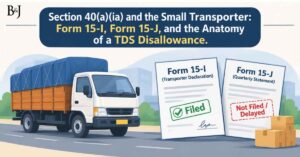
Consider a transport contractor – call the business Shreeji Roadlines – which takes a haulage contract from a cement company and, having no fleet large enough to perform it, engages a few dozen individual truck owners to run the loads. Each drives his own vehicle; none owns more than a truck or two. Under the law as it stood in the middle of the last decade, Shreeji Roadlines was not required to deduct tax at source on what it paid them, provided it collected from each a signed declaration in Form No. 15-I. It collected every one of those declarations. What it did not do was file the consolidated statement, Form No. 15J, with the Commissioner by 30 June following the year end. For that omission the Assessing Officer disallowed the whole of the sub-contract payments under Section 40(a)(ia) of the Income-tax Act, 1961, on the ground of failure to comply with the TDS provisions – several crores of rupees, on a business whose margin on the same turnover was a fraction of one per cent. The tax demanded exceeded everything the business had earned in the year.
That disproportion is why Section 40(a)(ia) disallowance has generated more litigation, relative to the revenue it protects, than almost any other provision in the computation chapter, and why the courts and Parliament have spent twenty years trimming it. This article traces what the provision does, how the Section 194C transporter exemption has been re-engineered three times, why the Gujarat High Court held that failing to file Form 15J does not attract the disallowance, what can fairly be said on the Revenue’s side of that question, and – the part that matters most going forward – why the Income-tax Act, 2025 may have quietly changed the answer.
What Section 40(a)(ia) Disallowance Actually Means?
Section 40(a)(ia), inserted by the Finance (No. 2) Act, 2004 with effect from 1 April 2005, is a disallowance provision, not a charging provision. It does not tax anything; it denies a deduction. Where a sum is payable to a resident, where tax on it is deductible at source under Chapter XVII-B, and where the payer has either not deducted that tax or, having deducted it, has not paid it over by the prescribed date, the expenditure is thrown out of the computation of business income. The deduction is not lost forever – it revives in the year in which the tax is eventually deducted and paid. The provision is best understood as a timing sanction with a collection purpose: a device to make a private payer do the State’s collection work, on pain of a temporary but often crushing addition.
The logic of the section has one consequence that governs the whole of the discussion that follows, and it is worth stating plainly. Section 40(a)(ia) bites only where there was a duty to deduct in the first place. If the payment falls outside the deducting sections, or falls within an exemption written into them, there is no failure to deduct, and the disallowance has nothing to operate upon. As the Gujarat High Court put it, for the application of section 40(a)(ia) ‘the foremost requirement would be of tax deduction at source’ (CIT v. Valibhai Khanbhai Mankad, [2012] 28 taxmann.com 119 / [2013] 216 Taxman 18 (Guj.), paragraph 5). Every argument about Form 15-I and Form 15J is, at bottom, an argument about whether the duty to deduct ever arose.
The Transporter Exemption, Re-Engineered Three Times
Payments to contractors and sub-contractors attract deduction under section 194C. Road transport, however, has always been an awkward sector to tax at source: a very large number of very small operators, many below the taxable threshold, whose working capital cannot absorb a deduction they must then reclaim by filing a return. Parliament has accordingly carved them out – but on three different sets of conditions in three successive periods, and a practitioner who applies the wrong period’s test to the wrong year will reach the wrong answer.
In the first period, from 1 June 2005 to 30 September 2009, the second proviso to section 194C(3)(i), inserted by the Finance Act, 2005, exempted payments to a sub-contractor in the goods-carriage business ‘on production of a declaration… if such sub-contractor is an individual who has not owned more than two goods carriages at any time during the previous year’. That declaration was Form No. 15-I, given by the sub-contractor to the payer. The third proviso separately required the payer to furnish prescribed particulars to the prescribed income-tax authority, which rule 29D of the Income-tax Rules, 1962 identified as Form No. 15J, to be filed with the Commissioner on or before 30 June following the financial year. Two documents, therefore, moving in two directions, on two different timetables – and the whole of the argument that follows turns on that separation.
In the second period, from 1 October 2009, the Finance (No. 2) Act, 2009 substituted section 194C wholesale, and the new sub-section (6) exempted any sum paid to a contractor in that business ‘on furnishing of his Permanent Account Number’. The two-vehicle ceiling vanished, as did the requirement that the payee be an individual; a PAN was the whole of the condition, and the reporting duty went into a separate sub-section (7), routed by rule 31A into the quarterly statement in Form No. 26Q. The predictable happened – large fleet operators claimed the exemption on the strength of a PAN – and in the third period, from 1 June 2015, the Finance Act, 2015 narrowed sub-section (6) to a contractor who ‘owns ten or less goods carriages at any time during the previous year and furnishes a declaration to that effect along with his Permanent Account Number’. The three regimes, and their successor, may be set out shortly.
| Period | Who escapes deduction | Reporting duty on the payer | Where the reporting duty sits |
|---|---|---|---|
| 1 June 2005 to 30 September 2009 (second and third provisos to s.194C(3)(i), inserted by the Finance Act, 2005) | A sub-contractor who is an individual and who has not owned more than two goods carriages at any time during the previous year, on producing a declaration in Form No. 15-I | Form No. 15J to the prescribed income-tax authority by 30 June following the financial year (rule 29D) | A separate, later proviso – the textual foundation of the Valibhai reasoning |
| 1 October 2009 to 31 May 2015 (s.194C(6) and (7), substituted by the Finance (No. 2) Act, 2009) | Any contractor in the business of plying, hiring or leasing goods carriages who furnishes his PAN. No ownership ceiling; the payee need not be an individual | Prescribed particulars in the quarterly statement (Form No. 26Q, rule 31A) | A separate sub-section, s.194C(7) |
| 1 June 2015 to 31 March 2026 (s.194C(6) as amended by the Finance Act, 2015) | A contractor who owns ten or less goods carriages at any time during the previous year and furnishes a declaration to that effect together with his PAN | Prescribed particulars in the quarterly statement (Form No. 26Q, rule 31A) | A separate sub-section, s.194C(7) |
| From 1 April 2026 (s.393(4), Table Sl. No. 8, Income-tax Act, 2025) | A contractor who owns ten or less goods carriages at any time during the tax year and furnishes a declaration together with his PAN | Particulars to the prescribed income-tax authority, in the prescribed form and time (Form No. 140, rule 219) | Clause (iv) inside the exemption itself, joined conjunctively by ‘and’ |
Form 15J Filing Under Section 194C: Is It a Condition of the Exemption?
This is the question on which the reported litigation turns, and it is genuinely arguable both ways.
The answer given by the Gujarat High Court in Valibhai Khanbhai Mankad (Akil Kureshi and Harsha Devani JJ., 1 October 2012) rests on the architecture of the section. The exclusion from liability, the Court reasoned, ‘would thus be complete the moment the requirements contained therein are satisfied’ – that is, the moment the sub-contractor produces a valid declaration and satisfies the two-vehicle condition. At that instant the payer not only need not deduct; he ‘would have no authority to make any such deduction’ (paragraph 7). The duty to file Form 15J, by contrast, ‘would arise at a much later point of time’ (paragraph 8) – months after the payments, months after the year has closed. A duty that arises after the deduction window has shut cannot logically be a condition precedent to the closing of that window. Its breach ‘may result into some other adverse consequences if so provided under the Act’, but it cannot retrospectively resurrect a deduction obligation that had already ceased, and so cannot found a disallowance under section 40(a)(ia) (paragraphs 9 and 10).
The contrary case, which the Revenue has pressed and which deserves to be stated at its strongest rather than caricatured, runs like this. The two provisos are parts of a single scheme, not free-standing rules. Form 15-I is a declaration made privately by one taxpayer to another; nothing in it reaches the Department except through Form 15J. If the consolidated statement is never filed, the Department has no means of knowing who the transporters were, whether they owned two vehicles or twenty, or whether the declarations were genuine or manufactured after the assessment began. On that view the reporting duty is not a collateral formality but the only point at which the exemption becomes verifiable, and an exemption the State can never audit is, in practical terms, an exemption granted on the payer’s say-so. There is a textual point too: the second proviso itself speaks of a declaration ‘within such time as may be prescribed’, which invites the argument that the prescribed timetable is part of the condition and not extraneous to it.
The Gujarat High Court preferred the first reading, and the practical justification for it is strong: disallowance of the entire payment is spectacularly disproportionate to the default, and the Act elsewhere provides its own penalties for failures to furnish statements. It is also consistent with the principle that a machinery provision should be construed so as to make the substantive right workable rather than to defeat it. A similar approach appears to have been taken by the Karnataka High Court in CIT v. Sri Marikamba Transport Co., treating the filing of Forms 15-I and 15J as directory rather than mandatory – though that report has been taken on secondary authority only, and is flagged accordingly below.
Two qualifications must be entered. First, none of this helps a payer who never obtained Form 15-I at all. The declaration is the condition; the statement is the report. Where no declaration was taken, the exemption never engaged, the duty to deduct subsisted, and section 40(a)(ia) applies in terms – a distinction the Cochin Bench of the Tribunal drew expressly in Kerala Transport Company v. ACIT, [2015] 54 taxmann.com 219, allowing the claim where Form 15-I had been obtained and rejecting it where it had not. Second, the Revenue’s challenge to Valibhai has never been closed out. The Supreme Court granted leave on 13 October 2014 ([2014] 51 taxmann.com 385 / 227 Taxman 372 (SC)) and the matter became Civil Appeal No. 9812 of 2014. That order is one line long – ‘Leave granted’ – and is emphatically not an affirmation or a reversal of the High Court, notwithstanding the way some reporters tag it. The Gujarat High Court has continued to treat Valibhai as binding while the appeal is pending, observing in a later matter that ‘as of now we are bound by the judgement in case of Valibhai Khanbhai Mankad’. No reported disposal of that appeal could be traced, and readers should verify its current status before relying on the High Court’s view in a live proceeding.
Section 40(a)(ia) TDS Disallowance: How the Law Has Evolved
The Form 15J controversy sits inside a larger story of retreat from the provision’s original severity, along four strands that are frequently conflated and should not be. The first is the word ‘payable’. As enacted the section spoke of amounts ‘payable’, which generated the argument – accepted by a Special Bench of the Tribunal at Visakhapatnam in Merilyn Shipping & Transports v. ACIT, 146 TTJ 1 (SB), and by the Allahabad High Court in CIT v. Vector Shipping Services, [2013] 357 ITR 642 – that sums actually paid during the year escaped the section altogether. The Gujarat High Court declined to follow Merilyn Shipping in CIT v. Sikandarkhan N. Tunvar (2 May 2013), and the Supreme Court closed the question in Palam Gas Service v. CIT, [2017] 394 ITR 300 (SC), holding at paragraph 15 that the section ‘covers not only those cases where the amount is payable but also when it is paid’ and overruling Vector Shipping by name. Since the point is often put loosely: Palam Gas does not mention Merilyn Shipping, which was disapproved by the High Courts and not by the Supreme Court. The second strand is timing – the Finance Act, 2010 substituted a single deposit deadline, no disallowance if the deducted tax is paid by the due date under section 139(1), which the Supreme Court held remedial, curative and retrospective to 1 April 2005 in CIT v. Calcutta Export Company, [2018] 404 ITR 654 (SC).
The third strand is the payee’s own compliance. The Finance Act, 2012 inserted a second proviso deeming the payer to have deducted and paid the tax where a resident payee has filed his return, taken the sum into account and paid the tax due, and the payer obtains a certificate to that effect – now Form No. 26A under rule 31ACB. Whether that relief reaches back before 1 April 2013 is unsettled: the Delhi High Court in CIT v. Ansal Land Mark Township (P.) Ltd., [2015] 377 ITR 635, held the proviso declaratory and retrospective, while the Kerala High Court in Thomas George Muthoot v. CIT, [2015] 235 Taxman 246, held that it conferred ‘an additional benefit’ and that ‘such a provision can only be prospective’. It is a genuine divergence, and it is not accurate to say that ‘the courts’ have held the proviso retrospective. Kerala in the same judgment declined to import into section 40(a)(ia) the principle of Hindustan Coca Cola Beverage (P.) Ltd. v. CIT, [2007] 293 ITR 226 (SC), that tax already paid by the deductee cannot be recovered again from the deductor – a principle which in any event leaves interest under section 201(1A) and penalty under section 271C untouched. The fourth strand is quantum: the Finance (No. 2) Act, 2014 both widened the section to every payment to a resident on which tax is deductible under Chapter XVII-B and reduced the Section 40(a)(ia) disallowance to thirty per cent of the expenditure, and the Supreme Court held in Shree Choudhary Transport Co. v. ITO, [2020] 426 ITR 289 (SC), that the reduction ‘was specifically made applicable w.e.f. 01.04.2015’ and cannot be read back. Shree Choudhary is also the leading authority that truck owners engaged on hire by a transport contractor are sub-contractors within section 194C – though it should not be pressed on the Form 15-I or 15J question, with which it does not deal at all.
The Income-tax Act, 2025: The Same Rule, In A Different Place
For tax years beginning on or after 1 April 2026, the governing text is the Income-tax Act, 2025. On the face of it, the change is one of numbering. The disallowance under Section 40(a)(ia) of the Income-tax Act, 1961 moves to section 35(b)(i), which denies deduction of ‘thirty per cent of any sum payable to a resident, on which tax is deductible at source under Chapter XIX-B’ where the tax has not been deducted or has not been paid by the due date under section 263(1); the year-of-payment revival is preserved in sub-clause (A) and the payee-has-paid relief in sub-clause (B), which now keys to section 398(2) in place of the first proviso to section 201(1). The transporter exemption moves to section 393(4), Table Sl. No. 8, on the same substantive terms: ten or less goods carriages owned at any time during the tax year, a declaration to that effect, and a PAN. Rates and thresholds are carried over, and the Central Board of Direct Taxes has confirmed in its transition FAQs that a circular clarifying ‘work’ under the old section 194C continues to apply to section 393 where the legislative intent is unchanged.
But there is one drafting change that is not cosmetic. Under the 1961 Act the exemption and the payer’s reporting duty lived in separate places – separate provisos before 2009, separate sub-sections (6) and (7) afterwards. That separation is precisely what allowed the Gujarat High Court to hold that the reporting duty is a later and collateral obligation whose breach cannot revive a deduction liability that had already ceased. Under section 393(4), Table Sl. No. 8 of the 2025 Act, the requirement that ‘the person responsible for paying to the contractor furnishes to the prescribed income-tax authority the particulars in such form and within such time as may be prescribed’ appears as clause (iv) of the exemption itself, joined to the other three conditions by the conjunction ‘and’. On a plain reading, the reporting duty has been converted from a collateral obligation into a condition of the exemption. If that is right, the Valibhai reasoning – which was always a reading of where the words sat – may not survive into the new Act, and a payer who takes the declaration but does not report it may find the exemption unavailable and thirty per cent of the payment disallowed under section 35(b)(i). Whether the courts will read clause (iv) that literally, given that it still speaks of a form and a time to be prescribed – that is, of a duty performed after the payment – remains to be seen. The point appears to be untested.
One transitional matter should not be overlooked in cases still on the file. Rule 29D and Forms 15-I and 15J were formally omitted from the Income-tax Rules, 1962 with effect from 29 July 2021 by Notification No. 83/2021, G.S.R. 514(E), which inserted rule 130. Sub-rule (3)(i) saves pending proceedings, which continue ‘as if rules and forms mentioned in sub-rule (1) and sub-rule (2) have not been omitted’. An appeal for assessment year 2007-08 argued in 2026 is therefore still argued on rule 29D as it stood.
Where The Balance Lies
The through-line of two decades of litigation on section 40(a)(ia) is a search for proportion. The provision was drafted as a blunt instrument and applied as one; the courts and Parliament between them have blunted it at each of the four points where it drew blood – the paid-or-payable distinction, the deposit deadline, the payee who has already paid, and the quantum. The Form 15J line of cases belongs to the same family: it says, in substance, that a reporting failure should be visited with a reporting penalty and not with the confiscation of an entire year’s expenditure.
The Revenue’s answer is a serious one: a self-declared exemption the Department cannot verify is an exemption that will be abused, and the machinery by which it is verified cannot sensibly be optional. That tension is unresolved, and the Supreme Court’s leave in Valibhai has now been pending for over a decade. What the 2025 Act appears to have done is resolve it prospectively, and in the Revenue’s favour, not by argument but by moving a clause. If that is what section 393(4) means, payers will need to treat the reporting of transporter declarations with a seriousness the case law under the old Act did not demand of them – and the first assessments for tax year 2026-27 will be the place to find out.
Frequently Asked Questions
Does obtaining Form 15-I alone protect the payer from a section 40(a)(ia) disallowance for years up to assessment year 2009-10? On the Gujarat High Court’s reasoning in Valibhai Khanbhai Mankad, yes: once a valid declaration is produced by a sub-contractor who satisfies the two-vehicle condition, the liability to deduct ceases at that moment, and the separate failure to file Form 15J cannot revive it. The Revenue’s appeal against that view appears still to be undisposed of in the Supreme Court, so the position should be checked at the date of reliance. Where no Form 15-I was obtained at all, the exemption never engaged and the disallowance follows.
How much is disallowed, and is it disallowed forever? For assessment years up to 2014-15 the whole of the sum; from assessment year 2015-16, thirty per cent of it, and the Supreme Court held in Shree Choudhary that the reduction does not reach earlier years. Either way the disallowance is a deferral rather than a forfeiture, the sum being allowed in the year the tax is eventually deducted and paid. Section 35(b)(i) of the Income-tax Act, 2025 retains the thirty per cent figure.
What must a payer do differently from 1 April 2026? Take the declaration and the PAN, as before, and confirm the ten-vehicle limit; but treat the reporting of those particulars as part of the exemption rather than an administrative afterthought. Section 393(4), Table Sl. No. 8 of the Income-tax Act, 2025 lists the payer’s reporting duty as a conjunctive condition of the exemption itself, which the corresponding provisions of the 1961 Act did not. The point is new and untested, and the safer course is to comply on the assumption that the literal reading will prevail.
Sources & Citations
- Income-tax Act, 1961, section 40(a)(ia) – inserted by the Finance (No. 2) Act, 2004 w.e.f. 1-4-2005; substituted by the Finance Act, 2008 w.r.e.f. 1-4-2005; substituted by the Finance Act, 2010 w.e.f. 1-4-2010; second proviso inserted by the Finance Act, 2012 w.e.f. 1-4-2013; substituted (30 per cent; all Chapter XVII-B resident payments) by the Finance (No. 2) Act, 2014 w.e.f. 1-4-2015.
- Income-tax Act, 1961, section 194C – second and third provisos to sub-section (3)(i) inserted by the Finance Act, 2005 w.e.f. 1-6-2005; section substituted by the Finance (No. 2) Act, 2009 w.e.f. 1-10-2009 (sub-sections (6) and (7)); sub-section (6) amended by the Finance Act, 2015 w.e.f. 1-6-2015 (‘owns ten or less goods carriages’).
- Income-tax Rules, 1962, rule 29D and Forms No. 15-I and 15J; rule 31A and Form No. 26Q; rule 31ACB and Form No. 26A. Rule 29D and Forms 15-I / 15J omitted w.e.f. 29-7-2021 by Notification No. 83/2021, G.S.R. 514(E) (rule 130), with a savings clause for pending proceedings.
- Income-tax Act, 2025 (in force 1 April 2026), section 35(b)(i) (successor to section 40(a)(ia)); section 393(1) Table Sl. No. 6(i) and section 393(4) Table Sl. No. 8 (successors to section 194C); section 263(1) (return due date); section 398(2) (assessee not in default). Income-tax Rules, 2026, rule 219 and Form No. 140. Concordance per the Central Board of Direct Taxes, ‘New Income Tax Bill 2025 Navigator’.
- Central Board of Direct Taxes, FAQs on Interplay and Transition from the Income-tax Act, 1961 to the Income-tax Act, 2025 (Q. 1.20, Q. 2.5, Q. 6.3).
- Central Board of Direct Taxes, Circular No. 5/2010 and Circular No. 19/2015 (payments to transporters); Circular No. 10/DV/2013 (departmental view, paid versus payable); Circular No. 275/201/95-IT(B) dated 29-1-1997.
- CIT v. Valibhai Khanbhai Mankad, [2012] 28 taxmann.com 119 / [2013] 216 Taxman 18 / [2013] 261 CTR 538 (Guj.) (Tax Appeal No. 1182 of 2011, 1-10-2012); leave granted [2014] 51 taxmann.com 385 / [2014] 227 Taxman 372 (SC), Civil Appeal No. 9812 of 2014.
- Palam Gas Service v. CIT, [2017] 394 ITR 300 (SC) (Civil Appeal No. 5512 of 2017, 3-5-2017).
- Shree Choudhary Transport Co. v. ITO, [2020] 426 ITR 289 / 272 Taxman 272 (SC) (Civil Appeal No. 7865 of 2009, 29-7-2020).
- CIT v. Calcutta Export Company, [2018] 404 ITR 654 / 255 Taxman 293 (SC).
- CIT v. Ansal Land Mark Township (P.) Ltd., [2015] 377 ITR 635 / 234 Taxman 825 (Delhi) (ITA Nos. 160 and 161 of 2015, 26-8-2015).
- Thomas George Muthoot v. CIT, [2015] 235 Taxman 246 / (2016) 287 CTR 101 (Ker.); Prudential Logistics and Transports v. ITO, [2014] 364 ITR 689 (Ker.).
- CIT v. Sikandarkhan N. Tunvar, Gujarat High Court, Tax Appeal No. 905 of 2012 and connected matters, 2-5-2013.
- CIT v. Vector Shipping Services (P.) Ltd., [2013] 357 ITR 642 (All.); Merilyn Shipping & Transports v. ACIT, 146 TTJ 1 (Visakhapatnam) (SB).
- Hindustan Coca Cola Beverage (P.) Ltd. v. CIT, [2007] 293 ITR 226 / 163 Taxman 355 (SC).
- Kerala Transport Company v. ACIT, [2015] 54 taxmann.com 219 / 67 SOT 338 (Cochin Bench of the Tribunal – note that this is a Tribunal, not a High Court, decision).
- CIT v. Sri Marikamba Transport Co., Karnataka High Court (reported as 379 ITR 129) – cited on secondary authority only; see the note on verification below.
Related Reading
- Revision under Section 263: “Erroneous and Prejudicial” and the Problem of Enquiry
- Reassessment under Sections 147, 148 and 148A: How the Law Reopens a Closed Year
- Capital or Revenue? Product Registration, Trade Marks and Regulatory Approvals
- Section 14A and Rule 8D: Disallowing Expenditure When There Is No Exempt Income
- Speculation Loss and the Explanation to Section 73: Trading in Shares and Commodities
(c) Bhatt & Joshi Associates. This article is published for general information and academic discussion only; it is not legal advice and should not be acted upon without professional advice on the facts of a particular case.

Advocate Aaditya Bhatt
Senior Standing Counsel Income Tax Department, Advocate Gujarat High Court. Aaditya combines his technical and legal expertise to deliver strategic counsel in litigation, constitutional, and regulatory matters. He represents clients before High Courts and Tribunals with a technology-driven approach.