 Whatsapp


Buy-Back MOU in Real Estate: The Legality of Assured-Return Property Deals

A buy-back MOU in real estate is an agreement in which a developer sells a unit and simultaneously promises to repurchase it later at a fixed price, or to pay a guaranteed monthly return. Its legality turns on substance: courts ask whether the money is a genuine sale consideration or a disguised deposit.
Key Takeaways
- A buy-back MOU in real estate or an assured-return agreement is not illegal per se. Its legal validity depends on the substance of the transaction, particularly whether the money represents genuine property consideration or a disguised deposit.
- The same arrangement can be read three ways: an ordinary contract (breach leads to damages), a real-estate transaction governed by RERA, or a deposit/collective-investment scheme attracting regulatory and even criminal consequences.
- The Supreme Court has treated committed-return real-estate money as having the ‘commercial effect of a borrowing’ – a financial debt – which is why the deposit characterisation is real, not theoretical.
- Whether you are the investor or the developer, get the characterisation right early: it decides your forum, your remedy and your exposure.
What this means for you
If you handed over money on a promise of guaranteed returns or a fixed buy-back price, you are not limited to a civil suit. Depending on the facts you may have a RERA remedy for refund with interest, and – where the promise looks like organised deposit-taking – a complaint to regulators or the police. If you are a developer, structuring a booking as a guaranteed-return scheme can pull you out of ordinary contract law and into deposit and securities regulation, with personal liability for promoters. Either way, the wording of the MOU alone will not save or sink you – the substance will.
The legality of a buy-back MOU in real estate is one of the most misunderstood questions in Indian property practice. Thousands of buyers have signed a booking form for a shop, office or flat and, alongside it, a memorandum of understanding promising a fixed monthly ‘assured return’ until possession, or a guaranteed buy-back at a premium after a few years. When the developer stops paying, the buyer discovers that what they signed can be read in three very different ways – and that each reading opens, or closes, a different door to relief. This guide explains those three characterisations and what each means for your rights.
What is a Buy-Back or Assured-Return MOU In Real Estate?
Two structures dominate the market. In an assured-return arrangement, the developer sells a unit and promises to pay the buyer a fixed sum every month – often described as rent, interest or ‘committed returns’ – from the date of booking until possession or for a fixed number of years. In a buy-back arrangement, the developer promises to repurchase the unit after a set period at a pre-agreed, usually higher, price, guaranteeing the buyer an exit and a profit. Both are sold as low-risk, real-asset-backed investments. Both blur the line between a sale and a financial product.
The blurring matters because the law does not decide the character of a transaction by its title. A document called an ‘MOU’ or a payment called a ‘booking amount’ is not conclusive. Courts and regulators look through the form to the substance: what was actually received, on what promise, and to what end.
The Three Legal Characterisations
Depending on the transaction’s substance, a buy-back MOU in real estate may fall under any of the following three legal categories.
1. An ordinary contract – breach and damages
At its simplest, an assured-return MOU is a contract. If the developer fails to pay the promised returns or to honour the buy-back, that is a breach, and the buyer can sue for compensation. Section 73 of the Indian Contract Act, 1872 entitles the injured party to compensation for loss naturally arising from the breach; where the MOU fixes a sum payable on default, Section 74 governs that stipulation, allowing reasonable compensation not exceeding the amount named. This is the narrowest reading. It gives a remedy, but a slow, money-only one, and it treats organised deposit-taking as if it were a one-off private bargain.
2. A real-estate transaction – the RERA lens
Where the unit is part of a project that must be registered under the Real Estate (Regulation and Development) Act, 2016, the buyer is an ‘allottee’ with statutory rights that do not depend on the MOU at all. Section 18 gives the allottee, on the developer’s failure to hand over possession by the agreed date, an absolute right to withdraw and obtain a refund of the amount paid with interest and compensation – or, if the allottee stays in, interest for every month of delay. Section 12 makes the developer liable to compensate a person who advances money on the faith of a false or misleading statement in an advertisement or prospectus, and to refund with interest if that person withdraws. The RERA route is faster and buyer-friendly, but it is anchored to the project and the possession timeline rather than to the ‘return’ promise as such.
3. A deposit or investment scheme – the regulatory and criminal lens
This is the characterisation developers least expect and investors most need to understand. When money is taken from the public on a promise to return it with a fixed profit, the arrangement starts to look less like a sale and more like deposit-taking or a collective investment.
Under Section 11AA of the SEBI Act, 1992, a scheme is a collective investment scheme if four conditions are all met: contributions are pooled and used for the scheme; they are made with a view to receiving profits or property; the pooled property is managed on behalf of the investors; and the investors have no day-to-day control. In P.G.F. Ltd. v. Union of India, AIR 2013 SC 3702, the Supreme Court held that a company’s scheme of selling and developing agricultural land with promised returns was a collective investment scheme, confirming that land-and-returns packages are not automatically outside securities regulation.
The deposit characterisation received its most striking endorsement in Pioneer Urban Land and Infrastructure Ltd. v. Union of India, (2019) 8 SCC 416, where the Supreme Court held that money raised from home-buyers has the ‘commercial effect of a borrowing’ and is a ‘financial debt’, so that allottees – including those under assured-return schemes – are financial creditors under the Insolvency and Bankruptcy Code. If committed-return money is a borrowing for insolvency purposes, it is a short step to treating it as a deposit for regulatory purposes.
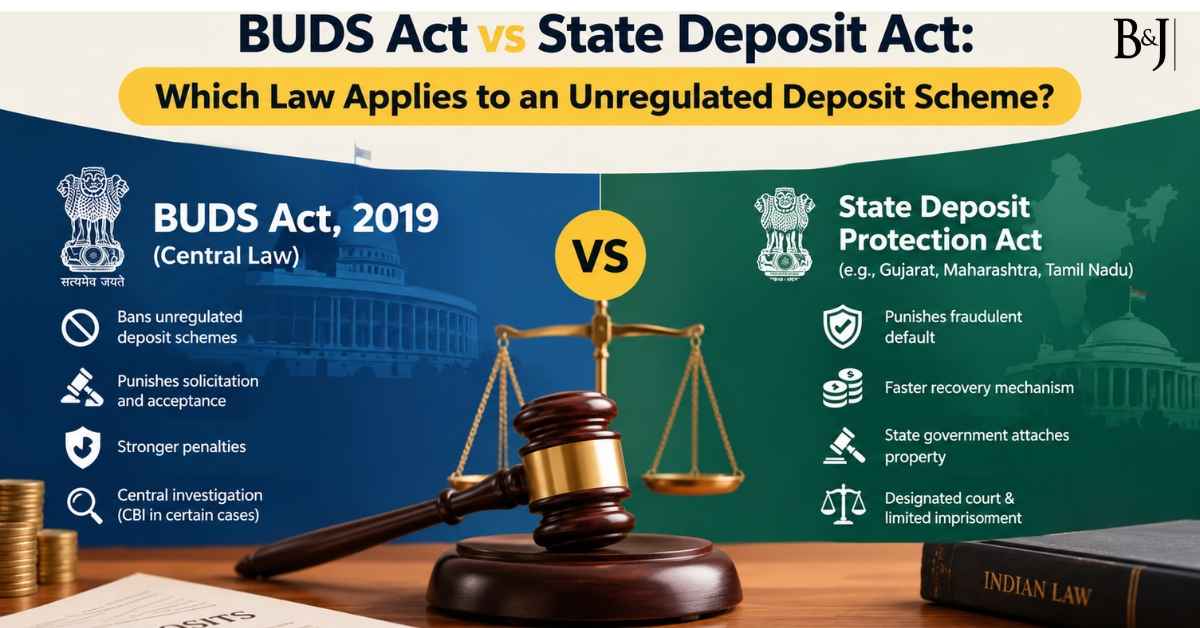
Two deposit statutes then come into play. Federally, the Banning of Unregulated Deposit Schemes Act, 2019 defines a ‘deposit’ in Section 2(4) very broadly – money received by way of advance, loan or in any other form with a promise to return it, with or without a benefit – and bans ‘unregulated deposit schemes’ under Section 2(17). A genuine advance adjusted against an immovable property is excluded, but a refundable, return-bearing sum taken outside a bona-fide sale is not. In parallel, State legislation such as the Gujarat, Maharashtra and Tamil Nadu depositor-protection Acts allows a designated authority to attach the assets of a defaulting ‘financial establishment’ and to prosecute its promoters. The Supreme Court upheld the constitutional validity of that State model in K.K. Baskaran v. State of Tamil Nadu, (2011) 3 SCC 793, locating it within the States’ legislative competence over money-lending and protection of depositors.
Comparing the Three Readings
| Reading | Trigger | Forum | Core remedy / consequence |
|---|---|---|---|
| Ordinary contract | Any binding MOU that is breached | Civil court | Damages under Contract Act ss. 73-74 |
| RERA transaction | Registrable project; possession default or false advertisement | RERA authority / appellate tribunal | Refund with interest, or delay interest, plus compensation (ss. 12, 18) |
| Deposit / CIS | Public money taken on a promise of guaranteed return | SEBI; deposit regulator; designated / criminal court | Ban, attachment of assets, refund orders, prosecution of promoters |
Practical Guidance
For buyers considering a real-estate buy-back or assured-return agreement, as well as investors already facing defaults:
- Read the money, not the label. Ask whether your payment is adjusted against a specific unit at a real price, or is really a return-bearing loan dressed as a booking.
- Check RERA registration. If the project is registered, you have Section 18 refund-with-interest rights that do not depend on the MOU’s ‘return’ clause.
- Preserve the paper trail. Keep the advertisement, brochure, MOU, receipts and every ‘return’ payment record – these prove both the promise and its breach.
- Match the remedy to the character. A single default may be a contract claim; a pattern of public deposit-taking with defaults may warrant a regulator or police complaint, not just a civil suit.
- Developers: assume substance will govern. Structuring bookings as guaranteed-return schemes can convert an ordinary sale into regulated deposit-taking, with personal exposure for promoters.
A Balanced View
Not every buy-back or assured-return MOU is a fraud. Legitimate commercial-property developers use assured-return leases to bridge the gap between sale and tenancy, and buy-back options are ordinary risk-allocation tools. The law does not ban these structures; it insists that if their substance is deposit-taking or collective investment, they carry the protections – and the duties – that go with those categories. Equally, an investor cannot convert every delayed payment into a criminal case: where the developer has assets, a genuine project and a real intention to perform, the dispute is civil or regulatory, not penal. The honest question in every matter is the same one the courts ask: looking past the words, what was this money, really?
Frequently Asked Questions
- Is a buy-back or assured-return MOU illegal in India?
- No. The MOU itself is a valid contract. What varies is its legal character. If its substance is genuine sale plus a service, it is an ordinary real-estate deal; if its substance is public deposit-taking on a promise of guaranteed returns, it can attract securities and deposit regulation, and default may have criminal consequences.
- Can I claim a refund if the developer stops paying assured returns?
- If the unit is in a RERA-registrable project and possession is delayed, Section 18 of the RERA, 2016 gives an absolute right to a refund with interest, or to delay interest if you continue. Outside RERA, you can sue for damages under the Contract Act, and where the scheme looks like unregulated deposit-taking you may also approach the deposit regulator or file a complaint.
- Does calling the payment a ‘booking amount’ keep it outside deposit law?
- No. Courts and regulators look at substance, not labels. The Supreme Court in Pioneer Urban treated home-buyer money as having the commercial effect of a borrowing. A refundable, return-bearing sum can be a ‘deposit’ even if the paperwork calls it a booking or a loan.
- What is the difference between the RERA route and the deposit route?
- RERA is anchored to a registered project and the possession timeline; it gives fast, buyer-friendly refunds and delay interest. The deposit route targets the return-taking itself, engaging SEBI’s collective-investment rules, the Banning of Unregulated Deposit Schemes Act, 2019 and State depositor-protection Acts, with asset attachment and prosecution of promoters.
- Are State depositor-protection Acts constitutionally valid?
- Yes. In K.K. Baskaran v. State of Tamil Nadu, (2011) 3 SCC 793 the Supreme Court upheld the validity of the State depositor-protection model, holding it within the State legislature’s competence and not in conflict with central law.
Glossary
- Allottee
- A person to whom a plot, apartment or building has been allotted or sold by a promoter, with statutory rights under RERA.
- Assured / committed return
- A fixed sum a developer promises to pay a buyer periodically, usually from booking until possession.
- Collective investment scheme (CIS)
- A pooled-money arrangement satisfying the four conditions in Section 11AA of the SEBI Act, 1992.
- Deposit (BUDS Act)
- Money received as advance, loan or otherwise with a promise to return it, with or without a benefit – defined widely in Section 2(4).
- Financial establishment
- An entity that accepts deposits and can be proceeded against under a State depositor-protection Act on default.
Related Reading in this Series
- The GPID Act Explained: A Complete Guide to Depositor-Protection Law
- Is a Real-Estate Builder a ‘Financial Establishment’? Buy-Back Schemes and the GPID Act
- Bail in Deposit-Fraud and Economic-Offence Cases: The Deposit-Condition Question
- BUDS Act 2019 vs State Depositor Acts: Which Law Governs Your Deposit?
Sources
- Indian Contract Act, 1872, ss. 73 and 74
- Real Estate (Regulation and Development) Act, 2016, ss. 12 and 18
- Securities and Exchange Board of India Act, 1992, s. 11AA
- P.G.F. Ltd. v. Union of India, AIR 2013 SC 3702
- Pioneer Urban Land and Infrastructure Ltd. v. Union of India, (2019) 8 SCC 416
- Banning of Unregulated Deposit Schemes Act, 2019, ss. 2(4) and 2(17)
- K.K. Baskaran v. State of Tamil Nadu, (2011) 3 SCC 793

Advocate Aaditya Bhatt
Senior Standing Counsel Income Tax Department, Advocate Gujarat High Court. Aaditya combines his technical and legal expertise to deliver strategic counsel in litigation, constitutional, and regulatory matters. He represents clients before High Courts and Tribunals with a technology-driven approach.