Whatsapp


BNS 316 318 Difference: Criminal Breach of Trust vs Cheating in Investment Schemes
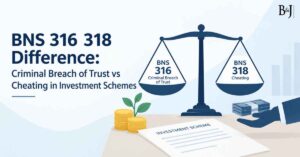
The BNS 316 318 difference turns on when the dishonest intention arose. Section 316 (criminal breach of trust) presumes property was lawfully entrusted and later misappropriated. Section 318 (cheating) requires deception and dishonest intention from the very inception, inducing the victim to part with property.
Key Takeaways
- The BNS 316 318 difference is one of timing: under Section 316 the accused gets the property lawfully and turns dishonest later; under Section 318 the dishonesty exists at the moment of the inducement.
- Section 316 needs entrustment or dominion over property. No entrustment, no criminal breach of trust – however dishonest the later conduct.
- Section 318 needs deception plus a dishonest or fraudulent intention at inception. A promise later broken is a breach of contract, not cheating.
- The Supreme Court has twice held that the two offences cannot co-exist on the same set of facts (Delhi Race Club, 2024; Arshad Neyaz Khan, 2025) – yet Section 244 BNSS expressly permits alternative charging where the facts are genuinely doubtful. Both propositions are good law; they operate at different stages.
- In collapsed investment and deposit schemes the two sections often point to different accused and different transactions. Sorting them out early is what separates a defensible charge-sheet from a quashable one.
What this Means for You
If a criminal complaint has been filed against you over money, the first question is not ‘how much do I owe’ but ‘which offence, on which facts’. An FIR that mechanically lists both Sections 316 and 318 over a single transaction has, on the Supreme Court’s own reasoning, an internal contradiction worth pressing – at charge, at discharge, and in a quashing petition. If you are the complainant, the opposite discipline applies: say plainly whether you handed over property in trust or were tricked into parting with it, and plead facts showing dishonest intention at the outset. A well-pleaded single section is far stronger than a scattergun FIR.
The BNS 316 318 Difference in One Sentence
Section 316 of the Bharatiya Nyaya Sanhita, 2023 deals with criminal breach of trust, where a person lawfully entrusted with property dishonestly misappropriates, converts or uses it in violation of the terms of the entrustment. In contrast, Section 318 deals with cheating, where deception and dishonest intention induce a person to deliver property or act to their detriment. These provisions replace Sections 405–409 and 415–420 of the Indian Penal Code, 1860, respectively, with the principles developed under the earlier law remaining relevant.
The key difference between BNS Sections 316 and 318 lies in when the dishonest intention arises: under Section 316, dishonesty follows lawful entrustment; under Section 318, it exists from the outset and induces the victim to part with the property. This distinction is central to determining which offence applies to a disputed transaction.
Section 316: Entrustment is the Gateway
Section 316(1) applies to a person who, ‘being in any manner entrusted with property, or with any dominion over property’, dishonestly misappropriates or converts it to his own use, or dishonestly uses or disposes of it in violation of a direction of law or a legal contract governing the trust, or wilfully allows another to do so.
Four elements have to be established: (i) entrustment of property or dominion over it; (ii) that the entrustment was lawful and the beneficial interest remained with the person entrusting; (iii) dishonest misappropriation, conversion, use or disposal; and (iv) that the act departed from the terms of the trust. The Supreme Court set out this framework in S.W. Palanitkar v. State of Bihar and returned to it in Delhi Race Club (1940) Ltd. v. State of Uttar Pradesh.
The gateway element is entrustment. Where property passes under an outright sale, a loan, or an ordinary commercial supply, the transferee becomes the owner and there is no trust to breach. In Delhi Race Club the Court quashed proceedings for exactly this reason: what was alleged was a sale of goods on credit, not an entrustment, and so Section 405 IPC (now Section 316 BNS) was not attracted at all.
Section 316 is graded. Sub-section (2) prescribes imprisonment up to five years for the general offence. Sub-section (3) raises it to seven years for a carrier, wharfinger or warehouse-keeper, and sub-section (4) does the same for a clerk or servant. Sub-section (5) – the successor to Section 409 IPC – prescribes imprisonment for life, or up to ten years, where the entrustment was in the capacity of a public servant or in the way of business as a banker, merchant, factor, broker, attorney or agent. That last category matters greatly in financial matters, because scheme operators frequently take money in an agency or fiduciary capacity.
Section 318: Deception, and the Moment of Intention
Section 318(1) defines cheating: ‘Whoever, by deceiving any person, fraudulently or dishonestly induces the person so deceived to deliver any property to any person, or to consent that any person shall retain any property, or intentionally induces the person so deceived to do or omit to do anything which he would not do or omit if he were not so deceived, and which act or omission causes or is likely to cause damage or harm to that person in body, mind, reputation or property, is said to cheat.’ The Explanation adds that dishonest concealment of facts is itself a deception.
Punishment is graded too: three years under sub-section (2) for simple cheating; five years under sub-section (3) where the accused was bound by law or contract to protect the victim’s interests; and seven years under sub-section (4) – the successor to Section 420 IPC – where the cheating dishonestly induces delivery of property or the making, alteration or destruction of a valuable security.
The decisive question is not whether the promise was broken but when the dishonest intention formed. In Hridaya Ranjan Prasad Verma v. State of Bihar the Supreme Court held that the intention to deceive must exist at the time of the inducement; a subsequent failure to keep a promise does not retrospectively convert an honest transaction into cheating. Hari Prasad Chamaria v. Bishun Kumar Surekha had said the same thing decades earlier: unless dishonest intention is shown at the time the complainant parted with the money, the case is a breach of contract and nothing more.
Culpable intention cannot be presumed from the outcome. It has to be pleaded and proved by cogent facts – what was represented, what was known to be false, and what was concealed.
Comparison at a Glance: BNS Sections 316 vs 318
| Test | Section 316 – criminal breach of trust | Section 318 – cheating |
|---|---|---|
| How the property was obtained | Lawfully, by entrustment or dominion | By deception and inducement |
| When dishonesty arises | After the property is received | At the very inception |
| Essential ingredient | Entrustment; beneficial interest stays with the giver | Deception causing delivery, or damage or harm |
| Typical fact pattern | Agent, trustee, partner, employee, escrow holder | False representation to obtain money or a security |
| Aggravated form | s.316(5) – public servant, banker, merchant, factor, broker, attorney or agent: life or up to 10 years | s.318(4) – inducing delivery of property or valuable security: up to 7 years |
| What defeats the charge | Absolute transfer of title – a sale, a loan, an outright payment | An honest intention at the outset, later frustrated |
Can both Sections be Charged Together?
This is where practice and doctrine pull apart, and honesty requires setting out both sides.
The doctrinal position is that they cannot. In Delhi Race Club (1940) Ltd. v. State of Uttar Pradesh the Supreme Court held that if the complainant’s case is criminal breach of trust, then ‘in the same breath’ it cannot be said that the accused also cheated, and it observed that police officers need training on the distinction. In Arshad Neyaz Khan v. State of Jharkhand the Court reiterated the point, describing the two offences as antithetical, and quashed proceedings in which both had been invoked on the same facts.
The procedural position is more permissive. Section 244 of the Bharatiya Nagarik Suraksha Sanhita, 2023 (the successor to Section 221 CrPC) provides that where a single act or series of acts is of such a nature that it is doubtful which of several offences the provable facts will constitute, the accused may be charged with all or any of them, or charged in the alternative. The illustration to the provision names theft, cheating and criminal breach of trust as exactly the sort of trio that may be charged alternatively. The Allahabad High Court, in a 2026 bail order in Vikash Kumar v. State of Uttar Pradesh, relied on this to hold that proceedings do not become illegal merely because both offences have been invoked while the true nature of the transaction is still being examined.
The two positions are reconcilable if they are read as operating at different stages. At the FIR and charge stage, where the facts are genuinely unclear, alternative charging is lawful. By the time evidence is complete, the court must choose: the same transaction cannot both begin in trust and begin in deception. What the Supreme Court is really deprecating is the reflex of adding both sections without applying mind – which is a different vice from a considered alternative charge. Two caveats are worth flagging honestly: Arshad Neyaz Khan was marked non-reportable, and the reasoning in Delhi Race Club has attracted academic criticism from commentators who argue that a course of dealing can contain both a deceptive inception and a later breach of an entrustment, so that both offences can co-exist across distinct transactions.
How this Plays Out in a Collapsed Investment Scheme
Consider a hypothetical scheme that raises money from the public on a promise of assured returns and collapses. Two quite different criminal cases are usually buried inside the same complaint.
The first is a cheating case: if the promoters knew at the outset that the promised returns were unachievable, that the underlying asset did not exist, or that earlier investors were being paid out of later subscriptions, then the inducement was deceptive from inception and Section 318(4) is the natural charge. The second is a breach-of-trust case: if money was collected for a declared and specific purpose – held as an agent, or in escrow, or under a documented obligation to apply it in a stated way – and was then diverted, the property was lawfully entrusted and Section 316, very often Section 316(5), applies.
Different investors, and different tranches from the same investor, may fall on different sides of that line. So may different accused: a promoter who designed a deceptive scheme and an employee who later siphoned collections are not committing the same offence. Discipline here protects everyone. A complainant who identifies the correct section pleads a stronger case; an accused facing an undifferentiated FIR has a real and principled ground to press. And the Supreme Court’s warning in Indian Oil Corporation v. NEPC India Ltd. against converting purely civil disputes into criminal cases remains the backdrop to all of it.
A Practitioner’s Checklist
- Identify the property and ask how the accused came to hold it. If title passed absolutely, Section 316 is not available.
- For Section 316, plead the entrustment specifically – the capacity, the terms, and the direction of law or contract that was violated.
- For Section 318, plead the representation, why it was false when made, and what the accused knew at that moment. Do not rely on the collapse alone to prove intention.
- Where a fiduciary or agency capacity exists, consider Section 316(5) rather than Section 316(2) – the sentencing exposure is materially different.
- If both sections appear in an FIR over a single transaction, take the point at charge and discharge as well as in any quashing petition, citing Delhi Race Club and Arshad Neyaz Khan; expect Section 244 BNSS in reply, and be ready to show that the facts are not genuinely doubtful.
- Where distinct transactions are alleged, map each one to its own section rather than arguing that the whole FIR must fall.
Frequently Asked Questions
- What is the difference between Section 316 and Section 318 of the BNS?
- Section 316 (criminal breach of trust) applies where property was lawfully entrusted to the accused and then dishonestly misappropriated. Section 318 (cheating) applies where the accused obtained the property by deception, with dishonest intention from the very beginning. The difference is when the dishonesty arose.
- Which IPC sections do BNS 316 and 318 replace?
- Section 316 BNS replaces Sections 405 to 409 IPC, and Section 318 BNS replaces Sections 415 to 420 IPC. The ingredients are substantially the same, so decisions under the old sections continue to apply.
- Can an FIR contain both Section 316 and Section 318 for the same transaction?
- The Supreme Court has held the two offences cannot co-exist on the same set of facts (Delhi Race Club, 2024; Arshad Neyaz Khan, 2025). Section 244 BNSS nonetheless allows alternative charging where it is genuinely doubtful which offence the facts will establish. In practice, alternative charging is defensible early; by the end of the trial the court must choose one.
- Is a broken promise to repay money cheating?
- Not by itself. Cheating requires dishonest or fraudulent intention at the time of the inducement. A later failure to perform is a breach of contract (Hridaya Ranjan Prasad Verma v. State of Bihar; Hari Prasad Chamaria v. Bishun Kumar Surekha).
- What is the punishment under Sections 316 and 318?
- Section 316(2) carries up to five years; 316(3) and 316(4) up to seven years for carriers, warehouse-keepers, clerks and servants; and 316(5) up to ten years or life for a public servant, banker, merchant, factor, broker, attorney or agent. Section 318(2) carries up to three years; 318(3) up to five years; and 318(4) up to seven years where property or a valuable security is obtained.
- Does the absence of entrustment defeat a Section 316 charge?
- Yes. Entrustment is the gateway ingredient. Where property passed under a sale, a loan or an outright payment, the recipient becomes the owner and there is no trust capable of being breached.
Glossary
- Entrustment
- Handing over property or dominion over it while the beneficial interest remains with the person handing it over. The gateway ingredient of Section 316.
- Dishonest intention at inception
- The mental element of cheating – the intention to deceive must exist when the inducement is made, not merely when the promise is later broken.
- Valuable security
- A document that creates, extends, transfers, restricts, extinguishes or releases a legal right. Obtaining one by cheating attracts Section 318(4).
- Alternative charge
- A charge framed under Section 244 BNSS where it is doubtful which of several offences the provable facts will constitute.
Related Reading
- The GPID Act Explained: A Complete Guide to Depositor-Protection Law
- Is a Real-Estate Builder a ‘Financial Establishment’ under the GPID Act?
- Buy-Back & Assured-Return Property MOUs: Civil Breach, RERA or Deposit Fraud?
- Bail in Economic-Offence & GPID Cases: The Deposit-Condition Trap
Sources
- Bharatiya Nyaya Sanhita, 2023, ss. 316 and 318
- Bharatiya Nagarik Suraksha Sanhita, 2023, s. 244 (alternative charges)
- Arshad Neyaz Khan v. State of Jharkhand, 2025 INSC 1151 (SC, 24.09.2025)
- Delhi Race Club (1940) Ltd. v. State of Uttar Pradesh, 2024 INSC 626 : [2024] 8 SCR 670 (SC, 23.08.2024)
- Hridaya Ranjan Prasad Verma v. State of Bihar, (2000) 4 SCC 168
- S.W. Palanitkar v. State of Bihar, (2002) 1 SCC 241
- Hari Prasad Chamaria v. Bishun Kumar Surekha, AIR 1974 SC 301
- Indian Oil Corporation v. NEPC India Ltd., (2006) 6 SCC 736
- Vikash Kumar v. State of Uttar Pradesh, 2026 LiveLaw (AB) 180 (Allahabad HC)

Advocate Aaditya Bhatt
Senior Standing Counsel Income Tax Department, Advocate Gujarat High Court. Aaditya combines his technical and legal expertise to deliver strategic counsel in litigation, constitutional, and regulatory matters. He represents clients before High Courts and Tribunals with a technology-driven approach.