 Whatsapp


GPID Attachment and Depositor Restitution: How the Designated Court Recovers Money
A prosecution punishes. It does not, by itself, return a rupee to anyone. The part of a State depositor-protection statute that actually recovers money is the attachment chapter, and GPID attachment before the Designated Court is a civil machinery that runs in parallel to the criminal case, on its own timetable, under its own rules of evidence. Depositors who follow only the criminal case often miss the proceeding that decides whether they are paid.
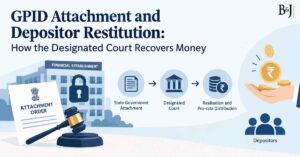
In short: On a depositor’s complaint the State Government attaches the establishment’s property by an order in the Official Gazette. The property vests immediately in a Competent Authority, who must move the Designated Court within thirty days, assess assets and liabilities, and invite claims. The court then confirms or varies the attachment, orders sale, and distributes the proceeds — proportionately, if there is not enough to go round.
Key Takeaways
- Attachment does not wait for conviction. The attachment provision creates no offence and no punishment; the civil and criminal tracks run independently.
- The one-month claim window is fatal if missed. A claim not filed within a month of the Competent Authority’s notice is not entitled to be paid under the Act.
- Third parties have a real remedy — an objection before the Designated Court, decided summarily, and the State must be able to connect the property to depositors’ money.
- Secured creditors have lost ground, but the Gujarat position is not identical to Maharashtra’s, and the point is open.
- Expect a proportion, not the whole. The statute assumes a shortfall and provides for pro-rata payment.
Step One: The Attachment Order
Under the Gujarat Protection of Interest of Depositors (in Financial Establishments) Act, 2003, the attachment process begins with administrative action rather than a judicial order. Where the State Government is satisfied, on receiving a complaint or otherwise, that a Financial Establishment has failed to return deposits, pay the assured benefit or provide the promised service, and is unlikely to fulfil its obligations, it may attach the establishment’s money, property and assets through an order published in the Official Gazette. The Government must record its reasons in writing before issuing the order (Section 4(1)). If the establishment’s assets are unavailable or insufficient, the attachment may also extend to the property of its promoter, director, partner or member.
Two aspects of GPID attachment proceedings are particularly important. First, a depositor may approach the district Collector with a complaint. The Collector must forward the complaint, along with a report, to the State Government and send a copy to the police for investigation (Section 4(3)). Second, publication of the attachment order has an immediate legal effect: the attached property forthwith vests in the Competent Authority, pending further orders of the Designated Court (Section 4(2)). This immediate vesting enables the authorities to secure the property without waiting for the criminal proceedings to conclude.
Step Two: GPID Attachment and the Designated Court’s Role
The Competent Authority — an officer not below the rank of Deputy Collector, appointed in the same order — may take physical possession of the attached property, requisition police assistance, appoint valuers and legal professionals, and realise assets, including by selling perishable goods immediately (Sections 5(1) and 6).
Under Section 5(3) of the GPID Act, the Competent Authority must apply to the Designated Court within thirty days of publication of the attachment order. The application must be supported by an affidavit setting out the grounds for attachment and identifying the property involved. The Designated Court is constituted at the level of a District and Sessions Judge, with the concurrence of the Chief Justice of the High Court. It has exclusive jurisdiction over matters entrusted to it under the Act, and proceedings pending before other courts concerning the same property stand transferred to it (Section 9).
Alongside the court application, the Authority must within thirty days assess the establishment’s assets, deposits and liabilities and file a statement, then issue notice — individually or by effective media publication — inviting depositors and secured creditors to submit claims with proof (s.7(1)–(2)).
The One-Month Rule
Section 7(3) is unforgiving: the notice must specify that if a statement of claim is not sent to the Competent Authority before the expiry of one month from the date of the notice, “the claims shall not be treated as claim entitled to be paid under the provisions of this Act”. A secured creditor who does not value his security within the same month is bound by the Authority’s own valuation (s.7(4)). Depositors who are waiting to see how the criminal case goes before making a claim are waiting in the wrong proceeding.
Step Three: Confirmation, Objection and the Third Party
On the Authority’s application the Designated Court issues notice to the establishment and to anyone whose property has been attached, to show cause why the attachment should not be made absolute (s.10(1)), and separately to all persons represented to it as likely to claim an interest or title (s.10(2)). Critically, a person claiming an interest may object “notwithstanding that no notice has been served upon him” (s.10(3)).
If no objection is made the court makes the attachment absolute and directs realisation and equitable distribution (s.10(4)). If cause is shown, it investigates under the summary procedure of Order 37 of the Code of Civil Procedure, exercising all the powers of a court hearing a suit; the objector must lead evidence that he had some interest in the property at the date of attachment (s.10(5)). The court may then confirm, release part, or cancel the attachment (s.10(6)) — but it may not release the establishment’s own interest unless enough remains attached to repay the depositors.
What the court is not doing at this stage was put well by the Madras High Court in P. Palanisamy v. District Revenue Officer-cum-Competent Authority, 2023 SCC OnLine Mad 6270: the special court must consider all objections and can exercise all the powers of a court deciding a civil suit, but it cannot adjudicate whether the person whose property is sought to be attached is guilty; and a non-accused’s property may still be attached. Attachment follows the money, not the charge-sheet.
That does not leave the innocent owner without an answer. In Seema Sharma v. State of Maharashtra (Bombay High Court, 21 July 2026), a house bought largely on a housing loan, standing in the name of a person against whom neither the investigation nor the forensic audit had found anything, was released — the Court holding that “in absence of any material establishing a nexus between the subject property and the investor’s funds, the attachment of the entire property cannot be sustained.” It also confirmed the correct route: an application under the Act itself, not a return application in the criminal case.
Step Four: Sale, Priority and Distribution
Once GPID attachment is absolute the Designated Court may direct sale by public auction or, where necessary, private sale, approve the statement of dues, finalise the list of depositors, and reach transferees who took the property otherwise than in good faith or for inadequate consideration (ss.11, 12). An owner may offer security in lieu of attachment (s.13), and the court may release funds for family maintenance and for the costs of defending the prosecution (s.14). Appeal lies to the High Court within thirty days (s.15).
The distribution provision is candid about what usually happens. Section 11(2)(e) empowers the court to order payment to depositors “or for proportionate payment to the depositors in the case where the moneys so realised is not sufficient to meet with the entire deposit liability”. A shortfall is the assumption, not the exception.
Where the Secured Creditor now Stands
The most significant recent development is National Spot Exchange Ltd. v. Union of India, 2025 INSC 694 (Supreme Court, 15 May 2025), arising from the Maharashtra Act. The Court held that the monies of defrauded depositors could not be said to be a “debt” contemplated by s.26E of the SARFAESI Act, and concluded “that no priority of interest can be claimed by the Secured Creditors against the properties attached under the MPID Act and that the provisions of MPID Act would override any claim for priority of interest by the Secured Creditors”. It rejected repugnancy with the Insolvency and Bankruptcy Code, holding that the statutes occupy distinct fields, and held that attached properties remained available for execution notwithstanding the s.14 moratorium. It also clarified that although the property vests in the Competent Authority, “such vesting would be subject to the orders passed by the Designated Court”.
Two qualifications keep this from being the end of the argument, and an article that omitted them would be misleading. First, the Bombay High Court in Seema Sharma expressly declined to enter the interaction between the State Act and the SARFAESI Act, deciding instead on absence of nexus — so the point is being kept open at High Court level. Second, and more importantly for Gujarat, the two statutes are not the same. The Gujarat Act expressly requires the Competent Authority to invite secured creditors’ claims and to value their security (s.7(2)–(4)); the Maharashtra Act has no equivalent. Whether reasoning built on a statute that ignores secured creditors transposes to one that provides for them is a live question.
Gujarat and Maharashtra Compared
| Gujarat Act, 2003 | Maharashtra Act, 1999 | |
|---|---|---|
| Attachment powers of the court | s.10 | s.7 |
| Appeal to the High Court | s.15 — 30 days | s.11 — 60 days |
| Secured creditors’ claims | Expressly invited and valued (s.7(2)–(4)) | No equivalent provision |
| Pro-rata distribution | Express power (s.11(2)(e)) | “Equitable distribution” only |
| Mala fide transferees | Not in good faith or for inadequate consideration (s.12) | Not in good faith and for consideration |
| Anticipatory bail | Excluded before the Designated Court (s.17(2)) | Not excluded |
Attachment and Acquittal — The Honest Position
A line of High Court authority holds the two tracks independent. The Bombay High Court in K.J. Anthony v. State of Maharashtra, 2019 SCC OnLine Bom 11664, observed that the attachment section “does not show any offence or any punishment” and that the offence and attachment provisions “are distinct and also operate independent of each other”; the Madras High Court in LCS Foundations v. J. Pattabiraman, 2022 SCC OnLine Mad 4396, held attachment, confirmation, sale and distribution to be independent of the result of the criminal proceedings; and the Orissa High Court in Braja Kishore Sumanta Pattnaik v. State of Odisha, 2022 SCC OnLine Ori 4243, described a fundamental difference between the two proceedings.
But this is High Court authority only. No State Act in this family provides for the return of attached property on acquittal, and the Supreme Court has not addressed what should happen when a prosecution fails after the property has been sold and distributed. Anyone told that “attachment survives acquittal” as settled law is being told more than the cases support.
What this Means for You
If you are a depositor: your complaint to the police and to the Collector is what starts the attachment machinery — it is not merely a criminal complaint. Then watch for the Competent Authority’s claim notice, in the newspapers if not by post, and file within one month with proof: receipts, bank statements, the MOU or deposit certificate. Recovery is proportionate, so the earlier property is traced and frozen, the larger everyone’s share.
If your property has been attached and you are not the accused: object before the Designated Court, and do it under the Act rather than by an application in the criminal case. You must show an interest in the property as at the date of attachment. The State should be put to proof of the link between the property and depositors’ money.
If you are a lender: file and value your security within the month. Do not assume your security interest survives the attachment automatically — the Supreme Court’s recent decision runs against secured creditors, and the counter-argument available in Gujarat depends on the statutory claims process you were invited to use.
Frequently Asked Questions
Does attachment require a conviction first?
No. Several High Courts hold that the attachment provision creates no offence and no punishment and that the two tracks run independently. The Supreme Court has not ruled on it, and no State Act provides for restoration on acquittal, so what follows an acquittal remains arguable.
How long does a depositor have to claim?
One month from the Competent Authority’s notice. A late claim is not entitled to be paid under the Act. This is the most common way a genuine depositor loses out.
My property is attached but I am not accused. What can I do?
Object before the Designated Court — you may do so even if no notice was served on you. Objections are decided summarily under Order 37 CPC and you must show an interest as at the date of attachment. Recent authority has released property where the State could show no nexus with depositors’ funds.
Can a bank enforce its mortgage over attached property?
In the Maharashtra context the Supreme Court has said no, because depositors’ money is not a “debt” under s.26E of the SARFAESI Act. Whether that transposes to Gujarat is open, because the Gujarat Act expressly provides for secured creditors’ claims.
Will depositors be repaid in full?
Usually not. The court is expressly empowered to order proportionate payment where the realisation falls short of the total deposit liability.
Glossary
- Provisional attachment — the freezing of property before any final adjudication, so that it cannot be sold or dissipated.
- Vesting — the transfer of control (not beneficial ownership) of the attached property to the Competent Authority, subject to the Designated Court’s orders.
- Competent Authority — the officer who takes possession, values, assesses claims and realises the assets.
- Designated Court — the special court, at District and Sessions Judge level, with exclusive jurisdiction over attachment, restitution and trial under the Act.
- Order 37 CPC — the Code’s summary procedure, used here so that objections are decided quickly rather than by a full trial.
Related Reading
- The GPID Act explained: a complete guide to depositor-protection law
- BUDS Act vs State deposit Act: which law applies?
- Is a real-estate builder a “financial establishment”?
- Trapped in a collapsed deposit or realty scheme? Your rights and remedies
Sources
- The Gujarat Protection of Interest of Depositors (in Financial Establishments) Act, 2003 (Gujarat Act 1 of 2004) — bare text, India Code.
- National Spot Exchange Ltd. v. Union of India, 2025 INSC 694 (Supreme Court, 15 May 2025).
- State of Maharashtra v. 63 Moons Technologies Ltd., (2022) 9 SCC 457 : 2022 INSC 465 — judgment.
- Seema Sharma v. State of Maharashtra, Criminal Appeal No. 86 of 2022 (Bombay High Court, 21 July 2026).
- P. Palanisamy v. District Revenue Officer-cum-Competent Authority, 2023 SCC OnLine Mad 6270.
- LCS Foundations v. J. Pattabiraman, 2022 SCC OnLine Mad 4396.
- K.J. Anthony v. State of Maharashtra, 2019 SCC OnLine Bom 11664.
- Braja Kishore Sumanta Pattnaik v. State of Odisha, 2022 SCC OnLine Ori 4243.
- K.K. Baskaran v. State, (2011) 3 SCC 793.

Advocate Aaditya Bhatt
Senior Standing Counsel Income Tax Department, Advocate Gujarat High Court. Aaditya combines his technical and legal expertise to deliver strategic counsel in litigation, constitutional, and regulatory matters. He represents clients before High Courts and Tribunals with a technology-driven approach.