 Whatsapp


Challenging an Income-Tax Assessment: The CIT(A)/NFAC Appeal, the ITAT and the High Court
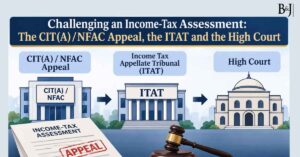
Every contested income-tax demand in India runs the same three-stage income tax appeal ladder – first to the Commissioner (Appeals) or, for most taxpayers today, the faceless National Faceless Appeal Centre, then to the Income Tax Appellate Tribunal, and finally, only on a genuine question of law, to the High Court. What has changed is the statute underneath it: the Income-tax Act 2025 has replaced the 1961 Act from 1 April 2026, renumbering the appeal provisions and changing at least one limitation period along the way, while a savings clause keeps older pending appeals running on the old rules. This guide sets out the ladder as it now stands, stage by stage, including how a stay of recovery is actually obtained while an appeal is pending.
In short: An income-tax appeal runs from the Joint Commissioner/Commissioner (Appeals) or NFAC, to the Income Tax Appellate Tribunal on Form 115, to the High Court on a substantial question of law. Since 1 April 2026 this ladder sits in the Income-tax Act 2025, though appeals already pending when the new Act commenced continue under the 1961 Act’s own procedure.
Key Takeaways
- The Income-tax Act 2025 has governed new appeals since 1 April 2026; an appeal or proceeding already pending on that date continues under the 1961 Act until it is finally disposed of.
- The first appeal must be filed within thirty days of the order or demand notice, ordinarily only after tax on the returned income has been paid.
- The appeal to the Tribunal now runs on Form 115, not the familiar Form 36, and the limitation wording has changed to two months from the end of the month of communication.
- A High Court appeal is available only on a substantial question of law – it is not a second review of the facts, and the Tribunal’s findings are ordinarily final unless perverse.
- A stay of recovery is available at every stage but is discretionary and usually conditional on a part-deposit – commonly cited today at around twenty per cent of the disputed demand, subject to genuine hardship being shown.
The Law that Now Governs your Appeal: The 2025 Transition
The Income-tax Act 2025 received Presidential assent in August 2025 and has been in force from 1 April 2026, replacing the Income-tax Act 1961. This is not a cosmetic renumbering exercise for a taxpayer mid-appeal: it changes the section a lawyer cites, and in at least one important respect – the limitation period for appealing to the Tribunal – it changes the rule itself. A savings provision in the new Act preserves continuity for work already in progress: an appeal or other proceeding pending before the CIT(A)/NFAC or the Tribunal on 1 April 2026 continues to be governed by the 1961 Act’s procedure through to its disposal, and no limitation period that had already expired under the old Act is revived by the change of statute. In practical terms, an assessee should ask a simple date-based question before doing anything else: was the order under challenge passed before or after 1 April 2026? An order predating that cut-off is very likely to travel on the 1961 Act’s own provisions and forms; an order passed after it falls to be appealed under the 2025 Act, with its new section numbers, its new Form 115, and its new limitation wording.
Step one: The First Appeal to the Joint Commissioner (Appeals), the Commissioner (Appeals), or NFAC
The appeal begins with the same order that always triggered it – most commonly an assessment order raising a demand, though a list of other orders (penalty, rectification refusal, and others) is also appealable. Under the 1961 Act this sat in section 246A, with the mechanics of filing in section 249 and the appellate procedure in section 250; the 2025 Act carries the same structure forward as appealable orders before the Joint Commissioner (Appeals) or Commissioner (Appeals), the filing mechanics, and the procedure in appeal. The limitation period remains thirty days from service of the notice of demand or the order, condonable for sufficient cause, and the appeal is not ordinarily entertained unless the tax due on the income actually returned has been paid – a precondition that protects the exchequer’s basic recovery position even while the dispute over the balance is heard, though it can be relaxed by the appellate authority on a written application showing good reason. Since 2021, most of these first appeals have been processed on a faceless basis through the National Faceless Appeal Centre, removing routine person-to-person contact between the taxpayer and the officer deciding the appeal. That faceless architecture is expected to continue in substance under the new Act’s general power to design technology-driven, interface-free schemes, though readers should confirm the exact scheme in force for their appeal year before assuming automatic continuity of every procedural detail. The Joint Commissioner/Commissioner (Appeals) has wide powers at this stage – going well beyond simply confirming or cancelling the assessment – which are examined in their own right further below.
Step Two: The Appeal to the Income Tax Appellate Tribunal
An order of the first appellate authority that still leaves either side aggrieved can be carried to the Income Tax Appellate Tribunal – the final fact-finding body in the hierarchy. Under the 1961 Act this appeal was filed on Form 36 within sixty days of communication of the order; under the 2025 Act, the form has changed to Form 115, and the limitation period is now expressed differently – within two months from the end of the month in which the order is communicated, which in most fact patterns gives an appellant a little more running room than the old flat sixty-day count, though the two should not be assumed identical in every case. A cross-objection can still be filed by the other side within thirty days of notice of the appeal. The Tribunal’s own powers on disposal are broad: it may pass such orders as it thinks fit after giving both sides a hearing, and it retains the power to rectify a mistake apparent from the record – a power now capped, as it has been since a 2016 amendment to the 1961 Act, at six months from the end of the month in which the order was passed, a limitation the new Act appears to carry forward without extending it.
Getting a Stay from the Tribunal Itself
Where recovery is pressing, the Tribunal can grant its own stay of the disputed demand, ordinarily for up to one hundred and eighty days at a time and extendable, on the Tribunal’s satisfaction that the delay in disposing of the appeal is not attributable to the assessee, to an aggregate outer limit of three hundred and sixty-five days – conditional, as a rule, on the assessee depositing at least twenty per cent of the disputed demand or furnishing equivalent security. The requirement that the stay must lapse automatically once the outer limit is reached, whatever the reason for the delay, was itself curtailed by the Supreme Court in 2021: in DCIT v. Pepsi Foods Ltd. (Civil Appeal No. 1106 of 2021, decided 6 April 2021) the Court struck down the words making automatic vacation of the stay apply “even if the delay in disposing of the appeal is not attributable to the assessee,” holding that an assessee who has done nothing to cause the delay cannot be made to suffer coercive recovery purely because the Tribunal’s own list is congested. A diligent assessee, in other words, should not assume that crossing the 365-day mark automatically exposes it to recovery – the reason for the delay still matters.
Step Three: The High Court, and Only on a Substantial Question of Law
The final ordinary avenue is an appeal to the jurisdictional High Court – under the 1961 Act, section 260A; carried forward in the 2025 Act in materially the same terms. The right to appeal is deliberately narrow: an appeal lies only “if the High Court is satisfied that the case involves a substantial question of law,” available to either the Revenue or the assessee, within one hundred and twenty days of the Tribunal’s order (condonable), and the memorandum of appeal must precisely state the question of law said to arise. The classical test for what makes a question “substantial” comes from the Supreme Court’s decision in Sir Chunilal V. Mehta & Sons Ltd. v. Century Spinning & Manufacturing Co. Ltd. (AIR 1962 SC 1314): a substantial question is one of general public importance, or one that directly and substantially affects the rights of the parties, that has not already been finally settled by the Supreme Court or a comparable court, that is not free from difficulty, or that calls for a discussion of alternative views – and it excludes a question already settled by binding authority or one that is merely fanciful. Applying that test specifically to tax appeals, the Supreme Court in Vijay Kumar Talwar v. CIT ((2011) 330 ITR 1) confirmed that the High Court’s jurisdiction under this provision is confined to the substantial questions it frames, that the Tribunal is the final fact-finding authority in the hierarchy, and that its findings of fact are not ordinarily disturbed unless they are perverse or based on no evidence at all. Once the High Court has formulated the question, the hearing is ordinarily confined to it, though the Court retains a discretion, for reasons it must record, to hear the appeal on a question not originally formulated, and it may also decide any issue that the Tribunal failed to determine or decided wrongly. The Code of Civil Procedure 1908 applies to these appeals as far as it can.
How Much Power does an Appellate Authority Actually Have?
A recurring, and genuinely doctrinal, question through all three stages is how far an appellate authority can go beyond the specific point the taxpayer originally raised. The Supreme Court has, over several decades, described the first appellate authority’s powers as co-extensive with the Assessing Officer’s own – it can do what the Assessing Officer could have done and can also direct him to do what he failed to do (CIT v. Kanpur Coal Syndicate, (1964) 53 ITR 225 (SC)) – and has allowed both the first appellate authority and the Tribunal to entertain an entirely new legal ground, or even a fresh claim, that was never raised before the Assessing Officer, so long as the relevant facts are already on the record (Jute Corporation of India Ltd. v. CIT, (1991) 187 ITR 688 (SC); National Thermal Power Co. Ltd. v. CIT, (1998) 229 ITR 383 (SC)) and even, in an appropriate case, to grant relief on such a ground without the appellant having asked for it at all (CIT v. Mahalakshmi Textile Mills Ltd., (1967) 66 ITR 710 (SC)). That power is not unlimited, however: a Full Bench of the Delhi High Court in CIT v. Sardari Lal & Co. ((2001) 251 ITR 864) held that the first appellate authority, however wide its powers over the subject matter the Assessing Officer actually considered, cannot travel outside that assessment altogether to bring an entirely new source of income to tax for the first time in appeal – that step belongs to reassessment, not appeal. Read together, the assessee gets real latitude to perfect a legal argument on appeal; the Revenue does not get a free-standing power, at the appellate stage, to go hunting for income the original assessment never touched.
Stay of Recovery before the First Appeal is Even Decided
An assessee does not have to wait for the CIT(A)/NFAC to decide the appeal before seeking relief from recovery. The Assessing Officer has long had a discretionary power – section 220(6) under the 1961 Act – to treat the assessee as not “in default” for the disputed amount while the first appeal is pending, and the exercise of that discretion has been shaped less by the bare section than by the Central Board of Direct Taxes’ own administrative guidance. The Bombay High Court’s decision in KEC International Ltd. v. B.R. Balakrishnan ((2001) 251 ITR 158) is still the standard reference on how that discretion should be exercised: the officer must record, in brief, the assessee’s case for a stay; must specifically consider whether the assessed income is so much higher than the returned income that unconditional stay – or only a part-deposit – is warranted; must genuinely examine a plea of financial hardship where one is raised; and must not take coercive recovery steps while the statutory period for filing the appeal is still running. A CBDT office memorandum of 29 February 2016 fixed the benchmark deposit at fifteen per cent of the disputed demand as a general norm, later revised upward, and the figure now commonly applied by field officers – and now also appearing as the Tribunal’s own statutory deposit threshold at the next stage – is twenty per cent. None of this is a rigid formula: a genuinely strong prima facie case, or genuine and demonstrated hardship, can justify a lower figure or no deposit at all, and a taxpayer who simply asks for “a stay” without addressing these specific parameters in writing is not making the case the guidance itself asks for.
The Move to Paperless Filing
Alongside the change of statute, the Tribunal’s own procedural rules have been substantially digitised. A notification amending the Appellate Tribunal Rules, issued in December 2025, made the digital signing of the memorandum of appeal mandatory, requires appeals to be e-filed rather than physically lodged in multiple paper copies, makes an email address and mobile number compulsory for service of notices, and prescribes the specific annexures – such as the draft assessment order, a transfer-pricing officer’s order, or Dispute Resolution Panel directions, where relevant – that must accompany the digitally-filed memorandum. The same regime now extends to applications for stay and other miscellaneous applications before the Tribunal. The change is procedural rather than substantive, but a defectively-filed or non-compliant appeal can still be treated as no appeal at all, so the formal filing requirements deserve the same attention as the substantive grounds.
Balance: Neither Side has it Easy
The appellate architecture is not tilted as one-sidedly as either an aggrieved taxpayer or a revenue officer might assume in the moment. In the assessee’s favour: the Supreme Court has read down the automatic, no-questions-asked lapse of a Tribunal stay at the 365-day mark where the assessee is not to blame for the delay (Pepsi Foods); the appellate authorities’ coextensive and plenary powers let a genuinely meritorious legal point be raised late without being lost on a technicality (Jute Corporation, NTPC, Mahalakshmi Textile Mills); and a long-standing, periodically revised CBDT policy on monetary limits means the Department does not, as a matter of settled practice, pursue a further appeal – to the Tribunal, the High Court or beyond – merely because it disagrees with a low-value order, sparing many small taxpayers a fight the tax effect does not justify. In the Revenue’s favour: the first appeal cannot even be filed, save in a case of relaxation, without paying tax on the income actually returned; the co-extensive powers of the first appellate authority stop well short of letting it hunt for an entirely new source of income never considered in the original assessment (Sardari Lal); the High Court’s jurisdiction is deliberately confined to genuine questions of law, so a taxpayer cannot use a section 260A-type appeal to reopen findings of fact that went against it (Vijay Kumar Talwar); and any stay of recovery, at either the assessing or the Tribunal stage, still comes at a real price – ordinarily a twenty per cent deposit or equivalent security – so an appeal, even a strong one, rarely buys an assessee a complete, cost-free pause on recovery.
What this Means for You
- Work out first whether your order was passed before or after 1 April 2026 – that decides whether the 1961 Act or the 2025 Act, and which forms and limitation periods, apply to your appeal.
- File the first appeal within thirty days and pay the tax on your returned income before or with it, unless you have a genuine reason to ask for that condition to be relaxed in writing.
- If you are appealing to the Tribunal, use Form 115, and calendar the “two months from the end of the month of communication” limitation carefully – it is not simply “sixty days” any more.
- Do not treat a High Court appeal as a chance to re-argue the facts. Frame a genuine question of law, or the appeal is unlikely to even be admitted.
- If recovery is pressing, ask for a stay in writing and address the specific parameters – your prima facie case, the gap between assessed and returned income, and any real financial hardship – rather than simply requesting “a stay.”
Frequently Asked Questions
Which law now governs an income-tax appeal – the 1961 Act or the 2025 Act?
The Income-tax Act 2025 has been in force since 1 April 2026. A savings provision keeps appeals and proceedings that were already pending under the 1961 Act running under the 1961 Act’s own procedure until they are disposed of. A fresh appeal against an order passed on or after 1 April 2026 follows the 2025 Act.
How long do I have to file a first appeal against an assessment order?
Thirty days from the date of service of the notice of demand or the order, whether the appeal is filed under the 1961 Act’s section 249 or its 2025 Act successor, and the appellate authority can condone a delay for sufficient cause. The appeal is not ordinarily entertained unless tax on the income returned has been paid, though this condition can be relaxed on a written application.
What form is used to appeal to the Income Tax Appellate Tribunal now?
Form 115 has replaced the familiar Form 36 for appeals filed under the Income-tax Act 2025. The limitation period has also changed in wording, from a flat sixty days under the old Act to two months from the end of the month in which the order is communicated under the new one.
When can the High Court be approached against an ITAT order?
Only where the High Court is satisfied the case involves a substantial question of law – not merely a disagreement with the Tribunal’s view of the facts. The appeal must be filed within one hundred and twenty days, precisely state the question of law, and the hearing is ordinarily confined to the question the High Court itself formulates.
Can recovery be stayed while my first appeal is pending?
Yes, on a written application, though the decision is discretionary. Guidance from the Central Board of Direct Taxes has long anchored the amount an assessee must ordinarily deposit as a condition of stay – fifteen per cent under a 2016 office memorandum, and the figure now commonly applied is twenty per cent – while leaving room for a lower or nil deposit where genuine financial hardship or a strong prima facie case is shown.
Can the Tribunal grant a stay, and for how long?
Yes. The Tribunal can stay recovery for up to one hundred and eighty days at a time, extendable to an aggregate of three hundred and sixty-five days, ordinarily conditional on depositing at least twenty per cent of the disputed demand or furnishing equivalent security. The Supreme Court has held that an automatic lapse of the stay at the outer limit cannot apply where the delay in deciding the appeal is not the assessee’s fault.
Glossary
- CIT(A) / JCIT(A) — Commissioner (Appeals) or Joint Commissioner (Appeals): the first appellate authority above the Assessing Officer.
- NFAC — National Faceless Appeal Centre, through which most first appeals are processed without direct officer-to-taxpayer contact.
- ITAT — Income Tax Appellate Tribunal, the second and final fact-finding appellate authority.
- Substantial question of law — the narrow gateway through which a High Court appeal is admitted; not available merely to re-argue findings of fact.
- Stay of demand — an order keeping recovery of a disputed tax demand in abeyance while an appeal is pending, usually on a part-deposit or security.
Coming next in this series
- Section 194Q TDS and the section 40(a)(ia) disallowance — when late deduction costs thirty per cent, and the routes back from it.
- Appealing to the ITAT after 1 April 2026 — a closer look at which Act, which form and which limitation period applies to an order under the 1961 Act decided after the transition.
Sources
- Income-tax Act, 2025 (Act 30 of 2025) — Income Tax Department; CBDT’s transition FAQs on the Income-tax Act 2025.
- Income-tax Act 1961, sections 246A, 249, 250, 251, 253, 254, 260A (as they stood before 1 April 2026) — India Code.
- Form 115 — Guidance Note and FAQs, Income Tax Department — incometaxindia.gov.in.
- Appellate Tribunal (Amendment) Rules 2025, Notification No. 71-Ad(AT)/2025, 19 December 2025.
- CBDT Office Memorandum F. No. 404/72/93-ITCC, 29 February 2016.
- DCIT v. Pepsi Foods Ltd., Civil Appeal No. 1106 of 2021, Supreme Court of India, decided 6 April 2021.
- KEC International Ltd. v. B.R. Balakrishnan, (2001) 251 ITR 158 (Bombay High Court), decided 31 May 2001.
- Sir Chunilal V. Mehta & Sons Ltd. v. Century Spinning & Manufacturing Co. Ltd., AIR 1962 SC 1314.
- Vijay Kumar Talwar v. CIT, (2011) 330 ITR 1 (Supreme Court of India).
- CIT v. Kanpur Coal Syndicate, (1964) 53 ITR 225 (Supreme Court of India).
- Jute Corporation of India Ltd. v. CIT, (1991) 187 ITR 688 (Supreme Court of India).
- National Thermal Power Co. Ltd. v. CIT, (1998) 229 ITR 383 (Supreme Court of India).
- CIT v. Mahalakshmi Textile Mills Ltd., (1967) 66 ITR 710 (Supreme Court of India).
- CIT v. Sardari Lal & Co., (2001) 251 ITR 864 (Delhi High Court, Full Bench).

Advocate Aaditya Bhatt
Senior Standing Counsel Income Tax Department, Advocate Gujarat High Court. Aaditya combines his technical and legal expertise to deliver strategic counsel in litigation, constitutional, and regulatory matters. He represents clients before High Courts and Tribunals with a technology-driven approach.