 Whatsapp


GST Show Cause Notice Reply: How to Seek Time, Relied-Upon Documents and a Personal Hearing
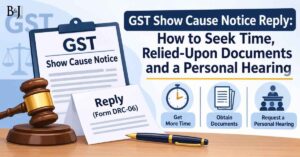
A GST show cause notice is not a verdict, but it is the document on which the final demand will be built, and what you do in the weeks after receiving it largely decides whether that demand survives. A good GST show cause notice reply does three things besides answering the allegations: it secures enough time, it obtains the papers the officer relies on, and it puts a request for a personal hearing on the record. This guide explains each, and the limits of what the courts have been willing to do for a taxpayer who is not given them.
In short: A GST show cause notice (Form GST DRC-01, with its summary) is issued under section 73, 74 or 74A of the CGST Act to call upon a person to explain why tax, interest and penalty should not be demanded. The reply is filed in Form DRC-06. Section 75 governs hearings, adjournments and the final order.
What this Means for You
Do not treat the portal date as the only deadline. Read the notice at once, note the date you actually saw it, and write to the officer in the first few days asking for the documents and for time if you need it. Say clearly, in your GST show cause notice reply, that you want a personal hearing. Keep copies and proof of every request.
Key Takeaways
- Which section applies depends on the period: sections 73 and 74 for periods up to FY 2023-24, and section 74A for FY 2024-25 onwards.
- Section 75(4) gives a right to a hearing on written request, or where an adverse decision is contemplated; section 75(5) permits at most three adjournments, each for sufficient cause with reasons recorded.
- An order cannot demand more than the notice, or rest on grounds the notice does not state (section 75(7)), and it must set out the facts and the basis of the decision (section 75(6)).
- Gujarat High Court has repeatedly set aside orders passed without a proper hearing, but it has also declined to interfere where the complaint was about incomplete documents and left the taxpayer to appeal.
- Always ask in writing, and ask early: the request is what turns a later complaint into a provable one.
Which Provision is the Notice Under?
Three provisions can sit behind a show cause notice. Section 73 deals with tax not paid, short paid or wrongly refunded or credited for reasons other than fraud, wilful misstatement or suppression. Section 74 covers the same where fraud, wilful misstatement or suppression is alleged. For periods from FY 2024-25 onwards, both are replaced by section 74A, inserted by the Finance (No. 2) Act 2024, which treats the two cases in a single provision; sections 73 and 74 continue to govern earlier periods.
The difference matters in three ways. A fraud allegation raises the penalty and extends the time the department has. Under section 74A the notice is to be issued within 42 months of the due date of the annual return, the order is due within twelve months of the notice (extendable by up to six months on written reasons recorded before the period expires), and the penalty for a non-fraud case is ten per cent of the tax or Rs 10,000, whichever is higher, against one hundred per cent where fraud, wilful misstatement or suppression is established. And a section 74 allegation must be pleaded with particulars, which is often the first line of defence.
Many notices are preceded by an intimation of the tax ascertained, in Form DRC-01A, which gives the taxpayer a chance to pay or explain before a notice is issued. The notice itself is accompanied by a summary in DRC-01, the reply is in DRC-06, and the order is summarised in DRC-07 (rule 142 of the CGST Rules). A DRC-01 summary is a summary only: the Jharkhand High Court has held that it cannot stand in place of the notice required by section 74(1) (Juhi Industries (P.) Ltd. v. State of Jharkhand, [2022] 141 taxmann.com 416 (Jhar)).
How do I Get more Time to Reply a GST show cause notice?
Time is the least contested of the three requests but the easiest to lose by delay. Write to the proper officer before the reply date, state the specific reason (volume of records, a pending reconciliation, the date on which the notice actually came to your attention), propose a defined period, and obtain an acknowledgement. A timely reply to GST show cause notice should explain why additional time is needed and preserve the taxpayer’s request for a fair opportunity to respond.
Section 75(5) is the statutory hook: the officer may grant adjournments of a hearing if sufficient cause is shown, must record the reasons in writing, and may not grant more than three to any person. That is a ceiling on adjournments of hearings, not a general entitlement to extension of the reply date, so frame the request in terms of the reasons and, where possible, ask also for a hearing date that falls after the documents are supplied.
Service is a related point. Where a notice has been uploaded only under the “Additional Notices/Orders” tab of the portal, the Delhi High Court has held that this is not sufficient service under section 169 (Neeraj Kumar v. Proper Officer, SGST Ward-19, [2024] 164 taxmann.com 685 (Del)), and the Gujarat High Court has set aside an order where the notice was misplaced under that tab and no hearing was held (Viswaat Chemicals Ltd. v. Sales Tax Officer, [2025] 173 taxmann.com 419 (Guj)). If that is how you came to know of the notice, say so, with dates, in the first letter.
How do I Get the Documents the Department Relies On?
The principle is uncontroversial: a notice must say what is alleged and on what, and an authority issuing it must keep an open mind. The Supreme Court has said that a notice must not read as though the matter were already decided (Oryx Fisheries Pvt. Ltd. v. Union of India, (2010) 13 SCC 427) and, in a blacklisting case, that it must state the grounds and the proposed action so that the person can respond (Gorkha Security Services v. Govt. (NCT of Delhi), (2014) 9 SCC 105). Section 75(7) carries the same idea into GST: the order cannot go beyond the notice.
In practice, list every document the notice or its annexures mention, and every document you suspect the officer has (third-party statements, supplier data, investigation records), and ask for them by description. Ask also for the complete notice with all annexures, since pages missing from the upload are a common complaint. Put the request in a separate letter, and repeat it in the DRC-06 reply.
The Honest Limit
Taxpayers should not assume that a missing document, without more, defeats the demand. In one 2026 matter the Gujarat High Court declined to interfere in a challenge to a notice, an order and a recovery summary where it was argued that only part of the notice and some relied-upon documents had been supplied, finding no breach of natural justice and leaving the facts to the appellate authority; the Supreme Court declined to interfere, allowed four weeks to file a section 107 appeal and kept all contentions open (Shivani Enterprise v. Union of India, SLP (C) No. 27455 of 2026, order of 17 August 2026). That is not a ruling on the merits, but it shows the practical value of making the request early and in writing, so that the appeal record shows exactly what was asked and when. Older authority points the same way: where no prejudice is shown and a later hearing cures the defect, courts are reluctant to intervene (Canara Bank v. Debasis Das, decided 12 March 2003).
What is the Right to a Personal Hearing under Section 75(4)?
Section 75(4) says an opportunity of hearing shall be granted where a request is received in writing from the person chargeable with tax, or where any adverse decision is contemplated against such person. Section 75(6) requires the order to set out the relevant facts and the basis of the decision.
The Gujarat High Court has enforced these provisions in a series of decisions. In K D Engineers v. Assistant Commissioner, R/SCA No. 16344 of 2025 (Division Bench), an order of August 2025 was quashed and remitted because requests for a personal hearing had been ignored and an additional reply was not considered. In Maheshwari Logistics Ltd. v. State of Gujarat, [2024] 168 taxmann.com 384 (Guj), a notice worded like a final order and issued without a section 75(4) hearing was quashed and the matter remanded. In Aarya Metals v. State of Gujarat, R/SCA No. 7535 of 2026, reported in October 2026, a section 74 order was quashed because the date, time and venue of a hearing were never communicated, the order was non-speaking and the hearings contemplated by the section were not given; the court is reported to have treated the portal option of declining a hearing in the DRC-06 reply as not defeating the section 75(4) right.
The Delhi High Court has taken a similar line when an assessee had not been heard, setting an order aside and directing a reply, a personal hearing and a reasoned order (Padam Kishore & Co. v. Union of India, W.P.(C) 19726/2025, 24 December 2025).
Two cautions follow. First, the usual relief is a remand for a fresh order, not the end of the demand. Second, the point must be preserved: do not leave the hearing option on the portal as “No”, and say expressly in the reply that you wish to be heard and that you rely on section 75(4).
When Can a High Court be Approached Directly?
The existence of a statutory appeal under section 107 does not by itself bar a writ. The Supreme Court allows one where there is a breach of natural justice, an absence of jurisdiction, a violation of a fundamental right or a challenge to the vires of a provision (Whirlpool Corporation v. Registrar of Trade Marks, (1998) 8 SCC 1, para 15; applied to a GST attachment in Radha Krishan Industries v. State of Himachal Pradesh, (2021) 6 SCC 771). Courts apply this sparingly to show cause notices: a challenge that merely disputes the facts, or complains of a defect that can be cured at the hearing, is likely to be answered with a direction to reply.
Older periods carry one further point. Limitation for notices and orders relating to FY 2017-18 to 2019-20 was extended by Notification Nos. 9/2023-Central Tax and 56/2023-Central Tax. High Courts have reached different results on their validity: the Gauhati and Madras High Courts struck down one or both, while the Telangana and Patna High Courts upheld them, and the matter is reported to be pending before the Supreme Court. If a notice for those years depends on the extension, reserve the point in the reply. The waiver scheme under section 128A for those years, which waived interest and penalty on payment of the tax, had an application window that closed on 30 June 2025, and no extension has been located.
A Practical Sequence
- Day 1-3: Note the date and manner in which the notice came to your attention. Download the notice with every annexure.
- Within the first week: Send a letter asking for the relied-upon documents and, if needed, a reasoned request for time.
- Before the reply date: File DRC-06 with the substantive reply, an express request for a personal hearing, and a reservation of the rights to supplement the reply once documents are supplied.
- At the hearing: Attend with written submissions; ask for the date, time and venue of any adjourned hearing in writing.
- If the order is adverse: Check it against the notice (section 75(7)), the reasons (section 75(6)) and the hearing record, and consider the section 107 appeal.
FAQ
Can I ask for more time to reply to a GST show cause notice?
Yes. Write to the proper officer before the reply date, giving specific reasons, and keep proof of the request. Section 75(5) allows adjournments of a hearing for sufficient cause, with reasons recorded in writing, but not more than three times for a person. Ask for a defined period.
Am I entitled to a personal hearing before a GST demand order is passed?
Section 75(4) requires a hearing where a request is received in writing, or where an adverse decision is contemplated. Orders passed without a hearing have been set aside and sent back by the Gujarat High Court.
What if I ticked “No” to a personal hearing in the DRC-06 reply?
In a decision reported in October 2026, the Gujarat High Court treated the portal option as not defeating the section 75(4) hearing. Do not rely on that: make an express written request for a hearing in the reply.
Can I insist on copies of the documents the department relies on?
You can and should ask in writing, document by document. The law is less helpful on the consequence of a refusal: the Gujarat High Court declined to interfere in one 2026 matter and the Supreme Court sent the taxpayer to the statutory appeal. An early request builds the record for that appeal.
Can I go straight to the High Court against a show cause notice?
A writ is possible but narrow: natural justice, absence of jurisdiction or vires. Courts usually tell the taxpayer to reply and, if necessary, appeal under section 107.
Glossary
- DRC-01 / DRC-01A
- The notice summary served with a show cause notice, and the pre-notice intimation of tax ascertained.
- DRC-06
- The taxpayer’s reply to a show cause notice on the portal.
- Relied-upon documents
- Papers, statements and data on which the department bases the allegations.
- Proper officer
- The officer authorised to issue the notice and decide the case.
Related Reading
- Cluster guide: Facing a GST/DGGI Investigation: A Business Guide to Summons, ITC Notices and Defence
- Replying to an ASMT-10 for Excess ITC: Step by Step
- Detained Perishable Imports: Section 110 Customs, Re-testing and Provisional Release
Sources
- Central Goods and Services Tax Act 2017, sections 73, 74, 74A (inserted by the Finance (No. 2) Act 2024), 75, 107, 128A, 168A and 169; Central Goods and Services Tax Rules 2017, rule 142. India Code; CBIC.
- Notification Nos. 9/2023-Central Tax and 56/2023-Central Tax (extension of limitation under section 168A).
- Oryx Fisheries Pvt. Ltd. v. Union of India, (2010) 13 SCC 427 (Supreme Court).
- Gorkha Security Services v. Govt. (NCT of Delhi), (2014) 9 SCC 105 (Supreme Court).
- Whirlpool Corporation v. Registrar of Trade Marks, (1998) 8 SCC 1 (Supreme Court).
- Radha Krishan Industries v. State of Himachal Pradesh, (2021) 6 SCC 771 (Supreme Court).
- Canara Bank v. Debasis Das, decided 12 March 2003 (Supreme Court).
- Shivani Enterprise v. Union of India, SLP (C) No. 27455 of 2026, order of 17 August 2026 (Supreme Court), arising from the Gujarat High Court.
- K D Engineers v. Assistant Commissioner, R/SCA No. 16344 of 2025; Maheshwari Logistics Ltd. v. State of Gujarat, [2024] 168 taxmann.com 384 (Guj); Viswaat Chemicals Ltd. v. Sales Tax Officer, [2025] 173 taxmann.com 419 (Guj); Aarya Metals v. State of Gujarat, R/SCA No. 7535 of 2026 (Gujarat High Court).
- Neeraj Kumar v. Proper Officer, SGST Ward-19, [2024] 164 taxmann.com 685 (Delhi); Padam Kishore & Co. v. Union of India, W.P.(C) 19726/2025, 24 December 2025 (Delhi High Court).
- Juhi Industries (P.) Ltd. v. State of Jharkhand, [2022] 141 taxmann.com 416 (Jharkhand).

Advocate Aaditya Bhatt
Senior Standing Counsel Income Tax Department, Advocate Gujarat High Court. Aaditya combines his technical and legal expertise to deliver strategic counsel in litigation, constitutional, and regulatory matters. He represents clients before High Courts and Tribunals with a technology-driven approach.