 Whatsapp


Insolvency of a GIFT IFSC Entity: Who Is a “Corporate Person”, and What Happens If No One Is
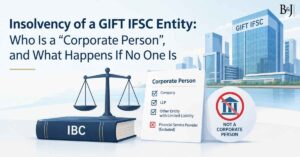
A lender dealing with a company in GIFT IFSC needs to know what happens if the borrower defaults. The obvious answer is the Insolvency and Bankruptcy Code, 2016 (IBC), but it may not apply. The Code excludes financial service providers from the ordinary corporate insolvency process, raising an important question about GIFT IFSC insolvency: what remedies are available to creditors when the usual insolvency route is closed?
The Exclusion Built into the Code
The Code applies its corporate insolvency resolution process to a corporate debtor, which is a corporate person who owes a debt. Section 3(7) defines a corporate person as a company under the Companies Act, an LLP, or any other person incorporated with limited liability under any law — “but shall not include any financial service provider“.
Section 3(17) defines a financial service provider as a person engaged in the business of providing financial services in terms of an authorisation issued or registration granted by a financial sector regulator. Section 3(16) defines “financial service” by an inclusive list that covers, among other things, accepting deposits; safeguarding and administering assets consisting of financial products; effecting contracts of insurance; offering or managing assets consisting of financial products belonging to another; advising on or soliciting the buying or selling of a financial product; establishing or operating an investment scheme; maintaining or transferring records of ownership of a financial product; underwriting; and providing payment services.
Section 3(18) defines a financial sector regulator as “an authority or body constituted under any law for the time being in force to regulate services or transactions of financial sector”, and includes RBI, SEBI, IRDAI, PFRDA “and such other regulatory authorities as may be notified by the Central Government”.
The NCLAT applied this chain in Nitin Pannalal Shah v. Vipul H. Raja (14 September 2023), holding that a SEBI-registered stock broker is a financial service provider, that section 3(16)(e) is an inclusive definition, and that a section 7 application against such an entity is not maintainable.
Applying the Chain to an IFSC Entity
The IFSCA is constituted under the IFSCA Act, 2019, to regulate financial products, financial services and financial institutions in an International Financial Services Centre (IFSC). Although no notification expressly adding the IFSCA to Section 3(18) of the Insolvency and Bankruptcy Code, 2016 (IBC) has been traced, the provision defines a financial sector regulator in broad terms and lists the RBI, SEBI, IRDAI and PFRDA as included authorities rather than an exhaustive list. On this interpretation, the IFSCA may fall within the definition of a financial sector regulator for GIFT IFSC insolvency purposes.
If this interpretation is accepted, an IFSC banking unit, finance company, fund management entity, capital market intermediary, insurance intermediary or payment service provider holding an IFSCA authorisation and carrying on an activity covered by Section 3(16) may qualify as a financial service provider (FSP) and consequently fall outside the definition of a corporate person under Section 3(7). This distinction has three important implications for insolvency proceedings and creditor recovery in GIFT IFSC:
Corporate insolvency resolution process (CIRP): Applications under Sections 7 and 9 of the IBC would generally be unavailable against an entity excluded from the definition of a corporate person.
Liquidation under the IBC: The Code’s ordinary corporate liquidation process would likewise not apply to such an entity.
Voluntary liquidation: Section 59 of the IBC is available only to a corporate person. A solvent IFSC entity falling within the exclusion would therefore need to consider the applicable winding-up provisions under the Companies Act, 2013, rather than rely on Section 59.
The Gateway that Has Barely Been Opened
Section 227 is the safety valve. It permits the Central Government, in consultation with the appropriate financial sector regulators, to notify financial service providers or categories of them for insolvency and liquidation proceedings under the Code, conducted in such manner as may be prescribed. The FSP Rules, 2019 supply that manner: the appropriate regulator applies to the Adjudicating Authority and proposes an Administrator who exercises the powers of an insolvency professional, an advisory committee may be constituted, and the regulator’s no-objection is required before any new management takes control under a resolution plan.
But the gateway has been opened once. The only notification under section 227, S.O. 4139(E) dated 18 November 2019, notifies a single category: non-banking finance companies, including housing finance companies, with asset size of ₹500 crore or more as per the last audited balance sheet, with the Reserve Bank of India as the appropriate regulator. No category defined by reference to IFSCA registration has been notified, and IFSCA is not named as an appropriate regulator in that notification.
So What Does Apply?
The answer depends on the legal form and the licence, and a creditor should establish it before lending rather than after default.
| Entity | Position |
|---|---|
| IFSC company that is a financial service provider | Outside the Code; winding up under Chapter XX of the Companies Act, 2013 before the NCLT, together with IFSCA’s own powers over the registration (Articles 4 and 49) |
| IFSC company that is not a financial service provider — for example certain ancillary or in-house service entities whose activity falls outside s. 3(16) | An ordinary corporate person; the Code applies |
| IFSC Banking Unit | A branch, not a separate legal person. Its solvency is the parent bank’s, governed by the parent’s home regime — for an Indian bank, the Banking Regulation Act, 1949 |
| Fund constituted as a trust | Not incorporated with limited liability, so not a corporate person at all; wound up under its trust deed and the IFSCA fund framework |
| Fund or entity constituted as an LLP | A corporate person in form, but excluded if it is a financial service provider |
| IFSC insurance office | Branch or subsidiary structures with insurance-specific regimes; general corporate insolvency is displaced |
The practical consequence for a creditor is that the familiar leverage of an insolvency petition may simply be unavailable. Security, guarantees from entities that are corporate persons, contractual events of default, and — where the counterparty’s regulator has powers — regulatory complaint routes carry correspondingly more weight.
The Cross-border Dimension
Where an IFSC entity is the creditor, the analysis reverses and is more familiar: it can proceed under sections 7 or 9 against an Indian corporate debtor like any other creditor, subject to the same thresholds. Where assets lie abroad, sections 234 and 235 of the Code contemplate agreements with foreign countries and letters of request to foreign courts, but they depend on bilateral arrangements, and no such agreement was traced as at 17 September 2026.
The Insolvency and Bankruptcy Code (Amendment) Act, 2026 enacted enabling provisions for group insolvency and for cross-border insolvency, including recognition, relief and judicial cooperation. Substantial parts of that Act were brought into force on 26 May 2026 by S.O. 2625(E), but the notified list does not include section 42 of the Amendment Act, identified in published analysis as the clause inserting the group insolvency chapter. The cross-border architecture likewise depends on rules yet to be prescribed. Until those steps are taken, the position described above stands.
What a Counterparty Should Do
- Ask, at diligence, whether the entity is a financial service provider. The answer determines whether an insolvency petition is even available.
- Do not assume section 59 is available for a solvent wind-down of a licensed IFSC entity.
- Take security and guarantees from entities that are corporate persons, or from entities in jurisdictions with a functioning insolvency regime.
- Track section 227. A single notification could bring a category of IFSC entities within the Code, with the regulator, not the creditor, controlling the trigger.
Frequently Asked Questions
1. Does the Insolvency and Bankruptcy Code apply to GIFT IFSC entities?
Not automatically. An entity qualifying as a financial service provider is generally excluded from the Code unless brought within its framework through the applicable statutory mechanism.
2. Can a creditor initiate CIRP against an IFSC finance company?
Ordinarily, not under Sections 7 or 9 if the company qualifies as a financial service provider and no applicable notification brings it within the Code.
3. How can a GIFT IFSC company wind up voluntarily?
A qualifying financial service provider generally cannot use Section 59 of the IBC. Its winding-up route depends on its legal form and the applicable Companies Act and IFSCA framework.
4. Can a GIFT IFSC entity initiate insolvency proceedings against an Indian borrower?
Yes. An eligible IFSC entity acting as a creditor may initiate proceedings against an Indian corporate debtor, subject to the applicable requirements and thresholds.
Sources / Authorities
- Insolvency and Bankruptcy Code, 2016, ss. 3(7), 3(8), 3(15) to 3(18), 7, 9, 59, 227, 234 and 235: https://ibbi.gov.in/uploads/legalframwork/547c9c2af074c90ac5919fa8a5c60bd4.pdf
- Insolvency and Bankruptcy (Insolvency and Liquidation Proceedings of Financial Service Providers and Application to Adjudicating Authority) Rules, 2019, notified 15 November 2019: https://www.pib.gov.in/Pressreleaseshare.aspx?PRID=1591728
- MCA Notification S.O. 4139(E) dated 18 November 2019 under s. 227 of the Code
- Nitin Pannalal Shah v. Vipul H. Raja, NCLAT, judgment dated 14 September 2023
- International Financial Services Centres Authority Act, 2019, ss. 12 and 13 and the First Schedule
- Companies Act, 2013, Chapter XX (winding up); Banking Regulation Act, 1949
- Insolvency and Bankruptcy Code (Amendment) Act, 2026 (Act 6 of 2026); MCA Notification S.O. 2625(E) dated 22 May 2026
Disclaimer: This article is published for general informational and educational purposes only. It does not constitute legal advice and is not a substitute for advice obtained on the specific facts of any matter. Publication or reading of this article does not create an advocate–client relationship.