 Whatsapp

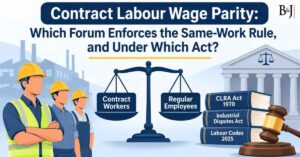
Contract Labour Wage Parity: Which Forum Enforces the Same-Work Rule, and Under Which Act?
Contract labour wage parity is the claim that workers engaged through a contractor must be paid the same wages as regular workmen doing the same or similar work. Under the Central Contract Labour Rules 1971 that duty sat on the licensed contractor, and the claim was decided by the labour authorities, not under the Minimum Wages Act.
A worker employed through a contractor on a factory floor, in a canteen or on a campus often finds that colleagues on the principal employer’s rolls are paid noticeably more for similar work. The legal question that follows is less about the principle than about the route: which authority can order the difference to be paid, and under which law? This article explains the rule on contract labour wage parity, the forums that courts have rejected, and how the position now stands after the four Labour Codes came into force.
What this Means for You
- If you are a contract worker, “equal pay for equal work” is not a free-standing right you can plead before any authority. It must be framed under the correct provision and before the correct forum.
- The burden of showing that your work is the same or similar to that of regular workmen is on you, and the courts do not accept a bare assertion.
- If you are a principal employer or contractor, a parity claim is a licence-condition and adjudication issue, not a wage-rate default under the minimum-wages law.
- Since 21 November 2025 the statutory ground has shifted. Take advice on which Code provision and which rules apply to your establishment.
Contract Labour Wage Parity Under Rule 25(2)(v)(a)
The Contract Labour (Regulation and Abolition) Act 1970 regulated contractors through licences. Rule 25(2) of the Central Rules of 1971 set out conditions of the licence. Clause (iv) required the contractor to pay at least the notified minimum wage, and clause (v) provided that where contract workers perform the same or similar kind of work as workmen directly employed by the principal employer, they must receive the same wage rates and conditions of service. A dispute about whether the work was the same or similar went to the Deputy Chief Labour Commissioner (Central) or the authority named in the rule.
The Supreme Court has described a rule of this kind as incorporating the principle of equal pay for equal work, in U.P. Rajya Vidyut Utpadan Board v. U.P. Vidyut Mazdoor Sangh (2009) 17 SCC 318 (4 November 2009). That case concerned the U.P. Rules of 1975, not the Central Rules, and it was a remand: the Labour Commissioner’s order was set aside for want of reasons and similarity itself was not decided. The Court said that nature of work, duties and degree of skill count, while volume of work does not.
Forum One that Fails: The Minimum Wages Act
The most common error is to enforce the parity differential through section 20 of the Minimum Wages Act 1948. The Supreme Court closed that route in Steel Authority of India Ltd v. Jaggu (2019) 7 SCC 658 (5 July 2019). It held that section 20 is a self-contained code about rates of wages, overtime and rest days, and that there is “no scope of enquiry” in it into equal pay for equal work, which is to be determined by the adjudicatory mechanism the law provides (para 34). The earlier foundation is Town Municipal Council, Athani v. Presiding Officer, Labour Court, Hubli (1969) 1 SCC 873, where the Court said the Act is concerned primarily with fixing rates, not enforcing payment, and that where the rate is undisputed the remedy lies elsewhere.
It is worth reading Jaggu accurately. It does not hold that Rule 25(2)(v) is unenforceable. It treats the rule as a condition of the contractor’s licence, a breach of which goes to the prescribed authority under the contract-labour scheme (para 39), and it records that after a prohibition notification under section 10(1) the Act and the Rules are not available to either party (para 41). The Court also held that a “mere assertion” of similar work does not entitle contract workers to the wages of regular employees (para 43), and that the burden of proving same or similar work lies on the workers (para 30).
The Gujarat High Court reached a related conclusion on the authority’s limits in Indian Oil Corporation v. Chief Labour Commissioner (Central) (Division Bench, 17 September 2018, LPA 65 of 2013, 2018:GUJHC:44254-DB): once the Chief Labour Commissioner has decided the type of work, further directions to the principal employer are beyond his authority, and a breach of the licence condition is a matter for the licensing authority.
Forum Two that Fails: Section 33C(2) of the Industrial Disputes Act
A second route is the Labour Court’s power under section 33C(2) of the Industrial Disputes Act 1947 to compute money due to a worker. That power is wide enough to decide questions incidental to computing an existing benefit: Central Bank of India Ltd v. P.S. Rajagopalan AIR 1964 SC 743. But it is an execution-type power. In State of U.P. v. Brijpal Singh (2005) 8 SCC 58 the Court held that the benefit must be pre-existing or flow from a pre-existing right, and that a disputed claim to a fresh entitlement, such as parity wages never adjudicated, is outside the section. A worker whose parity claim has not been established by the competent authority will therefore struggle here.
Against Whom Does the Claim Lie?
In Hindustan Steelworks Construction Ltd v. Commissioner of Labour (1996) 10 SCC 599, decided under the Andhra Pradesh Contract Labour Rules, the Supreme Court held that the Rule 25(v)(a) differential is a condition of the licence rather than “wages” in the contractual sense covered by section 21 of the Act, so the principal employer’s back-up liability under section 21(4) did not extend to it. The workers’ right to recover any additional wages lay against the contractor. Jaggu adds that primary wage responsibility is the contractor’s, with the principal employer’s liability as a back-stop (para 40).
The workers’ side has a counter-argument. The sham-contract route in Steel Authority of India Ltd v. National Union Waterfront Workers (2001) 7 SCC 1 (Constitution Bench, 30 August 2001) allows an industrial adjudicator to ask whether the contract is genuine. If it is a “camouflage”, the workers are treated as the principal employer’s own employees, and the parity question then disappears into an ordinary employment claim. The same Bench held that there is no automatic absorption of contract labour when a prohibition notification is issued.
The Constitutional Strand: Equal Pay for Equal Work
Equal pay for equal work has also been enforced against State employers under Articles 14, 16 and 39(d): Randhir Singh v. Union of India (1982) 1 SCC 618, extended to temporary employees in State of Punjab v. Jagjit Singh (2017) 1 SCC 148. A second strand requires “complete and total identity” between the comparators: State of Punjab v. Surinder Singh (2007) 13 SCC 231 and S.C. Chandra v. State of Jharkhand (2007) 8 SCC 279. These are writ authorities against State employers. They do not by themselves supply a statutory claim against a private principal employer.
It is also fair to note a remand order that cuts against principal employers. In Chemical Mazdoor Panchayat v. Indian Oil Corporation Ltd (Supreme Court, order of 28 March 2017, Civil Appeal 1074 of 2017 and connected appeals), the Court remitted the matter to the High Court without deciding the merits, and indicated that source of recruitment and qualifications are not a proper basis for distinction and that variations in the work performed do not by themselves defeat similarity. It is an order of remand and is not a ruling on the merits.
Contract Labour Wage Parity After the Labour Codes: What Changed?
The legal position on contract labour wage parity changed on 21 November 2025, when the four Labour Codes came into force. On the text of the Occupational Safety, Health and Working Conditions Code 2020 (OSH Code), section 143(1)(h) repeals the Contract Labour (Regulation and Abolition) Act 1970 from the date notified, and section 143(3) saves actions, rules and notifications under the repealed laws “to the extent they are not contrary to the provisions of this Code” until the Central Government repeals them. The Code on Wages 2019 repeals the Minimum Wages Act 1948 and the Payment of Wages Act 1936 (section 69). The Industrial Relations Code 2020 carries the successor to section 33C in its section 59, with the Tribunal replacing the Labour Court.
| Question | Old law | Under the Codes (text reviewed) |
|---|---|---|
| Licensing of contractors | CLRA Act 1970 | OSH Code, ss.45-52; s.47(3)(a) allows licence conditions on “fixation of wages” as prescribed |
| Principal employer’s back-up liability | CLRA s.21(4) | OSH Code s.55: contractor pays; principal employer liable for the unpaid balance on default |
| Same-work parity | CLRA Central Rules, r.25(2)(v) | No express equivalent found in the Code texts; may depend on rules made under the OSH Code |
| Prohibition of contract labour | CLRA s.10 | OSH Code s.57: core activities, with provisos |
| Money-claim computation | ID Act s.33C | IR Code s.59 (Tribunal) |
Two cautions apply. First, the Code on Wages deals with gender-based pay discrimination in “the same work or work of a similar nature”, not with parity between contract and regular workers. Second, the Ministry’s own release said that existing Acts and rules continue during the transition, which is hard to reconcile with a notification that brought the OSH Code into force in full. Secondary reports say final Central Rules under the Codes were notified in May 2026, and we have not reviewed them. Whether the 1971 Central Rules, and with them Rule 25(2)(v), survive under the savings clause is not yet settled by any authority we could find, and State rules vary.
Contract Labour Wage Parity: A Practical Map
- Identify the regime. Establish when the engagement began, which Code provisions apply, and whether State rules exist.
- Identify the true claim. Is it a licence-condition parity claim, a sham-contract claim or a constitutional claim against a State employer?
- Do not use the wage-rate authority. A parity claim framed as a minimum-wages claim is the recurring error.
- Gather comparators. Duties, skill, supervision and responsibility of the contract workers and the named regular workmen.
- Join the right parties. The contractor is the primary obligor; the principal employer’s exposure is narrower.
For related reading in this cluster, see recovery of excess payment from an employee and departmental appeals in bank disciplinary proceedings.
Key Takeaways
- Contract labour wage parity rested on a licence-condition rule, Rule 25(2)(v), not on the Minimum Wages Act.
- Section 20 of the Minimum Wages Act is not a parity forum (Jaggu), and section 33C(2) cannot decide a fresh disputed entitlement (Brijpal Singh).
- The burden of proving same or similar work lies on the workers.
- The primary liability is the contractor’s; the principal employer’s liability is limited.
- The Labour Codes (in force from 21 November 2025) contain no express counterpart to Rule 25(2)(v) on the texts reviewed; the position depends on rules and is unsettled.
Glossary
Principal employer: the establishment for which the contractor supplies workers. Licence condition: a term on which the contractor’s licence is granted. Camouflage contract: a contract that is a sham to disguise direct employment. Core activity: an activity defined in the OSH Code in which contract labour is prohibited, subject to provisos.
Frequently Asked Questions
Can contract workers claim the same wages as regular employees doing the same work?
Under Rule 25(2)(v)(a) of the Central Contract Labour (Regulation and Abolition) Rules 1971, a licensed contractor had to pay contract workers doing the same or similar work the same wages and conditions as directly employed workmen. The burden of proving same or similar work lies on the workers (Steel Authority of India v. Jaggu, 2019). Whether an equivalent rule now exists under the Labour Codes is unsettled.
Can I claim wage parity before the Minimum Wages authority?
No. The Supreme Court held in Steel Authority of India Ltd v. Jaggu (2019) 7 SCC 658 that section 20 of the Minimum Wages Act 1948 deals with rates of wages and is not the forum for an equal-pay or parity claim.
Is the principal employer liable for the parity differential?
Not on the Supreme Court’s reasoning in Hindustan Steelworks Construction Ltd v. Commissioner of Labour (1996) 10 SCC 599, which treated the differential as a licence condition recoverable from the contractor. The point arose under state rules in identical terms.
Can the Labour Court order parity wages under section 33C(2) of the Industrial Disputes Act?
Not if the entitlement is disputed and has never been adjudicated. Section 33C(2) executes a pre-existing right (State of U.P. v. Brijpal Singh, 2005).
Did the Labour Codes change the position?
The four Labour Codes came into force on 21 November 2025, repealing the Contract Labour Act, the Minimum Wages Act and the Payment of Wages Act. On the Code texts we reviewed, there is no express section equivalent to Rule 25(2)(v). Contract-labour wage conditions may be prescribed through licence conditions under the OSH Code, so the rules made under it need to be checked.
Sources
- Steel Authority of India Ltd v. Jaggu, (2019) 7 SCC 658; AIR 2019 SC 3601 (5 July 2019) — text.
- Town Municipal Council, Athani v. Presiding Officer, Labour Court, Hubli, (1969) 1 SCC 873 — text.
- Hindustan Steelworks Construction Ltd v. Commissioner of Labour, (1996) 10 SCC 599 — text.
- Central Bank of India Ltd v. P.S. Rajagopalan, AIR 1964 SC 743 — text; State of U.P. v. Brijpal Singh, (2005) 8 SCC 58 — text.
- U.P. Rajya Vidyut Utpadan Board v. U.P. Vidyut Mazdoor Sangh, (2009) 17 SCC 318 (4 November 2009) — text.
- Steel Authority of India Ltd v. National Union Waterfront Workers, (2001) 7 SCC 1 — text.
- Randhir Singh v. Union of India, (1982) 1 SCC 618; State of Punjab v. Jagjit Singh, (2017) 1 SCC 148; State of Punjab v. Surinder Singh, (2007) 13 SCC 231; S.C. Chandra v. State of Jharkhand, (2007) 8 SCC 279.
- Indian Oil Corporation v. Chief Labour Commissioner (Central), LPA 65 of 2013, Gujarat High Court (Division Bench), 17 September 2018.
- Chemical Mazdoor Panchayat v. Indian Oil Corporation Ltd, Supreme Court, order dated 28 March 2017 (remand).
- Contract Labour (Regulation and Abolition) Act 1970; Central Rules 1971, r.25(2)(iv)-(v); Minimum Wages Act 1948, s.20; Industrial Disputes Act 1947, s.33C.
- Occupational Safety, Health and Working Conditions Code 2020, ss.45-57 and 143; Industrial Relations Code 2020, s.59; Code on Wages 2019.
- Ministry of Labour & Employment, press release of 21 November 2025 on the Labour Codes — PIB.

Advocate Aaditya Bhatt
Senior Standing Counsel Income Tax Department, Advocate Gujarat High Court. Aaditya combines his technical and legal expertise to deliver strategic counsel in litigation, constitutional, and regulatory matters. He represents clients before High Courts and Tribunals with a technology-driven approach.