 Whatsapp

Recovery of Excess Payment from an Employee: When the Employer Can Claw Back, and When It Cannot
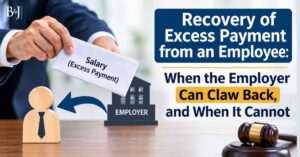
Recovery of excess payment from an employee means an employer taking back salary, allowances or retiral dues paid beyond entitlement. Indian courts allow it as a general rule, but the Supreme Court has barred it where the employee is in a junior grade, has retired, the excess is more than five years old, or recovery would be harsh or arbitrary. An undertaking to refund weakens that protection.
Few workplace letters cause more alarm than one announcing that the employer has “discovered” an overpayment and will deduct it from your salary or retirement dues. If you are on the receiving end, the first question is whether the employer can do this at all. The second is whether you can resist. This article explains the rule that courts apply to recovery of excess payment from an employee, the limits on that rule, and a recent line of decisions that has made the position less certain than many employees assume.
What this Means for You
- An employer does not lose the right to correct its own mistake. The law starts from the position that money paid without entitlement can be taken back.
- Your strongest protections are your grade (Group C or D), retirement (or retirement within a year), the passage of more than five years, and the absence of any undertaking by you.
- If you signed a refund undertaking when the benefit was fixed, assume that recovery is a real possibility and take advice early.
- Insist on a written notice, the working of the amount, and a chance to reply before any deduction.
Recovery of Excess Payment from an Employee: The Legal Starting Point
Salary, increments and pay scales are fixed by rules. When an authority applies the wrong rule, the resulting payment is not an entitlement, and public money paid without authority of law is, in principle, recoverable. The Supreme Court said so in Chandi Prasad Uniyal v. State of Uttarakhand (2012) 8 SCC 417: such payments “can always be recovered barring few exceptions of extreme hardships but not as a matter of right”. The Court added that it had not laid down that recovery is possible only where the employee committed fraud or misrepresentation.
The other strand begins earlier. In Shyam Babu Verma v. Union of India (1994) 2 SCC 521 and Sahib Ram v. State of Haryana 1995 Supp (1) SCC 18, the Court declined to allow recovery where the employee was not at fault and had received a higher scale through the employer’s misreading of the rules. Syed Abdul Qadir v. State of Bihar (2009) 3 SCC 475 explained that this relief is granted “not because of any right in the employees, but in equity, exercising judicial discretion”, and that recovery may still be ordered where the employee knew the payment was excess or where the mistake is corrected quickly.
The Rafiq Masih Guidelines: Five Situations Where Recovery is Impermissible
The working test in most High Court cases comes from State of Punjab v. Rafiq Masih (White Washer) (2015) 4 SCC 334, decided by a two-judge bench on 18 December 2014. The Court set out, for ready reference, situations in which recovery of a wrongly paid excess would be impermissible in law:
- recovery from employees belonging to Class III and Class IV service (Group C and Group D);
- recovery from retired employees, or employees due to retire within one year of the recovery order;
- recovery of an excess paid for a period of more than five years before the recovery order is issued;
- cases where an employee has wrongly been required to discharge the duties of a higher post and has been paid accordingly, even though entitled only to the lower post; and
- any other case where the court concludes that recovery would be iniquitous, harsh or arbitrary to an extent that outweighs the employer’s right to recover.
Two points deserve emphasis. The list is a guide rather than a statute, and the fifth category leaves room for judicial judgment either way. The Court rooted the exercise in equity and in Article 14: recovery is lawful until it has a harsh and arbitrary effect. (Paragraph numbers differ between the SCC print and online copies; later Supreme Court judgments quote the list as paragraph 18.)
Courts below apply the list routinely. The Gujarat High Court, for instance, quashed recovery of excess gratuity from retired employees of a statutory board in Chairman, Gujarat Water Supply & Sewerage Board v. N.N. Patel (Division Bench, 3 July 2024, C/LPA/99/2024), and held that the retiree protection is not confined to Class III and IV staff but extends to retired officers of higher grades. It also observed that the position might have been viewed differently had the error been caught soon after payment.
Recent Supreme Court Decisions that Protect Employees
Several recent decisions apply the equitable line in the employee’s favour. In Thomas Daniel v. State of Kerala (2022 SCC OnLine SC 536), increments granted through a misreading of service rules could not be recovered about ten years after retirement, as there was no misrepresentation or fraud. In Jagdish Prasad Singh v. State of Bihar (2024 INSC 591), a reduction of pay and recovery imposed eight years after superannuation, based on a misread government resolution, was quashed as arbitrary and in breach of natural justice, with refund and interest. In Jogeswar Sahoo v. District Judge, Cuttack (2025 INSC 449), recovery from retired non-gazetted staff, ordered six years after the payment and without a hearing, was set aside.
A fourth decision shows how the Court shapes relief. In Union of India v. N.M. Raut (2024 INSC 1042), the Court barred recovery of arrears from retirees and those retiring within a year, but allowed other recoveries after notice, in instalments over up to two years and without interest.
The Other Side: Undertakings and the Employer’s Argument
A balanced account has to include the contrary line, because it can defeat an employee’s case. In High Court of Punjab & Haryana v. Jagdev Singh (2016) 14 SCC 267, a judicial officer had signed an undertaking, required by the pay rules, to refund any excess if the revised scale was later found incorrect. The Supreme Court held that the retiree protection in Rafiq Masih could not apply to an officer who was on notice and had given the undertaking: “He is bound by the undertaking”. Recovery was allowed in instalments over two years.
That line has now been reinforced. In Dr. M.K. Ravi Varma v. National Institute of Technology (2026 INSC 1080, decided 23 September 2026), teachers who had received a higher grade pay by mistake, and withdrawn within months, had signed undertakings. The Supreme Court upheld recovery, applying Jagdev Singh, and said hardship must be pleaded and proved. It also made observations that employees should note. It recorded that Chandi Prasad Uniyal, an Article 136 decision, is binding under Article 141; that the Sahib Ram line rests on the Court’s Article 142 powers; and that “the law, perhaps, has not developed on correct lines”. The bench added that it did not intend to cast doubt on Rafiq Masih or Thomas Daniel. There is no larger-bench ruling resolving the tension, and the 2026 judgment is recent, so its reach will become clearer as courts apply it.
| Approach | Key authorities | What it favours |
|---|---|---|
| Equity and fairness to the blameless employee | Sahib Ram; Syed Abdul Qadir; Rafiq Masih; Thomas Daniel; Jagdish Prasad Singh; Jogeswar Sahoo | Employee, particularly retirees, junior grades and long-delayed recovery |
| Recovery as the rule; undertaking as decisive | Chandi Prasad Uniyal; Jagdev Singh; Ravi Varma | Employer, particularly where an undertaking exists or the error is corrected quickly |
A Practical Checklist if You Receive a Recovery Notice
- Get the working. Ask for the order that fixed the benefit, the order that corrects it, and the arithmetic of the sum claimed.
- Check the dates. Count the gap between the excess payment and the recovery order. More than five years engages the third Rafiq Masih category.
- Check your grade and retirement status. Group C or D, or retirement within a year of the order, engages categories one and two.
- Look for an undertaking. Review the pay-fixation forms you signed. A refund undertaking changes the analysis.
- Ask whether you caused or knew of the error. Misstatement by the employee is a recognised ground for recovery.
- Reply in writing before any deduction, raising hardship and the factors above, and ask for a personal hearing.
- If recovery is unavoidable, ask for instalments and no interest, as the courts have often directed.
Open Questions for the Academic Reader
Three doctrinal questions remain open. First, how far can an equitable bar built on Article 14 and judicial discretion stand beside the unjust-enrichment reasoning that Chandi Prasad Uniyal draws on? The 2026 judgment notes that no precedent in the line discusses section 72 of the Indian Contract Act 1872, which concerns money paid by mistake. Second, does the Article 142 character of Sahib Ram and Shyam Babu Verma limit their precedential weight, as the 2026 bench suggests? Third, is an undertaking enforceable without more, or must it be weighed against the equities in each case? The decisions do not give one answer.
For the cluster overview, see our guide to service-law entitlements (pillar to follow) and the companion article on departmental appeals in bank disciplinary proceedings. For a different kind of money dispute with an employer, see wage parity for contract labour and the correct forum.
Key Takeaways
- Recovery of a genuine overpayment is the legal starting point.
- Rafiq Masih bars recovery from Group C and D staff, retirees, in cases beyond five years, and where recovery would be harsh or arbitrary.
- An undertaking to refund, signed when the benefit was fixed, can take an employee outside that protection (Jagdev Singh; Ravi Varma, 2026).
- Recovery without notice and a hearing is open to challenge.
- Courts often order repayment in instalments rather than a lump-sum deduction.
Glossary
Class III/IV (Group C/D): junior grades of government service. Undertaking: a written promise by the employee to refund any excess later found to have been paid. Article 142: the Supreme Court’s power to do complete justice in the case before it. Superannuation: retirement on reaching the prescribed age.
Frequently Asked Questions
Can an employer recover excess payment from an employee?
Generally yes, but not always. Recovery of a genuine overpayment is the starting point. The Supreme Court has barred it in listed situations, including Group C and D staff, retirees, recoveries sought more than five years after the payment, and cases where recovery would be harsh or arbitrary. A signed undertaking to refund can take an employee outside that protection.
Does the five-year rule mean recovery is always barred after five years?
The five-year limit in State of Punjab v. Rafiq Masih applies to the period between the excess payment and the recovery order. It is one of five listed situations, not an independent limitation statute, and courts apply it with the other factors, including any undertaking.
I signed an undertaking to refund any excess. Am I protected?
Much less so. In High Court of Punjab & Haryana v. Jagdev Singh (2016) and Dr. M.K. Ravi Varma v. NIT (2026), the Supreme Court allowed recovery from employees who had given such undertakings, even after retirement.
Can the employer deduct the amount from my gratuity or pension without telling me?
A recovery order passed without notice and a hearing is vulnerable. Several Supreme Court decisions, including Jagdish Prasad Singh (2024) and Jogeswar Sahoo (2025), quashed recoveries made without a hearing.
What if recovery is allowed?
Courts commonly direct repayment in instalments. In several decisions the Supreme Court ordered instalments over twelve months to two years, and in one, without interest.
Sources
- State of Punjab v. Rafiq Masih (White Washer), (2015) 4 SCC 334 (Supreme Court, 18 December 2014) — text.
- Chandi Prasad Uniyal v. State of Uttarakhand, (2012) 8 SCC 417 — text.
- Syed Abdul Qadir v. State of Bihar, (2009) 3 SCC 475 — text.
- Shyam Babu Verma v. Union of India, (1994) 2 SCC 521 — text; Sahib Ram v. State of Haryana, 1995 Supp (1) SCC 18 — text.
- High Court of Punjab & Haryana v. Jagdev Singh, (2016) 14 SCC 267 — text.
- Thomas Daniel v. State of Kerala, 2022 SCC OnLine SC 536 (2 May 2022) — text.
- Jagdish Prasad Singh v. State of Bihar, 2024 INSC 591 (8 August 2024) — text.
- Union of India v. N.M. Raut, 2024 INSC 1042 (12 December 2024) — text.
- Jogeswar Sahoo v. District Judge, Cuttack, 2025 INSC 449 (4 April 2025).
- Dr. M.K. Ravi Varma v. National Institute of Technology, 2026 INSC 1080 (23 September 2026) — text.
- Chairman, Gujarat Water Supply & Sewerage Board v. N.N. Patel, C/LPA/99/2024, Gujarat High Court (Division Bench), 3 July 2024 — text.
- Indian Contract Act 1872, section 72 (payment made by mistake).

Advocate Aaditya Bhatt
Senior Standing Counsel Income Tax Department, Advocate Gujarat High Court. Aaditya combines his technical and legal expertise to deliver strategic counsel in litigation, constitutional, and regulatory matters. He represents clients before High Courts and Tribunals with a technology-driven approach.