 Whatsapp


Railways Act Land Acquisition Compensation: Chapter IVA, the Section 20F(6) Arbitration and the 60 Per Cent Addition
People affected by a railway line usually assume they stand where a neighbour stood when a highway took his land. They do not. Railways Act land acquisition compensation for a declared special railway project is governed by a self-contained code — Chapter IVA of the Railways Act 1989 — with its own notification, vesting rule, valuation criteria, arbitration and interest provision. Section 20N puts it beyond argument: nothing in the Land Acquisition Act 1894 applies.
In short: Chapter IVA of the Railways Act 1989 (sections 20A to 20P) lets the Central Government acquire land for a declared special railway project. A competent authority determines compensation under section 20F(1); a dissatisfied party may have the amount redetermined by an arbitrator appointed by the Central Government under section 20F(6); section 20F(9) adds sixty per cent of market value for the compulsory nature of the acquisition; and since 1 January 2015 the compensation and rehabilitation schedules of the 2013 Act apply as well.
Key Takeaways
- Chapter IVA was inserted by the Railways (Amendment) Act 2008 (Act 11 of 2008), section 3, with effect from 31 January 2008. It applies only where the Central Government has declared a special railway project.
- Land vests absolutely in the Central Government, free from all encumbrances, on publication of the section 20E declaration — that is, before compensation is determined.
- The award must come within one year of that declaration. DFCCIL v. Subodh Singh reads that with the six-month extension to give an outer limit of eighteen months.
- The arbitrator under section 20F(6) is appointed by the Central Government alone; the Arbitration and Conciliation Act 1996 applies, so the award is challengeable under section 34.
- Interest is confined to section 20H(5): nine per cent, only on the arbitrator’s excess, only from possession to deposit. That gap is the Chapter’s clearest constitutional vulnerability.
- Since 1 January 2015 the First, Second and Third Schedules to the 2013 Act apply, and the cut-off is fixed by the date of the competent authority’s determination.
How Railways Act Land Acquisition Compensation is Structured: The Chapter IVA Sequence
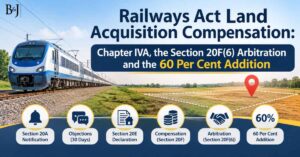
This framework governs railway land acquisition compensation for projects formally declared as special railway projects under the Railways Act 1989. The thirty-day objection window under section 20D is the only realistic opportunity to contest the acquisition itself rather than its price, and the order on those objections is declared final. And the section 20E declaration vests the land absolutely in the Central Government, free from all encumbrances, before any compensation has been determined — which is why the landowner’s remaining fight is almost always about money rather than about land.
| Section | What it does |
|---|---|
| 20A | Central Government notifies its intention to acquire for a special railway project; substance published in two local newspapers, one vernacular. Fixes the valuation date. |
| 20B, 20C | Entry, survey, measurement, levels, sub-soil boring. Damage to land ultimately excluded from the acquisition to be compensated within six months of the works ending — a remedy neighbours routinely miss. |
| 20D | Written objections within thirty days; hearing in person or through a legal practitioner; order allowing or disallowing is “final”. |
| 20E | Declaration; land vests absolutely, free from all encumbrances. Notification lapses if no declaration within a year (court stay excluded). Declaration not to be called in question in any court. |
| 20F | Compensation: the competent authority’s determination, the one-year award clock, the arbitration, the valuation heads and the sixty per cent addition. See below. |
| 20G | Market-value criteria, including the stamp-duty minimum value floor. |
| 20H | Deposit with the competent authority before possession; payment and entitlement; apportionment disputes to the principal civil court; nine per cent interest on the arbitrator’s excess. |
| 20-I, 20J | Possession on sixty days’ written notice, enforceable through the Collector or Commissioner of Police; entry for construction, maintenance and operation. |
| 20K | Civil court powers: summoning, discovery, evidence on affidavit, public records, commissions. |
| 20L | No diversion to another purpose without prior Central Government approval; land unutilised for five years reverts. |
| 20M | Eighty per cent of the gain on any onward transfer for consideration to be shared pro rata with the original landowners or their heirs — worth watching when railway land is later commercialised. |
| 20N | The Land Acquisition Act 1894 does not apply. |
| 20-O, 20P | National Rehabilitation and Resettlement Policy 2007 applied to project-affected families; rule-making power, including the manner of appointing the arbitrator. |
Section 20F: The Award, the Clock and the Arbitration
Under section 20F(1) of the Railways Act 1989, compensation is determined by an order of the competent authority. This determination forms the starting point for calculating the railway land acquisition award. Section 20F(2) disciplines it: the award must come within one year of the section 20E declaration, failing which “the entire proceedings for the acquisition of the land shall lapse”, subject to a six-month extension for unavoidable circumstances recorded in writing, with additional compensation for the extended period “at the rate of not less than five per cent. of the value of the award, for each month of such delay”. Where only a right of user or easement is taken, section 20F(3) fixes the amount at ten per cent.
In Dedicated Freight Corridor Corporation of India Ltd. v. Subodh Singh, decided on 30 March 2011, the Supreme Court read these provisions together. Publication of the declaration is complete on Official Gazette publication, so the newspaper publication does not start the clock; on a harmonious construction the acquisition is “eclipsed” at one year and lapses only at eighteen months; and the duty to record reasons is directory, not mandatory. Crucially for landowners, where the award comes after a year but within eighteen months the additional compensation is payable and may be fixed at more than five per cent a month if reasons are absent or unsatisfactory. The Court also catalogued seven internal anomalies in Chapter IVA and sent the judgment to the Law Commission and the Ministry of Railways.
Railway Land Acquisition Arbitration under Section 20F(6)
Where the competent authority’s figure is unacceptable to either party, then on an application by either party the amount “shall… be determined by the arbitrator to be appointed by the Central Government in such manner as may be prescribed”. Three features repay attention. The appointing authority is the Central Government — the same government for whose project the land is taken; the landowner has no nomination or veto. The section prescribes no qualification, the only control being the rules under section 20P(2)(a); in practice serving revenue officers have been appointed. And the reference is a real arbitration: section 20F(7) applies the Arbitration and Conciliation Act 1996 “subject to the provisions of this Act”, so the award is open to challenge under section 34.
That last point was confirmed, at High Court level, in Vijaybhai Bhailalbhai Patel v. Union of India (Gujarat High Court, R/Special Civil Application No. 17199 of 2023, decided 8 December 2023). A challenge to the vires of sections 20F(6), 20F(7), 20F(9), 20G(1)(i), 20H(5) and 20N, and to the appointment of State officers as arbitrators, was dismissed on laches. The Court observed in passing that the sixty per cent is given “as solatium, in consideration of the compulsory nature of acquisition” and that an “alternative efficacious remedy to file an application under Section 34” was available; liberty was granted to challenge the award on all grounds, and those observations were expressly not to bind the section 34 court. Read fairly, that is a judgment about delay rather than a vindication of the Chapter on the merits.
Compensation Award under the Railways Act 1989: Valuation and Damages
Section 20F(8) lists the heads: market value as on the section 20A notification; damage by severance; injurious affection to other immovable property or to earnings; and the reasonable expenses of a compelled change of residence or place of business. Section 20G supplies the floor — the higher of the stamp-duty minimum value for the area (the jantri or circle rate) or the average sale price for similar land nearby, taken from the sale deeds registered in the preceding three years in which the higher price was paid.
One drafting asymmetry is argued both ways. Sections 20F(8) and 20F(9) speak of “the competent authority or the arbitrator“; section 20G speaks only of “the competent authority”. Whether the jantri floor therefore binds the arbitrator is textually open, and we have traced no decision resolving it.
The 60 PerCent Addition — and What Section 20F(9) Does not Say
Section 20F(9) requires the competent authority or the arbitrator, in addition to market value, to “award a sum of sixty per centum on such market-value, in consideration of the compulsory nature of the acquisition”. Two glosses circulate widely and both should be resisted. The first is that the sixty per cent is given “in lieu of solatium and interest”: those words are not in the sub-section, and the rationale it does give is the classic definition of solatium and says nothing about interest. The second is that the sixty per cent runs on the whole award. It does not; it is computed “on such market-value”, leaving the severance, injurious affection and relocation heads outside the base.
Interest is dealt with separately, and meagrely. Section 20H(5) is the only interest provision in the Chapter: where the arbitrator’s determination exceeds the competent authority’s, “the arbitrator may award interest at nine per cent. per annum on such excess amount from the date of taking possession under section 20-I till the date of actual deposit thereof”. Note what is left out. No interest on the competent authority’s own award. No interest at all for the period between the section 20A notification, which fixes the valuation date, and the award — in practice a gap of years. And the power belongs to the arbitrator alone, so a landowner who accepts the first figure is compensated for delay not at all.
That gap is the strongest argument a landowner has, and it borrows its force from the National Highways Act. In Union of India v. Tarsem Singh, (2019) 9 SCC 304, the Supreme Court struck down section 3J of the National Highways Act 1956, so far as it excluded solatium and interest, as violative of Article 14; it later declined to make that ruling prospective. The Railways Act is that Act’s structural twin, but not identical: Chapter IVA does contain a solatium equivalent. On that limb, which cuts against the landowner, its exposure is weaker than the NH Act’s was; on interest it is very nearly the same. We have traced no judgment applying Tarsem Singh to Chapter IVA.
2013 Act Compensation for Railway Land Acquisition: The 1 January 2015 Cut-Off
None of this is now the whole picture. The Railways Act 1989 is one of the thirteen enactments in the Fourth Schedule to the Right to Fair Compensation and Transparency in Land Acquisition, Rehabilitation and Resettlement Act 2013. Section 105(1) excludes the body of that Act from those enactments, but section 105(3) required the Central Government, by notification within a year of commencement, to apply the compensation provisions of the First Schedule and the rehabilitation provisions of the Second and Third Schedules to them, with no exception or modification that reduces or dilutes them.
The extension came about in two overlapping ways: an Ordinance promulgated on 31 December 2014 substituted section 105(3) so that those Schedules apply to the Fourth Schedule enactments “with effect from 1st January, 2015”; and, as the successive Ordinances were about to lapse, a Removal of Difficulties Order dated 28 August 2015 was issued under section 113 read with section 105 to the same effect — an Order whose existence, date and source of power the Supreme Court itself recorded in Tarsem Singh. The Ministry of Railways accepted the consequence in Railway Board letter No. E(NG)II/2010/RC-5/1 dated 11 November 2019, which directs that compensation be determined under the First, Second and Third Schedules of the 2013 Act whether or not the acquisition goes through the Railways Act, and substituted the Second Schedule lump sum for the old land-loser employment policy.
Which date controls was settled only this month. In Manav Bhanot v. National Highway Authority of India, 2026 INSC 973, decided on 8 September 2026, the Supreme Court held — on the NH Act, but on reasoning that turns wholly on section 105 and the Fourth Schedule and is therefore enactment-neutral — that the applicable regime is fixed by the date of the competent authority’s initial determination. Before 1 January 2015, the 1894 Act rates; on or after it, the First Schedule to the 2013 Act. The date of the arbitrator’s award is irrelevant.
| Head | Railways Act, Chapter IVA | 2013 Act, First Schedule |
|---|---|---|
| Market value | Higher of stamp-duty minimum value or the average of the top fifty per cent of sale deeds over three years (s.20G) | Determined under s.26, then multiplied by a factor of 1.00 to 2.00 for rural land |
| Compulsory-acquisition addition | 60 per cent on market value (s.20F(9)) | 100 per cent solatium on the aggregate |
| Assets attached to land | Buildings, trees, plants and crops valued with expert assistance (s.20G(4)–(6)) | Value of assets added before solatium |
| Interest | 9 per cent, only on the arbitrator’s excess, only from possession to deposit (s.20H(5)) | Interest provisions of the 2013 Act |
| Rehabilitation and resettlement | National Rehabilitation and Resettlement Policy 2007 (s.20-O) | Second and Third Schedule entitlements |
The arithmetic is not clean and should not be presented as though it were: Chapter IVA compensates severance, injurious affection and relocation separately, so the comparison is fact-dependent. What can be said with confidence is that for any determination made on or after 1 January 2015 the First Schedule is the floor, and an award that stops at market value plus sixty per cent is open to challenge on that ground alone.
What this means for you
- Establish which law applies first. If the notification cites section 20A of the Railways Act, you are in Chapter IVA; if not, you are in the ordinary acquisition process and a different article applies.
- Diarise thirty days from the section 20A notification. That is the only window for objections to the acquisition itself, and the order on them is declared final.
- Do not wait for possession to raise valuation points. Market value is assessed as on the section 20A date, so comparable sale instances, the jantri entry and the intended use category should be gathered and filed early.
- Check the date of the competent authority’s award, not the arbitrator’s. On or after 1 January 2015, press for the First Schedule to the 2013 Act and the Second Schedule entitlements.
- If the award is unacceptable, apply under section 20F(6) promptly. Only the arbitrator can award the nine per cent on the excess, and Chapter IVA fixes no limitation period — a reason for speed, not for comfort.
- If land taken from you is later sold on, section 20M matters. Eighty per cent of the gain is to be shared with the original landowners or their heirs, and land left unused for five years reverts.
What Remains Genuinely Unsettled
Whether a section 20F(6) award can be modified or only set aside. NHAI v. M. Hakeem, (2021) 9 SCC 1, held in the closely analogous NH Act context that a section 34 court may set aside but not modify. Gayatri Balasamy v. ISG Novasoft Technologies Ltd., 2025 INSC 605, then recognised a narrow modification power — severance, correction of clerical or computational error on the face of the record, variation of post-award interest, and the Supreme Court’s Article 142 power. Whether a court can correct an arbitrator who applies the wrong statutory interest rate is unsettled for Chapter IVA.
Whether the interest gap survives Article 14. Vijaybhai Patel turned principally on laches; the absence of interest on the competent authority’s own award, and for the years between valuation date and award, was not separately analysed, and is on all fours with the reasoning that struck down section 3J.
Whether section 20G binds the arbitrator, and the exact effective date of the 2015 extension. The asymmetry noted above cuts both ways: if section 20G does not bind, the arbitrator is free of the jantri floor, which usually helps the landowner. As to the date, the Ordinance route gives 1 January 2015 and that is the date applied in Manav Bhanot, though other dates in 2015 appear in the reports. There is also an unlitigated question whether a removal-of-difficulties order under section 113 can do work that section 105(3) and (4) contemplated for a notification laid before Parliament. No court has taken the point.
Glossary
- Special railway project — a project so declared, which alone triggers Chapter IVA.
- Competent authority — the officer notified under the Railways Act who conducts the acquisition and makes the first determination of compensation.
- Solatium — an additional sum paid because the acquisition is compulsory, not because the land is worth more.
- Severance — loss caused by the acquisition splitting a holding, leaving the remainder less useful or less valuable.
- Injurious affection — damage to other property or to earnings caused by the acquisition or the works.
- Jantri — the government’s minimum land value schedule used for stamp duty on registration; the section 20G(1)(i) floor.
- Fourth Schedule enactments — the thirteen central acquisition laws excluded from the body of the 2013 Act but brought within its compensation and rehabilitation schedules.
Read next
- Land acquisition compensation in India — the pillar guide covering the 2013 Act, the NH Act and the Railways Act together.
- Arbitration under the National Highways Act, section 3G(5) — the closest statutory cousin, and the source of most of the authority in this field.
- The Removal of Difficulties Order 2015 — what it extended to highway and railway acquisitions, and what it did not.
- Section 18 reference: challenging a Collector’s compensation award — the route where the acquisition is not under a special enactment.
- Partial land acquisition and the severed residue — when a landowner can insist the whole be acquired.
Sources
- Railways Act 1989, Chapter IVA, sections 20A to 20P — India Code, consolidated text.
- Railways (Amendment) Act 2008 (Act 11 of 2008), section 3, with effect from 31 January 2008.
- Right to Fair Compensation and Transparency in Land Acquisition, Rehabilitation and Resettlement Act 2013, sections 26, 105 and 113, and the First, Second, Third and Fourth Schedules.
- RFCTLARR (Removal of Difficulties) Order 2015, dated 28 August 2015, made under section 113 read with section 105.
- Arbitration and Conciliation Act 1996, sections 34 and 37.
- Indian Stamp Act 1899 — minimum land value for registration, referred to in section 20G(1)(i).
- National Rehabilitation and Resettlement Policy 2007, applied by section 20-O.
- Railway Board letter No. E(NG)II/2010/RC-5/1 dated 11 November 2019 (RBE No. 193/2019).
- Dedicated Freight Corridor Corporation of India Ltd. v. Subodh Singh, Supreme Court, decided 30 March 2011.
- Vijaybhai Bhailalbhai Patel v. Union of India, Gujarat High Court, R/Special Civil Application No. 17199 of 2023, decided 8 December 2023.
- Union of India v. Tarsem Singh, (2019) 9 SCC 304; and the subsequent order declining prospective operation, 2025 SCC OnLine SC 235.
- Manav Bhanot v. National Highway Authority of India, 2026 INSC 973, decided 8 September 2026.
- Project Director, NHAI v. M. Hakeem, (2021) 9 SCC 1; Gayatri Balasamy v. ISG Novasoft Technologies Ltd., 2025 INSC 605.

Advocate Aaditya Bhatt
Senior Standing Counsel Income Tax Department, Advocate Gujarat High Court. Aaditya combines his technical and legal expertise to deliver strategic counsel in litigation, constitutional, and regulatory matters. He represents clients before High Courts and Tribunals with a technology-driven approach.