 Whatsapp


The Removal of Difficulties Order 2015: What It Actually Extended to Highway and Railway Acquisitions — and What It Did Not
The Removal of Difficulties Order 2015 is a two-clause instrument under the RFCTLARR Act 2013 that most landowners have never heard of and that determines compensation in several categories of land acquisition governed by special enactments. It is the reason a farmer whose field is taken for a National Highway can claim the same solatium and the same multiplier as a neighbour whose field is taken for a general public purpose. It is also, because of what it leaves out, the reason several important questions about highway and railway compensation remain unsettled in September 2026.
The Removal of Difficulties Order 2015 — S.O. 2368(E) dated 28 August 2015, made under section 113(1) of the RFCTLARR Act 2013 — extends the Act’s First, Second and Third Schedules to the thirteen enactments in its Fourth Schedule. It extends nothing else, and it came into force on 1 September 2015.
Key Takeaways
- The Order was made under section 113(1), the removal-of-difficulties power, and not under section 105(3), because the section 105(3) deadline had already passed.
- It extends the three Schedules only — compensation, rehabilitation and resettlement, and infrastructure amenities.
- It commenced on 1 September 2015. The widely repeated date of 1 January 2015 belongs to a lapsed Ordinance.
- The route taken had a constitutional side-effect: a section 105(3) notification would have gone to Parliament in draft, for approval. A section 113 order is merely laid after it is made.
- Whether the body of the 2013 Act travels with the Schedules is unresolved, and the appellate authority points both ways.
Why Was the Removal of Difficulties Order 2015 Necessary?
The Right to Fair Compensation and Transparency in Land Acquisition, Rehabilitation and Resettlement Act 2013 was meant to end the parsimony of the colonial statute. But it did not repeal every acquisition law. Section 105(1) provides that the Act “shall not apply to the enactments relating to land acquisition specified in the Fourth Schedule” — thirteen of them — and then qualifies that exclusion with the words “subject to sub-section (3)”.
Sub-section (3) was the safety valve. It obliged the Central Government, “by notification, within one year from the date of commencement of this Act”, to direct that the compensation provisions of the First Schedule and the rehabilitation provisions of the Second and Third Schedules would apply to those thirteen Fourth Schedule land acquisition Acts. The Act commenced on 1 January 2014, so the deadline was 31 December 2014.
The notification was not issued. On 31 December 2014 an Ordinance instead substituted section 105(3), directing the extension with effect from 1 January 2015. That Ordinance was re-promulgated in April 2015 and again in May 2015. The replacement Bill was referred to a Joint Committee of Parliament and did not emerge. When the second Ordinance was about to lapse at the end of August 2015, the Government faced a gap: the statutory route in section 105(3) was time-barred, and the legislative route had stalled.
It reached instead for section 113(1) — the power to make orders “for removing the difficulty” in giving effect to the Act. That power carried its own sunset: “no such power shall be exercised after the expiry of a period of two years from the commencement of this Act”, that is, after 31 December 2015. The Order was made on 28 August 2015, comfortably inside it.
What Does the Removal of Difficulties Order 2015 Provide?
The instrument is short. Clause 1(2) fixes commencement: “It shall come into force with effect from the 1st day of September, 2015.” Clause 2 is the operative provision. It directs that the provisions of the 2013 Act relating to the determination of compensation in accordance with the First Schedule, rehabilitation and resettlement in accordance with the Second Schedule, and infrastructure amenities in accordance with the Third Schedule “shall apply to all cases of land acquisition under the enactments specified in the Fourth Schedule to the said Act”.
Two consequences follow immediately, and both are frequently got wrong.
The commencement date is 1 September 2015. A very large body of commentary — including material that ought to know better — states that the Order is deemed effective from 1 January 2015. It is not. That date attached to the Ordinance which lapsed. An argument that the Order operates retrospectively to 1 January 2015 has nothing in the text to stand on.
The Order extends Schedules, not sections. Clause 2 names three Schedules and stops. It extends the First Schedule compensation provisions, together with the rehabilitation and infrastructure benefits under the other two Schedules. It says nothing about section 24, or section 64, or the constitution of the Authority, or the objection procedure, or the definitions in section 3.
The Thirteen Fourth Schedule Acts Covered by the Order
The Order reaches every acquisition under any of these thirteen Acts:
| # | Enactment |
|---|---|
| 1 | Ancient Monuments and Archaeological Sites and Remains Act 1958 |
| 2 | Atomic Energy Act 1962 |
| 3 | Damodar Valley Corporation Act 1948 |
| 4 | Indian Tramways Act 1886 |
| 5 | Land Acquisition (Mines) Act 1885 |
| 6 | Metro Railways (Construction of Works) Act 1978 |
| 7 | National Highways Act 1956 |
| 8 | Petroleum and Minerals Pipelines (Acquisition of Right of User in Land) Act 1962 |
| 9 | Requisitioning and Acquisition of Immovable Property Act 1952 |
| 10 | Resettlement of Displaced Persons (Land Acquisition) Act 1948 |
| 11 | Coal Bearing Areas Acquisition and Development Act 1957 |
| 12 | Electricity Act 2003 |
| 13 | Railways Act 1989 |
Numbers 7 and 13 account for the overwhelming majority of the litigation involving National Highways Act compensation and railway land acquisition compensation. The pipeline Act at number 8 and the Electricity Act at number 12 generate a steady stream of their own, and the Order applies to all thirteen enactments in identical terms.
Section 113 of the RFCTLARR Act: The Constitutional Implications
This is where the academic interest lies, and it is not merely academic.
Had the Government proceeded under section 105(3), section 105(4) would have applied. That sub-section requires a draft of the proposed notification to be laid before each House of Parliament for thirty days, with power in both Houses to disapprove it or to agree on modifications. It is a prior-approval mechanism: Parliament sees the instrument before it takes effect and may block it.
Section 113(2) is different in kind. It requires only that every order made under section 113 “shall be laid… as soon as may be after it is made”. Parliament sees the instrument afterwards. Nothing turns on its approval.
The result is that a measure Parliament had specifically reserved to itself for prior scrutiny was delivered by an instrument subject only to subsequent laying. Whether that is a permissible use of a removal-of-difficulties power — traditionally a narrow, gap-filling device that may not be used to do what a substantive provision was designed to do — is a fair question, and it has been raised. Two observations should be made in fairness to the Order.
First, the Supreme Court has had the Order squarely before it. In Union of India v. Tarsem Singh, (2019) 9 SCC 304, the Court set out the whole Ordinance-to-Order sequence, reproduced the Order verbatim at paragraph 38, and relied on it — not as a defective instrument to be disregarded, but as evidence that the Government itself accepted that parity of compensation was owed. It recorded that “[i]t is only when this Ordinance lapsed that the notification dated 28th August, 2015 was then made under Section 113 of the 2013 Act.”
Second, whatever the formal objection, the Order operates entirely in the landowner’s favour. A challenge to its validity would, if it succeeded, remove solatium and the multiplier from every highway and railway acquisition since September 2015. That is a reason for caution, not a reason to pretend the question does not exist — but it explains why the point is not pressed.
What the Removal of Difficulties Order 2015 Did Not Extend: The 2026 Legal Dispute
The Schedules-only limit decides real arguments.
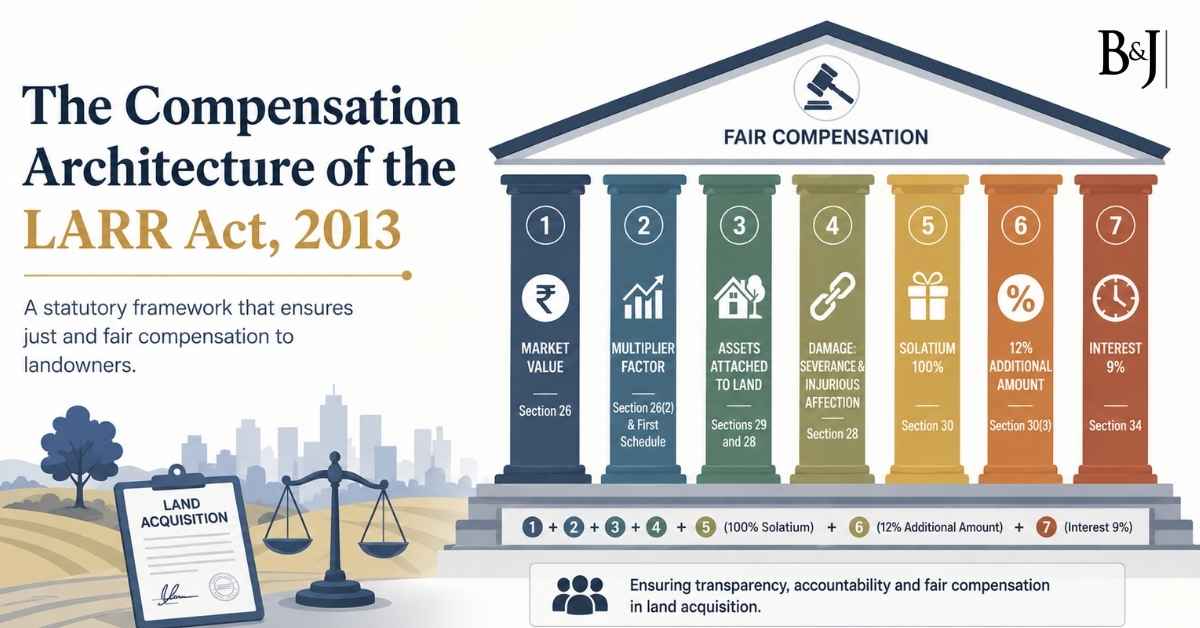
The most consequential issue concerns the calculation of land acquisition compensation under the RFCTLARR Act. The First Schedule prescribes a multiplier to be applied to “market value”, and a solatium of one hundred per cent on “the compensation amount”. Neither term is defined in the First Schedule. Market value is defined in section 26, which sits in the body of the Act and is not mentioned in the Order. So a highway arbitrator asked to apply the First Schedule must decide what he is multiplying: the market value fixed under section 3G(7)(a) of the National Highways Act, or the market value fixed under section 26 of the 2013 Act? The two methods can produce very different figures, because section 26 requires the higher of the guideline value and the average of the top half of comparable sale deeds, while the special Act does not.
The Supreme Court’s answer has tended towards the body. In NHAI v. P. Nagaraju @ Cheluvaiah, Civil Appeal No. 4671 of 2022, decided 11 July 2022, the Court held that “all aspects contained in Section 26 to 28 of RFCTLARR Act for determination of compensation will be applicable notwithstanding Section 3J and 3G(7)(a) of NH Act”. In Project Director, NHAI v. Alfa Remidis Ltd, 2026 INSC 480, decided 12 May 2026, it went further and set aside a section 3G(5) award as patently illegal because it had ignored the section 26 methodology — including the rule that an “average sale price” cannot be built from a single sale deed.
The contrary view has recent support too. In Sreeja v. Malabar Devaswom Board, 2026 LiveLaw (Ker) 289, the Kerala High Court held that the 2015 notification imported the compensation and rehabilitation provisions but did not displace the National Highways Act’s own machinery, so that a dispute about entitlement to compensation goes to the civil court under section 3H(4) and not to the LARR Authority. On that reading the Order changes the quantum but not the route.
Both positions are defensible on the text. The first says that extending a Schedule which cannot operate without a definition necessarily extends the definition. The second says that a two-clause executive order cannot silently rewrite the procedural architecture of thirteen statutes, and that if Parliament had wanted the whole Act to apply it would have said so. As at September 2026 there is no Supreme Court decision squarely reconciling them.
A related limit is settled enough to state. The prohibitory right in section 94 of the 2013 Act — the owner’s right to require that the whole of a house or building be taken rather than a part — sits in the body, is not in any Schedule, and therefore does not travel to the Fourth Schedule enactments by force of the Order. The Kerala High Court reached that conclusion in the highway context in Sudheer Kumar V.V. v. NHAI (W.P.(C) No. 5944 of 2021, decided 21 March 2024). We deal with that right separately.
What this means for you
- If your land was taken under any of the thirteen Acts on or after 1 September 2015, you are entitled to First Schedule compensation — the multiplier and one hundred per cent solatium — whatever the special Act’s own scale says.
- For acquisitions before that date, the Order does not help you directly. The Tarsem Singh line does, but subject to the cut-off the Supreme Court laid down in March 2026.
- You are also entitled to be considered for Second and Third Schedule rehabilitation and resettlement benefits, including applicable infrastructure amenities, which are almost never offered unprompted. Ask for them in writing.
- If an arbitrator or Competent Authority applies the multiplier to a market value fixed without the section 26 method, that is worth taking up — but understand that the point is contested, not settled.
Frequently Asked Questions
Is the Removal of Difficulties Order 2015 still in force? Yes. The two-year sunset in section 113(1) limited when an order could be made, not how long it lasts.
Does it apply to acquisitions begun before September 2015? Not by its own terms. Pre-Order acquisitions are governed by the case law, principally Tarsem Singh and its 2025 and 2026 sequels.
Can the Order be challenged? The section 105(4) versus section 113(2) asymmetry gives an arguable ground. It is rarely raised because success would strip benefits from landowners generally.
Does it give me access to the LARR Authority? That is the disputed question. The Kerala High Court says no; the Supreme Court’s valuation cases point the other way on substance without deciding forum.
Where do I find the text? The Order is reproduced verbatim at paragraph 38 of Tarsem Singh, which is the most reliable publicly available source.
Glossary
Removal of difficulties power — a provision allowing the executive to make orders resolving practical obstacles to a new Act’s operation, usually for a limited period after commencement. Fourth Schedule enactments — the thirteen acquisition statutes excluded from the 2013 Act by section 105(1). First Schedule — the compensation schedule, containing the multiplier and the hundred per cent solatium. Laying before Parliament — the requirement that delegated legislation be placed before both Houses, either in draft for approval or after the event for information. Competent Authority — the officer who determines compensation under a special acquisition Act.
Read Next
- Land Acquisition Compensation in India: the LARR Act, the National Highways Act and the Railways Act — the cluster guide to how the whole stack is built.
- Partial Land Acquisition and the Severed Residue — section 94, and why it does not travel to the Fourth Schedule Acts.
- Jantri versus Market Value: How Compensation Is Really Determined — the section 26 method the whole dispute above turns on.
Sources
- RFCTLARR (Removal of Difficulties) Order 2015, S.O. 2368(E) dated 28 August 2015, Ministry of Rural Development — text reproduced verbatim at paragraph 38 of Union of India v. Tarsem Singh, (2019) 9 SCC 304
- Right to Fair Compensation and Transparency in Land Acquisition, Rehabilitation and Resettlement Act 2013 — sections 26, 28, 94, 105(1) to 105(4) and 113(1) to 113(2), and the First, Second, Third and Fourth Schedules
- National Highways Act 1956 — sections 3G(5), 3G(7)(a), 3H(4) and 3J
- Railways Act 1989 — Chapter IVA, sections 20A to 20P, in particular sections 20F(9) and 20G
- RFCTLARR (Amendment) Ordinance 2014 (Ordinance 9 of 2014), and the re-promulgating Ordinances of April and May 2015
- Union of India v. Tarsem Singh, (2019) 9 SCC 304 (Civil Appeal No. 7064 of 2019, decided 19 September 2019)
- NHAI v. P. Nagaraju @ Cheluvaiah, Civil Appeal No. 4671 of 2022, decided 11 July 2022
- Sudheer Kumar V.V. v. National Highways Authority of India, W.P.(C) No. 5944 of 2021 and connected petitions (Kerala High Court, decided 21 March 2024)
- Union of India v. Tarsem Singh, 2025 INSC 146 (Miscellaneous Application No. 1773 of 2021, decided 4 February 2025)
- NHAI v. Tarsem Singh, 2026 INSC 291 (Review Petition (C) No. 2528 of 2025, decided 25 March 2026)
- Project Director, NHAI v. Alfa Remidis Ltd, 2026 INSC 480 (decided 12 May 2026)
- Sreeja v. Malabar Devaswom Board, 2026 LiveLaw (Ker) 289 (Kerala High Court)

Advocate Aaditya Bhatt
Senior Standing Counsel Income Tax Department, Advocate Gujarat High Court. Aaditya combines his technical and legal expertise to deliver strategic counsel in litigation, constitutional, and regulatory matters. He represents clients before High Courts and Tribunals with a technology-driven approach.