 Whatsapp


Penalty for Concealment and Inaccurate Particulars: Section 271(1)(c), Section 270A, and the Road to the 2025 Act
A Deduction That Failed, And A Penalty That Followed
Consider a manufacturing company that borrows money from its bankers and uses part of it to subscribe to shares in a group concern. It pays interest on the loan and claims the amount as a business deduction. The loan, interest payment and shareholding are all disclosed in its financial statements and tax audit report. The Assessing Officer, however, takes the view that interest relating to an investment yielding exempt dividend income cannot be claimed as a deduction and disallows the amount. The company may challenge that disallowance in appeal, but at this stage, the dispute is simply about whether the deduction is allowable.
The position changes when the Assessing Officer also initiates penalty proceedings. The question is no longer just whether the deduction was correctly claimed, but whether the company concealed its income or furnished inaccurate particulars under Section 271(1)(c) of the Income-tax Act, 1961. In CIT v. Reliance Petroproducts (P) Ltd., (2010) 322 ITR 158 (SC), the Supreme Court dealt with a similar situation and held that merely making an incorrect claim in law does not amount to furnishing inaccurate particulars of income.
This distinction between a disallowed claim and concealment of income is central to understanding penalty under Section 271(1)(c). The law has since changed, and the applicable provisions now depend on the assessment year or tax year involved.
Penalty under Section 271(1)(c): Two Limbs and Why the Difference Matters
Section 271(1)(c) authorises the Assessing Officer, the Commissioner (Appeals) or the Principal Commissioner, if satisfied in the course of any proceeding that a person has concealed the particulars of his income or has furnished inaccurate particulars of such income, to direct payment of a penalty. The quantum is prescribed by Section 271(1)(iii): a sum which shall not be less than, but shall not exceed three times, the amount of tax sought to be evaded. In practice, this is described as a range of 100 per cent to 300 per cent, though the statutory floor is expressed as the evaded tax itself rather than as a percentage. “Tax sought to be evaded” is not left to impression; Explanation 4 to the sub-section supplies an arithmetical formula, including a specific rule, introduced with retrospective effect in 2002, for cases where the return disclosed a loss.
The two limbs are not synonyms. Concealment of income connotes withholding – an item of income kept out of the return or out of the books. Furnishing inaccurate particulars of income connotes supplying something that is positively wrong – a figure, a description, or a claim of fact that does not correspond to reality. The Supreme Court examined the two expressions at length in Dilip N. Shroff v. JCIT, (2007) 291 ITR 519 (SC), and its exposition of what the two words mean has never been displaced, a point to which we return below.
The difference matters for a practical reason. A penalty is a quasi-criminal exaction; the person on whom it is proposed is entitled to know the case he has to meet. If the notice and the order do not identify which of the two limbs is alleged, the assessee is left defending both, and the resulting litigation over the adequacy of the penalty notice has occupied the High Courts for more than a decade.
Explanation 1: The Presumption That Does Most Of The Work
In the great majority of contested cases it is not the main charge but Explanation 1 to section 271(1) that decides the outcome. The Explanation provides that where, in respect of any facts material to the computation of total income, the person either (A) fails to offer an explanation, or offers an explanation which is found to be false, or (B) offers an explanation which he is not able to substantiate and fails to prove that the explanation was bona fide and that all material facts were disclosed, then the amount added or disallowed is deemed to represent concealed income.
The structure repays attention, because the two limbs of the Explanation do different work and are constantly conflated in penalty orders. Limb (A) is about falsity: the Revenue must find the explanation false, and a finding of falsity is a finding, not an inference from the mere fact that an addition was sustained. Limb (B) is a composite of three ingredients, all of which must fail before the deeming operates – the explanation must be unsubstantiated, it must not be bona fide, and material facts must not have been disclosed. An assessee who has disclosed everything and whose explanation, though unproved, is honestly advanced falls outside limb (B) altogether.
Two points of procedure follow. First, the Explanation is part of section 271 itself, so the Revenue need not issue a separate notice invoking it: K.P. Madhusudhanan v. CIT, (2001) 251 ITR 99 (SC), which also put an end to the earlier view, traceable to Sir Shadilal Sugar and General Mills Ltd. v. CIT, (1987) 168 ITR 705 (SC), that agreeing to an addition is not an admission of concealment. Secondly, since the insertion of section 271(1B) by the Finance Act, 2008 with retrospective effect from 1 April 1989, an assessment order that makes an addition and contains a direction for initiation of penalty is deemed to constitute the officer’s satisfaction – a legislative answer to a line of High Court decisions that had required a distinctly recorded satisfaction.
From Intention To Strict Liability, And Part Of The Way Back
The most-cited turn in this field is the shift on mens rea. In Dilip N. Shroff the Court had spoken of the element of deliberateness in the concealment charge. In Union of India v. Dharamendra Textile Processors, (2008) 306 ITR 277 (SC), a three-judge Bench held that Dilip Shroff had not been correctly decided on that point, and treated the penalty as a civil liability for which wilful concealment need not be established.
Practitioners should be careful about how broadly they state that proposition, for two reasons. First, Dharamendra Textile was a central excise case concerning Section 11AC of the Central Excise Act, 1944, and its application to income tax is by analogy. Secondly, the Supreme Court itself narrowed the reading almost immediately. In CIT v. Atul Mohan Bindal, (2009) 317 ITR 1 (SC), the Court made clear that the statutory conditions under Section 271(1)(c) must still exist before penalty can be imposed. A similar clarification appears in Union of India v. Rajasthan Spinning and Weaving Mills, (2009) 13 SCC 448. Reliance Petroproducts, decided in 2010, then confirmed that no fault had been found with Dilip Shroff’s analysis of the two limbs; what was overruled was the requirement of a guilty mind, not the definition of the offence. The correct legal position is therefore that the Revenue need not prove intention to impose a penalty under Section 271(1)(c), but must still establish that the return concealed or misstated something, with Explanation 1 providing the relevant deeming framework.
The Boundary Of Reliance Petroproducts
Reliance Petroproducts is the assessee’s most-cited authority and also the most over-read. It decides that a claim which is fully disclosed and fails in law is not, without more, the furnishing of inaccurate particulars. It does not decide that every failed claim is penalty-proof.
The counterweight is CIT v. Zoom Communication (P) Ltd., (2010) 327 ITR 510 (Del), where the Delhi High Court sustained penalty on a claim that was disclosed but had no arguable foundation at all, observing in substance that if a patently inadmissible claim escapes penalty merely because it was disclosed, the deterrent purpose of the provision is defeated. The two decisions are best read as addressing different axes: Reliance Petroproducts is about disclosure, Zoom Communication is about arguability. A claim that is both disclosed and reasonably arguable is protected; a claim that is disclosed but hopeless may not be.
Two further decisions mark the edges. In Price Waterhouse Coopers (P) Ltd. v. CIT, (2012) 348 ITR 306 (SC), a provision for gratuity was inadvertently claimed although the tax audit report itself disclosed that it was not allowable; the Court treated this as a human error and cancelled the penalty – a holding that is, however, tied to the fact that the assessee’s own audit report had disclosed the disallowability, and is overstated when cited as a general rule that any bona fide mistake escapes penalty. At the other edge, MAK Data (P) Ltd. v. CIT, (2013) 358 ITR 593 (SC) holds that a surrender made to buy peace and avoid litigation does not release the assessee from penalty; there, too, the context matters, since the Court found on the facts that the surrender followed a survey on a sister concern and was not voluntary at all.
The Notice That Does Not Say Which Limb
The most heavily litigated question in this area is not substantive but procedural: what happens when the notice under section 274 is a printed form on which the inapplicable limb has not been struck out, so that the assessee is told only that he has “concealed the particulars of income or furnished inaccurate particulars of such income”.
The dominant line holds the defect fatal. In CIT v. Manjunatha Cotton and Ginning Factory, (2013) 359 ITR 565 (Karn), the Karnataka High Court laid down a detailed conspectus, including that sending a printed form in which all the grounds are mentioned does not satisfy the requirement of law. The Bombay High Court, sitting as a Full Bench at the Goa Bench in Mohd. Farhan A. Shaikh v. DCIT, (2021) 434 ITR 1 (Bom) (FB), agreed, holding that an omnibus notice suffers from the vice of vagueness. Delhi has taken the same view, rejecting both the curative argument under section 292B and the argument that no prejudice was caused: PCIT v. Gragerious Projects (P) Ltd. (Del, 2024).
An important caution attaches to the way this line is usually cited. It is very often said that Manjunatha was “upheld by the Supreme Court” in CIT v. SSA’s Emerald Meadows, (2016) 386 ITR 13 (SC). What the Supreme Court did was dismiss the Revenue’s special leave petition by a non-speaking order recording that it found no merit in the petition. A dismissal of a special leave petition in limine neither merges the judgment below nor declares law under Article 141: Kunhayammed v. State of Kerala, (2000) 245 ITR 360 (SC). The same caution applies in the opposite direction to Sundaram Finance Ltd. v. ACIT, which the Revenue sometimes cites as Supreme Court authority that the defect is not fatal; the reasoning is in the Madras High Court judgment, (2018) 403 ITR 407 (Mad), which treated the sufficiency of the notice as a question of fact and found no prejudice because the assessee had understood the charge, and the Supreme Court merely declined leave.
The contrary, curative line is older and thinner but not extinct. CIT v. Kaushalya, (1995) 216 ITR 660 (Bom), held that the mere non-striking of the inapplicable portion does not by itself invalidate a notice where the assessee knew the charge he had to meet; the Full Bench in Mohd. Farhan distinguished rather than overruled it. That distinction was exploited by a Division Bench of the Bombay High Court in Veena Estate (P) Ltd. v. CIT (Bom, decided 11 January 2024), which declined to strike down a penalty where the objection was taken orally for the first time at the section 260A hearing some three decades after the notice, had never been raised below, and where the assessee had in fact replied to both limbs. The reported citations for that decision diverge across reporters and should be pinned before use.
Gujarat practitioners should note that the Gujarat line historically operates at a different stage. New Sorathia Engineering Co. v. CIT, (2006) 282 ITR 642 (Guj) and CIT v. Manu Engineering Works, (1980) 122 ITR 306 (Guj) require a clear positive finding in the penalty order as to which limb is held established. That is an order-stage requirement, and it is analytically distinct from the notice-stage requirement developed in Karnataka and Bombay. The two are frequently run together, and they should not be.
The question is, as this article is written, before the Supreme Court. In PCIT (Central) v. Ennoble Constructions, the Court admitted the Revenue’s petition on 7 November 2025 and listed the matter for hearing; no judgment had been traced as at the date below. That the question remains open is corroborated by an order of 31 July 2026 in PCIT v. Mahesh G. Garodia, where the Court dismissed the Revenue’s petition against a similar deletion but expressly kept the question of law open.
The 2016 Reset: Section 270A And Section 270AA
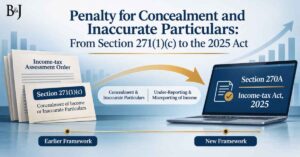
Section 271(7) provides that section 271 shall not apply to any assessment for the assessment year commencing on or after 1 April 2017. In its place the Finance Act, 2016 inserted section 270A, dealing with under-reporting and misreporting of income, and section 270AA, providing for immunity. The cut-off is keyed to the assessment year, not to the date of the order, so a penalty order passed today for assessment year 2016-17 remains a section 271(1)(c) order. The two regimes therefore run in parallel and will do so for years.
The architecture is deliberately different. Section 270A(2) lists seven situations in which income is treated as under-reported, and they are arithmetical triggers – assessed income exceeding the income determined under section 143(1)(a), reassessed income exceeding the previously assessed income, an assessment that reduces a declared loss, and so on. Nothing in sub-section (2) requires culpability. Culpability enters at two later points. Sub-section (6) carves out five situations in which the amount is not treated as under-reported, the first and most important being where the assessee offers a bona fide explanation and has disclosed all material facts; the others cover estimates where the books are correct and complete but the method does not permit proper deduction of income, estimates where the assessee himself made a lower estimate and disclosed it, additions made in conformity with an arm’s length price determined by the Transfer Pricing Officer where the prescribed documentation was maintained, and undisclosed income covered by the separate search-penalty provision. Sub-section (9) then lists six cases of misreporting, including misrepresentation or suppression of facts, failure to record investments in the books, claims of expenditure unsupported by evidence, false entries, and failure to record receipts.
The consequence of that structure is that under-reporting attracts penalty at 50 per cent of the tax payable on the under-reported income under sub-section (7), while misreporting attracts 200 per cent under sub-section (8). Sub-section (8) opens with a non-obstante clause, and two things follow from it that are worth stating plainly. The first is that once misreporting is established, the sub-section (6) exclusions – including the bona fide explanation defence – are displaced. The second is that the 200 per cent is computed on the tax payable on the under-reported income, not on some separately computed quantum of “misreported income”, an error that appears with some regularity in penalty orders.
It is this two-tier structure that has produced the modern litigation. Because the consequences of the two labels differ by a factor of four, and because immunity under section 270AA is unavailable where penalty has been initiated for misreporting, an order or notice that does not say which of the six misreporting cases is alleged leaves the assessee in the position of the recipient of an omnibus section 274 notice. The High Courts have responded much as they did under the old regime. In Schneider Electric South East Asia (HQ) Pte Ltd v. ACIT, (2022) 443 ITR 186 (Del), immunity was refused on a misreporting footing although the notice specified no limb, and the refusal was set aside as arbitrary. In GE Capital US Holdings Inc. v. DCIT, (2024) 468 ITR 746 (Del), a Division Bench held that under-reporting and misreporting are separate and distinct defaults and that the officer must reach a firm conclusion, referable to an identified clause of section 270A(9), before refusing immunity. In Prem Brothers Infrastructure LLP v. NFAC, (2022) 288 Taxman 768 (Del), a disallowance under section 14A computed from the very details the assessee had furnished was held incapable of amounting to misreporting.
The immunity provision has generated its own body of law. Section 270AA(1) makes immunity conditional on payment of the tax and interest within the time allowed by the notice of demand and on no appeal being filed; sub-section (3) provides that the officer “shall” grant immunity once those conditions are satisfied and the appeal period has expired, provided penalty has not been initiated in the misreporting circumstances. The mandatory language matters. In Chambal Fertilisers and Chemicals Ltd. v. PCIT, (2024) 462 ITR 4 (Raj), a rejection by a non-speaking order without a hearing was quashed where the item had been volunteered rather than detected and the authorities were themselves unclear which misreporting clause applied; the Rajasthan High Court also held that the assessee cannot be prejudiced by the officer’s failure to decide the application within the prescribed time. More recently, the Calcutta High Court in Amalgam Steel (P) Ltd. v. ACIT (Cal, decided 9 January 2026) set aside a rejection that did not state which condition was unfulfilled, reiterating that a rejection order must give reasons.
Two amendments should be noted and both should be checked against the gazette before being relied upon in a pleading. The Finance Act, 2025 is reported to have extended the time within which the officer must dispose of an immunity application from one month to three months from the end of the month of receipt – which matters, because every reported decision on that time limit was decided on the one-month text. The Finance Act, 2026 is reported to have widened the immunity regime so that relief is available even in misreporting cases on payment of additional tax. If that is right, it substantially alters the premise of the Schneider Electric and GE Capital line, which proceeded on the footing that immunity is simply unavailable wherever misreporting is alleged.
The Income-tax Act, 2025
The Income-tax Act, 2025 (Act No. 30 of 2025) received assent on 21 August 2025 and, by section 1(3), came into force on 1 April 2026, replacing the concept of the “assessment year” with the “tax year”. For penalties, the concordance is straightforward but the numbering is a trap. Section 270A of the old Act corresponds to section 439 of the new; section 270AA corresponds to section 440; the procedural provision in section 274 corresponds to section 471; the limitation bar in section 275 to section 472; and the reasonable-cause provision in section 273B to section 470. Section 271 of the 2025 Act is not a penalty provision at all – it is the best-judgment assessment provision, the successor to section 144 – so anyone cross-referencing by number will go badly wrong.
The concealment charge has no successor, for the simple reason that it had already been sunset in 2016. Section 439 substantially re-enacts section 270A, with the exclusions reorganised into four clauses rather than five; the missing search-related carve-out has not been abandoned but relocated, since section 297 of the new Act bars a section 439 penalty for a block period and section 298 supplies a dedicated block-period penalty.
Section 536 of the Income-tax Act, 2025 repeals the 1961 Act but expressly preserves its application to specified pending and subsequent proceedings relating to earlier tax years. Section 536(2)(c) covers proceedings pending at commencement and those initiated on or after 1 April 2026 in respect of earlier tax years, including penalty proceedings. Section 536(2)(d) further permits such penalties to be initiated and imposed under the repealed Act as if the new Act had not been enacted. The CBDT has adopted the same position in its published transition FAQs. As a result, Section 271(1)(c) will continue to apply to penalty proceedings relating to assessment years up to 2016-17, even where those proceedings remain pending after 1 April 2026.
Which Regime Governs Which Year
The applicable penalty provision depends on the relevant assessment year or tax year. Section 271(1)(c) governs earlier years, Section 270A applies to subsequent assessment years, and Sections 439 and 440 govern the corresponding regime under the Income-tax Act, 2025.
| Period | Governing provision | Rate |
|---|---|---|
| Assessment years up to 2016-17 | Section 271(1)(c), Income-tax Act 1961 (saved by section 271(7) read with section 536(2)(c) and (d) of the 2025 Act) | 100% to 300% of tax sought to be evaded |
| Assessment years 2017-18 to 2026-27 | Section 270A, Income-tax Act 1961; immunity under section 270AA | 50% (under-reporting); 200% (misreporting) |
| Tax year 2026-27 onwards | Section 439, Income-tax Act 2025; waiver and immunity under section 440 | 50% (under-reporting); 200% (misreporting) |
Where The Balance Lies
It would be wrong to present this body of law as settled in favour of either side. The Revenue’s position has real force: penalty is a civil consequence of a wrong return, not a criminal conviction; the legislature has twice restructured the provision to reduce the scope for subjective assessment, first by Explanation 1 and section 271(1B), then by the arithmetical triggers of section 270A; and a rule that voids a penalty for a defect in a printed form, where the assessee understood the charge perfectly well and contested it on the merits, elevates form over substance in a way that the Bombay High Court in Kaushalya and again in Veena Estate found unattractive. Section 270A(1), notably, contains no express requirement of “satisfaction” at all, which is the department’s strongest textual answer to the limb-specification argument as it is now being run under the new regime.
The assessee’s position has equal force. A penalty of two or three times the tax is a serious exaction, and the elementary requirement that a person be told the case against him is not a technicality when the two available cases carry consequences differing by a factor of four and when the choice between them determines whether immunity is available at all. The Full Bench in Mohd. Farhan and the Delhi High Court in GE Capital are not protecting a drafting quibble; they are insisting that the officer decide, and record, what the assessee is said to have done.
What is genuinely unsettled is the middle ground: whether the defect is jurisdictional and incurable, whether it is curable under section 292B, or whether it yields to a threshold of demonstrated prejudice and acquiescence. That is precisely the question the Supreme Court admitted in Ennoble Constructions, and until it is answered, the safest course for both sides is to litigate the merits of the addition as well as the form of the notice, rather than to rest on either alone.
Frequently Asked Questions
Does an addition in assessment automatically lead to penalty under Section 271(1)(c)?
No. Penalty proceedings are separate from assessment, and a finding sustaining an addition is not by itself a finding of concealment. Reliance Petroproducts, (2010) 322 ITR 158 (SC), holds that a claim which is disclosed and fails in law does not amount to furnishing inaccurate particulars of income. But disclosure is not a complete defence in every case; Zoom Communication, (2010) 327 ITR 510 (Del), sustained penalty on a disclosed but untenable claim, while Explanation 1 continues to place the onus on the assessee to establish that the explanation was bona fide and all material facts were disclosed.
Is a penalty notice under Section 274 invalid if it does not strike out the inapplicable limb?
The weight of High Court authority says yes, following Manjunatha Cotton, (2013) 359 ITR 565 (Karn) and the Bombay Full Bench in Mohd. Farhan, (2021) 434 ITR 1 (Bom). There is a contrary line, running from Kaushalya, (1995) 216 ITR 660 (Bom), which asks whether the assessee was in fact prejudiced. The Supreme Court’s order in SSA’s Emerald Meadows was a dismissal of a special leave petition and not a declaration of law, and the question has been admitted for consideration in Ennoble Constructions.
What is the difference between under-reporting and misreporting of income under Section 270A?
Under-reporting of income is defined arithmetically in Section 270A(2) and attracts a penalty of 50 per cent of the tax on the under-reported income. Misreporting of income is confined to the six situations listed in Section 270A(9), broadly involving misrepresentation, suppression, unsubstantiated claims or unrecorded transactions, and attracts a penalty of 200 per cent. The classification also determines eligibility for immunity under Section 270AA, which is why the High Courts have required the officer to identify the specific clause relied upon: GE Capital US Holdings, (2024) 468 ITR 746 (Del).
Sources & Citations
- Income-tax Act, 1961, sections 271(1)(c), 271(1)(iii), 271(1B), 271(7), Explanations 1, 4, 5 and 5A to section 271(1), sections 270A, 270AA, 273B, 274 and 275, as amended to date.
- Income-tax Act, 2025 (Act No. 30 of 2025), sections 1(3), 297, 298, 439, 440, 470, 471, 472 and 536.
- Finance Act, 2016 (insertion of sections 270A and 270AA with effect from 1 April 2017); Finance Act, 2008 (insertion of section 271(1B) with retrospective effect from 1 April 1989); Finance Act, 2002 (Explanation 4, loss cases).
- CIT v. Reliance Petroproducts (P) Ltd., (2010) 322 ITR 158 (SC).
- Dilip N. Shroff v. JCIT, (2007) 291 ITR 519 (SC); (2007) 6 SCC 329.
- Union of India v. Dharamendra Textile Processors, (2008) 306 ITR 277 (SC); (2008) 13 SCC 369.
- CIT v. Atul Mohan Bindal, (2009) 317 ITR 1 (SC); Union of India v. Rajasthan Spinning and Weaving Mills, (2009) 13 SCC 448.
- K.P. Madhusudhanan v. CIT, (2001) 251 ITR 99 (SC); Sir Shadilal Sugar and General Mills Ltd. v. CIT, (1987) 168 ITR 705 (SC).
- MAK Data (P) Ltd. v. CIT, (2013) 358 ITR 593 (SC); Price Waterhouse Coopers (P) Ltd. v. CIT, (2012) 348 ITR 306 (SC).
- CIT v. Zoom Communication (P) Ltd., (2010) 327 ITR 510 (Del).
- CIT v. Manjunatha Cotton and Ginning Factory, (2013) 359 ITR 565 (Karn); Mohd. Farhan A. Shaikh v. DCIT, (2021) 434 ITR 1 (Bom) (Full Bench).
- CIT v. SSA’s Emerald Meadows, (2016) 386 ITR 13 (SC) (special leave petition dismissed); Kunhayammed v. State of Kerala, (2000) 245 ITR 360 (SC).
- CIT v. Kaushalya, (1995) 216 ITR 660 (Bom); Veena Estate (P) Ltd. v. CIT (Bom, 11 January 2024); Sundaram Finance Ltd. v. ACIT, (2018) 403 ITR 407 (Mad).
- New Sorathia Engineering Co. v. CIT, (2006) 282 ITR 642 (Guj); CIT v. Manu Engineering Works, (1980) 122 ITR 306 (Guj).
- PCIT v. Gragerious Projects (P) Ltd. (Del, 2024); PCIT (Central) v. Ennoble Constructions (SC, petition admitted 7 November 2025); PCIT v. Mahesh G. Garodia (SC, order dated 31 July 2026).
- Schneider Electric South East Asia (HQ) Pte Ltd v. ACIT, (2022) 443 ITR 186 (Del); GE Capital US Holdings Inc. v. DCIT, (2024) 468 ITR 746 (Del); Prem Brothers Infrastructure LLP v. NFAC, (2022) 288 Taxman 768 (Del).
- Chambal Fertilisers and Chemicals Ltd. v. PCIT, (2024) 462 ITR 4 (Raj); Amalgam Steel (P) Ltd. v. ACIT (Cal, 9 January 2026).
- Central Board of Direct Taxes, Circular No. 3 of 2017 (immunity under section 270AA); Circular No. 9 of 2024 dated 17 September 2024 (monetary limits for departmental appeals; in penalty matters the tax effect is the quantum of penalty deleted or reduced).
- Central Board of Direct Taxes, Frequently Asked Questions on Interplay and Transition (Income-tax Act, 2025).
Related Reading
- Unexplained Cash Credits under Section 68: Identity, Genuineness and Creditworthiness
- Revision under Section 263: “Erroneous and Prejudicial” and the Problem of Enquiry
- Rejection of Books under Section 145(3) and Best-Judgment Assessment under Section 144: When May the Taxman Set Aside Your Accounts, and What May He Put in Their Place?

Advocate Aaditya Bhatt
Senior Standing Counsel Income Tax Department, Advocate Gujarat High Court. Aaditya combines his technical and legal expertise to deliver strategic counsel in litigation, constitutional, and regulatory matters. He represents clients before High Courts and Tribunals with a technology-driven approach.