 Whatsapp


Search Assessments under Sections 153A and 153C of Income Tax Act: The “Incriminating Material” Requirement
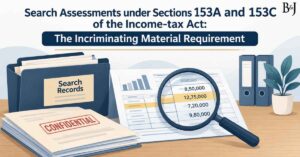
Consider a construction company whose premises are searched by the income-tax authorities in November 2019. The officers seize a spiral diary in which a site engineer has noted cash receipts against flat numbers for one particular year. Nothing else of consequence is found. In due course the company receives six separate notices, one for each of the six assessment years preceding the year of search, requiring it to file returns afresh. For the year to which the diary relates, the Assessing Officer adds the unrecorded receipts. For an earlier year, in which the company’s assessment had long since been completed after scrutiny, the Officer adds the entire share capital raised that year as unexplained – not because anything was found in the search, but because, on re-reading the balance sheet already on his file, he now doubts the subscribers. The second addition is the subject of this article. It raises a question that occupied the High Courts for the better part of a decade and was settled by the Supreme Court only in April 2023: when a search reopens a completed year, may the Assessing Officer assess that year on any material he pleases, or only on material unearthed in the search itself? The answer is central to understanding search assessments under Section 153A and 153C of the Income-tax Act, 1961, particularly the role of incriminating material in determining whether additions can be made to completed assessments.
Abated and Unabated Assessments under Section 153A
Two terms carry most of the weight. A search under section 132 of the Income-tax Act, 1961 is the exercise by which authorised officers enter premises, examine and seize books, documents, money and valuables; a requisition under section 132A is the parallel power to call for material already seized by another agency. When either happens, section 153A (for searches initiated after 31 May 2003) obliges the Assessing Officer to issue notices for the six assessment years immediately preceding the year of the search, and to assess or reassess the “total income” of each of them. The Finance Act 2017 added a further four years – the “relevant assessment year or years”, up to ten in all – but only where the fourth proviso is satisfied: the Officer must hold books, documents or evidence revealing escaped income of fifty lakh rupees or more represented in the form of an asset, and the search must have been initiated on or after 1 April 2017.
Within those six years, the second proviso to section 153A(1) draws the critical line. Any assessment or reassessment that was still pending on the date of the search abates – it lapses, and the year goes into the section 153A basket to be assessed from scratch. A year in which no proceeding was pending, because the assessment had been completed or because the time to issue a scrutiny notice had expired, is described as unabated or completed. This distinction between abated and unabated assessments under Section 153A determines the extent of the Assessing Officer’s jurisdiction over each assessment year. Nothing in the text of section 153A expressly states that completed years must be treated differently. That silence became the centre of the controversy.
Section 153A Assessment: The Conflict in the High Courts
The taxpayer’s argument ran as follows. Section 153A is a machinery provision enacted to bring the fruits of a search to tax. If it permitted the Assessing Officer to reopen a concluded assessment on any ground at all, it would render the elaborate safeguards of sections 147 to 151 – reason to believe, sanction, limitation – a dead letter in every search case, and would give the Revenue a second innings on issues it had already examined and accepted. A completed assessment, on this view, may be disturbed under section 153A only by something the search produced.
The Bombay High Court accepted that reasoning in CIT v. Continental Warehousing Corporation (Nhava Sheva) Ltd. [2015] 374 ITR 645 (Bom), and the Delhi High Court set it out at length in CIT v. Kabul Chawla [2016] 380 ITR 573 (Del), which became the most cited statement of the principle. The Gujarat High Court took the same view in PCIT v. Saumya Construction (P.) Ltd. [2016] 387 ITR 529 (Guj). A refinement followed in PCIT v. Meeta Gutgutia [2017] 395 ITR 526 (Del): the material must exist for each assessment year sought to be assessed, so that a finding for one year cannot simply be projected backwards over the others. The Revenue’s special leave petition against that decision was dismissed (PCIT v. Meeta Gutgutia [2018] 257 Taxman 441 (SC)).
The Revenue’s position, however, had its own textual basis. Section 153A begins with a non obstante clause overriding sections 139, 147, 148, 149, 151 and 153, and requires the Assessing Officer to assess the “total income” rather than merely the undisclosed income detected during the search. Parliament had used the expression “undisclosed income” in the block-assessment chapter that it repealed in 2003 but deliberately omitted it from Section 153A. The Revenue therefore argued that restricting additions to incriminating material found during the search would introduce a limitation that Parliament had not written into the provision. It also raised a practical concern: a search may reveal a pattern of suppression without producing a year-by-year record of the concealed transactions. Restricting the assessment to documents physically seized could leave that pattern untaxed in years for which the relevant records were not found. This approach found expression in Dayawanti Gupta v. CIT [2016] 390 ITR 496 (Del), where the Delhi High Court upheld extrapolation across years in a case involving admitted non-maintenance of books. However, the Supreme Court subsequently stayed the operation of that judgment, a qualification that must be kept in view when referring to it.
Abhisar Buildwell: What The Supreme Court Settled
In PCIT v. Abhisar Buildwell (P.) Ltd. [2023] 454 ITR 212 (SC), decided on 24 April 2023, the Court resolved the split. It drew precisely the distinction the High Courts had drawn. Where a year has abated, the Assessing Officer steps into the shoes of an ordinary assessing authority and may assess the total income on all material, whether seized or not; there is no completed assessment to protect. Where the year is completed or unabated, no addition may be made in the absence of incriminating material found in the course of the search under section 132 or the requisition under section 132A. The approach of the Delhi, Bombay and Gujarat High Courts was approved.
The Court was equally careful not to leave the Revenue remediless. If a completed year cannot be disturbed under section 153A, the Revenue may still resort to reassessment under sections 147 and 148, subject to the conditions of those provisions. That saving has itself become a battleground. The Central Board of Direct Taxes issued Instruction No. 1 of 2023 dated 23 August 2023 directing officers to separate abated from unabated years and to reopen the latter under section 148, taking the benefit of section 150, which lifts limitation for assessments made to give effect to a finding or direction in an appellate order. The Delhi High Court has declined to accept that reading: in ARN Infrastructures India Ltd. v. ACIT [2024] 469 ITR 333 (Del) it held that the Supreme Court’s liberty, granted “in accordance with law”, is not a finding or direction within section 150, and that notices otherwise barred by section 149 cannot be revived by an administrative instruction. The point has not yet been decided by the Supreme Court; a miscellaneous application by the Revenue seeking clarification on precisely this question was declined, the Court observing that the relief sought was in substance a review (PCIT v. Abhisar Buildwell (P.) Ltd. [2023] 294 Taxman 70 (SC)).
What Counts as Incriminating Material under Section 153A
Abhisar settled that incriminating material is necessary; it did not define it, and the definitional question is where most contemporary disputes now sit. Three propositions can be stated with reasonable confidence, and one cannot.
First, the material must have been found in the search. Documents gathered afterwards from public records, or information already available on the Officer’s file, do not qualify, however probative they may be; the jurisdictional trigger is discovery during the search, not the strength of the evidence. Second, it must be year-specific. That follows from Meeta Gutgutia and, in the context of section 153C, from CIT v. Sinhgad Technical Education Society [2017] 397 ITR 344 (SC), where the Supreme Court treated the correlation between the seized documents and the particular assessment years as a jurisdictional fact, so that years without such correlation must be dropped. Third, a loose sheet or an untitled scribble is not automatically incriminating. In Common Cause (A Registered Society) v. Union of India [2017] 394 ITR 220 (SC) the Court held that entries in loose papers are not “books of account” within section 34 of the Evidence Act and are not, by themselves, sufficient to fasten liability. The Karnataka High Court applied similar reasoning in Dy. CIT v. Sunil Kumar Sharma [2024] 469 ITR 197 (Karn), where the Revenue’s special leave petition was dismissed ([2024] 469 ITR 271 (SC)). The Revenue’s rejoinder is that a document seized from the assessee’s own premises carries a presumption of truth under section 132(4A) and section 292C, and that a court should not require of a clandestine record the formality of a ledger.
What remains genuinely unsettled is the status of a statement recorded on oath under section 132(4) standing alone. The Delhi High Court held in PCIT v. Anand Kumar Jain (HUF) [2021] 432 ITR 384 (Del) that such a statement has evidentiary value but cannot by itself support an addition without corroborative material discovered in the search. Whether that survives Abhisar has not been authoritatively decided, and practitioners should not assume that it has.
Section 153C: Search Assessment of a Person Who Was Not Searched
Searches routinely yield material relating to somebody else – a supplier, a group company, a director. Section 153C is the bridge. In its original form it applied where seized documents “belonged to” another person; the Finance Act 2015, with effect from 1 June 2015, widened this to documents that “pertain to” that person or whose contents “relate to” him, and the Finance Act 2017 added the requirement that the material have a bearing on the determination of his total income. In ITO v. Vikram Sujitkumar Bhatia [2023] 453 ITR 417 (SC) the Court held that the amended provision governs a notice issued after 1 June 2015 even though the search preceded that date, since the law in force on the date of the notice applies.
Two procedural requirements are strictly enforced. The first is the satisfaction note. Following CIT v. Calcutta Knitwears [2014] 362 ITR 673 (SC), extended to section 153C by CBDT Circular No. 24/2015 dated 31 December 2015, satisfaction must be recorded by the Assessing Officer of the searched person before the material is transmitted, and again by the Assessing Officer of the other person; where the same officer holds both charges a single note suffices, Super Malls (P.) Ltd. v. PCIT [2020] 423 ITR 281 (SC). The second is the block. Under the first proviso to section 153C(1) the reference point shifts from the date of the search to the date on which the seized material is received by the Assessing Officer of the other person, so that the six years are counted backwards from that later date and pending proceedings abate then – CIT v. Jasjit Singh [2023] 458 ITR 437 (SC), the arithmetic being worked out in detail in PCIT v. Ojjus Medicare (P.) Ltd. (Del, 3 April 2024). A third party is therefore frequently assessed for a set of years different from the searched person’s.
Search Assessment Regime by Period: Section 153A to Block Assessment
Because search assessment has been legislated and re-legislated, the first question in any matter is which machinery applies. That depends on the date the search was initiated, not on the assessment year involved.
| Search initiated | Governing machinery | What may be assessed |
|---|---|---|
| 1 July 1995 to 31 May 2003 | Chapter XIV-B, ss.158B to 158BH (Finance Act 1995; block reduced to six years by the Finance Act 2001) | Only the undisclosed income of the block period, taxed at a special rate; the regular assessments stood apart. |
| After 31 May 2003 to 31 March 2021 | ss.153A, 153B and 153C (Finance Act 2003); seventh to tenth years added by the Finance Act 2017 w.e.f. 1 April 2017 | Total income of six (or up to ten) assessment years. Pending years abate and are assessed afresh; completed years may be disturbed only on incriminating material found in the search. |
| 1 April 2021 to 31 August 2024 | ss.147 to 151A (Finance Act 2021); a search is deemed to be information suggesting escapement | Escaped income for the years reopened, subject to the s.148A gateway and the s.149 time limits. |
| 1 September 2024 to 31 March 2026 | Chapter XIV-B revived, ss.158B to 158BI (Finance (No. 2) Act 2024) | Total undisclosed income of the block period, taxed under s.113 at 60 per cent; the ordinary income of the search year is assessed separately. |
| On or after 1 April 2026 | Income-tax Act, 2025, Chapter XVI Part B, ss.292 to 301 (search u/s 247, requisition u/s 248) | Undisclosed income of the block period as defined in s.301, on substantially the 2024 pattern. |
Section 153A after Abhisar Buildwell: Where the Law Stands
The revived block-assessment chapter has, in one sense, carried the debate forward rather than brought it to an end. Section 158BA(1), as it now stands, refers to “total undisclosed income” instead of “total income”, following the retrospective substitution made by the Finance Act, 2025, with effect from 1 September 2024. Section 158B(b) defines undisclosed income to include money, bullion, jewellery, valuables, expenditure and income represented by entries or transactions that have not been disclosed, as well as expenses, exemptions, deductions or allowances found to be incorrect. Parliament has therefore expressly linked block assessments to undisclosed income identified through the search. Although the revived block-assessment regime and the earlier framework under Section 153A operate under different statutory provisions, both raise an important question: how far can an assessment following a search extend beyond the income or material identified through that search? Whether courts will interpret “undisclosed income” as narrowly as they have interpreted the requirement of incriminating material under Section 153A remains to be seen. The expanded definition, particularly its references to expenditure and exemptions and the substitution of “incorrect” for “false”, may give the Revenue grounds to argue for a wider scope. The Income-tax Act, 2025, which came into force on 1 April 2026, carries forward the same broad framework in Sections 292 to 301.
For the very large body of appeals still working through the system on searches conducted between 2003 and 2024, the position is stable and can be stated in a sentence: the year determines the question. If it abated, the Officer assesses at large and the taxpayer must meet the addition on its merits. If it did not, the Assessing Officer must identify incriminating material under Section 153A, found during the search and relating to that particular assessment year, before making an addition – and if he cannot, the addition fails however plausible it may be. That is not a technicality. It reflects a considered judgment that the finality of a completed assessment is worth something, balanced against the recognition, preserved in the reassessment route Abhisar expressly kept open, that finality is not the same as immunity.
Frequently Asked Questions
Does a search mean all six years will be reassessed under Section 153A? Notices will ordinarily issue for all six years, but that is a procedural step, not a licence. For any year in which no assessment was pending on the date of the search, the Assessing Officer must identify incriminating material found in the search and referable to that year before making an addition (Abhisar Buildwell). Years in which proceedings were pending abate and are open to assessment at large.
If a completed year cannot be touched under section 153A, has the Revenue lost it altogether? Not necessarily. Abhisar preserved the Revenue’s right to reopen under sections 147 and 148 subject to the conditions of those sections. What is contested is whether those conditions include the ordinary limitation in section 149. The Delhi High Court has held that they do (ARN Infrastructures), and the Supreme Court has not yet ruled on the point.
Under Section 153C, from which year does the six-year block run for a person who was not searched? From the date on which the seized books, documents or assets are received by that person’s own Assessing Officer, not the date of the search – the first proviso to section 153C(1), as confirmed in Jasjit Singh. Since that receipt is often a year or more after the search, the block for the third party will frequently differ from the block for the searched person.
Sources & Citations
- Income-tax Act, 1961, s.132 and s.132A; s.153A (inserted by the Finance Act 2003 w.e.f. 1-6-2003; fourth proviso and Explanations 1 and 2 inserted by the Finance Act 2017 w.e.f. 1-4-2017); s.153B; s.153C (as amended by the Finance Act 2015 w.e.f. 1-6-2015 and the Finance Act 2017 w.e.f. 1-4-2017); ss.132(4A) and 292C.
- Income-tax Act, 1961, Chapter XIV-B as revived by the Finance (No. 2) Act 2024 w.e.f. 1-9-2024: ss.158B to 158BI, in particular s.158B(b), s.158BA (sub-sections (1), (2), (6) and (7); “total income” substituted by “total undisclosed income” by Act No. 7 of 2025 w.r.e.f. 1-9-2024), s.158BB, s.158BD, s.158BE and s.113 (60 per cent).
- Income-tax Act, 2025 (in force 1 April 2026), Chapter XVI Part B, ss.292 to 301; search under s.247 and requisition under s.248; “undisclosed income” defined in s.301.
- CIT v. Calcutta Knitwears [2014] 362 ITR 673 (SC).
- CIT v. Continental Warehousing Corporation (Nhava Sheva) Ltd. [2015] 374 ITR 645 (Bom).
- CIT v. Kabul Chawla [2016] 380 ITR 573 (Del), decided 28 August 2015.
- PCIT v. Saumya Construction (P.) Ltd. [2016] 387 ITR 529 (Guj).
- Dayawanti Gupta v. CIT [2016] 390 ITR 496 (Del), decided 27 October 2016 – operation stayed by the Supreme Court; cite with that qualification.
- PCIT v. Meeta Gutgutia [2017] 395 ITR 526 (Del); SLP dismissed, PCIT v. Meeta Gutgutia [2018] 257 Taxman 441 (SC), 2 July 2018.
- Common Cause (A Registered Society) v. Union of India [2017] 394 ITR 220 (SC).
- CIT v. Sinhgad Technical Education Society [2017] 397 ITR 344 (SC).
- Super Malls (P.) Ltd. v. PCIT [2020] 423 ITR 281 (SC), decided 5 March 2020.
- PCIT v. Anand Kumar Jain (HUF) [2021] 432 ITR 384 (Del).
- ITO v. Vikram Sujitkumar Bhatia [2023] 453 ITR 417 (SC), decided 6 April 2023.
- PCIT v. Abhisar Buildwell (P.) Ltd. [2023] 454 ITR 212 (SC), decided 24 April 2023; miscellaneous application declined, [2023] 294 Taxman 70 (SC).
- CIT v. Jasjit Singh [2023] 458 ITR 437 (SC).
- PCIT v. Ojjus Medicare (P.) Ltd. (Del), decided 3 April 2024.
- Dy. CIT v. Sunil Kumar Sharma [2024] 469 ITR 197 (Karn); SLP dismissed, [2024] 469 ITR 271 (SC).
- ARN Infrastructures India Ltd. v. ACIT [2024] 469 ITR 333 (Del), decided 26 September 2024.
- CBDT Circular No. 24/2015 dated 31 December 2015; CBDT Instruction No. 1 of 2023 dated 23 August 2023.
- Memorandum Explaining the Provisions in the Finance (No. 2) Bill, 2024.
Related Reading
- Reassessment under Sections 147, 148 and 148A: How the Law Reopens a Closed Year
- Unexplained Cash Credits under Section 68: Identity, Genuineness and Creditworthiness
- Bogus Purchases and Accommodation Entries: Burden of Proof and Commission-Rate Additions
- Depreciation on Goodwill in Amalgamations: From Smifs Securities to the Finance Act, 2021
- Is Goodwill an “Asset” for Depreciation? Smifs Securities and Explanation 3(b)

Advocate Aaditya Bhatt
Senior Standing Counsel Income Tax Department, Advocate Gujarat High Court. Aaditya combines his technical and legal expertise to deliver strategic counsel in litigation, constitutional, and regulatory matters. He represents clients before High Courts and Tribunals with a technology-driven approach.