Whatsapp

How to File a Private Complaint under BNSS Before a Magistrate in Gujarat
Not every criminal case begins with the police. Where an FIR is refused, the offence is non-cognizable, or the complainant prefers to proceed directly, a private complaint to a Magistrate under BNSS may be filed.
This route is often misunderstood — either as a shortcut around the police, which it is not, or as a mere formality, which it certainly is not. The complainant must present the facts and supporting material from the outset, and the Magistrate must determine whether there are sufficient grounds to proceed.
When a Private Complaint is Appropriate?
A private complaint may be appropriate where the police refuse to register an FIR, the offence is non-cognizable, or the law requires proceedings to begin through a complaint. It may also be chosen where the complainant prefers to lead evidence directly before the Magistrate.
Where the police refuse to register an FIR. The Bharatiya Nagarik Suraksha Sanhita, 2023 provides a graded remedy: information may be sent in writing to the Superintendent of Police, and if that produces no result, the complainant may approach the Magistrate. The Magistrate may direct investigation, or may proceed to take cognizance on the complaint itself.
Where the offence is non-cognizable. The police cannot investigate without an order of the Magistrate, so a complaint is the natural route.
Where the matter is one the law requires to be initiated by complaint — cheque dishonour under Section 138 of the Negotiable Instruments Act, 1881 being the most common example, and various offences under special statutes requiring a complaint by a specified person or authority.
Where the complainant prefers to lead evidence directly rather than depend on an investigation.
Procedure for Filing a Private Complaint Before a Magistrate
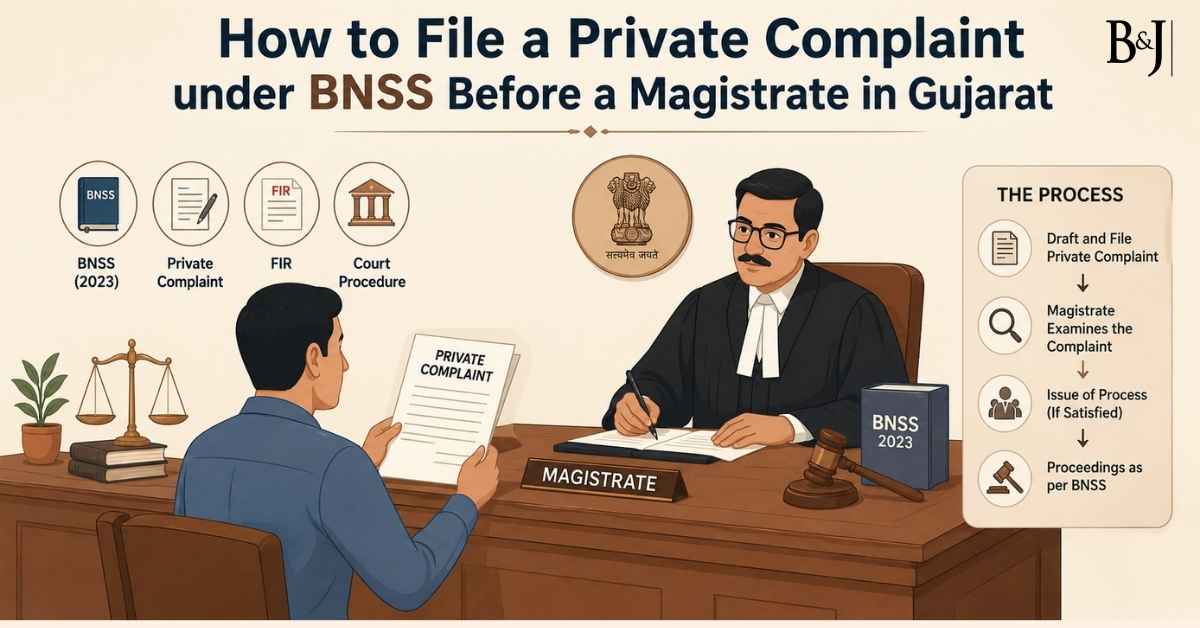
Under the BNSS, filing a private complaint before a Magistrate follows a defined process, from presentation of the complaint to examination and enquiry. If sufficient grounds are found, the Magistrate may issue process and the case proceeds further in accordance with law.
Presentation. The complaint is presented in writing to the Magistrate having jurisdiction, setting out the facts constituting the offence, the provisions invoked, the names and addresses of the accused, and a list of witnesses and documents.
Examination of the complainant. The Magistrate examines the complainant, and any witnesses present, on oath. This is the stage at which the complainant is first put to proof, and the substance of what is stated becomes part of the record. The corresponding provision in the Code of Criminal Procedure, 1973 was Section 200; the BNSS renumbers it.
Postponement of process and enquiry. The Magistrate may postpone the issue of process and either enquire into the case himself or direct an investigation, for the purpose of deciding whether there is sufficient ground for proceeding. Where the accused resides outside the Magistrate’s jurisdiction, the Sanhita requires an enquiry or investigation before process is issued.
Issue of process. If the Magistrate is satisfied that there is sufficient ground for proceeding, process is issued — summons or warrant according to the nature of the case. If not, the complaint is dismissed, and reasons are recorded.
Trial. The case proceeds as a warrant case or a summons case according to the offence, with the complainant leading evidence and the accused entitled to cross-examine.
What If Police Refuse an FIR?
This deserves separate attention because it is the most common reason people consider a private complaint.
The graded structure is deliberate: approach the officer in charge; if refused, send the information in writing to the Superintendent of Police; if that fails, apply to the Magistrate. The Magistrate has two courses — direct the police to investigate, or take cognizance of the complaint and proceed by examining the complainant.
Which course is sought matters. Where the case genuinely requires investigative powers — recovery of documents, seizure, examination of unwilling witnesses — a direction to the police is more useful than proceeding on a private complaint, because a complainant cannot compel production of material in the way an investigating agency can.
Filing a Private Complaint in Gujarat
Complaints are filed before the Judicial Magistrate having territorial jurisdiction, at the taluka or district court concerned, according to where the cause of action arose. Filing and case management in the district judiciary in Gujarat operate through the e-filing arrangements of the district courts, and the current filing requirements of the concerned court should be confirmed before presentation.
Where the offence is triable exclusively by the Court of Session, the Magistrate takes cognizance and commits the case.
Drafting the Private Complaint
A private complaint is not a police report and should not be drafted like one. It should clearly set out the facts, the specific role of each accused, and how those facts satisfy the ingredients of the alleged offence.
Plead the ingredients. For each offence alleged, the facts must disclose every ingredient. A complaint that recites section numbers without connecting them to specific acts by specific persons is liable to be dismissed at the threshold.
Identify each accused separately. Where several persons are named, the role of each must be pleaded. This is particularly important where a company and its directors are involved: a person is not liable merely by virtue of a designation.
Plead the date and place of each act, since these determine jurisdiction and, where the offence straddles 1 July 2024, whether the Indian Penal Code or the Bharatiya Nyaya Sanhita, 2023 applies.
Annex the documents relied upon, and list the witnesses to be examined.
Address limitation. The Sanhita bars cognizance after the expiry of the period prescribed for offences in the categories it specifies, subject to the power to extend in the interests of justice.
The Most Common Reason Private Complaints Fail
Courts are alert to the use of criminal process to pursue what is in substance a civil dispute. A complaint arising out of a breach of contract, a failed partnership, a property dispute or a recovery claim, dressed in the language of cheating or criminal breach of trust, is vulnerable — first to dismissal at the threshold, and then to quashing by the High Court under Section 528 of the BNSS, the provision that carries the inherent powers formerly found in Section 482 of the Code.
To survive, a complaint alleging cheating must plead dishonest intention at the time of the transaction, not merely a subsequent failure to perform. That distinction — between a promise that was false when made and a promise that was later broken — is the line between an offence and a contractual claim, and it is where most such complaints are decided.
Practical Guidance
Keep a record of every attempt to register an FIR, including the written complaint sent to the Superintendent of Police. These documents can be important when approaching the Magistrate with a private complaint under BNSS.
Be ready to be examined on oath at the first hearing, with documents in order.
Consider carefully whether what is sought is investigation or adjudication, because the two call for different applications.
And be candid about the nature of the dispute. A genuine criminal grievance pleaded precisely is far stronger than an inflated one, and an inflated complaint tends to be dismissed together with whatever was legitimate in it.
Frequently Asked Questions
1. What is a private complaint under BNSS?
A private complaint under bnss is a complaint filed directly before a Magistrate alleging that an offence has been committed.
2. Can I file a private complaint if police refuse to register an FIR?
Yes. After approaching the Superintendent of Police, the complainant may approach the Magistrate if the FIR is still not registered.
3. What happens after filing a private complaint?
The Magistrate may examine the complainant and witnesses, conduct or order an enquiry, issue process if sufficient grounds exist, or dismiss the complaint.
4. Can a private complaint be filed for a non-cognizable offence?
Yes. A private complaint before the Magistrate is a recognised route for initiating proceedings in appropriate non-cognizable offences.
5. What should a private complaint contain?
It should set out the facts constituting the offence, the accused persons and their specific roles, supporting documents, witnesses, and the legal provisions relied upon.
Legal Information Disclaimer
This article is published for general legal information and educational purposes only. It reflects the position of Indian law as researched up to 10 August 2026 and may not account for subsequent amendments, rules, notifications or judicial developments. The BNSS is recent legislation and its interpretation is still developing. It is not legal advice, does not take into account any individual’s particular facts or circumstances, and no advocate-client relationship arises from reading it. Readers dealing with an actual matter should obtain independent professional advice from a qualified advocate of their own choosing before acting on any information contained here. Statutory provisions, notified figures, rules and case citations referred to in this article have been compiled from published legal materials and may contain errors or omissions, and may have changed since the date stated; no representation or warranty, express or implied, is given as to their accuracy, completeness or currency, and each should be independently verified against the official text or the official record before being relied upon. No liability is accepted for any loss arising from reliance on this article.
Sources / Authorities
- Bharatiya Nagarik Suraksha Sanhita, 2023 (Act No. 46 of 2023) — provisions governing information in cognizable cases, complaints to Magistrates, examination of the complainant, postponement of issue of process, issue of process, dismissal of complaint, limitation for taking cognizance, and the inherent powers of the High Court under Section 528 — India Code, https://www.indiacode.nic.in
- Code of Criminal Procedure, 1973 — Sections 154, 190, 200, 202, 203 and 204, for offences committed on or before 30 June 2024
- Bharatiya Nyaya Sanhita, 2023 (Act No. 45 of 2023)
- Negotiable Instruments Act, 1881 — Sections 138 and 142
- High Court of Gujarat — district judiciary filing arrangements, https://gujarathighcourt.nic.in