Whatsapp

GIFT City PMS Regulations: IFSCA Framework for Discretionary Portfolio Management
Discretionary Portfolio Management From Gift City Part :2
This article is a complete guide to the GIFT City PMS regulatory framework for foreign investment advisers seeking to offer discretionary portfolio management to Indian residents. If Part 1 of this series established that the onshore SEBI route is structurally foreclosed, this article sets out the framework that opens the remaining route. The IFSCA (Fund Management) Regulations, 2025 — consolidated and amended through 27 January 2026 — provide the complete legal architecture for establishing a GIFT City PMS operation and managing global securities for Indian residents through the GIFT City IFSC. Understanding how GIFT City portfolio management services work under this framework is essential for any foreign adviser targeting the Indian market.
IFSCA (Fund Management) Regulations, 2025 — Overview
The IFSCA (Fund Management) Regulations, 2025 were notified on 19 February 2025, amended through 30 July 2025, with a further amendment on 27 January 2026. The consolidated instrument is the complete framework for Fund Management Entities (FMEs) operating in the GIFT City IFSC.
What the Regulations are not:
- Not a liberalisation of the SEBI framework — SEBI continues to apply onshore
- Not a general green light for offshore investment advice to Indian residents — Indian residents may access the framework only within the LRS’s foreign-exchange limits
- Not a route around IFSCA’s own regulatory oversight — a branch FME is supervised by IFSCA with mandatory physical presence requirements
What they provide is a jurisdictionally distinct framework that permits activities which the SEBI framework prohibits, within a structure that imposes its own substance conditions.
GIFT City PMS Eligibility — FME Categories and Regulatory Requirements
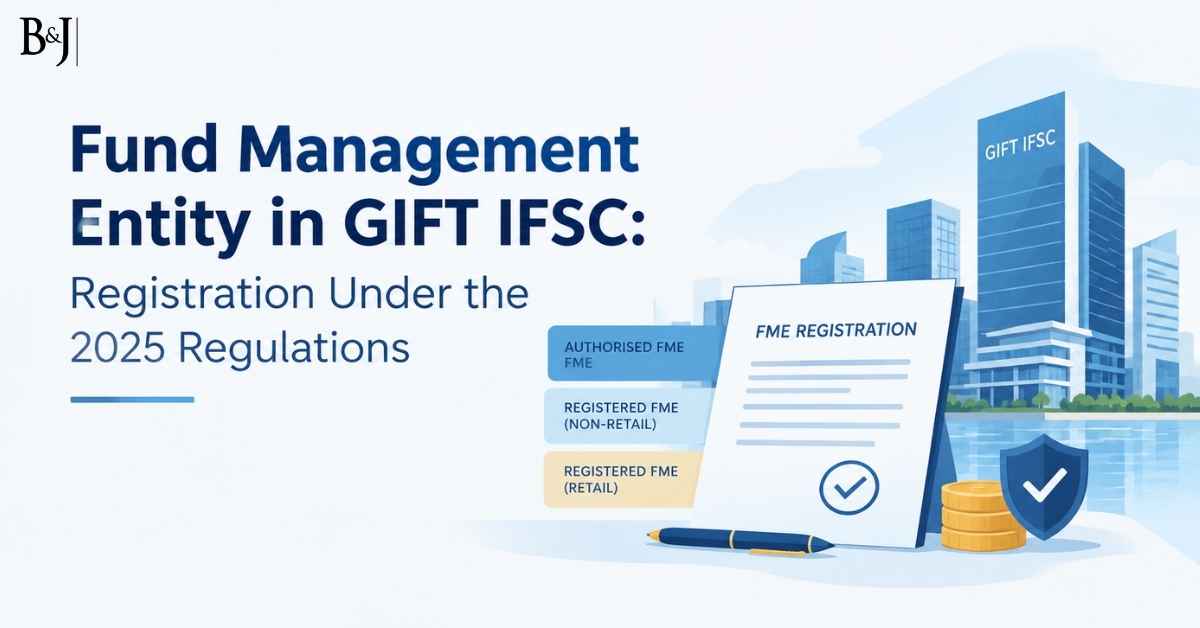
The Fund Management Regulations recognise three FME categories, distinguished by permitted activities, minimum net worth, and key managerial personnel required.
| Category | Permitted Activities | Min. Net Worth | Key Personnel |
| Authorised FME | Venture Capital Schemes, Family Investment Funds | USD 75,000 | Principal Officer in IFSC |
| Registered FME (Non-Retail) | AIFs (Cat I/II/III), PMS, Multi-Family Office, REITs/InvITs | USD 500,000 | Principal Officer + Compliance Officer in IFSC |
| Registered FME (Retail) | All of the above plus Retail Schemes, ETFs, public REITs/InvITs | USD 1,000,000 | PO + CO + additional KMP |
The practical choice for a foreign investment adviser seeking to offer a GIFT City PMS to Indian residents is the Registered FME (Non-Retail) category. It permits PMS as an independent activity — no pooled fund scheme is required. Each client has a separate portfolio management agreement with a minimum investment of USD 75,000 (reduced from USD 150,000 in 2024, materially expanding the accessible investor base).
| PMS as a Standalone Activity Regulation 73 permits separately managed accounts without launching any fund scheme. A Registered FME (Non-Retail) can offer only PMS. This is the natural structural fit for a foreign investment adviser that operates globally through separately managed accounts rather than pooled funds. |
The GIFT City PMS Branch Structure — Regulation 5
The structural pivot that makes the IFSCA route work is the branch option under Regulation 5. A branch is permitted only for an entity already registered or regulated by a financial sector regulator in India or a foreign jurisdiction for conducting similar activities. Eligible home regulators include the SEC (USA), FCA (UK), BaFin (Germany), Central Bank of Ireland, CSSF (Luxembourg), JFSA (Japan), ASIC (Australia), MAS (Singapore), and CMA (Saudi Arabia).
Regulation 5 — The Enabling Provision
“(1) The applicant shall be set up in IFSC in the form of a company or LLP or branch thereof or any other form as may be permitted by the Authority: Provided further that the branch structure is permitted only for a FME which is already registered or regulated by a financial sector regulator in India or a foreign jurisdiction for conducting similar activities. (2) A FME operating in branch structure in an IFSC shall comply with the following conditions: (a) the parent entity shall adequately ring fence the operations of the branch in IFSC; (b) the parent entity shall maintain such minimum capital as may be specified by the Authority, which shall at all times be earmarked for its branch in IFSC…”
— IFSCA (Fund Management) Regulations, 2025, Regulation 5(1)–(2)
Why a Branch and Not a Subsidiary — The Critical Distinction
A branch is the same legal entity as the parent. Research, model portfolios, investment insights, and quantitative frameworks generated by the parent flow within a single legal entity — not as ‘outsourcing’ to a third party, and not as ‘advice of any other entity.’ This is the precise structural feature that makes GIFT City portfolio management services viable for foreign advisers and separates the IFSCA branch from the SEBI framework.
A subsidiary would reintroduce the same problem that exists onshore: the subsidiary, being a separate legal entity, would be receiving advice from the parent — another entity. The branch form avoids this because there is only one legal person operating in two jurisdictions.
| Element | Position Under Branch Structure |
| Legal identity | Same as the parent — the IFSC branch is not a separate legal entity |
| Research and models | Flow within the same legal entity — not ‘outsourcing’ under the SEBI 2011 Circular; not ‘advice of any other entity’ under Regulation 24(10) |
| Net worth | Maintained at parent level under Regulation 8(2), earmarked for IFSC operations |
| Ring-fencing | Regulation 5(2)(a) requires adequate ring-fencing — separate books, records, compliance and governance for IFSC activities |
| Supervision | IFSCA supervises IFSC activities; home regulator continues to supervise the parent |
| Precedent | Several global reinsurers operate GIFT City IIO branches of their parent entities — the same structural logic applies |
For a Registered FME (Non-Retail), the USD 500,000 net worth requirement may be earmarked within the parent’s balance sheet — a negligible amount for any established foreign investment adviser. No separate capital injection into a distinct subsidiary is required (Regulation 8(2)).
Key Managerial Personnel and the Regulation 7(7) Substance Requirement
Regulation 7(7) — The Core Provision
“The proposal on the portfolio composition of a fund shall be initiated by a person who is based in the office of the FME in the IFSC.”
— IFSCA (Fund Management) Regulations, 2025, Regulation 7(7)
Portfolio composition proposals must originate from IFSC-based personnel. The critical question is what ‘initiation’ means — particularly for a branch FME receiving research and models from its foreign parent.
What Initiation Requires and What It Does Not Require
- Research, models, macroeconomic analysis, and quantitative frameworks may be generated at the parent level and flow to the IFSC branch as same-entity work product. These are inputs.
- The portfolio composition decision for each client — the decision to buy, sell, rebalance, or reallocate — must be initiated by the IFSC-based Principal Officer or KMP physically present in GIFT City. This is the decision.
- The IFSC KMP must exercise genuine independent judgment. Mechanical implementation of parent-generated model portfolios without independent review would convert the IFSC operation into a letterbox arrangement inconsistent with Regulation 7(7).
- Rationale for each portfolio decision must be documented contemporaneously. Documentation is the evidence that the decision was initiated locally and that genuine local discretion was exercised.
The Five-Function Mapping
| Function | Description | Must Be Local? | Basis |
| IPC / Strategic views | Sets global over/underweights and stock universes | No — may remain at parent | Reg 7(7) addresses initiation of portfolio proposals, not research origin |
| Research | Fundamental, macro, sector and quantitative research | No — may remain at parent | Research is an input function — nothing requires it to be conducted in IFSC |
| Portfolio evaluation | Determines asset allocation per client | Yes — must be local | First Schedule Declaration (f) — investment decisions must be undertaken from IFSC |
| Portfolio engineering | Decides specific securities per model | Yes — must initiate locally | Reg 7(7) — portfolio composition proposals must be initiated by IFSC-based person |
| Implementation | Decides specific buys and sells for each client | Yes — must be local | First Schedule Declaration (f) — portfolio management includes execution |
First Schedule Declaration (f)
“We shall ensure that the key activities of Investment decision, portfolio management and grievance handling shall be undertaken from IFSC.”
— IFSCA (Fund Management) Regulations, 2025, First Schedule, Declaration (f)
This is a substantive commitment, not a formality. Investment decisions, portfolio management, and grievance handling for the IFSC branch’s clients must be undertaken from the IFSC.
Regulation 79(2) — Individual and Independent Management
“The FME in its capacity as a discretionary portfolio manager shall individually and independently manage the funds of the client in accordance with the needs of the client, in a manner which does not partake the character of a retail fund…”
— IFSCA (Fund Management) Regulations, 2025, Regulation 79(2)
The same ‘individually and independently’ language as SEBI Regulation 23(1) — but without the SEBI 2011 outsourcing Circular. In the branch context, the independent judgment is the judgment of the IFSC-based KMP, informed by but not delegated to the parent’s research and models.
| The Regulation 7(7) Bottom Line A branch FME that receives global research and model portfolios from its parent, has those reviewed by an IFSC-based Principal Officer exercising genuine independent judgment, documents the rationale for each portfolio decision, and operates through staff physically present in GIFT City — satisfies Regulation 7(7) and First Schedule Declaration (f). This is the model that a properly structured GIFT City PMS operation should follow. A branch FME that mechanically implements parent-generated model portfolios without independent review does not. |
GIFT City PMS Provisions — Regulations 73 to 81
Regulation 73(2)(d) — Eligible Clients
“An individual resident in India who is eligible under FEMA to invest funds offshore, to the extent allowed under the liberalised remittance scheme (LRS) of Reserve Bank of India.”
— IFSCA (Fund Management) Regulations, 2025, Regulation 73(2)(d)
An Indian resident individual may become a GIFT City PMS client of an IFSC FME to the extent permitted by the LRS. The current LRS limit is USD 250,000 per financial year per individual — the practical ceiling on new annual inflows from any single Indian resident investor.
Regulation 77(1) — Minimum Investment
The minimum per-client threshold for opening a portfolio management account is USD 75,000 — reduced from USD 150,000 in 2024, significantly expanding the accessible investor base for foreign firms offering global PMS mandates.
Regulation 73(3) — Investment Universe
“A FME operating as a portfolio manager in an IFSC shall be permitted to invest in securities and financial products in an IFSC, India or Foreign Jurisdiction. Provided that in case of a discretionary portfolio management service, it shall invest in the securities listed or to be listed or traded on the stock exchanges, money market instruments, units of investment schemes and other financial products as specified by the Authority from time to time.”
— IFSCA (Fund Management) Regulations, 2025, Regulation 73(3) and Proviso
The permissible investment universe for a GIFT City PMS is substantially broader than the SEBI PMS universe — encompassing securities and financial products across jurisdictions. For foreign advisers comparing onshore versus GIFT IFSC PMS structures, this global reach is one of the most significant structural advantages. The Proviso limits discretionary PMS to listed or to-be-listed securities, money market instruments, and IFSCA-specified products. This fully accommodates typical global equity strategies.
Regulation 76 — Periodic Reporting
The FME is obliged to furnish periodic reports to the portfolio management client. Regulation 76(2) permits the periodic report to be made available online. The servicing obligation under Regulation 76 is distinct from cross-border solicitation — a distinction addressed in Article 3 of this series.
Regulation 78(2) — Derivatives
For a discretionary GIFT City PMS, derivatives are permitted with client consent. The retail scheme restrictions on leverage under Regulation 49 do not apply to PMS separately managed accounts. A PMS mandate may therefore use derivatives for hedging, defensive positioning, or risk management.
Conculsion
The IFSCA (Fund Management) Regulations, 2025 provide a complete, workable framework for any foreign investment adviser seeking to offer a GIFT City PMS to Indian residents. The branch structure is the structural key — same legal entity as the parent, eliminating the outsourcing problem that forecloses the SEBI route. Regulation 7(7) requires genuine local initiation of portfolio decisions in GIFT City, not the physical location of research. The investment universe for a GIFT City PMS is global, the minimum investment threshold is USD 75,000, and the compliance architecture is well-defined. For foreign advisers evaluating discretionary PMS India entry strategies, the GIFT City IFSC route is the only legally viable and scalable option currently available. Part 3 of this series addresses how the GIFT City FME may lawfully reach Indian clients. Advisers seeking regulatory guidance on establishing a GIFT City PMS operation may contact Bhatt & Joshi Associates.
Frequently Asked Questions (FAQs) — GIFT City PMS & IFSCA Regulations
1. What is GIFT City PMS?
GIFT City PMS refers to discretionary portfolio management services offered from IFSC (GIFT City) under the IFSCA Fund Management Regulations, 2025, allowing investment in global securities.
2. Can Indian residents invest in GIFT City PMS?
Yes. Indian residents can invest under the Liberalised Remittance Scheme (LRS), subject to a limit of USD 250,000 per financial year.
3. What is the minimum investment for PMS in GIFT City?
The minimum investment is USD 75,000 per client, as per Regulation 77.
4. Why is the branch structure important in GIFT City?
Because a branch is the same legal entity as the parent, it avoids regulatory issues related to outsourcing and third-party advice under SEBI.
5. What does Regulation 7(7) require?
It requires that portfolio decisions be initiated by personnel physically present in IFSC, ensuring real substance and local decision-making.
6. Can research be conducted outside IFSC?
Yes. Research and models can be generated offshore, but final investment decisions must be taken in IFSC.
7. What is the investment scope under GIFT City PMS?
PMS can invest in global, Indian, and IFSC securities, including listed equities and financial instruments.
8. Are derivatives allowed in PMS?
Yes. Derivatives are permitted with client consent for hedging and risk management purposes.

Advocate Aaditya Bhatt
Senior Standing Counsel Income Tax Department, Advocate Gujarat High Court. Aaditya combines his technical and legal expertise to deliver strategic counsel in litigation, constitutional, and regulatory matters. He represents clients before High Courts and Tribunals with a technology-driven approach.