 Whatsapp

Section 151A and Faceless Reassessment: Who May Issue the Notice, the Jurisdictional or the Faceless Officer?
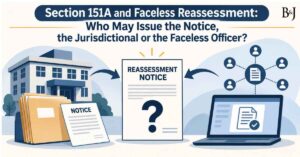
Picture a manufacturing company in a mid-sized city whose return for an old assessment year was accepted without scrutiny. Years later it receives a notice under section 148 of the Income-tax Act, 1961 (“the Act”), saying that income has escaped assessment. The notice is signed by the jurisdictional assessing officer (JAO), the officer in the local ward who has always dealt with the company. The company’s advisers do not dispute that the department had some information. They ask a different question: was this officer the right person to sign? Under the faceless reassessment scheme framed under Section 151A, cases are allotted by software to officers in distant cities who never meet the taxpayer. If that scheme was meant to cover the issue of the notice itself, the JAO may have had no power to sign it, and everything built on the notice – the reasons, the objections, the final order – would fall with it. That question, usually shortened to “JAO versus FAO” (the jurisdictional assessing officer against the faceless assessing officer), has become central to the interpretation of Section 151A and the faceless reassessment process. It has produced one of the sharpest conflicts among High Courts in recent tax law, a retrospective amendment by Parliament in 2026, a decision by the Punjab and Haryana High Court striking that amendment down, and an interim order of the Supreme Court. This article sets out the statutory scheme, the competing readings, and the position as it stands on the date of writing, with each stage dated because the law has changed more than once.
Section 151A and the Faceless Reassessment Scheme, 2022
Section 151A was inserted into the Act by the Taxation and Other Laws (Relaxation and Amendment of Certain Provisions) Act, 2020. It empowers the Central Government to frame, by notification, a scheme for “making assessment, reassessment or recomputation under section 147” and, as the provision now reads, for the “issuance of notice under section 148” and related steps under section 148A, so as to impart greater efficiency, transparency and accountability by eliminating the interface between the taxpayer and the department, optimising the use of resources, and introducing a team-based system with dynamic jurisdiction. Section 144B, which sets out the faceless assessment procedure, was inserted by the Finance Act, 2021, and refers to the National Faceless Assessment Centre (“NFAC”) and to “assessment units” that work without any physical contact with the taxpayer.
The scheme under section 151A was notified on 29 March 2022 as the e-Assessment of Income Escaping Assessment Scheme, 2022 (Notification No. 18/2022), and is commonly called ‘the Scheme’. This Faceless Reassessment Scheme, 2022 provides the framework for conducting reassessment proceedings through automated allocation and a faceless process. Its central provision is paragraph 3, which states that the assessment, reassessment or recomputation under section 147 shall be made “in a faceless manner” in accordance with the Scheme, and that the allotment of cases shall be by automated allocation. The disagreement turns largely on what that paragraph covers. One reading holds that “faceless” runs from the very first step, so that only the faceless machinery may issue a notice under section 148. The other holds that the notice is a jurisdictional act, to be issued by the officer who holds territorial or functional jurisdiction over the taxpayer, and that facelessness begins afterwards, when the case is allotted for the enquiry and the assessment.
The backdrop is the overhaul of reassessment effected by the Finance Act, 2021, with effect from 1 April 2021, which replaced sections 147 to 151 and inserted section 148A, requiring a preliminary enquiry and an order before a notice under section 148 could issue. The Supreme Court explained the transition in Union of India v. Ashish Agarwal (2022) 444 ITR 1 (SC), and fixed the limitation consequences in Union of India v. Rajeev Bansal (2024) 469 ITR 46 (SC). Those decisions deal with the timing and procedure of reopening; they do not decide who the officer must be, and each side in the present debate has cited them for different purposes.
The First Reading: Faceless Assessing Officer and Section 148 Notice
The decision most often associated with this view is Hexaware Technologies Ltd. v. Assistant Commissioner of Income-tax, (2024) 162 taxmann.com 225 (Bom), decided on 3 May 2024 in Writ Petition No. 1778 of 2023. The Bombay High Court was concerned with a reassessment notice for an old assessment year that had been issued by the jurisdictional officer after the Scheme was notified. It held that the Scheme applies to both limbs of section 151A, not only to the conduct of the assessment but also to the issue of the notice under section 148; that after 29 March 2022 the jurisdictional officer therefore had no power of his own to issue the notice; and that a notice issued in that manner suffered from a jurisdictional defect which could not be cured and which led to the notice, and all that followed it, being quashed. The reasoning relied on the structure of section 151A itself: Parliament had spoken of a scheme for “making assessment, reassessment or recomputation” and also for “issuance of notice”, and it would be strange, the Court thought, to read the Scheme as applying to one of these and not the other.
Other courts have taken the same view. The Telangana High Court, in Kankanala Ravindra Reddy v. ITO, (2023) 156 taxmann.com 178 (Telangana), regarded the faceless route as mandatory for the department once the Scheme was in force, and later followed that approach in 2024. The Punjab and Haryana High Court, in Jatinder Singh Bhangu v. Union of India, (2024) 165 taxmann.com 115 (P&H), held that the faceless scheme applies from the stage of the show-cause notice. The Rajasthan and Karnataka High Courts are also reported to have reached similar conclusions. The argument in its fairest form is one of legislative purpose: if the objective is to remove the interface between the taxpayer and the local officer, it would defeat the object to leave the most consequential step, the decision to reopen a closed year, in the hands of the very officer the system was designed to keep at a distance.
The Second Reading: The Jurisdictional Officer Retains The Power
The contrary view has been taken by several High Courts, and its arguments are not trivial. The Calcutta High Court, in Triton Overseas (P.) Ltd. v. Union of India, (2023) 156 taxmann.com 318 (Cal), upheld notices under section 148 issued by jurisdictional officers by reference to departmental instructions. The Delhi High Court, in T.K.S. Builders (P.) Ltd. v. ITO, (2024) 167 taxmann.com 759 (Del), decided on 28 October 2024, held that the functions of the jurisdictional officer and of the faceless centre are complementary and concurrent, so that the existence of the faceless machinery did not divest the jurisdictional officer of authority. The Madras High Court, in Mark Studio India (P.) Ltd. v. ITO, decided on 20 December 2024, went further and described the jurisdictional officer’s authority to issue notices under sections 148 and 148A as exclusive, with the faceless centre’s role confined to the completion of assessment after the notice.
The Gujarat High Court joined this group in Snehdham Trust v. ACIT, Special Civil Application No. 9909 of 2022, decided on 17 September 2025. As reported, the Court held that “faceless manner” in the Scheme refers to the assessment procedure and not to the issue of the notice, that paragraph 3 of the Scheme requires only automated allocation of cases and not faceless issuance, and that section 144B does not mandate a faceless notice. It expressly declined to follow the Bombay and Telangana line. The reasoning of this group may be put in three steps. First, the notice under section 148 is the act that confers jurisdiction and is therefore naturally an act of the officer with territorial jurisdiction. Second, the text of paragraph 3 speaks of the conduct of proceedings and of allocation, not of issuing the notice. Third, a rule that invalidates every reassessment notice issued in a period of several years by officers who had always been understood to hold the power would cause serious dislocation, and a court should be slow to find such a result unless the text compels it.
A table helps to keep the competing positions apart.
| Court | Decision | Date | Position |
|---|---|---|---|
| Telangana HC | Kankanala Ravindra Reddy v. ITO, (2023) 156 taxmann.com 178 | 2023 | Faceless route mandatory |
| Calcutta HC | Triton Overseas v. Union of India, (2023) 156 taxmann.com 318 | 2023 | JAO notice upheld |
| Bombay HC | Hexaware Technologies v. ACIT, (2024) 162 taxmann.com 225 | 3 May 2024 | JAO has no concurrent power; notice quashed |
| Delhi HC | T.K.S. Builders v. ITO, (2024) 167 taxmann.com 759 | 28 Oct 2024 | JAO and NFAC concurrent |
| Madras HC | Mark Studio India v. ITO | 20 Dec 2024 | JAO has the power to issue the notice |
| Gujarat HC | Snehdham Trust v. ACIT, SCA 9909 of 2022 | 17 Sep 2025 | JAO may issue; Hexaware not followed |
The Supreme Court Before The Amendment
The conflict reached the Supreme Court, but not in a form that settled it. Reports indicate that a special leave petition against a Telangana High Court decision in the faceless group was dismissed in limine, without reasons, on 16 July 2025 (ADIT (International Taxation)-2 v. Deepanjan Roy). An unreasoned dismissal of that kind does not declare the law under Article 141 of the Constitution, and it has not ended the argument. Special leave petitions from the other side of the divide were also pending.
The 2026 Amendment: Section 147A of the Income-tax Act
The Finance Act, 2026 (Act No. 4 of 2026) responded by inserting section 147A into the Act with retrospective effect from 1 April 2021. It provides, in substance, that notwithstanding any judgment, order or decree of any court, or section 151A, or any scheme framed under it, the Assessing Officer for the purposes of sections 148 and 148A “shall mean and shall always be deemed to have meant” an Assessing Officer other than the National Faceless Assessment Centre or any assessment unit referred to in section 144B(3). Parliament, in other words, adopted the second reading and declared that it had always been the law.
Retrospective validation of this kind is an established legislative technique. The accepted test is that the legislature may remove the basis on which a judicial decision rested, but may not simply overrule a decision by declaring it wrong. The Revenue’s case is that section 147A alters the meaning of the very expression on which the decisions turned, and that it is therefore a permissible way of removing the foundation of the Hexaware line. The taxpayers’ case is the converse: section 147A leaves untouched section 151A and the Scheme, on which the High Courts had actually ruled, and merely instructs the courts to read them differently, which looks more like a legislative reversal of a finding than a cure of a defect.
On 10 April 2026, the Supreme Court, in a batch headed Income Tax Officer, Ward 2(1), Chandigarh v. Tej Partap Singh, is reported to have set aside the impugned High Court judgments and remitted the matters to the respective High Courts for fresh consideration in the light of the amendment, expressing no opinion on its validity, scope or retrospectivity and leaving that question open. A similar order is reported in ITO v. Sai Kumar Mateti on 4 May 2026.
The Challenge To Section 147A And The Present Position
The first substantial High Court ruling after the remand came from the Punjab and Haryana High Court. In Jyoti Sareen v. Union of India (CWP No. 15791 of 2024, decided on 10 September 2026), a Division Bench is reported to have declared section 147A unconstitutional on the ground that a retrospective deeming provision which substitutes the legislature’s opinion for a judicial finding, without altering the provisions on which that finding rested, offends the separation of powers. The Union moved the Supreme Court promptly. On 18 September 2026, a Bench of Justices Alok Aradhe and K. Vinod Chandran is reported to have stayed the High Court’s judgment on the condition that assessment proceedings in the affected cases shall not proceed further until the final disposal of the main matter, which is reported to be listed for hearing on 3 December 2026.
The result is a position of suspended animation. Section 147A remains on the statute book; its operation in the cases before the Punjab and Haryana High Court is frozen, and the question of validity is before the Supreme Court. In High Courts that have not yet decided the point afresh, parties are reasonably cautious about assuming that either reading has been finally accepted.
Reassessment Under the Income-tax Act, 2025
The Income-tax Act, 2025 came into force on 1 April 2026. Its reassessment provisions are reported to correspond to sections 279 (power to assess or reassess), 280 (notice), 281 (the show-cause stage corresponding to section 148A), 282 (time limits) and 286 (limit for completion), and section 536(2)(c) is reported to preserve the old law for proceedings pending on commencement. Fresh notices for earlier years may still be issued under the 1961 Act within its time limits. A taxpayer facing a notice should therefore first establish which statute governs, and then which officer issued it. How the faceless-versus-jurisdictional question is to be answered under the 2025 Act is not addressed here, because the corresponding scheme provision has not been independently verified.
Frequently Asked Questions
Is a Section 148 Notice Issued by the Jurisdictional Assessing Officer Valid? It depends on the High Court and the period. Within the jurisdiction of the Bombay or Telangana High Court the notice is vulnerable on the Hexaware line, while the Gujarat, Delhi, Madras and Calcutta High Courts have upheld such notices. Since the Finance Act, 2026 the Revenue also relies on section 147A, whose validity is now before the Supreme Court.
Why does the question matter if the department had real information? Because a defect in jurisdiction is not a defect in merits. A notice issued without authority is a nullity on one view, and what is built on it falls with it, whatever the strength of the underlying material. The other view treats the issue as one of internal allocation of work that does not affect the taxpayer’s rights.
Should a taxpayer raise the objection at the first opportunity? Prudence suggests so. The objection to jurisdiction is commonly raised in reply to the show-cause notice under section 148A(b) or the notice under section 148, and in the assessment itself, and the choice of forum – writ petition or statutory appeal – raises its own questions of maintainability.
Sources & Citations
- Income-tax Act, 1961, sections 144B, 147, 147A (inserted by Finance Act, 2026, Act No. 4 of 2026, w.e.f. 1 April 2021), 148, 148A, 151A (www.incometaxindia.gov.in)
- Income-tax Act, 2025, sections 279-282, 286, 536 (as reported in secondary sources; not independently verified)
- Notification No. 18/2022 dated 29 March 2022 (e-Assessment of Income Escaping Assessment Scheme, 2022)
- Union of India v. Ashish Agarwal, (2022) 444 ITR 1 (SC)
- Union of India v. Rajeev Bansal, (2024) 469 ITR 46 (SC)
- Hexaware Technologies Ltd. v. ACIT, (2024) 162 taxmann.com 225 (Bom), WP 1778 of 2023
- Kankanala Ravindra Reddy v. ITO, (2023) 156 taxmann.com 178 (Telangana)
- Triton Overseas (P.) Ltd. v. Union of India, (2023) 156 taxmann.com 318 (Cal)
- Jatinder Singh Bhangu v. Union of India, (2024) 165 taxmann.com 115 (P&H)
- T.K.S. Builders (P.) Ltd. v. ITO, (2024) 167 taxmann.com 759 (Del)
- Mark Studio India (P.) Ltd. v. ITO, WP 25223 and 25227 of 2024 (Mad), 20 December 2024
- Snehdham Trust v. ACIT, SCA 9909 of 2022 (Guj), 17 September 2025
- ADIT (International Taxation)-2 v. Deepanjan Roy, SLP Diary No. 33956 of 2025 (SC), 16 July 2025 (as reported)
- ITO, Ward 2(1), Chandigarh v. Tej Partap Singh (SC), 10 April 2026, and ITO v. Sai Kumar Mateti (SC), 4 May 2026 (as reported)
- Jyoti Sareen v. Union of India, CWP 15791 of 2024 (P&H), 10 September 2026; SC stay 18 September 2026 (as reported)
© Bhatt & Joshi Associates. This article is general information for discussion and is not legal advice.

Advocate Aaditya Bhatt
Senior Standing Counsel Income Tax Department, Advocate Gujarat High Court. Aaditya combines his technical and legal expertise to deliver strategic counsel in litigation, constitutional, and regulatory matters. He represents clients before High Courts and Tribunals with a technology-driven approach.