 Whatsapp


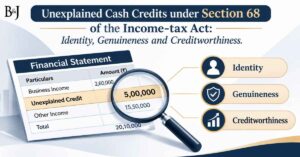
Unexplained Cash Credits under Section 68 of the Income-tax Act: Identity, Genuineness and Creditworthiness
Imagine a small trading company whose accountant, closing the books for the year, records a fresh entry on the liabilities side: Rs. 40 lakh received as an unsecured loan from three individuals, and another Rs. 60 lakh received as share application money from four investor companies. The money is in the bank; the cheques have cleared. A year later the Assessing Officer — the tax official who scrutinises the return — asks a deceptively simple question: where did this money actually come from, and is it really a loan and a share subscription, or is it the company’s own untaxed income wearing a borrowed coat? That question lies at the heart of Section 68 of the Income-tax Act, 1961, which deals with unexplained cash credits appearing in an assessee’s books. The provision is short, but it sits at the busy intersection where genuine commercial borrowing meets the laundering of unaccounted money, and it has generated one of the largest bodies of case law in Indian direct tax. This article explains, for the non-specialist and the practitioner alike, what a taxpayer must show to keep a credit out of the tax net, what the Revenue must do before it can bring the credit in, and how the rules have shifted — often against the taxpayer — across three distinct periods: the original regime, the 2012 proviso for share capital, and the 2022 extension to loans and borrowings.
What Section 68 of the Income-tax Act Actually Says
In its core form, Section 68 of the Income-tax Act provides that where any sum is found credited in the books of an assessee, and the assessee offers no explanation about its nature and source, or offers an explanation which the Assessing Officer does not find satisfactory, the sum may be charged to tax as the income of the assessee. Three features deserve emphasis. First, the provision is triggered by a credit in the books — a bank passbook, on its own, has been held by some courts not to be “books” for this purpose, though a running cash book plainly is. Second, the statute deems the credited sum to be income, which means it is taxed even though the Department need not identify the actual source from which it came. Third, and most importantly, the section places the initial burden of explanation squarely on the assessee, not on the Revenue. It is a statutory reversal of the ordinary rule that he who asserts must prove.
This allocation of burden is not a modern innovation. As long ago as 1963 the Supreme Court, in Kale Khan Mohammad Hanif v. CIT (1963) 50 ITR 1 (SC), held that the onus of proving the source of a sum found credited is on the assessee, and that in the absence of a satisfactory explanation the Income-tax Officer is entitled to treat it as taxable income. The Court reiterated the point in Roshan Di Hatti v. CIT (1977) 107 ITR 938 (SC): where the nature and source of a receipt cannot be satisfactorily explained, the Revenue may hold it to be the assessee’s income, and no further burden lies on the Revenue to show from what particular source that income was derived. Section 68, enacted in 1961, essentially codified this pre-existing judicial rule.
Three Ingredients of Section 68 of the Income-tax Act: Identity, Genuineness and Creditworthiness
Over decades the courts have distilled the assessee’s initial burden into three cumulative ingredients that must be established for every credit — whether a loan, a deposit or share money. These are the identity of the creditor or subscriber (who is this person, and does he exist?), the genuineness of the transaction (did the money really move as a loan or subscription, or is the paperwork a facade?), and the creditworthiness or capacity of the creditor (did that person actually have the means to advance the sum in question?). A credit fails the test if any one ingredient is missing; proving identity alone, or producing a cheque alone, is not enough.
The classic statement of this three-fold requirement is CIT v. Precision Finance (P.) Ltd. (1994) 208 ITR 465 (Cal), where the Calcutta High Court held that it is for the assessee to prove the identity of the creditors, their creditworthiness and the genuineness of the transactions, and that mere payment by account-payee cheque is not by itself sacrosanct — a cheque establishes the route of the money, not its true character or the capacity of the person who signed it. This is the Revenue’s strongest doctrinal anchor: banking channels can be, and routinely are, used to give unaccounted cash the appearance of legitimate finance.
When the Burden Shifts Back to the Revenue
The burden under Section 68, though it starts with the assessee, is not immovable. Once the assessee has led evidence that discharges the initial onus, the burden shifts to the Revenue to displace that evidence, and the Assessing Officer cannot make an addition merely by expressing suspicion or by declining to make the enquiries that were open to him. This is the taxpayer’s side of the balance, and it too rests on Supreme Court authority.
In CIT v. Orissa Corporation (P.) Ltd. (1986) 159 ITR 78 (SC), the assessee had given the names and addresses of its creditors, produced confirmation letters and discharged hundis, and the creditors were themselves income-tax assessees whose file numbers were on the Department’s own record. The Revenue issued summons under Section 131 but, when the creditors did not appear, did not pursue the matter further and did not examine the source of the creditors’ funds. The Supreme Court held that in those circumstances the assessee had done all it could, the burden had shifted, and the addition could not stand. The lesson is that the Revenue cannot sit back: once the assessee produces credible primary evidence, inaction by the Assessing Officer is fatal to the addition.
The same logic was applied to share capital in CIT v. Lovely Exports (P.) Ltd. (2008) 216 CTR 195 (SC). There the Supreme Court, dismissing the Revenue’s special leave petition, observed that if the share application money is received from alleged bogus shareholders whose names are given to the Assessing Officer, the Department is free to reopen the individual assessments of those shareholders, but the sum cannot be regarded as undisclosed income of the recipient company. In other words, once the subscriber’s identity is disclosed, the enquiry into that subscriber’s own funds is to be pursued against the subscriber, not visited upon the company. The Delhi High Court carried the principle further in CIT v. Kamdhenu Steel & Alloys Ltd. (2012) 248 CTR 33 / (2014) 361 ITR 220 (Del), holding that once the assessee adduces evidence establishing the identity of the subscribers and the movement of money through banking channels, the initial onus is discharged, and the Revenue cannot make an addition without bringing material of its own to show that the money in truth emanated from the assessee’s coffers.
The Counterweight: Human Probabilities and the “Apparent versus Real”
If Orissa Corporation and Lovely Exports mark the taxpayer’s high-water line, a parallel stream of authority supplies the Revenue with an equally powerful counterweight. The courts have consistently refused to let taxpayers convert Section 68 into a paper exercise in which self-serving documents are treated as conclusive. Assessment is not a game of make-believe, and the Assessing Officer is entitled to test an explanation against the ordinary course of human conduct and probabilities.
The foundational case is CIT v. Durga Prasad More (1971) 82 ITR 540 (SC), where the Supreme Court warned that a party who relies on a recital in a document may find that the taxing authorities are entitled to look behind it, because “human minds may differ” but the taxing authority is not required to leave its common sense at the door. The principle was crystallised in Sumati Dayal v. CIT (1995) 214 ITR 801 (SC). The assessee there claimed that large capital-account credits were winnings from horse races; the Court held that the apparent must be considered real only until it is shown to be otherwise, and that the taxing authority is entitled to look into the surrounding circumstances and apply the test of human probabilities. On the improbable facts — a novice punter winning jackpot after jackpot — the credits were rightly treated as undisclosed income. Together, these decisions establish that identity documents and confirmation letters are the beginning of the enquiry, not the end of it.
Share capital, the closely-held company and the 2012 proviso
Share capital produced the sharpest doctrinal contest, because a company can dress unaccounted money as premium-laden share subscriptions from shell companies. The tension between the Lovely Exports line (identity disclosed — pursue the subscriber) and the anti-abuse instinct came to a head in PCIT v. NRA Iron & Steel (P.) Ltd. (2019) 412 ITR 161 (SC). The assessee company had received share capital and premium from a web of investor companies. The Supreme Court, restoring the addition, held that the three ingredients must be established to the satisfaction of the Assessing Officer, that the Assessing Officer is duty-bound to conduct an independent and meaningful enquiry, and that where the investor companies were found to be paper entities with no real business, negligible income and no explained source for the large sums invested, the mere production of PAN details, bank statements and incorporation documents did not discharge the onus. NRA did not overrule Lovely Exports; it clarified that identity on paper is not identity in substance, and that genuineness and creditworthiness remain live questions even after names are furnished.
Parliament had, in the meantime, intervened. The Finance Act, 2012 inserted the first proviso to Section 68 with effect from 1 April 2013 (assessment year 2013-14 onward). For a closely-held company (one in which the public is not substantially interested), the proviso deems the company’s explanation for share application money, share capital, share premium or any such amount to be unsatisfactory unless the resident shareholder in whose name the credit stands also offers an explanation of the nature and source of his investment, which the Assessing Officer finds satisfactory. In plain terms, for such companies the statute legislatively imported a “source of source” requirement for share money: it is no longer enough to point to the subscriber; the subscriber’s own funds must be explained. The proviso does not apply where the investor is a venture capital fund or company registered with SEBI.
The 2022 Extension: “Source of Source” for Loans and Borrowings
Until recently, the source-of-source obligation stopped at share capital in closely-held companies. For ordinary loans and borrowings, the settled judicial position was that the assessee had only to establish the identity and creditworthiness of the lender and the genuineness of the loan; it was not required to prove where the lender in turn had obtained his money. The Finance Act, 2022 changed this with effect from 1 April 2023 (assessment year 2023-24 onward). The amended Section 68 now provides that the nature and source of any sum credited as a loan or borrowing, or any other liability, shall be treated as explained only if the source of funds in the hands of the creditor or entry-provider is also explained and found satisfactory. An exception is carved out where the creditor is a well-regulated entity such as a venture capital fund or venture capital company registered with SEBI. The Memorandum to the Finance Bill explained the object frankly: to curb the practice of routing unaccounted money into the books through a masquerade of loans.
The taxpayer’s objection to this expansion is one of practicality and fairness. A genuine borrower has no legal right to interrogate his lender’s bank account and may be unable to compel disclosure of the lender’s own sources; casting that burden on the borrower, the argument runs, can penalise honest borrowing for the sins of the lender. The Revenue’s answer is that the requirement bites only where the lender is a conduit with no visible means, that regulated lenders are expressly excluded, and that the amendment merely aligns loans with the anti-abuse logic already applied to share capital since 2012. Where exactly the courts will draw the line for the post-2023 period — how far a borrower must go, and when a lender’s confirmation plus return of income suffices — is still being worked out, and taxpayers should expect the earlier, more lenient loan authorities to be read down for years falling after the amendment.
Section 115BBE: Tax on Unexplained Income under Section 68
A Section 68 addition is not taxed at ordinary slab rates. Since the insertion of Section 115BBE (and its enhancement by the Taxation Laws (Second Amendment) Act, 2016 with effect from assessment year 2017-18), income assessed under Sections 68 to 69D is taxed at a flat 60 per cent, plus a 25 per cent surcharge and cess — an effective rate in the region of 77.25 per cent — and, critically, Section 115BBE(2) forbids any deduction of expenditure or allowance and any set-off of losses against such income. The practical consequence is severe: a credit that fails the Section 68 test is not merely added to income but taxed at a near-punitive rate with no shelter, which is why the identity–genuineness–creditworthiness enquiry so often decides the entire economics of an assessment.
The Position by Period, at a Glance
| Period | Loans / borrowings | Share capital & premium (closely-held company) |
|---|---|---|
| Up to AY 2012-13 | Assessee proves identity, genuineness, creditworthiness of lender; need not prove lender’s own source (Orissa Corpn.). | Identity of subscriber disclosed → pursue subscriber, not company (Lovely Exports), subject to genuineness/creditworthiness (NRA principle). |
| AY 2013-14 to 2022-23 | Same as above — no statutory source-of-source for ordinary loans. | First proviso (FA 2012): closely-held company must also explain the resident subscriber’s source of funds; SEBI-registered VCF/VCC excepted. |
| AY 2023-24 onward | FA 2022: nature and source of loan/borrowing explained only if the creditor’s own source is also explained; regulated lenders excepted. | Proviso continues; source-of-source firmly required. |
Tax on any resulting addition: Section 115BBE — flat 60% + 25% surcharge + cess, no deduction or set-off (from AY 2017-18).
A Balanced Reading
Section 68 is best understood not as a weapon for either side but as a calibrated shifting of burdens. It begins by placing the onus on the taxpayer, because the taxpayer alone knows the true provenance of what appears in his own books. It then shifts that onus to the Revenue once credible primary evidence is produced, because the State cannot make additions on mere suspicion or through its own inertia. And it permits the taxing authority, throughout, to test the explanation against human probability rather than accept paperwork at face value. The genuine borrower and honest company have, in Orissa Corporation, Lovely Exports and Kamdhenu Steel, robust protection; the launderer of unaccounted money faces, in NRA Iron & Steel, Sumati Dayal and the 2012 and 2022 amendments, an increasingly demanding gauntlet. The direction of legislative travel has undoubtedly favoured the Revenue, but the constitutional core — that an addition must rest on material and reasoning, not conjecture — remains intact.
Frequently Asked Questions
Is a payment by cheque enough to prove a loan under Section 68 of the Income-tax Act?
No. A cheque establishes only the route by which money moved, not the capacity of the lender or the genuineness of the transaction. As the Calcutta High Court held in Precision Finance (208 ITR 465), account-payee cheques are not sacrosanct; the assessee must still establish identity, genuineness and creditworthiness.
If I give the tax officer the names and PAN of my share subscribers, is my burden discharged?
Disclosing identity is necessary but, since NRA Iron & Steel (412 ITR 161), not always sufficient. Where the subscribers are paper companies with no real means, the Assessing Officer may still add the sum; and for a closely-held company after AY 2013-14, the first proviso requires the subscriber’s own source of funds to be explained.
Do the older, taxpayer-friendly loan judgments still apply?
For years up to AY 2022-23, the rule that a borrower need not prove the lender’s source largely holds. For AY 2023-24 onward, the Finance Act 2022 requires the creditor’s source of funds to be explained as well (except for SEBI-regulated lenders), so those earlier authorities must be read in light of the amendment.
Sources & Citations
- Section 68, Income-tax Act, 1961 — core provision; first proviso inserted by the Finance Act, 2012 (w.e.f. 01.04.2013); source-of-source for loans/borrowings inserted by the Finance Act, 2022 (w.e.f. 01.04.2023).
- Section 115BBE, Income-tax Act, 1961 — as enhanced by the Taxation Laws (Second Amendment) Act, 2016 (w.e.f. AY 2017-18).
- Kale Khan Mohammad Hanif v. CIT (1963) 50 ITR 1 (SC).
- Roshan Di Hatti v. CIT (1977) 107 ITR 938 (SC).
- CIT v. Durga Prasad More (1971) 82 ITR 540 (SC).
- CIT v. Orissa Corporation (P.) Ltd. (1986) 159 ITR 78 (SC).
- Sumati Dayal v. CIT (1995) 214 ITR 801 (SC).
- CIT v. Precision Finance (P.) Ltd. (1994) 208 ITR 465 (Cal).
- CIT v. Lovely Exports (P.) Ltd. (2008) 216 CTR 195 (SC).
- CIT v. Kamdhenu Steel & Alloys Ltd. (2012) 248 CTR 33 / (2014) 361 ITR 220 (Del).
- PCIT v. NRA Iron & Steel (P.) Ltd. (2019) 412 ITR 161 (SC).
Related Reading
- Bogus Purchases and Accommodation Entries: Burden of Proof and Commission-Rate Additions
- Search Assessments under Sections 153A and 153C: The “Incriminating Material” Requirement
- Reassessment under Sections 147, 148 and 148A: How the Law Reopens a Closed Year
- On-Money in Real Estate: Whole Receipt or Only the Profit Element?
- Peak Credit and Telescoping: When Arithmetic Limits an Addition under Sections 68 and 69