 Whatsapp


Section 14A and Rule 8D: Disallowing Expenditure When There Is No Exempt Income
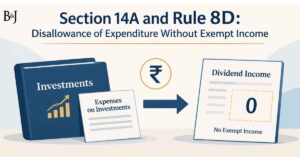
Consider a manufacturing company that, over several years, has bought shares in two of its group companies. It holds them to retain control of the group, not for trading. It borrows working capital from a bank, pays interest, and maintains a finance department that, among its many responsibilities, keeps the share certificates and attends the investee companies’ general meetings. In the year under assessment, neither group company declares a dividend. The company therefore earns no exempt income. Yet the Assessing Officer disallows several lakh rupees of its interest and administrative expenditure, reasoning that the shares are investments capable of generating exempt income and that the cost of holding them should not reduce the tax payable on its taxable profits. This raises a fundamental question concerning Section 14A and Rule 8D: can expenditure be disallowed merely because it relates to investments capable of generating exempt income, even when no such income is earned during the relevant year?
The company’s answer is intuitive: how can an expense be incurred “in relation to” exempt income when no exempt income has arisen? The Revenue’s position is equally straightforward: the purpose of Section 14A is to prevent expenditure attributable to tax-exempt income from reducing the tax payable on taxable profits, and that purpose does not necessarily depend on whether a dividend is declared in a particular year. For more than a decade, this question divided the Income Tax Appellate Tribunal, the High Courts and the Central Board of Direct Taxes. Parliament intervened through the Finance Act, 2022, and the Income-tax Act, 2025 carries that legislative position forward. This article examines the scope of Section 14A disallowance, the computation mechanism under Rule 8D, the judicial interpretation of expenditure relating to exempt income, and the legal position governing years in which no exempt income is earned.
The Purpose and Scope of Section 14A Disallowance
Some income is not taxed at all. Dividends from Indian companies were exempt under section 10(34) of the Income-tax Act, 1961 for most of the period between 2003 and 2020; long-term capital gains on listed shares were exempt under section 10(38) until 2018; income from units of mutual funds, agricultural income and certain bond interest have enjoyed exemptions at various times. The difficulty such exemptions create is simple. If a taxpayer borrows to buy tax-free assets and then deducts the interest from its taxable business profits, the exemption is effectively used twice: the income escapes tax, and its cost reduces tax on other income.
Section 14A was inserted by the Finance Act, 2001, with retrospective effect from 1 April 1962, to close that gap. Its first sub-section provides that, in computing total income, no deduction shall be allowed in respect of expenditure incurred by the assessee “in relation to income which does not form part of the total income under this Act”. A proviso inserted by the Finance Act, 2002 (with effect from 11 May 2001) prevents the section from being used to reassess, or rectify, assessments for assessment years beginning on or before 1 April 2001. Sub-sections (2) and (3), inserted by the Finance Act, 2006 with effect from 1 April 2007, empower the Assessing Officer to determine the disallowable amount by a prescribed method if, having regard to the assessee’s accounts, he is not satisfied with the correctness of the assessee’s own claim – including a claim that no expenditure at all relates to exempt income.
The Supreme Court has described the purpose in terms of net income. In CIT v. Walfort Share and Stock Brokers (P.) Ltd. (2010) 326 ITR 1 (SC), the Court explained that the section is intended to prevent the deduction of expenditure incurred to earn exempt income against taxable income; it applies to expenditure, and not to a loss, so that a loss on the sale of units after a tax-free dividend was not caught. In Godrej & Boyce Manufacturing Co. Ltd. v. DCIT (2017) 394 ITR 449 (SC), the Court held that dividends on which the distributing company had paid dividend distribution tax under section 115-O were nonetheless income that did not form part of the recipient’s total income, so that section 14A applied to them.
“In Relation To”: Apportionment, Not Dominant Purpose
The phrase “in relation to” does the real work in section 14A, and its meaning was settled by a bench of two judges in Maxopp Investment Ltd. v. CIT (2018) 402 ITR 640 (SC), decided on 12 February 2018 together with the Revenue’s appeals in the State Bank of Patiala group. Taxpayers had argued that where shares are bought to acquire or retain control of a company, the dominant purpose of the borrowing is control, not dividends, and so the interest is not “in relation to” the exempt income. The Punjab and Haryana High Court had accepted a dominant-purpose approach. The Supreme Court rejected it. The expression, it held, is synonymous with “in connection with” or “pertaining to”; where dividend is in fact earned on shares, the expenditure on those shares is related to that income regardless of the investor’s primary motive, and the theory of apportionment applies.
The Court nevertheless drew a practical distinction for shares held as stock-in-trade. Where a dealer – typically a bank – holds shares as trading stock, the purpose is to sell them at a profit, the income is business income, and any dividend is incidental. The Court upheld the High Court’s result in the banks’ appeals, while observing that the reasoning required clarification. It added a procedural safeguard of considerable importance: before applying the apportionment method, the Assessing Officer must record satisfaction, having regard to the kind of assessee, that the assessee’s own computation (or its claim that nothing is disallowable) is not correct, and in doing so should examine the nature of the loans used to buy the investments. The requirement of satisfaction had also been emphasised in Godrej & Boyce (2017), where, on the facts of a pre-Rule 8D year and a consistent history, the Court found no basis for the disallowance.
Rule 8D Under Section 14A: How the Disallowance Is Computed
Rule 8D of the Income-tax Rules, 1962 prescribes the method under section 14A(2). It was inserted by Notification No. 45/2008 dated 24 March 2008. In CIT v. Essar Teleholdings Ltd. (2018) 401 ITR 445 (SC) the Supreme Court held the rule to be prospective, and in Maxopp the Court applied that holding to dismiss the Revenue’s appeals for earlier years. The Bombay High Court had earlier held, in Godrej & Boyce Manufacturing Co. Ltd. v. DCIT (2010) 328 ITR 81 (Bom), that the rule applies from assessment year 2008-09; for earlier years the Assessing Officer must make a reasonable disallowance on the facts.
As originally framed, the rule had three limbs: expenditure directly relating to exempt income; a proportion of interest not directly attributable to any particular income, computed by the formula A x B / C (interest multiplied by the average value of exempt-income investments, divided by the average total assets); and one-half per cent of the average value of those investments, representing administrative cost. Sub-rule (2) was substituted by Notification No. 43/2016 dated 2 June 2016. From assessment year 2017-18 the disallowance consists of the direct expenditure plus one per cent of the annual average of the monthly averages of the opening and closing values of investments whose income does not form part of total income, and the total may not exceed the expenditure actually claimed. The interest formula disappeared.
Three judicial glosses shaped the computation. First, a special bench of the Delhi Tribunal held in ACIT v. Vireet Investment (P.) Ltd. (2017) 165 ITD 27 (Del) (SB) that only investments which actually yielded exempt income during the year enter the average. Second, where the assessee’s own interest-free funds exceed its tax-free investments, a presumption arises that the investments were made from those funds and no interest is disallowable: CIT v. Reliance Utilities and Power Ltd. (2009) 313 ITR 340 (Bom) and CIT v. HDFC Bank Ltd. (2014) 366 ITR 505 (Bom), approved by the Supreme Court in South Indian Bank Ltd. v. CIT (2021) 438 ITR 1 (SC). Third, the Delhi High Court held in Joint Investments (P.) Ltd. v. CIT (2015) 372 ITR 694 (Del) that the disallowance cannot exceed the exempt income itself – a cap that is related to, but not the same as, the cap on total expenditure later written into the 2016 rule.
The Central Controversy: No Exempt Income In The Year
The difficult question is the one in the opening illustration. The Revenue’s position rested on three arguments. The first was textual: section 14A speaks of income which “does not form part of the total income”, not income “of the year”, and the heading of the section and of Rule 8D uses the word “includible”, suggesting a character of income rather than an actual receipt. The second was purposive: the cost of carrying a tax-free investment is incurred whether or not the dividend comes in that year. The third was authority: in Cheminvest Ltd. v. ITO (2009) 121 ITD 318 (Del) (SB), a special bench of the Tribunal held that disallowance followed irrespective of whether income was earned, drawing on CIT v. Rajendra Prasad Moody (1978) 115 ITR 519 (SC), which had held that interest on money borrowed to buy shares was deductible under section 57(iii) even in a year in which no dividend was received. The Central Board of Direct Taxes adopted this reasoning in Circular No. 5/2014 dated 11 February 2014, clarifying that Rule 8D read with section 14A provides for disallowance “even where taxpayer in a particular year has not earned any exempt income”.
The High Courts, almost uniformly, took the opposite view. The Punjab and Haryana High Court in CIT v. Winsome Textile Industries Ltd. (2009) 319 ITR 204 (P&H) observed that where no exemption is claimed, section 14A has no application. The Gujarat High Court in CIT v. Corrtech Energy (P.) Ltd. (2015) 372 ITR 97 (Guj), decided on 24 March 2014, declined to interfere with the Tribunal’s finding that no exempt income had been claimed and held that no question of law arose. The fullest reasoning came from the Delhi High Court in Cheminvest Ltd. v. CIT (2015) 378 ITR 33 (Del), decided on 2 September 2015, which reversed the special bench. The Court distinguished Rajendra Prasad Moody on the ground that section 57(iii) allows expenditure incurred “for the purpose of making or earning” income, a forward-looking test, while section 14A disallows expenditure “in relation to income which does not form part of the total income”; a decision allowing a deduction could not be used in reverse to justify a disallowance. It held that the expression envisages an actual receipt of exempt income in the relevant year, following its own earlier decision in CIT v. Holcim India (P.) Ltd. (ITA No. 486/2014, decided 5 September 2014). The Madras High Court took the same view in Chettinad Logistics (P.) Ltd. v. CIT [2017] 80 taxmann.com 221 (Mad), and the Revenue’s special leave petition against that decision was dismissed on 2 July 2018.
It is worth being precise about what such dismissals establish. A dismissal of a special leave petition, without reasons, does not amount to a declaration of law by the Supreme Court: Kunhayammed v. State of Kerala (2000) 245 ITR 360 (SC). Commentary describing the point as “upheld by the Supreme Court” therefore overstates it. The assessee’s position before 2022 rested on a strong and consistent body of High Court authority, not on a Supreme Court ruling. The Revenue, for its part, could point out that the Board’s circular was never withdrawn, and that the purpose of the provision – to ensure that exemptions are measured net of their cost – is not obviously served by allowing the cost in the years in which the investee happens not to pay a dividend.
Finance Act, 2022 Amendment to Section 14A
Parliament intervened in 2022. The Finance Act, 2022 amended section 14A(1), with effect from 1 April 2022, to begin with the words “Notwithstanding anything to the contrary contained in this Act”, and added an Explanation stating, “for the removal of doubts”, that the section shall apply, and shall be deemed to have always applied, in a case where the exempt income has not accrued or arisen or has not been received during the previous year relevant to an assessment year and the expenditure has been incurred during that year. The Memorandum explaining the Finance Bill described the change as a clarification made “to make the intention of the legislation clear”, but stated that it would take effect from 1 April 2022 and apply to assessment year 2022-23 and subsequent years.
The tension between the words “deemed to have always applied” and the stated commencement date was resolved, in the Delhi High Court, in the assessee’s favour. In PCIT v. Era Infrastructure (India) Ltd. (2022) 448 ITR 674 (Del), decided on 20 July 2022, the Court held that the amendment was prospective and applied only from assessment year 2022-23. Relying on Sedco Forex International Drill Inc. v. CIT (2005) 279 ITR 310 (SC), it reasoned that an amendment which changes the law does not become retrospective merely because it is described as being for the removal of doubts, particularly where the Legislature has itself fixed a prospective date and the Memorandum confirms it. Benches of the Tribunal initially divided on the point, and the Gauhati High Court is reported to have followed the prospective reading. The Revenue’s position retains a foothold: the Delhi High Court directed that its decision would abide by the outcome of the Revenue’s special leave petition in PCIT v. IL&FS Energy Development Co. Ltd., and on the information available to us that petition has not been decided. The Supreme Court has not, so far as we can ascertain, ruled on the retrospectivity of the 2022 Explanation.
The practical position is therefore divided by period. For assessment years up to 2021-22, the preponderant High Court view is that no disallowance can be made in a year without exempt income, subject to any contrary ruling of the Supreme Court. For assessment year 2022-23 onwards, the statute expressly permits a disallowance even without exempt income, although the procedural requirement of recorded satisfaction and the computational limits of Rule 8D continue to apply.
Section 14A Disallowance and Book Profit Under Section 115JB
A related question arises for companies paying minimum alternate tax under section 115JB, where tax is levied on adjusted book profit rather than on total income. Clause (f) of Explanation 1 to section 115JB requires the addition to book profit of expenditure relatable to exempt income. The special bench in Vireet Investment held that this addition must be computed on its own terms and that the Rule 8D formula, which belongs to the computation of total income, cannot be imported into it. The Revenue argues that the two provisions share a common purpose and that the formula is the most objective measure available. There is no Supreme Court decision on the point, and the position rests on the special bench and on High Court decisions declining to interfere with it.
The Position By Period
| Period | Position |
|---|---|
| AY 2001-02 and earlier | Section 14A (Finance Act 2001, w.e.f. 1 April 1962) applies, but the proviso bars reassessment or rectification to give effect to it. |
| AY 2002-03 to AY 2007-08 | Disallowance on a reasonable basis; Rule 8D does not apply (Essar Teleholdings; Godrej & Boyce (Bom)). Section 14A(2)-(3) from 1 April 2007. |
| AY 2008-09 to AY 2016-17 | Original Rule 8D: direct expenditure, interest formula A x B / C, and 0.5 per cent of average investments. AO must record satisfaction (Maxopp). |
| AY 2017-18 to AY 2021-22 | Substituted Rule 8D(2): direct expenditure plus 1 per cent of average monthly investments, capped at total expenditure claimed. High Court view: no disallowance without exempt income (Cheminvest; Corrtech). |
| AY 2022-23 to AY 2025-26 | Finance Act 2022 non-obstante clause and Explanation: disallowance even where no exempt income is earned; held prospective (Era Infrastructure). |
| Tax year 2026-27 onwards | Income-tax Act, 2025, section 14; section 14(3) applies the rule even where the exempt income has not accrued, arisen or been received; Rule 14 of the Income-tax Rules, 2026 prescribes the method. |
Under The Income-tax Act, 2025
The Income-tax Act, 2025, in force from 1 April 2026, re-enacts section 14A as section 14. Section 14(1) denies a deduction for expenditure incurred in relation to income which does not form part of total income, “irrespective of anything to the contrary” in the Act; section 14(2) preserves the requirement that the Assessing Officer be dissatisfied, having regard to the accounts, before applying the prescribed method; and section 14(3) provides that the section applies even where the exempt income has not accrued, arisen or been received during the tax year. The 2022 Explanation has thus become a substantive sub-section, without the “deemed to have always applied” formula. The method now appears in Rule 14 of the Income-tax Rules, 2026, which retains the structure of the 2016 Rule 8D: direct expenditure plus one per cent of the annual average of monthly investment values, capped at total expenditure claimed. Because the new Act operates only from tax year 2026-27, the older decisions remain relevant to every pending year – and Maxopp‘s insistence on recorded satisfaction, together with the own-funds presumption in South Indian Bank, should continue to govern the new provision, whose language on those points is materially unchanged.
Frequently Asked Questions
Can expenditure be disallowed under section 14A in a year in which no exempt income was earned? For assessment years up to 2021-22, the High Courts (among them Delhi in Cheminvest, Gujarat in Corrtech Energy and Madras in Chettinad Logistics) held that it cannot, notwithstanding CBDT Circular No. 5/2014. From assessment year 2022-23 the Finance Act, 2022 Explanation – now section 14(3) of the 2025 Act – permits it. The Delhi High Court has held the 2022 amendment prospective, and the Supreme Court has not yet ruled on the point.
Must the Assessing Officer record satisfaction before applying Rule 8D? Yes. Maxopp Investment (2018) 402 ITR 640 (SC) and Godrej & Boyce (2017) 394 ITR 449 (SC) require the officer, having regard to the accounts, to record why the assessee’s own computation is incorrect before applying the prescribed method; section 14(2) of the 2025 Act retains that condition.
Is interest disallowable if the company’s own funds exceed its tax-free investments? Ordinarily not. Where interest-free own funds exceed the investments, the courts presume the investments were made from those funds: Reliance Utilities (2009) 313 ITR 340 (Bom) and HDFC Bank (2014) 366 ITR 505 (Bom), approved in South Indian Bank (2021) 438 ITR 1 (SC). The question has less practical weight after 2016, when the interest limb was removed from Rule 8D.
Sources & Citations
- Income-tax Act, 1961: section 14A (inserted by the Finance Act, 2001, w.e.f. 1 April 1962; proviso inserted by the Finance Act, 2002, w.e.f. 11 May 2001; sub-sections (2) and (3) inserted by the Finance Act, 2006, w.e.f. 1 April 2007; non-obstante clause and Explanation inserted by the Finance Act, 2022, w.e.f. 1 April 2022); sections 10(34), 10(38), 57(iii), 115-O, 115JB (Explanation 1, clause (f)), 119.
- Income-tax Rules, 1962: Rule 8D (inserted by Notification No. 45/2008 dated 24 March 2008; sub-rule (2) substituted by Notification No. 43/2016 dated 2 June 2016).
- CBDT Circular No. 5/2014 dated 11 February 2014; Memorandum explaining the Finance Bill, 2022.
- Income-tax Act, 2025: section 14; Income-tax Rules, 2026: Rule 14.
- CIT v. Walfort Share and Stock Brokers (P.) Ltd. (2010) 326 ITR 1 (SC).
- Godrej & Boyce Manufacturing Co. Ltd. v. DCIT (2017) 394 ITR 449 (SC); Godrej & Boyce Manufacturing Co. Ltd. v. DCIT (2010) 328 ITR 81 (Bom).
- Maxopp Investment Ltd. v. CIT (2018) 402 ITR 640 (SC), with PCIT v. State Bank of Patiala.
- CIT v. Essar Teleholdings Ltd. (2018) 401 ITR 445 (SC), [2018] 90 taxmann.com 2 (SC).
- South Indian Bank Ltd. v. CIT (2021) 438 ITR 1 (SC).
- CIT v. Rajendra Prasad Moody (1978) 115 ITR 519 (SC).
- Sedco Forex International Drill Inc. v. CIT (2005) 279 ITR 310 (SC).
- Kunhayammed v. State of Kerala (2000) 245 ITR 360 (SC).
- Cheminvest Ltd. v. CIT (2015) 378 ITR 33 (Del), reversing Cheminvest Ltd. v. ITO (2009) 121 ITD 318 (Del) (SB).
- CIT v. Holcim India (P.) Ltd., ITA No. 486/2014 (Del), decided 5 September 2014.
- PCIT v. Era Infrastructure (India) Ltd. (2022) 448 ITR 674 (Del).
- Joint Investments (P.) Ltd. v. CIT (2015) 372 ITR 694 (Del).
- CIT v. Corrtech Energy (P.) Ltd. (2015) 372 ITR 97 (Guj), [2014] 223 Taxman 130 (Guj).
- CIT v. Winsome Textile Industries Ltd. (2009) 319 ITR 204 (P&H).
- Chettinad Logistics (P.) Ltd. v. CIT [2017] 80 taxmann.com 221 (Mad); SLP (Revenue) dismissed, [2018] 95 taxmann.com 250 (SC).
- CIT v. Reliance Utilities and Power Ltd. (2009) 313 ITR 340 (Bom); CIT v. HDFC Bank Ltd. (2014) 366 ITR 505 (Bom).
- ACIT v. Vireet Investment (P.) Ltd. (2017) 165 ITD 27 (Del) (SB).
© Bhatt & Joshi Associates. This article is for general information and does not constitute legal advice.

Advocate Aaditya Bhatt
Senior Standing Counsel Income Tax Department, Advocate Gujarat High Court. Aaditya combines his technical and legal expertise to deliver strategic counsel in litigation, constitutional, and regulatory matters. He represents clients before High Courts and Tribunals with a technology-driven approach.