Whatsapp

2006 Mumbai Train Blasts: Bombay High Court Acquittal – Legal Analysis and Historical Context
Case Overview: State of Maharashtra v. Kamal Ahmed Mohd. Vakil Ansari and Others
Introduction
On July 21, 2025, the Bombay High Court delivered a landmark judgment acquitting all 12 accused in the 2006 Mumbai train blasts case. A special bench comprising Justice Anil Kilor and Justice Shyam Chandak overturned the September 2015 conviction by a special MCOCA court that had sentenced five accused to death and seven to life imprisonment[1][2][3].
The High Court’s unanimous verdict stated that “the prosecution has utterly failed to prove the case against the accused” and that it was “hard to believe that the accused committed the crime”[4][1][5]. This acquittal comes 19 years after one of India’s deadliest terror attacks that claimed 189 lives and injured over 800 people[4][6].
The 2006 Mumbai Train Blasts: Historical Context
The Attack
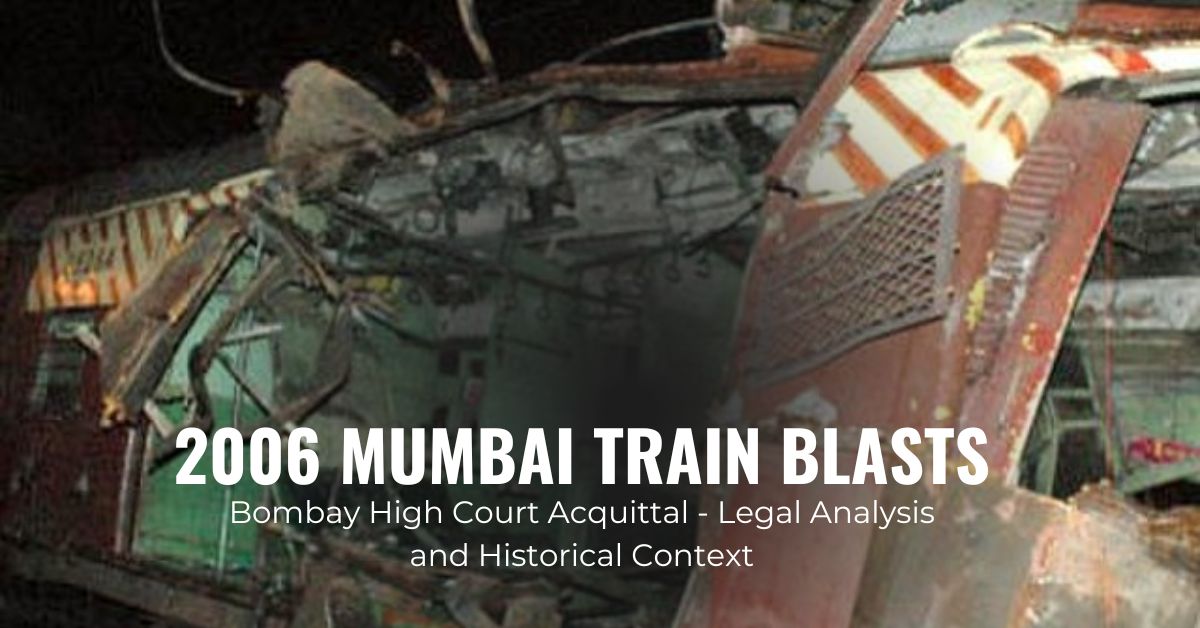
On July 11, 2006, seven synchronized bomb explosions ripped through first-class compartments of suburban trains on Mumbai’s Western Railway line during evening rush hour between 6:24 PM and 6:35 PM[4][7][8]. The explosions occurred at stations including Matunga Road, Mahim Junction, Bandra, Khar Road, Jogeshwari, Bhayandar, and Borivali[4][7].
Investigation and Initial Convictions
The Maharashtra Anti-Terrorism Squad (ATS) conducted the investigation, ultimately charging 13 individuals under the Maharashtra Control of Organised Crime Act (MCOCA)[9]. In September 2015, a special MCOCA court convicted 12 of the 13 accused:
Death Sentences (5 accused):
- Kamal Ahmed Mohd. Vakil Ansari
- Mohammad Faisal Ataur Rahman Shaikh
- Ehtesham Qutubuddin Siddiqui
- Naveed Hussain Khan
- Asif Khan Bashir Khan (alias Junaid)[2][6][10]
Life Imprisonment (7 accused):
- Tanveer Ahmed Mohammed Ibrahim Ansari
- Mohammed Majid Mohammed Shafi
- Shaikh Mohammed Ali Alam Shaikh
- Mohammed Sajid Margub Ansari
- Muzzammil Ataur Rahman Shaikh
- Suhail Mehmood Shaikh
- Zameer Ahmed Latifur Rehman Shaikh[2][6]
One accused, Abdul Wahid Din Mohammad Shaikh, was acquitted by the trial court after spending nine years in jail[2][6].
Legal Framework and Statutory Provisions
Maharashtra Control of Organised Crime Act (MCOCA), 1999
The case was prosecuted under MCOCA, India’s first state legislation specifically enacted to address organised crime[11][12]. Key provisions invoked included:
Section 3 – Punishment for Organised Crime:
- Section 3(1)(i): Organised crime resulting in death – punishable with death or life imprisonment and minimum fine of Rs. 5 lakhs[13][14]
- Section 3(2): Conspiracy, abetting, or facilitating organised crime – 5 years to life imprisonment with fine up to Rs. 5 lakhs[13][14]
Section 17 – Special Rules of Evidence: MCOCA establishes exceptions to the Indian Evidence Act, allowing courts to consider prior conduct of accused persons, recognizing that organised crime members are typically repeat offenders[13][15].
Section 18 – Confessions to Police Officers: A critical provision allowing confessions made before police officers not below the rank of Superintendent of Police to be admissible in court, overriding Section 25 of the Indian Evidence Act[13][16][17]. The section requires strict procedural safeguards:
- Confession must be recorded in a “free atmosphere”
- Officer must explain that the person is not bound to confess
- Voluntary nature must be certified in writing
- Immediate transmission to Chief Judicial Magistrate
- Production of accused before magistrate without unreasonable delay[18][17]
Section 22 – Presumption of Guilt: Once possession of unaccounted property is established, the burden shifts to the accused to prove it was not obtained illegally[13][19].
Indian Penal Code Provisions
The accused were also charged under various IPC sections:
Section 121 – Waging War Against Government: “Whoever wages war against the Government of India, or attempts to wage such war, or abets the waging of such war, shall be punished with death, or imprisonment for life and shall also be liable to fine”[20][21][22].
Section 121A – Conspiracy to Wage War: Criminalizes conspiracy to commit offences under Section 121 or to overawe the Government by criminal force[20][23].
Section 122 – Collecting Arms with Intent to Wage War: “Whoever collects men, arms or ammunition or otherwise prepares to wage war with the intention of either waging or being prepared to wage war against [Government of India], shall be punished with [imprisonment] for life or imprisonment of either description for a term not exceeding ten years”[20][24].
Section 120B – Criminal Conspiracy: General conspiracy provision under the IPC[9].
High Court’s Findings and Legal Reasoning
Evidentiary Failures
The Bombay High Court identified several critical deficiencies in the prosecution’s case:
1. Unreliable Witness Testimony
The court found that “nearly all prosecution witnesses’ testimonies were deemed unreliable”[2]. The bench specifically noted that “after nearly 100 days following the blasts, taxi drivers or passengers could not be expected to remember the accused with certainty”[25][26]. This finding directly challenges the reliability of eyewitness identification, a cornerstone of the prosecution’s case.
2. Flawed Test Identification Parade (TIP)
The court questioned the “trustworthiness of certain prosecution witnesses and the Test Identification Parade (TIP) of some of the accused”[3]. Legal precedent establishes that TIP loses evidentiary value if witnesses who participated in the identification are not examined during trial[27]. The defence had successfully demonstrated inconsistencies in witness conduct, with some remaining silent for years before suddenly identifying accused persons[28].
3. Insufficient Material Evidence
Regarding the recovery of explosives, arms, and maps, the court held that these were “ultimately immaterial since the prosecution failed to establish even the type of bomb used in the attacks”[25][26]. This finding undermines the entire foundation of the prosecution’s case regarding the modus operandi.
4. Procedural Violations in Confession Recording
The defence successfully challenged the admissibility of confessional statements under Section 18 of MCOCA, arguing they were obtained through “torture” by the Maharashtra Anti-Terrorism Squad and were therefore inadmissible[29][30]. The court appears to have accepted that proper procedural safeguards were not followed.
Burden of Proof Analysis
Under Section 101 of the Indian Evidence Act, the burden of proof lies with the party asserting the crime[19][31]. However, MCOCA’s Section 22 creates a reverse burden regarding unaccounted property[13]. The court’s finding that the prosecution “utterly failed to prove the case beyond reasonable doubt”indicates that even with these statutory presumptions, the basic foundational facts required for conviction were not established[2][25].
The Supreme Court has established that even under special terrorism laws with reverse burden provisions, prosecution must first establish basic foundational facts before presumptions operate[32]. In this case, the High Court found these foundational requirements were not met.
Key Legal Arguments and Defence Strategy
Defence Counsel Arguments
Senior advocates Dr. S. Muralidhar, Yug Mohit Chaudhry, Nitya Ramakrishnan, and S. Nagamuthu represented the accused[2][25]. Dr. Muralidhar’s arguments were particularly impactful:
“Innocent people are sent to jail and then years later, when they are released from jail, there is no possibility for reconstruction of their lives. For the last 17 years these accused have been in jail. They haven’t stepped out even for a day”[26][30].
The defence successfully argued:
- Biased Investigation: Systematic failures in the probe with predetermined conclusions[30]
- Media Trial Impact: Public outcry leading police to assume guilt first[30]
- Coerced Confessions: Statements obtained under duress violating MCOCA procedural safeguards[29]
- Stigma Factor: Impact on families and society’s treatment of accused and relatives[30]
Use of Right to Information Act
Notably, accused Ehtesham Siddiqui used RTI applications to expose prosecution falsehoods:
- Witness facing three criminal cases concealed from court
- Police diary entries contradicting official testimony about identification parade timing
- Officers claiming to record confessions before joining their assigned zones[33]
This innovative use of transparency laws to challenge prosecution evidence represents a significant development in criminal defence strategy.
Comparative Legal Analysis
Terrorism Cases and Burden of Proof
The acquittal reflects ongoing tensions in Indian terrorism jurisprudence between security concerns and due process rights. Section 111A of the Evidence Act creates presumptions in “disturbed areas” for offences under Sections 121, 121A, 122, and 123 IPC[34][19], but courts have increasingly scrutinized the quality of evidence even under these provisions.
Recent Supreme Court decisions emphasize that “mere association with a terrorist organisation is not sufficient” and require proof of “intention of furthering the activities of a terrorist organisation” through overt acts[35].
MCOCA’s Evidentiary Provisions in Practice
This case demonstrates the practical limitations of MCOCA’s enhanced powers:
- Section 17’s allowance for considering prior conduct proved insufficient without reliable primary evidence
- Section 18’s confession provisions failed due to procedural non-compliance
- Section 22’s presumptions could not operate without establishing basic possession facts
Implications and Analysis
For Criminal Justice System
The acquittal raises fundamental questions about:
- Investigation Quality: The court’s findings suggest systemic failures in evidence collection and witness preparation despite nine years of investigation[36]
- Special Laws Efficacy: MCOCA’s extraordinary powers proved insufficient when basic investigative standards were not met[25]
- Confession Reliability: The judgment reinforces the importance of strict compliance with procedural safeguards in confession recording under special laws[30]
For Counter-Terrorism Law
The verdict highlights the challenge of balancing security imperatives with due process requirements. While MCOCA provides enhanced powers, courts continue to demand rigorous evidence standards, particularly in capital cases.
The “rarest of rare” doctrine for death penalty cases requires exceptional proof standards that were not met here despite the gravity of the terrorist attack[36].
Broader Implications
Dr. Muralidhar’s observation about “history of failures in probes in terror cases” reflects systemic challenges in terrorism prosecutions in India[30]. The 17-year incarceration of ultimately innocent individuals underscores the human cost of inadequate investigations.
Timeline of Legal Proceedings
| Date | Event |
| July 11, 2006 | Seven bomb blasts on Mumbai trains |
| 2006-2014 | Investigation and arrests by ATS |
| September 30, 2015 | Special MCOCA court convictions and sentences |
| 2015-2024 | Appeals pending in High Court |
| July 2024 | Special bench constituted for daily hearings |
| July 21, 2025 | Bombay High Court acquittals |
Conclusion
The Bombay High Court’s acquittal in the 2006 Mumbai train blasts case represents a significant moment in Indian criminal jurisprudence. While the verdict brings closure to the 12 accused after 19 years of incarceration, it raises profound questions about investigative standards, the efficacy of special terrorism laws, and the protection of individual rights in high-profile cases.
The judgment reaffirms that even under extraordinary legislative frameworks like MCOCA, courts will not compromise on fundamental evidentiary standards. The prosecution’s failure to meet basic proof requirements despite enhanced statutory powers demonstrates that procedural safeguards and rigorous investigation remain the cornerstones of criminal justice.
As Justice Kilor and Justice Chandak observed, when prosecution “utterly fails” to establish guilt beyond reasonable doubt, courts must have the courage to acquit regardless of public expectations or the gravity of the alleged crimes. This verdict, while bringing relief to the accused, also serves as a stark reminder of the human cost of investigative failures in terrorism cases and the paramount importance of maintaining constitutional protections even in the face of heinous crimes.
The case will likely prompt renewed examination of counter-terrorism investigation protocols and may influence future prosecutions under special security laws, reinforcing that enhanced state powers must be exercised with corresponding diligence and adherence to constitutional principles.
Sources:
[1] Bombay High Court acquits all 12 accused including 5 on death row https://www.barandbench.com/news/litigation/711-mumbai-train-blasts-bombay-high-court-acquits-all-12-accused-including-5-on-death-row
[2] Mumbai train blasts 2006: Bombay HC acquits all 12 accused https://www.financialexpress.com/india-news/july-2006-mumbai-train-blasts-bombay-hc-acquits-all-12-accused/3921377/
[3] Bombay High Court Acquits All Accused in 2006 Mumbai Train … https://lawtrend.in/bombay-high-court-acquits-all-accused-in-2006-mumbai-train-blasts-case-citing-lack-of-evidence/
[4] 189 Killed In 2006 Mumbai Train Blasts. All 12 Convicts Acquitted Today https://www.ndtv.com/india-news/2006-mumbai-local-train-blasts-bombay-high-court-acquits-12-after-19-years-8914345
[5] 2006 Mumbai train bombings – Wikipedia https://en.wikipedia.org/wiki/2006_Mumbai_train_bombings [6] 2006 Mumbai train blasts: Bombay HC acquits all 12 accused; says prosecution utterly failed to prove case https://timesofindia.indiatimes.com/city/mumbai/2006-mumbai-train-blasts-bombay-hc-acquits-all-12-accused-says-prosecution-utterly-failed-to-prove-case-against-them/articleshow/122806160.cms
[7] 7/11 Mumbai blast: HC acquits all 12, says prosecution failed to prove case https://www.business-standard.com/india-news/7-11-mumbai-blast-hc-acquits-all-12-says-prosecution-failed-to-prove-case-125072100216_1.html
[8] Eyewitness identifies 7/11 accused – Mumbai – The Indian Express http://www.indianexpress.com/news/eyewitness-identifies-7-11-accused/733553/
[9] 2006 Mumbai blasts case: All 12 convicts acquitted after 19 years https://www.daijiworld.com/news/newsDisplay?newsID=1286899
[10] 7/11 Mumbai Train Blasts: Bombay High Court Acquits All 12 Accused https://www.livelaw.in/high-court/bombay-high-court/711-mumbai-train-blasts-bombay-high-court-acquits-all-12-accused-298189 [11] [PDF] The Maharashtra Control of Organised Crime Act, 1999 – India Code https://www.indiacode.nic.in/bitstream/123456789/16362/3/maharashtra_control_of_.pdf
[12] Maharashtra Control of Organised Crime Act, 1999 – India Code https://www.indiacode.nic.in/handle/123456789/16362?locale=en
[13] [PDF] Burden of proof.—Whoever desires any Court to give judgment as to … https://law.uok.edu.in/Files/5ce6c765-c013-446c-b6ac-b9de496f8751/Custom/Evidence%20UNIT_III.pdf
[14] [PDF] THE INDIAN PENAL CODE, 1860 ACT NO. 45 OF 1860 1* [6th … https://www.indiacode.nic.in/bitstream/123456789/4219/1/THE-INDIAN-PENAL-CODE-1860.pdf
[15] 121a ipc – Indian Kanoon https://indiankanoon.org/search/?formInput=121a+ipc&pagenum=8
[16] Section 101 – India Code https://www.indiacode.nic.in/show-data?actid=AC_CEN_3_20_00034_187201_1523268871700§ionId=38909§ionno=101&orderno=115
[17] IEA : Of The Burden Of Proof – Devgan.in https://devgan.in/iea/chapter_07.php
[18] [PDF] Criminal-Appeal-No.-1125-of-2022.pdf https://www.cvmc.in/wp-content/uploads/Judgment/Criminal-Appeal-No.-1125-of-2022.pdf
[19] All 12 accused acquitted in 2006 Mumbai train blasts case https://newsarenaindia.com/nation/all-12-accused-acquitted-in-2006-mumbai-train-blasts-case/50829
[20] Section 121 in The Indian Penal Code, 1860 https://indiankanoon.org/doc/786750/
[21] [PDF] iinaa I9′ – S3waas https://cdnbbsr.s3waas.gov.in/s3ec0238ed162a0dbef7b3fe0f628aa08b/uploads/2025/01/2025011775.pdf
[22] [PDF] admissibility of confessions under the law of evidence and counter … https://thelawbrigade.com/wp-content/uploads/2020/07/Divya-Singhania-JLSR.pdf
[23] The Penal Code, 1860 | OF OFFENCES AGAINST THE STATE http://bdlaws.minlaw.gov.bd/act-11/chapter-details-8.html
[24] [PDF] reportable – Supreme Court of India https://api.sci.gov.in/supremecourt/2022/2575/2575_2022_12_1501_36044_Judgement_20-May-2022.pdf
[25] Bombay High Court Acquits All 12 Accused In 2006 Mumbai Train Blasts Case, Citing Flawed Probe And Lack Of Evidence https://swarajyamag.com/news-brief/bombay-high-court-acquits-all-12-accused-in-2006-mumbai-train-blasts-case-citing-flawed-probe-and-lack-of-evidence
[26] 2006 Mumbai train blasts: Bombay High Court acquits all 12 accused https://economictimes.com/news/india/2006-mumbai-train-blasts-bombay-high-court-acquits-all-12-accused/articleshow/122806041.cms
[27] GUJARAT CONTROL OF TERRORISM AND ORGANISED CRIME … https://criminallawstudiesnluj.wordpress.com/2021/09/15/gujarat-control-of-terrorism-and-organised-crime-act-a-procrustes-solution/
[28] [PDF] A study with respect to the Maharashtra Control of Organised Crime … https://www.dmejournals.com/index.php/DMEJL/article/download/51/25/82
[29] 2006 Mumbai Train Serial Bomb Blast Case Judgement | PDF – Scribd https://www.scribd.com/document/284022818/2006-Mumbai-Train-Serial-Bomb-Blast-Case-Judgement
[30] Maharashtra Control of Organised Crime Act – Wikipedia https://en.wikipedia.org/wiki/Maharashtra_Control_of_Organised_Crime_Act
[31] IPC : Offences Against The State – Devgan.in https://devgan.in/ipc/chapter_06.php
[32] “Presumption of Guilt” should be used to serve… – ActionAid India https://www.actionaidindia.org/presumption-of-guilt-should-be-used-to-serve-the-vulnerable-not-to-build-unaccountability/
[33] Mumbai serial train blasts investigations – Wikipedia https://en.wikipedia.org/wiki/Mumbai_serial_train_blasts_investigations
[34] [PDF] reportable – Supreme Court of India https://api.sci.gov.in/supremecourt/2016/26557/26557_2016_2_1502_36258_Judgement_11-Jul-2022.pdf
[35] Death sentence given in India train blasts case – Al Jazeera https://www.aljazeera.com/news/2015/9/30/death-sentence-given-in-india-train-blasts-case
[36] Maharashtra Control of Organised Crime Act – Testbook https://testbook.com/mpsc-preparation/maharashtra-control-of-organised-crime-act