Whatsapp

Indian Customs Baggage Rules 2016: Free Allowance and Limits
Introduction and Historical Context
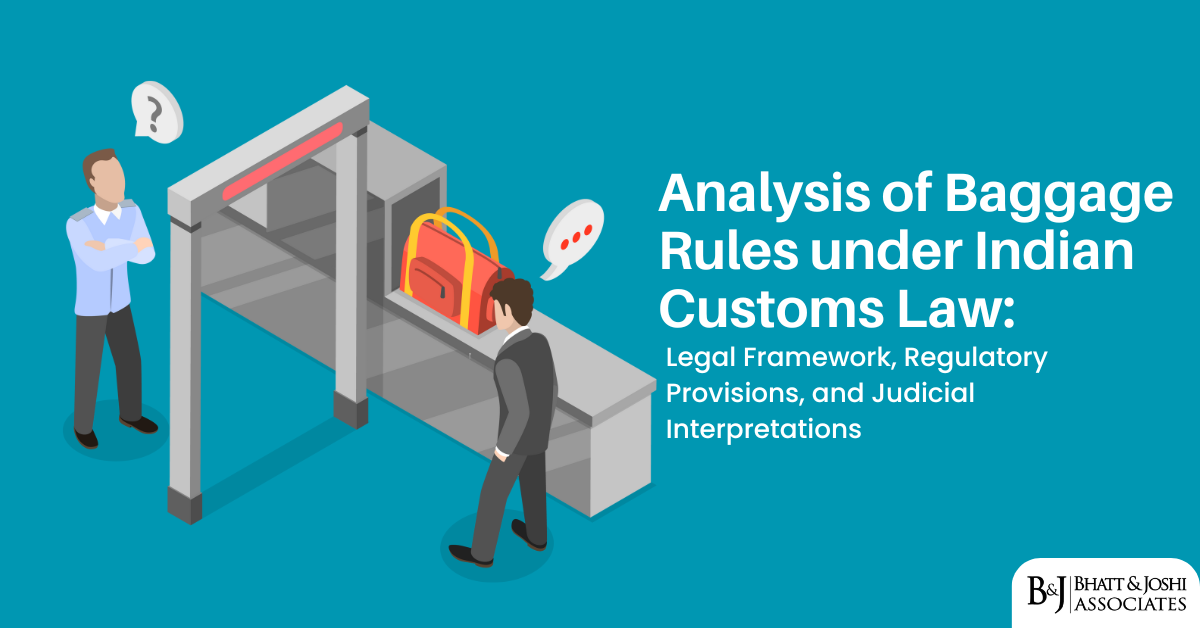
The regulation of passenger baggage under Indian customs law represents a critical aspect of international trade facilitation and revenue protection. The evolution of baggage rules in India reflects the country’s progressive approach toward balancing legitimate passenger convenience with effective customs administration. The current legal framework governing passenger baggage is primarily embodied in the Baggage Rules, 2016, which represents a significant modernization of customs procedures for international travelers.
The genesis of comprehensive baggage regulation in India can be traced to the increasing volume of international passenger traffic and the corresponding need for standardized procedures that ensure both revenue protection and passenger facilitation. The Central Government, recognizing the limitations of the earlier regulatory framework, undertook a comprehensive review of existing provisions and introduced the current set of rules through careful consideration of international best practices and domestic requirements.
Constitutional and Statutory Foundation
Primary Legislative Authority
The constitutional foundation for customs regulation in India emanates from Entry 83 of List I (Union List) of the Seventh Schedule to the Constitution of India, which grants the Union Government exclusive jurisdiction over customs duties. This constitutional provision empowers Parliament to enact comprehensive legislation governing customs matters, including the regulation of passenger baggage.
The Customs Act, 1962, serves as the principal statute governing all aspects of customs administration in India. Section 79 of this Act specifically addresses the treatment of bona fide baggage and provides the statutory foundation for the current regulatory framework. The section reads as follows:
Section 79 – Bona fide baggage exempted from duty:
“(1) The proper officer may, subject to any rules made under sub-section (2), pass free of duty any article in the baggage of a passenger or a member of the crew in respect of which the said officer is satisfied— (a) that it has been in the use of the passenger or member of the crew for his personal use for a reasonable period, or (b) that it is not being imported for trade purposes and is not of a description specified in any rules made under sub-section (2) and its value is within such limit as may be specified in the said rules.”
This provision establishes the fundamental principle that certain articles carried by passengers may be exempted from customs duty, subject to specific conditions and limitations prescribed through subordinate legislation.
Rule-Making Power and Administrative Framework
Subsection (2) of Section 79 confers comprehensive rule-making powers upon the Central Government, stating:
“The Central Government may make rules for the purpose of carrying out the provisions of this section and, in particular, such rules may specify— (a) the minimum period for which any article has been used by a passenger or a member of the crew for the purpose of clause (a) of sub-section (1); (b) the maximum value of any individual article and the maximum total value of all the articles which may be passed free of duty under clause (b) of sub-section (1); (c) the conditions (to be fulfilled before or after clearance) subject to which any baggage may be passed free of duty.”
This delegation of legislative power enables the executive to formulate detailed operational procedures while maintaining parliamentary oversight through the parent statute.
The Baggage Rules, 2016: Comprehensive Legal Analysis
Promulgation and Legal Status
The Central Government exercised its powers under Section 79 of the Customs Act, 1962, and promulgated the Baggage Rules, 2016, through Notification No. 30/2016-Customs (N.T.) dated March 1, 2016. These rules came into force on April 1, 2016, and superseded the earlier Baggage Rules, 1998, marking a significant milestone in the modernization of customs procedures for passenger baggage.
The 2016 Rules represent a comprehensive legal instrument comprising nine substantive rules, one appendix, and three annexures. This structure reflects a systematic approach to addressing various scenarios and categories of passengers while maintaining clarity in administrative procedures.
Scope of Application and Jurisdictional Framework
Rule 2 of the Baggage Rules, 2016, establishes the comprehensive scope of application, stating that these rules shall apply to all passengers arriving in India, including members of the crew engaged in foreign-going conveyances. The territorial jurisdiction extends to all customs areas within India, ensuring uniform application across different ports of entry.
The rules specifically address both accompanied and unaccompanied baggage, recognizing the practical realities of modern international travel where passengers may not always be able to carry all their belongings on the same conveyance. This comprehensive approach ensures that legitimate passenger requirements are accommodated while maintaining effective customs control.
Definitional Framework and Legal Interpretations
Key Definitions Under the Rules
The Baggage Rules, 2016, incorporate several critical definitions that establish the legal parameters for their application. The term “baggage” includes both accompanied and unaccompanied baggage but specifically excludes motor vehicles, maintaining consistency with the parent Act’s definitional framework.
The concept of “bona fide baggage” represents a crucial legal construct that encompasses articles genuinely intended for personal use rather than commercial purposes. This distinction forms the foundation for determining eligibility for duty-free treatment and requires careful assessment by customs officers during clearance procedures.
Judicial Interpretation of Baggage Provisions
Recent judicial developments have significantly clarified the scope and application of baggage rules. The Chennai Bench of the Customs, Excise and Service Tax Appellate Tribunal (CESTAT) has provided important guidance on jurisdictional matters related to baggage appeals. In a landmark ruling, CESTAT clarified that its jurisdiction to entertain appeals pertaining to baggage is subject to specific statutory limitations under the Customs Act.
The tribunal’s interpretation emphasizes that goods imported or exported as domestic baggage under the proviso to Section 129A(1) of the Customs Act fall outside CESTAT’s appellate jurisdiction, establishing clear procedural boundaries for legal challenges related to baggage clearance decisions.
Passenger Categories and Duty-Free Allowances
General Passengers from Non-Neighboring Countries
The regulatory framework establishes differentiated treatment based on the passenger’s country of origin and residential status. For passengers arriving from countries other than Nepal, Bhutan, or Myanmar, the rules provide specific duty-free allowances that reflect India’s trade relationships and practical administrative considerations.
Indian residents and foreigners residing in India, along with tourists of Indian origin, are entitled to duty-free clearance of articles in their bona fide baggage up to a value of Rs. 50,000. This allowance covers used personal items, travel souvenirs, and other articles not specifically prohibited under Annexure-I, provided these items are carried on the person or in accompanied baggage.
Foreign tourists receive a more limited allowance of Rs. 15,000, reflecting policy considerations related to preventing commercial exploitation of tourist privileges while maintaining reasonable facilitation for genuine travelers.
Passengers from Neighboring Countries
Recognition of India’s special relationships with Nepal, Bhutan, and Myanmar is reflected in the distinct treatment accorded to passengers arriving from these countries. The uniform allowance of Rs. 15,000 for all categories of passengers from these countries reflects the unique nature of cross-border movement and traditional trade relationships.
The rules specifically address land border arrivals, recognizing the different patterns of travel and commerce along India’s land frontiers. Passengers arriving by land, including infants, are restricted to carrying only used personal items duty-free, reflecting the need for enhanced vigilance along land borders.
Special Provisions for Transfer of Residence
The rules recognize the legitimate requirements of individuals relocating to India and provide enhanced allowances based on the duration of residence abroad. This graduated system reflects the practical reality that longer overseas residence typically involves accumulation of greater personal and household effects.
For Indian nationals who have resided abroad for periods between three to six months, the rules permit duty-free clearance of personal and household articles (excluding items specified in Annexures I and II but including those in Annexure III) up to an aggregate value of Rs. 60,000.
The allowance increases progressively for longer periods of residence abroad, reaching Rs. 1,00,000 for those who have resided abroad for six months to one year, and Rs. 2,00,000 for those with minimum one-year residence during the preceding two years. The highest category of allowance, available to those with minimum two-year residence abroad, includes additional provisions for specific household items and appliances.
Prohibited and Restricted Items: Annexure Analysis
Annexure-I: Absolutely Prohibited Items
Annexure-I establishes categories of items that are absolutely prohibited from duty-free clearance, reflecting national security, health, and revenue considerations. The inclusion of firearms and ammunition reflects security imperatives, while limitations on tobacco and alcohol products serve both revenue and public health objectives.
The prohibition on gold and silver in any form other than ornaments represents a significant revenue protection measure, recognizing the traditional Indian preference for precious metals as investment vehicles. The specific exclusion of flat panel televisions reflects technology-based categorization that may require periodic review to maintain relevance.
Annexure-II: Conditionally Restricted Items
Annexure-II establishes a middle category of items that may be eligible for duty-free treatment under specific transfer-of-residence provisions but are otherwise subject to customs duty. This category includes various household appliances and electronic items that represent significant value and potential revenue implications.
The inclusion of items such as color televisions, video home theater systems, dishwashers, and large-capacity refrigerators reflects policy decisions balancing passenger convenience with revenue protection. These items typically represent substantial investments and may be legitimate components of household relocation.
Annexure-III: Conditionally Permitted Items
Annexure-III encompasses items that may be cleared duty-free under transfer-of-residence provisions, representing a more liberal category that acknowledges the legitimate requirements of individuals establishing residence in India. The inclusion of personal computers, laptops, microwave ovens, and other modern appliances reflects recognition of contemporary lifestyle requirements.
Unaccompanied Baggage: Legal Framework and Procedures
Statutory Provisions and Conditions
The treatment of unaccompanied baggage represents a sophisticated aspect of the regulatory framework that accommodates practical travel requirements while maintaining customs control. Rule 4 of the Baggage Rules, 2016, establishes the conditions under which unaccompanied baggage may receive the same treatment as accompanied baggage.
The fundamental requirement is that the unaccompanied baggage must have been in the possession of the passenger abroad and be dispatched within one month of arrival in India. This temporal limitation ensures that the baggage genuinely represents the passenger’s personal effects rather than subsequent commercial transactions.
Administrative Discretion and Extensions
The rules recognize that circumstances beyond passenger control may necessitate flexibility in time limits. Deputy Commissioners and Assistant Commissioners of Customs are empowered to grant extensions based on documented circumstances such as sudden illness, natural calamities, disturbed conditions, or transport disruptions.
The provision for unaccompanied baggage to arrive up to two months before the passenger, with possible extension up to one year under exceptional circumstances, demonstrates administrative sensitivity to practical travel complications while maintaining appropriate safeguards against abuse.
Enforcement Mechanisms and Compliance Framework
Administrative Enforcement
The enforcement of baggage rules involves multiple levels of administrative oversight, beginning with frontline customs officers at ports of entry. The proper officer, as defined under the Customs Act, bears primary responsibility for determining eligibility for duty-free treatment and ensuring compliance with applicable conditions.
Recent CBIC notifications have emphasized procedural uniformity across customs formations in handling baggage cases, reflecting the importance of consistent application of rules and prevention of forum shopping by passengers seeking favorable treatment.
Appellate and Review Mechanisms
The appellate framework for baggage-related disputes involves multiple tiers of review, beginning with departmental appeals and potentially extending to CESTAT and higher judicial forums. Recent judicial clarifications have established important precedents regarding the scope of appellate jurisdiction and the specific circumstances under which challenges may be pursued.
The distinction between domestic and international baggage has emerged as a significant factor in determining appellate jurisdiction, with recent CESTAT rulings clarifying that domestic baggage cases fall outside traditional customs appellate procedures.
Contemporary Challenges and Reform Initiatives
Technological Integration and Modernization
The contemporary customs environment increasingly relies on technological solutions to enhance efficiency and transparency in baggage clearance procedures. Integration of risk management systems, automated clearance procedures, and digital documentation represents ongoing modernization efforts.
The implementation of goods and services tax (GST) has created additional complexity in baggage clearance procedures, requiring coordination between customs and GST authorities to ensure seamless passenger facilitation while maintaining compliance with all applicable tax obligations.
Policy Considerations and Future Directions
Recent policy discussions have focused on the need for periodic review of value limits and product categorizations to maintain relevance with contemporary travel patterns and economic conditions. The increasing prevalence of high-value electronic items and changing lifestyle patterns may necessitate adjustments to existing frameworks.
International best practices and bilateral agreements with neighboring countries continue to influence policy development, with emphasis on facilitating legitimate travel while maintaining effective control over commercial exploitation of passenger privileges.
Conclusion
The Baggage Rules, 2016, represent a comprehensive and sophisticated regulatory framework that successfully balances multiple policy objectives including revenue protection, passenger facilitation, and administrative efficiency. The rules demonstrate careful consideration of different passenger categories, travel patterns, and legitimate requirements while maintaining necessary safeguards against abuse.
The legal framework’s foundation in constitutional principles and statutory authority, combined with detailed administrative procedures and appropriate appellate mechanisms, provides a robust system for customs administration of passenger baggage. Recent judicial interpretations have further clarified the scope and application of these rules, contributing to legal certainty and consistent enforcement.
Future developments in this area will likely focus on technological enhancement, periodic review of value limits and product categories, and continued alignment with international best practices. The fundamental principles underlying the current framework, however, remain sound and provide a solid foundation for continued evolution of customs procedures for passenger baggage.
The success of the Baggage Rules, 2016, in achieving their policy objectives while maintaining administrative efficiency demonstrates the effectiveness of carefully crafted subordinate legislation in implementing broad statutory mandates. This framework serves as a model for other areas of customs administration and contributes to India’s broader objectives of trade facilitation and economic integration with the global community.
References
- The Customs Act, 1962, Section 79 – Bona fide baggage exempted from duty. Available at: https://www.indiacode.nic.in/handle/123456789/2475
- Baggage Rules, 2016, Notification No. 30/2016-Customs (N.T.) dated 01.03.2016. Available at: https://taxinformation.cbic.gov.in/content/html/tax_repository/customs/rules/baggage_rules_2016/documents/baggage_rules__2016_01_march_2016.html
- Central Board of Indirect Taxes and Customs, Baggage Rules. Available at: https://dor.gov.in/baggage-rules
- Chennai CESTAT Ruling on Baggage Appeals Jurisdiction (2025). Available at: https://www.jurishour.in/indirect-taxes/baggage-appeals-cestat-jurisdiction/
- CESTAT Chennai, “No Jurisdiction Over Domestic Baggage Appeals Under Section 129A(1),” April 2025. Available at: https://www.livelaw.in/tax-cases/proviso-to-sec-129a1-of-customs-act-lack-jurisdiction-to-entertain-appeal-pertaining-to-any-goods-imported-exported-as-baggage-says-chennai-cestat-288925
- CBIC Notification on Procedural Uniformity in Baggage Handling, May 2025. Available at: https://www.jurishour.in/notification/handling-baggage-customs-formations-cbic/
- Tax Management India, Customs Case Laws Database. Available at: https://www.taxmanagementindia.com/visitor/case_laws_list2.asp?Law=3
- Referencer.in, Baggage Rules 2016 Commentary. Available at: https://www.referencer.in/Baggage_Rules/Baggage_Rules_2016.aspx
- Kolkata Customs Zone, Baggage Rules Implementation Guidelines. Available at: https://www.kolkatacustoms.gov.in/airport/pages/a-baggage-rules
- India Code Portal, Complete Text of Customs Act 1962. Available at: https://www.indiacode.nic.in/bitstream/123456789/15359/1/the_customs_act,_1962.pdf
- https://bhattandjoshiassociates.s3.ap-south-1.amazonaws.com/judgements/the_customs_act,_1962.pdf

Advocate Aaditya Bhatt
Senior Standing Counsel Income Tax Department, Advocate Gujarat High Court. Aaditya combines his technical and legal expertise to deliver strategic counsel in litigation, constitutional, and regulatory matters. He represents clients before High Courts and Tribunals with a technology-driven approach.