Whatsapp

Absenteeism in Criminal Justice: Trial in Absentia in India and Legal Framework
Introduction
The Indian criminal justice system grapples with a persistent challenge that threatens the very foundation of judicial efficiency and fairness. When accused persons deliberately absent themselves from trial proceedings, they create a bottleneck that delays justice for victims, clogs court dockets, and undermines public confidence in the legal system. This phenomenon of absenteeism has evolved from an occasional procedural difficulty into a calculated strategy employed by those seeking to evade accountability. The right to be present during one’s trial, while fundamental, has been exploited as a tool for obstruction rather than protection.
Absenteeism in criminal justice proceedings manifests in various forms—from deliberate absconding after securing bail to strategic disappearance at critical stages of trial. The Supreme Court has repeatedly highlighted how this practice has become a major impediment to speedy justice. In Hussain v. Union of India [1], the Court emphasized that timely delivery of justice is a part of human rights and observed that trials were being delayed due to the absconding of accused persons. The judgment acknowledged that while speedy trial is guaranteed under Article 21 of the Constitution, its realization remains elusive when accused persons manipulate procedural safeguards to their advantage.
The legislative response to this challenge has evolved significantly. The Code of Criminal Procedure, 1973 provided limited mechanisms to address absenteeism, primarily through recording of evidence in the absence of accused persons. However, these provisions proved inadequate in preventing deliberate delay tactics. The newly enacted Bharatiya Nagarik Suraksha Sanhita, 2023, represents a paradigm shift by introducing provisions for trial in absentia of proclaimed offenders, thereby ensuring that justice cannot be held hostage by those who choose to flee from accountability.
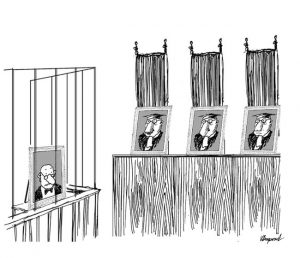
The entire process of criminal adjudication potentially goes into hibernation if the accused absconds
Historical Context and Evolution of Law
The legal framework governing absenteeism from criminal justice proceedings has undergone substantial transformation over the decades. Under the Code of Criminal Procedure, 1973, the provisions dealing with absence of accused persons were primarily reactive rather than preventive. The law recognized that evidence might be lost if proceedings were indefinitely postponed awaiting the appearance of absconding accused, but it stopped short of allowing complete trials in their absence.
Section 299 of the Code of Criminal Procedure, 1973 emerged as the primary provision addressing situations where an accused had absconded with no immediate prospect of arrest [2]. This section permitted courts to examine witnesses produced by the prosecution and record their depositions in the absence of the absconding accused. However, these depositions could only be used in evidence against the accused under strictly limited circumstances—when the witness had died, become incapable of giving evidence, or could not be produced without unreasonable delay, expense, or inconvenience.
The limitation of this approach became apparent in practice. The depositions remained dormant until the accused was arrested or appeared before the court, and even then, the witness had to be subjected to cross-examination unless one of the exceptional circumstances under Section 299 existed. This created a scenario where criminal adjudication hung in uncertainty, and with every passing month and year, the prospect of justice became increasingly distant.
Section 317 of the Code of Criminal Procedure, 1973 provided another mechanism for proceeding in the absence of accused persons, but under different circumstances [3]. This provision allowed a judge or magistrate to dispense with the personal attendance of an accused if satisfied that such attendance was not necessary in the interests of justice, or if the accused persistently disturbed court proceedings. However, this section required that the accused be represented by a pleader and did not permit a complete trial in absentia resulting in conviction and sentencing.
The inadequacy of these provisions was recognized by multiple stakeholders. The Law Commission of India, in its 177th and 239th Reports, identified absconding by accused persons as one of the biggest impediments in the speedy administration of criminal justice [4]. The Supreme Court, in several pronouncements, expressed concern about the systemic manipulation of procedural safeguards by accused persons to delay proceedings indefinitely.
Provisions Under the Code of Criminal Procedure, 1973
The Code of Criminal Procedure, 1973 established a framework that prioritized the presence of accused persons during trial while acknowledging practical necessities that might require limited exceptions. This framework reflected the principle enshrined in Article 14(3)(d) of the International Covenant on Civil and Political Rights, to which India is a party, guaranteeing every person the right to be tried in their presence and to defend themselves in person or through legal assistance.
Section 299 of the Code of Criminal Procedure, 1973 states: “If it is proved that an accused person has absconded, and that there is no immediate prospect of arresting him, the Court competent to try, or commit for trial, such person for the offence complained of or of which he is suspected, may examine the witnesses (if any) produced on behalf of the prosecution, and record their depositions.” The section further provides that such depositions may be given in evidence against the accused on the inquiry into, or trial for, the offence with which he is charged, if the deponent is dead or incapable of giving evidence, or beyond the reach of process, or cannot be produced without an amount of delay, expense or inconvenience which would be unreasonable.
This provision operated on two prerequisites. First, the prosecution had to establish before the court that the accused had absconded. Mere absence was insufficient; there had to be evidence of deliberate evasion. Second, the prosecution had to demonstrate that there was no immediate prospect of arresting the accused. The court was required to record an order explicitly stating that these conditions were satisfied before proceeding under Section 299.
The application of Section 299 involved recording prosecution evidence in the absence of the accused, but this evidence remained in suspended animation until either the accused was arrested or one of the exceptional circumstances materialized. In Sukhpal Singh v. NCT of Delhi, the Supreme Court clarified that if prosecution witnesses could not be located after the accused was arrested, their statements recorded under Section 299 could be regarded as substantive evidence when read with Section 33 of the Indian Evidence Act, 1872 [5].
Section 317 of the Code of Criminal Procedure, 1973 provided a different avenue for proceeding without the physical presence of accused persons. The section stated: “At any stage of an inquiry or trial under this Code, if the Judge or Magistrate is satisfied, for reasons to be recorded, that the personal attendance of the accused before the Court is not necessary in the interests of justice, or that the accused persistently disturbs the proceedings in Court, the Judge or Magistrate may, if the accused is represented by a pleader, dispense with his attendance and proceed with such inquiry or trial in his absence.”
The jurisprudence around Section 317 established that courts possessed discretion to exempt accused persons from personal attendance based on factors such as distance from residence, business commitments, health considerations, and other valid reasons. However, this dispensation was conditional upon the accused being represented by legal counsel and could not be used as a blanket exemption. Courts could direct personal attendance at any subsequent stage if deemed necessary.
The distinction between Sections 299 and 317 was crucial. Section 299 applied when an accused had absconded and allowed recording of prosecution evidence, while Section 317 permitted continuation of proceedings when physical presence was not essential but required legal representation. Neither provision authorized a complete trial resulting in conviction and sentencing in the absence of the accused.
Judicial Pronouncements and Case Law Development
The Indian judiciary has played a pivotal role in interpreting provisions related to absenteeism and highlighting the systemic challenges posed by absconding accused persons. Through a series of landmark judgments, courts have attempted to balance the right of accused persons to be present during trial with the equally important right of society to timely justice.
In Hussain v. Union of India [1], the Supreme Court confronted appeals against denial of bail in cases where accused persons had been in custody for extended periods awaiting trial. The Court observed that judicial service and legal service are not ordinary services but missions for serving society, and this mission fails when litigants waiting in queue do not get their turn for prolonged periods. The judgment emphasized that speedy trial, recognized as part of reasonable, fair and just procedure guaranteed under Article 21, cannot be denied even on the plea of non-availability of financial resources.
The Court in Hussain specifically noted that trials were being delayed due to absconding of accused persons and recommended suitable amendments to the Code of Criminal Procedure to address this malady. Justice Adarsh Kumar Goel, writing for the bench, observed that there are obstructions at every level in enforcement of the right to speedy trial, with vested interests trying to delay proceedings. The judgment called upon Chief Justices of all High Courts to take appropriate steps for speeding up disposal of cases of undertrials and to establish monitoring mechanisms on both administrative and judicial sides.
Earlier, in Surya Baksh Singh v. State of Uttar Pradesh, the Supreme Court had expressed alarm at the sinister increase in instances where convicts filed appeals apparently with the view to circumvent and escape undergoing sentences awarded against them [6]. The Court noted that the criminal justice delivery system was being held to ransom by convicts who developed the devious practice of escaping punishment by filing appeals, obtaining bail or suspension of sentence, and thereafter disappearing beyond the reach of law.
The decision in Jayendra Vishnu Thakur v. State of Maharashtra clarified that while accused persons have a statutory right to be present during cross-examination of witnesses under the Code of Criminal Procedure and the Indian Evidence Act, this right has not been recognized as a fundamental right under Article 21 of the Constitution [7]. This distinction became important in subsequent discussions about permissibility of trials in absentia.
The Gujarat High Court, recognizing the practical difficulties posed by absconding accused, issued a circular in 2016 directing all lower courts to proceed with trial and pass orders under Section 82 of the Code of Criminal Procedure for proclamation of absconding accused. This administrative measure reflected growing judicial recognition that procedural delays caused by absent accused persons could not be indefinitely tolerated.
In various High Court decisions, courts grappled with balancing competing interests. The principle emerged that while fair trial rights are important, they cannot be weaponized by accused persons to frustrate the judicial process. Courts emphasized that the right to be present during trial, like any other right, is not absolute and is subject to reasonable restrictions when exercised in bad faith or for collateral purposes.
Regulatory Framework Under Bharatiya Nagarik Suraksha Sanhita, 2023
The enactment of the Bharatiya Nagarik Suraksha Sanhita, 2023, marks a watershed moment in addressing absenteeism from criminal Justice proceedings. This legislation, which replaced the Code of Criminal Procedure, 1973 with effect from July 1, 2024, introduces comprehensive provisions for conducting trials in absentia of proclaimed offenders, thereby closing the loophole that allowed accused persons to indefinitely stall justice by absconding.
Section 355 of the Bharatiya Nagarik Suraksha Sanhita, 2023 retains the framework of Section 317 of the Code of Criminal Procedure, 1973, allowing courts to dispense with personal attendance of accused persons when their presence is not necessary in the interests of justice or when they persistently disturb proceedings [8]. This provision continues to serve situations where physical presence is not essential but does not authorize complete trials in absentia.
The revolutionary provision is Section 356 of the Bharatiya Nagarik Suraksha Sanhita, 2023, titled “Inquiry, trial or judgment in absentia of proclaimed offender” [9]. This section provides: “Notwithstanding anything contained in this Sanhita or in any other law for the time being in force, when a person declared as a proclaimed offender, whether or not charged jointly, has absconded to evade trial and there is no immediate prospect of arresting him, it shall be deemed to operate as a waiver of the right of such person to be present and tried in person, and the Court shall, after recording reasons in writing, in the interest of justice, proceed with the trial in the like manner and with like effect as if he was present, under this Sanhita and pronounce the judgment.”
This provision establishes three conjunctive conditions that must be satisfied before a trial in absentia can proceed. First, the person must have been declared a proclaimed offender under Section 84 of the Bharatiya Nagarik Suraksha Sanhita, 2023. Second, the person must have absconded to evade trial, demonstrating deliberate intent to avoid accountability. Third, there must be no immediate prospect of arresting the person, indicating that waiting for appearance would result in indefinite delay.
Section 84(4) of the Bharatiya Nagarik Suraksha Sanhita, 2023 significantly expands the scope of who can be declared a proclaimed offender. Under the Code of Criminal Procedure, 1973, this declaration was limited to specific serious offenses. The new law extends this to all offences punishable with imprisonment of ten years or more, imprisonment for life, or death under the Bharatiya Nyaya Sanhita, 2023, or under any other law. This expansion reflects legislative recognition that absconding in any serious criminal case warrants stringent measures.
The Bharatiya Nagarik Suraksha Sanhita, 2023 mandates a waiting period of ninety days from the date of framing of charges before a trial in absentia can commence. This cooling-off period provides the proclaimed offender with sufficient opportunity to surrender and participate in the trial. During this period, courts cannot proceed with substantive trial proceedings under Section 356.
Procedural Safeguards and Due Process Requirements
While permitting trials in absentia, the Bharatiya Nagarik Suraksha Sanhita, 2023 incorporates multiple procedural safeguards to protect the rights of accused persons and ensure that the power is not exercised arbitrarily. Section 356(2) mandates that courts must ensure compliance with specific procedures before proceeding with trial in absentia.
First, the court must issue two consecutive warrants of arrest with an interval of at least thirty days between them. This requirement ensures that reasonable efforts have been made to secure the attendance of the accused through judicial process. The dual warrant system provides multiple opportunities for the accused to respond before the drastic step of trial in absentia is taken.
Second, the court must publish a notice in a national or local daily newspaper circulating in the place of the accused’s last known address of residence. This publication must require the proclaimed offender to appear before the court for trial and inform them that if they fail to appear within thirty days from the date of publication, the trial shall commence in their absence. This ensures that the accused has actual or constructive notice of the impending trial.
Third, the court must inform a relative or friend of the accused about the commencement of trial. This personal notification requirement recognizes that accused persons may not always have direct access to official communications and their family members or associates should be made aware so they can facilitate surrender or legal representation.
Fourth, information about the commencement of trial must be affixed on some conspicuous part of the house or homestead where the accused ordinarily resides and displayed at the police station of the district of their last known address. This public posting serves as additional notice and creates a permanent record of efforts made to inform the accused.
Section 356(3) provides a critical safeguard regarding legal representation. Where the proclaimed offender is not represented by any advocate, they shall be provided with an advocate for their defense at the expense of the State. This ensures that even in absentia, the accused has competent legal representation to protect their interests and present their defense. The State-funded legal aid mechanism prevents miscarriage of justice due to lack of representation.
The provision for audio-video recording under Section 356(5) represents a technological innovation in criminal procedure. The section states that where a trial is conducted in absentia, the deposition and examination of witnesses may, as far as practicable, be recorded by audio-video electronic means, preferably through mobile phones. Such recordings must be preserved as directed by the court. This creates a complete record that can be reviewed if the accused later surrenders or is arrested.
Section 356(4) addresses the evidentiary use of depositions recorded in the absence of proclaimed offenders. It provides that where the court has examined prosecution witnesses and recorded their depositions, such depositions shall be given in evidence against the proclaimed offender. However, if the proclaimed offender is arrested and produced or appears before court during trial, the court may, in the interest of justice, allow examination of any evidence taken in their absence. This provision balances evidentiary efficiency with fairness.
Appeals and Post-Conviction Rights
The Bharatiya Nagarik Suraksha Sanhita, 2023 establishes a unique framework for appeals arising from convictions in absentia trials. Section 356(7) provides that no appeal shall lie against the judgment rendered under this section unless the proclaimed offender presents themselves before the Court of appeal. This requirement serves multiple purposes—it prevents abuse of appellate process by persons continuing to evade arrest, it ensures that appellate courts have the accused available for proceedings, and it incentivizes proclaimed offenders to surrender if they wish to challenge their conviction.
Additionally, Section 356(7) imposes a temporal limitation, stating that no appeal against conviction shall lie after three years from the date of judgment. This three-year window balances the right to appeal with the need for finality in criminal proceedings. It prevents indefinite uncertainty about convictions and allows the criminal justice system to close cases where convicted persons show no intention of submitting to legal process.
Section 356(6) addresses situations where an accused, having initially participated in trial, voluntarily absents themselves after trial has commenced. The provision states that voluntary absence of accused after trial has begun shall not prevent continuation of trial including pronouncement of judgment, even if the accused is arrested and produced or appears at the conclusion of trial. This prevents last-minute disappearance as a tactic to stall judgment.
The provisions regarding appeals reflect a philosophical shift in criminal jurisprudence. Traditionally, the right to appeal has been considered fundamental to justice. However, the Bharatiya Nagarik Suraksha Sanhita, 2023 recognizes that this right cannot be exercised in perpetual absence of the convicted person. By requiring personal appearance before the appellate court, the law ensures that appeals are genuine attempts to seek justice rather than mechanisms for continued evasion.
International Perspectives and Comparative Analysis
The introduction of trials in absentia in Indian law aligns India with global practices adopted by several major jurisdictions. Understanding these international approaches provides context for evaluating the Indian framework and identifying best practices.
In the United States, Federal Rules of Criminal Procedure allow trials in absentia if the defendant absconds after the trial has begun. The defendant must have been present at the beginning of trial and must voluntarily absent themselves. American jurisprudence emphasizes that presence at the commencement of trial satisfies due process requirements, and subsequent voluntary absence constitutes waiver of the right to be present.
The United Kingdom’s Criminal Procedure Rules provide for trials in absence, particularly in summary offenses where the defendant fails to attend without reasonable excuse. British courts exercise this power cautiously, considering factors such as whether the defendant knew about the hearing, reasons for absence, and likelihood of defendant appearing if trial is adjourned. The focus is on proportionality and ensuring that absence is truly voluntary.
China’s 2018 amendment to the Criminal Procedural Law introduced trial in absentia procedures under Article 291 for specific crimes including embezzlement, bribery, crimes seriously compromising national security, and terrorist activities for fugitives who have fled China. Chinese law limits trials in absentia to intermediate people’s courts or courts of first instance at municipal level, and does not apply to crimes such as homicide or kidnapping. Like India, China provides for state-appointed lawyers to represent absent accused.
Pakistan does not allow complete trials in absentia, but Section 512 of its Code of Criminal Procedure permits recording of evidence in absence of defendants proved to have absconded without immediate prospect of arrest. This mirrors the earlier Indian position under Section 299 of the Code of Criminal Procedure, 1973, demonstrating that Pakistan has not yet adopted the more expansive approach now embodied in Indian law.
Saudi Arabia and the United Arab Emirates have provisions for trial in absentia for serious offenses including terrorism, drug trafficking, and organized crime. These countries emphasize that absence must be deliberate and that accused persons must have received adequate notice of proceedings.
The Indian approach under Section 356 of the Bharatiya Nagarik Suraksha Sanhita, 2023 incorporates international best practices while adapting them to Indian constitutional and procedural requirements. The extensive safeguards regarding notice, legal representation, and recording of evidence reflect lessons learned from global experiences. The limitation to proclaimed offenders in serious cases ensures proportionality, while the requirement for court-appointed counsel addresses concerns about fairness raised in various jurisdictions.
Impact on Criminal Justice Administration
The provisions for trial in absentia under the Bharatiya Nagarik Suraksha Sanhita, 2023 are expected to have significant impact on the functioning of criminal justice system. One of the primary benefits is reduction in case pendency caused by absconding accused. Courts will no longer be compelled to indefinitely postpone trials awaiting appearance of proclaimed offenders, enabling more efficient use of judicial resources.
The deterrent effect on potential absconders represents another important impact. Accused persons contemplating flight to evade trial must now weigh the certainty that proceedings will continue in their absence and conviction can be secured without their presence. This changes the risk-calculus that previously favored absconding as a viable strategy for avoiding accountability. The knowledge that property can be attached and confiscated under Section 107 of the Bharatiya Nagarik Suraksha Sanhita, 2023 in proceedings against proclaimed offenders adds further deterrence.
Victims and complainants benefit significantly from these provisions. Previously, victims in cases where accused absconded faced the prospect of being repeatedly called to court over many years without resolution. The trauma of reliving victimization through testimony was compounded by uncertainty about whether justice would ever be served. Trials in absentia provide closure and vindication of rights within reasonable timeframes.
From an investigative perspective, the provisions strengthen the prosecution’s ability to preserve evidence. Witnesses who might otherwise become unavailable, die, or lose memory of events over extended delays can now have their testimony recorded and utilized. This is particularly important in organized crime, terrorism, and economic offense cases where witnesses may face intimidation or may be located in different jurisdictions.
The extradition implications merit attention. When India seeks extradition of fugitives who have fled the country, the existence of convictions secured through fair trials in absentia strengthens extradition requests. Many countries are more willing to extradite individuals who have been convicted through legal processes that meet international standards of due process, including notice and legal representation.
Challenges and Constitutional Considerations
Despite the benefits, trials in absentia raise important questions about constitutional rights and procedural fairness. The right to be present during one’s trial has deep roots in principles of natural justice. Article 21 of the Constitution guarantees that no person shall be deprived of life or personal liberty except according to procedure established by law, and the Supreme Court has interpreted this to include the right to fair trial.
Critics argue that trials in absentia may compromise the accused’s ability to effectively participate in their defense. Even with court-appointed counsel, the absence of the accused means they cannot instruct counsel on facts, identify witnesses, or make strategic decisions about defense. The personal knowledge and perspective of the accused is irreplaceable, and its absence may affect the quality of defense.
The determination of whether an accused has “absconded to evade trial” involves subjective assessment. In some situations, accused persons may be unable to appear due to circumstances beyond their control—illness, detention elsewhere, lack of resources for travel, or genuine fear for safety. If courts erroneously conclude that absence is deliberate when it is not, innocent persons may be convicted without opportunity to present their defense.
The requirement for newspaper publication and affixing of notices raises questions about effectiveness in reaching genuinely absent accused. In an era of digital communication and global mobility, publication in local newspapers may not actually inform accused persons who have moved to different cities or countries. While these requirements satisfy procedural fairness in form, their substantive effectiveness in ensuring actual notice may be limited.
The three-year limitation on appeals against conviction represents a significant departure from traditional appellate rights. While the requirement that proclaimed offenders present themselves before appellate courts is justifiable, the temporal limitation may bar appeals even from persons who surrender after three years. This raises questions about whether the right to appeal, recognized as important for correcting judicial errors, should be subject to such stringent time limits.
The expansion of proclaimed offender declaration to all offenses punishable with ten years or more imprisonment casts a wide net. This includes many offenses where absconding may not be as prevalent or problematic as in organized crime or terrorism cases. The question arises whether trials in absentia should be reserved for the most serious offenses or specific categories of crimes rather than applied broadly.
Conclusion
Absenteeism from criminal justice proceedings has evolved from a peripheral concern into a central challenge affecting the functioning of India’s criminal justice system. The legislative response, culminating in the comprehensive framework established by the Bharatiya Nagarik Suraksha Sanhita, 2023, represents a decisive attempt to address this challenge while balancing competing rights and interests.
The provisions for trial in absentia under Section 356, while controversial, reflect pragmatic recognition that accused persons cannot be permitted to hold the justice system hostage through deliberate absence. The extensive procedural safeguards—including proclamation requirements, notice provisions, mandatory legal representation, recording of proceedings, and limitations on who can be tried in absentia—demonstrate legislative sensitivity to constitutional concerns about fair trial.
The true test of these provisions lies not in their text but in their implementation. Courts must exercise powers under Section 356 judiciously, carefully verifying that accused persons have genuinely absconded rather than being unable to appear for legitimate reasons. The requirement for recording reasons in writing before proceeding with trial in absentia serves as an important check, compelling courts to engage in reasoned decision-making rather than mechanically applying the provision.
Legal representation for absent accused must be meaningful rather than perfunctory. State-appointed defense counsel must diligently investigate facts, examine witnesses, and present defenses as they would for present accused. Bar associations and legal services authorities have important roles in ensuring quality of representation in absentia trials.
The impact of these provisions will unfold over time as courts develop jurisprudence interpreting and applying Section 356. Appellate courts will inevitably face questions about the scope of the provision, adequacy of procedural compliance, and constitutional validity. The ultimate success of this legislative innovation depends on whether it achieves its objectives of reducing delays and ensuring accountability while preserving essential fair trial guarantees.
For victims of crime, witnesses, and society at large, the provisions offer hope that justice will not be indefinitely deferred by accused persons who choose flight over facing the consequences of their actions. For the legal system, these provisions represent an opportunity to demonstrate that procedural rules serve justice rather than obstruct it. The challenge is to implement this framework in a manner that vindicates both the right to speedy justice and the right to fair trial, recognizing that these are complementary rather than contradictory imperatives in a constitutional democracy.
References
[1] Hussain v. Union of India, (2017) 5 SCC 702. Available at: https://indiankanoon.org/doc/70780578/
[2] Section 299, Code of Criminal Procedure, 1973. Available at: https://indiankanoon.org/doc/831107/
[3] Section 317, Code of Criminal Procedure, 1973. Available at: https://indiankanoon.org/doc/1009979/
[4] Trial in Absentia – A Tool for Justice or Injustice?, LiveLaw. Available at: https://www.livelaw.in/articles/absence-of-accused-and-criminal-trial-delay-287610
[5] Sukhpal Singh v. NCT of Delhi case analysis, Drishti Judiciary. Available at: https://www.drishtijudiciary.com/current-affairs/section-299-of-crpc
[6] Absenteeism from Criminal Justice: A Plea for Reform, SCC Times (October 10, 2020). Available at: https://www.scconline.com/blog/post/2020/10/10/absenteeism-from-criminal-justice-a-plea-for-reform/
[7] Reworking Section 299(1) of the CrPC in the Interest of Speedy Justice, NUJS SACJ (March 2, 2021). Available at: https://www.nujssacj.com/post/reworking-section-299-1-of-the-crpc-in-the-interest-of-speedy-justice
[8] Trial in Absentia Under Bharatiya Nagarik Suraksha Sanhita, LiveLaw (January 21, 2024). Available at: https://www.livelaw.in/top-stories/trial-in-absentia-under-bharatiya-nagarik-suraksha-sanhita-247278
[9] Section 356, Bharatiya Nagarik Suraksha Sanhita, 2023. Available at: https://indiankanoon.org/doc/105262049/
Written by Parthvi Patel, student at United World School of Law.

Chandni Joshi
Advocate at Gujarat High Court and CoFounder at Bhatt and Joshi Associates. As Co-Founder, Chandni leads firm operations and client advisory functions. Her dual background in technology and law enables her to handle corporate, cyber, and IP matters with precision and insight.