 Whatsapp

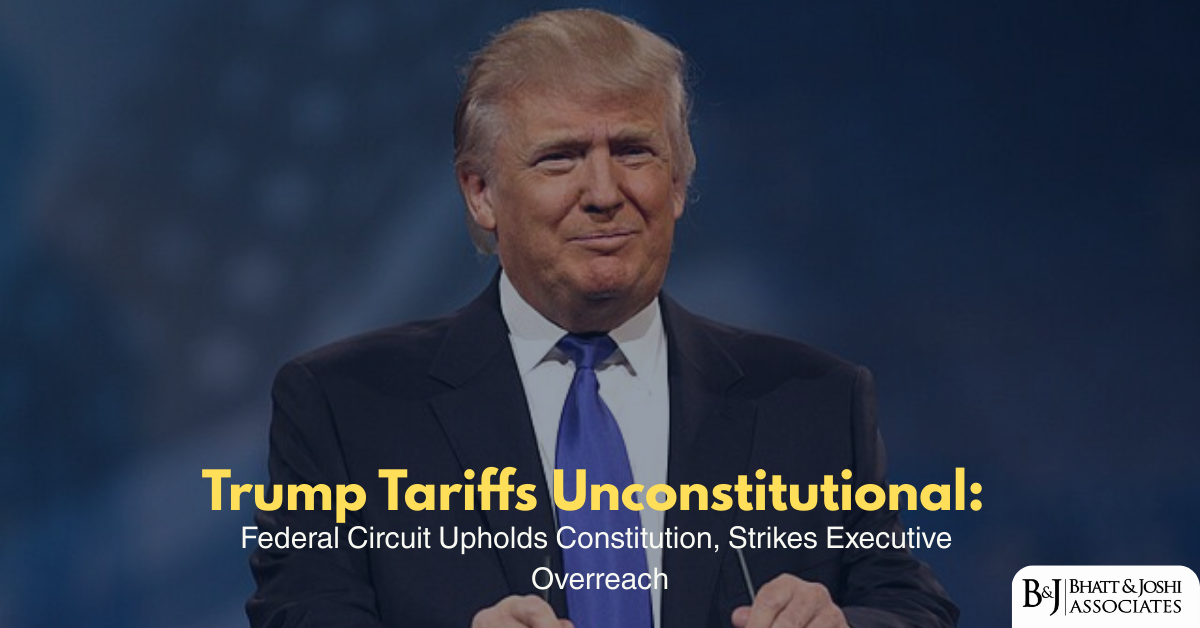
Trump Tariffs Unconstitutional: Federal Circuit Upholds Constitution, Strikes Executive Overreach
The U.S. Judiciary’s Challenge to Transnational Tariff Regimes and India’s Weaponized Legal Counter-Offensive
Introduction
In an era of unprecedented global economic warfare, the judiciary’s role in constraining imperial executive overreach has once again proven decisive. The recent landmark ruling by the U.S. Court of Appeals for the Federal Circuit—a stunning 7-4 decision declaring the vast majority of trump tariffs unconstitutional—has sent shockwaves through the international trade landscape.[1]
This judgment, rooted in the most foundational principles of American constitutional law, represents nothing less than the judicial dismantling of economic imperialism. The Trump Tariffs Unconstitutional ruling creates an unprecedented opportunity for targeted nations, including India, to strategically engage with America’s legal system against executive overreach.
[pdfjs-viewer url=”https://bj-m.s3.ap-south-1.amazonaws.com/p/2025/09/25-1812.OPINION.8-29-2025_2566151.pdf” attachment_id=”27097″ viewer_width=100% viewer_height=600px fullscreen=false download=true print=false]
Context for Indian Lawyers
The U.S. Court of Appeals for the Federal Circuit is a unique appellate court with nationwide jurisdiction over specific subject matters, including international trade and patent law. Its decisions are binding across the country unless overturned by the U.S. Supreme Court, making its rulings particularly significant in trade disputes.
For India, which has borne the brunt of Trump’s 50% punitive tariffs affecting $48.2 billion in bilateral trade, this development transcends academic interest. It is a constitutional vindication of our strategic resistance and, more critically, a legal blueprint for an aggressive, multi-dimensional counter-offensive within the American judicial system itself. The empire’s constitutional crisis has become our constitutional opportunity.[2]
The Constitutional Earthquake: America’s Judiciary Strikes Down Imperial Overreach
The Youngstown Framework Applied: Presidential Power at Its “Lowest Ebb”
The Federal Circuit’s 7-4 decision represents the most significant constitutional constraint on presidential trade power since the Supreme Court’s legendary ruling in Youngstown Sheet & Tube Co. v. Sawyer (1952). Applying Justice Jackson’s three-part framework with surgical precision, the court concluded that trump tariffs unconstitutional are based on IEEPA overreach and fall squarely into “Category Three”—where presidential power operates at its lowest ebb because Congress has not authorized the claimed authority.[3]
Context for Indian Lawyers:
- Category One (Maximum Power): President acts with Congressional authorization.
- Category Two (Zone of Twilight): President acts where Congress is silent.
- Category Three (Lowest Ebb): President acts against Congress’s will—making the action presumptively unconstitutional.
The tariffs were placed in Category Three, where presidential actions are unconstitutional unless supported by exclusive Article II powers—a standard that Trump’s tariff regime catastrophically failed to meet.
Context for Indian Lawyers: What is IEEPA? IEEPA is a 1977 U.S. law that grants the President broad authority to regulate international commerce after declaring a national emergency in response to an “unusual and extraordinary threat” to the national security, foreign policy, or economy of the United States, where that threat originates substantially outside the U.S. It was originally intended for situations like sanctioning foreign governments or freezing assets of terrorist groups, not for imposing sweeping tariffs on major trading partners. The court’s ruling suggests that using IEEPA for such tariffs was an overreach beyond the statute’s intended scope.
This constitutional classification is devastating: In Category Three, presidential actions are presumptively unconstitutional unless supported by exclusive Article II powers—a standard that the trump tariffs unconstitutional ruling confirms Trump’s tariff regime failed to meet.
Context for Indian Lawyers: Article II of the U.S. Constitution outlines the powers of the executive branch, headed by the President. These include roles as Commander-in-Chief of the military and the authority to make treaties (with Senate approval). The argument is that the power to set tariffs does not fall under the President’s exclusive constitutional powers and therefore cannot justify an action taken against the will of Congress.
The Non-Delegation Doctrine: Judicial Restoration of Congressional Supremacy
The court’s application of the non-delegation doctrine strikes at the heart of executive authoritarianism. As the court explicitly held, Trump’s interpretation of IEEPA would grant him “unlimited authority to impose tariffs”—precisely the kind of boundless delegation that the Constitution’s framers designed the separation of powers to prevent.
Context for Indian Lawyers: The Non-Delegation Doctrine is a principle in U.S. constitutional law that holds that one branch of government (in this case, Congress) cannot delegate its constitutional powers to another branch (the Executive). While some delegation is permitted, it must be guided by an “intelligible principle.” This is very similar to the doctrine in Indian administrative law that holds that the legislature cannot delegate its essential legislative functions. The court here is saying that if IEEPA were interpreted to allow any tariff on any product at any time, it would amount to an unconstitutional delegation of Congress’s core legislative power to tax and regulate commerce.
The constitutional principle is ironclad: Article I, Section 8 vests the power to “lay and collect Taxes, Duties, Imposts and Excises” exclusively with Congress. When the court declared that “tariffs are a core Congressional power,” it wasn’t merely interpreting statute—it was reaffirming the fundamental architecture of American democracy against executive usurpation.
Context for Indian Lawyers: Article I, Section 8 of the U.S. Constitution explicitly enumerates the powers of Congress (the legislative branch). This clause is the foundation of Congress’s “power of the purse” and its authority over economic policy, including all forms of taxation and tariffs. The court’s decision reaffirms that this power belongs to the legislature, not the executive.
The Major Questions Doctrine: The Death Knell of Administrative Imperialism
Perhaps most significantly, the Federal Circuit deployed the Major Questions Doctrine—the Supreme Court’s newest and most powerful weapon against executive overreach—with devastating effect. The court found that Trump’s tariff regime, with its multi-trillion-dollar economic impact, unquestionably met the threshold for “vast economic and political significance,” reaffirming that the Trump Tariffs Unconstitutional ruling was justified and required clear congressional authorization.[4]
Context for Indian Lawyers: The Major Questions Doctrine is a relatively new but highly influential rule of statutory interpretation in U.S. law. It states that if a government agency or the President wants to take an action of “vast economic and political significance,” the authority for that action must be explicitly and clearly stated in a law passed by Congress. Ambiguous or general language in a statute is not enough. This doctrine serves as a powerful judicial check on the expansion of executive power into major policy areas without direct legislative approval.
The constitutional logic was unassailable: Trump’s attempt to derive unlimited taxation power from the ambiguous word “regulate” in IEEPA represented precisely the kind of interpretive imperialism that the Major Questions Doctrine was designed to destroy.
India’s Weaponized Legal Counter-Offensive: Constitutional Warfare Through American Courts
The Federal Circuit’s decision, while fundamentally an internal U.S. constitutional dispute, creates a rare strategic opening for the Indian government and its economic interests. When the subject of a domestic constitutional crisis is a foreign policy action—in this case, punitive tariffs—the nations targeted by that action are no longer mere spectators. They become stakeholders with a compelling interest in the outcome. The ruling, which declared the trump tariffs unconstitutional, provides India with an unprecedented opportunity to actively intervene and influence the interpretation of the U.S. Constitution to its own strategic advantage.
The central question is no longer just whether the tariffs are harmful, but whether they are legal under American law. With the trump tariffs unconstitutional ruling as precedent, this shifts the battleground from diplomatic protest to the U.S. judicial system itself. The challenge, therefore, lies in identifying the precise modes and modalities that permit a foreign sovereign and its commercial entities to engage in this constitutional battle. India can deploy a multi-pronged strategy that leverages different legal instruments and forums within the American system, effectively turning the U.S. rule of law into a weapon against its own executive’s overreach. What follows is a blueprint for this legal counter-offensive, divided into distinct phases and methods of engagement.
Phase One: Immediate Strategic Intervention
1. Supreme Court Amicus Brief: India’s Constitutional Voice
The most immediate and strategically devastating pathway for India is aggressive intervention in the pending Supreme Court appeal as amicus curiae. With the Federal Circuit’s ruling stayed until October 14, 2025 to allow Trump’s desperate Supreme Court challenge, India has a prime opportunity to deliver a constitutional coup de grâce.[5]
Context for Indian Lawyers: An amicus curiae (“friend of the court”) brief is a submission made by a person or organization who is not a party to the case but has a strong interest in the matter. While the term is familiar in India, in the U.S. Supreme Court, such briefs from foreign governments can be particularly influential in cases involving international trade, foreign relations, and the interpretation of federal statutes with global implications.
Strategic Objectives of India’s Amicus Brief:
Constitutional Validation: Support the Federal Circuit’s non-delegation and Major Questions analysis with India’s evidence of executive overreach
International Law Integration: Demonstrate how unlimited presidential tariff power violates fundamental principles of international economic law
Comparative Constitutional Analysis: Present evidence from other constitutional democracies showing how executive trade power is properly constrained
Economic Evidence: Provide comprehensive documentation of the $48.2 billion economic warfare inflicted on India through illegal executive action[2]
The Supreme Court regularly accepts and relies heavily on amicus briefs from foreign governments in trade-related constitutional cases. India’s brief would transform the case from domestic constitutional law into global constitutional principle—exactly the kind of systemic analysis that influences Supreme Court jurisprudence.[6]
2. The Corporate Phalanx: Coordinated Litigation Through Indian Subsidiaries
While a direct lawsuit by the Government of India against the U.S. government would face formidable jurisdictional hurdles, Indian corporations and their U.S. subsidiaries face no such constraints. This creates a powerful opportunity for coordinated constitutional warfare through corporate litigation vehicles.
Context for Indian Lawyers: A direct legal challenge by the Indian government would almost certainly be dismissed by U.S. courts for several reasons. First is the doctrine of sovereign immunity; the U.S. government cannot be sued without its consent by a foreign Government in USA. Apart, the more significant barriers are the doctrines of standing (the U.S. equivalent of locus standi) and the political question doctrine.
A court would likely rule that the direct, legally cognizable injury was suffered by the companies that paid the tariffs, not by the Indian state whose injury is more general economic harm. Furthermore, a court would likely view a government-vs-government lawsuit as a non-justiciable “political question”—a foreign policy dispute best left to the executive and legislative branches.
The strategy proposed is to bypass these barriers entirely. Private corporations, having suffered direct financial harm, have clear standing. Their lawsuit is framed as a commercial dispute (an illegal tax), not a political one, making it impossible for a court to dismiss. This transforms the issue from a diplomatic standoff into a straightforward administrative and constitutional law case.
Strategic Corporate Intervention:
Indian Conglomerates with U.S. Operations: Major Indian companies like Tata, Reliance, Infosys, and their U.S. subsidiaries have clear Article III standing to challenge tariffs in the Court of International Trade[7]
Context for Indian Lawyers: Article III standing is the constitutional requirement for a party to bring a lawsuit in a U.S. federal court. It is analogous to the concept of locus standi in India. To have standing, a plaintiff must prove they have suffered a concrete and particularized “injury in fact,” that the injury was caused by the defendant’s conduct, and that a favorable court decision can redress the injury. U.S. subsidiaries of Indian companies that paid the illegal tariffs would easily meet this requirement as they have suffered a direct financial injury.
Coalition with U.S. Importers: India can provide strategic coordination, funding, and evidentiary support to U.S. importers challenging the tariffs—effectively funding constitutional challenges from within the American system[8]
Multiple Jurisdictional Attacks: Simultaneous challenges in the Court of International Trade, Federal District Courts, and through administrative challenges create multiple pressure points that overwhelm the government’s defense capabilities
Context for Indian Lawyers: The Court of International Trade is a specialized federal court that handles cases involving customs, tariffs, and international trade laws. Federal District Courts are the general trial courts of the U.S. federal system. Filing cases in multiple courts can create a complex and resource-intensive legal battle for the government.
Current Active Litigation Opportunities: Multiple cases are immediately available for Indian intervention, including pending Court of International Trade proceedings and federal district court challenges. India can immediately join existing battles rather than starting new litigation.
Phase Two: Institutional Infrastructure Development
3. The Bilateral Investment Treaty Imperative: Building Permanent Legal Architecture
The current crisis exposes a critical strategic vulnerability: the absence of a comprehensive U.S.-India Bilateral Investment Treaty. This gap must be transformed from defensive weakness into offensive legal infrastructure.
Recent Strategic Developments: India is actively revising its Model BIT to be more investor-friendly as of 2025, suggesting a strategic pivot toward more aggressive investment protection. India is currently negotiating BITs with 12+ countries, demonstrating institutional capacity for rapid treaty development.[9]
Strategic BIT Elements for Constitutional Protection:
Clear Definition of Indirect Expropriation: Include discriminatory tariffs as a form of regulatory taking requiring compensation
Emergency Arbitration Procedures: Enable rapid response to time-sensitive trade disputes
Most-Favored-Nation Treatment: Prevent discriminatory trade measures through treaty obligation
Investor-State Dispute Settlement: Provide direct legal remedy against discriminatory government action
The Constitutional Leverage: America’s own courts have now declared unilateral tariff imposition constitutionally illegal. This creates unprecedented negotiating leverage for a BIT that constrains such actions through international law obligations.[10]
4. The WTO Offensive: Legal Predicate for Broader Constitutional Challenges
India’s aggressive expansion of its WTO retaliation package to $3.82 billion—nearly doubling the original amount—demonstrates our shift from defense to constitutional offense.[11] While the WTO’s Appellate Body remains paralyzed, India’s comprehensive WTO filings serve multiple strategic legal purposes:
Legal Functions of WTO Strategy:
International Law Foundation: Creates formal adjudication that U.S. tariffs violate international trade law
Evidence for U.S. Courts: WTO panel findings become powerful evidence in amicus briefs and corporate litigation
Diplomatic Pressure: Multilateral legal condemnation strengthens India’s position in bilateral negotiations
Precedent Building: Establishes legal framework for future disputes and alternative forums
Phase Three: Alternative Constitutional Architecture
5. BRICS Legal Framework: Constitutional Democracy’s Counter-Imperial Alliance
India’s leadership in BRICS provides the platform for creating comprehensive alternative legal architecture that protects constitutional democracies from economic imperialism.[12]
BRICS Constitutional Framework Elements:
Investment Protection Agreements: Reciprocal protection against discriminatory trade measures among member nations
Alternative Arbitration Forums: Independent dispute resolution mechanisms free from Western institutional control
Coordinated Legal Challenges: Joint amicus briefs and litigation support in multiple jurisdictions
Cross-Retaliation Mechanisms: Economic responses that span multiple sectors and jurisdictions
Legal Innovation Through Economic Architecture: India’s rupee-based trade settlement expansion creates practical alternatives to dollar dependence while building legally protected economic relationships. When these systems operate under comprehensive legal frameworks, they provide constitutional democracies with economic independence from imperial coercion.
Conclusion: Leveraging the Rule of Law for Constitutional Victory
The U.S. Federal Circuit’s ruling is more than a legal victory; it is a constitutional roadmap for dismantling economic imperialism through America’s own legal system. For India, this judicial earthquake creates unprecedented opportunities for an aggressive legal counter-offensive that transforms us from a passive target into an active constitutional warrior. The ruling that declared trump tariffs unconstitutional provides a legal precedent India can leverage to protect its trade and investment interests.
The empire’s constitutional crisis has become our constitutional opportunity. While America’s executive branch violates its own Constitution through illegal tariff warfare, India’s democratic institutions work in constitutional harmony to advance our national interests through the rule of law. This legal counter-offensive serves a purpose beyond immediate economic relief—it establishes India as the natural leader of constitutional democracies seeking legal protection from executive overreach. The Federal Circuit has handed us the constitutional sword. Through strategic legal action, comprehensive treaty negotiations, and leadership in developing alternative dispute resolution mechanisms, India can transform the current crisis into a foundation for constitutional victory over economic imperialism, further solidifying the precedent set by the trump tariffs unconstitutional decision.
The author is an Advocate specializing in constitutional law, international trade law, and investment treaty arbitration. He has extensive experience in cross-border commercial dispute resolution and strategic litigation against governmental overreach. Views expressed are personal.
References
[1] What happens next after Trump tariffs ruled illegal? Available at :https://www.bbc.com/news/articles/cy983g8jr5do
[2] 50% trade tariffs hit India as US punishes the country for buying Russian oil Available at: https://www.itv.com/news/2025-08-27/50-trade-tariffs-hit-india-as-us-punishes-the-country-for-buying-russian-oil
[3] ArtII.S1.C1.5 The President’s Powers and Youngstown Framework Available at: https://www.law.cornell.edu/constitution-conan/article-2/section-1/clause-1/the-presidents-powers-and-youngstown-framework
[4] The Three Major Questions Doctrines Available at: https://wlr.law.wisc.edu/the-three-major-questions-doctrines/
[5] What happens if the US Supreme Court also knocks down Trump’s tariffs? Available at:https://economictimes.indiatimes.com/news/international/us/what-happens-if-the-us-supreme-court-also-knocks-down-trumps-tariffs/articleshow/123602511.cms
[6] national pork producers council vs ross Available at: https://www.supremecourt.gov/DocketPDF/21/21468/233529/20220815155044138_21-468bsacProfessorMarkWu.pdf
[7] UNITED STATES COURT OF INTERNATIONAL TRADE Available at: https://www.cit.uscourts.gov/sites/cit/files/25-66.pdf
[8] Importers Seek Review by Supreme Court of Challenge to IEEPA Tariffs Available at: https://www.internationaltradeinsights.com/2025/06/importers-seek-review-by-supreme-court-of-challenge-to-ieepa-tariffs/
[9] BIT Network Expansion in Fast lane India in Talks With 12 Nations Saudi Arabia Russia Among Priority Partner Available at : https://timesofindia.indiatimes.com/business/india-business/bit-network-expansion-in-fast-lane-india-in-talks-with-12-nations-saudiarabia-russia-among-priority-partners/articleshow/122278913.cms
[10] US appeals court rules Trump’s tariffs illegal, setting stage for Supreme Court battle Available at :https://economictimes.indiatimes.com/news/international/world-news/us-appeals-court-rules-trumps-tariffs-illegal-setting-stage-forsupreme-court-battle/articleshow/123606062.cms?utm_source=contentofinterest&utm_medium=text&utm_campaign=cppst
[11] India Revises Retaliatory Tariffs against U.S. Steel and Aluminium Duties from a WTO Perspective Available at :https://www.vajiraoinstitute.com/upsc-ias-current-affairs/india-revises-retaliatory-tariffs-against-us-steel-and-aluminium.aspx
[12] India’s Push for Rupee Trade: A Strategic Move to Challenge Dollar Dominance Through BRICS Available at :https://www.linkedin.com/pulse/indias-push-rupee-trade-strategic-move-challenge-dollar-gaurav-mehta-ga7gc

Advocate Aaditya Bhatt
Senior Standing Counsel Income Tax Department, Advocate Gujarat High Court. Aaditya combines his technical and legal expertise to deliver strategic counsel in litigation, constitutional, and regulatory matters. He represents clients before High Courts and Tribunals with a technology-driven approach.
