Whatsapp

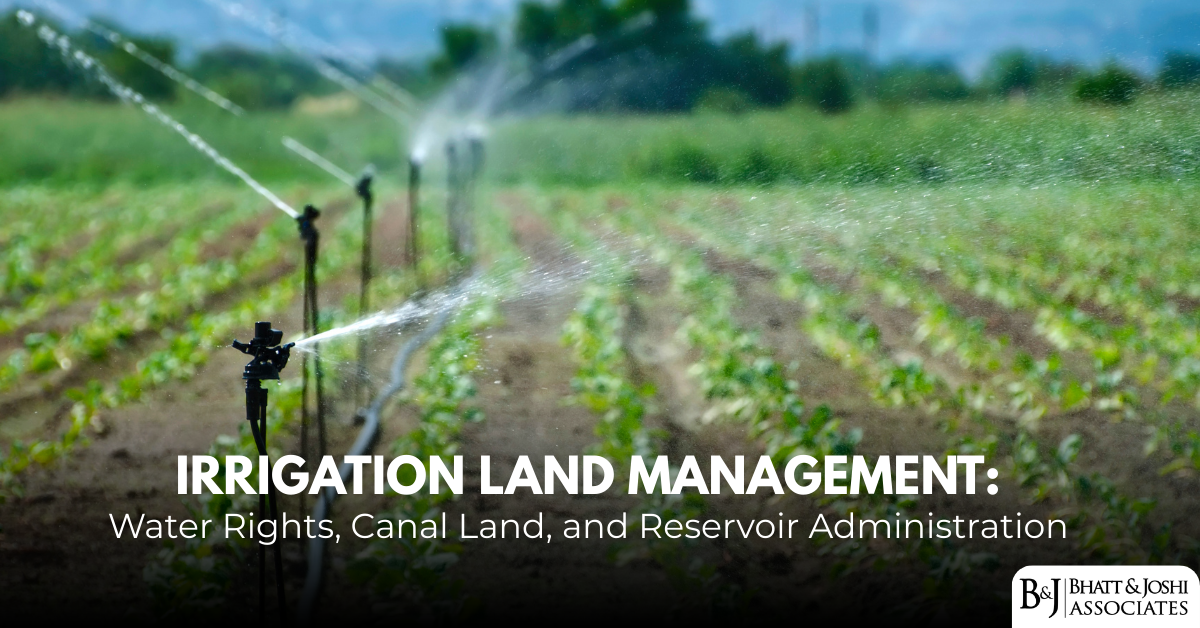
Irrigation Land Management: Water Rights, Canal Land, and Reservoir Administration
Executive Summary
Irrigation land management in India operates within a complex constitutional and legal framework that governs water rights, canal land administration, and reservoir management. The regulatory structure encompasses multiple statutes including the Northern India Canal and Drainage Act, 1873, Inter-State Water Disputes Act, 1956, and various state-specific irrigation laws, creating an integrated approach to water resource utilization and land management for agricultural purposes. This comprehensive analysis examines the legal mechanisms governing water rights allocation, canal land acquisition and maintenance, and reservoir administration that collectively shape contemporary irrigation land management practices across Indian states.
Introduction
Water resources management in India represents one of the most critical challenges facing the nation, with irrigation infrastructure serving approximately 51% of agricultural land while the remaining area depends on monsoon rainfall [1]. The legal framework governing irrigation land management has evolved significantly since colonial times, establishing sophisticated systems for water rights allocation, canal construction and maintenance, and reservoir administration that balance agricultural needs with environmental conservation and inter-state equity considerations.
The constitutional allocation of water governance between Union and State governments, combined with traditional riparian rights and statutory frameworks, creates a multilayered system that requires careful coordination between various administrative authorities, agricultural communities, and legal institutions to ensure effective irrigation land management.
Constitutional Framework for Water Rights
Federal Structure and Water Governance
Water governance in India operates within the federal structure established by the Constitution, which places water-related subjects primarily under state jurisdiction through Entry 17 of the State List [2]. This entry encompasses water supplies, irrigation, canals, drainage, embankments, water storage, and waterpower, granting states comprehensive authority over water resource development and management within their territories.
However, this state authority is subject to Union powers under Entry 56 of the Union List, which enables Parliament to regulate inter-state rivers and river valleys [2]. This constitutional division creates a framework where local water management remains under state control while inter-state water disputes and navigation on national waterways fall under central jurisdiction.
Fundamental Right to Water
The Supreme Court of India has consistently recognized water as a fundamental right under Article 21 of the Constitution, establishing that “water is the basic need for the survival of human beings and is part of right of life and human rights as enshrined in Article 21 of the Constitution of India” [3]. This judicial recognition creates constitutional obligations for both central and state governments to ensure adequate water access for citizens while balancing competing demands from agriculture, industry, and domestic consumption.
The evolution of the right to water reflects the judiciary’s response to water scarcity challenges and the inadequacy of purely statutory approaches to water governance. Despite this constitutional recognition, implementation through comprehensive national water legislation remains incomplete, with the National Water Framework Bill, 2016 remaining in draft form [4].
Legal Framework for Water Rights
Riparian Rights Doctrine
The Indian legal system recognizes riparian rights as fundamental entitlements of landowners whose properties adjoin natural water bodies. Under the common law doctrine codified through the Indian Easements Act, 1882, riparian owners possess natural rights to use water flowing through or adjacent to their land for reasonable domestic purposes, livestock watering, and irrigation [5].
Illustrations (f) and (h) of Section 7 of the Indian Easements Act specifically address water pollution, establishing that “the pollution of a natural stream is a wrong, actionable at the instance of any riparian owner past whose land the water so polluted flows” [5]. However, riparian rights in India are increasingly subordinated to statutory regulations and state control over water resources for public purposes.
Statutory Water Rights Framework
The Northern India Canal and Drainage Act, 1873 establishes the foundational principle that “the State Government is entitled to use and control for public purposes the water of all rivers and streams flowing in natural channels, and of all lakes and other natural collections of still water” [6]. This statutory framework supersedes traditional riparian rights when water resources are required for public irrigation projects or other governmental purposes.
Section 32(f) of the Act explicitly states that “no right to the use of the water of a canal shall be, or be deemed to have been, acquired under the Indian Limitation Act, 1877, Part IV, nor shall the State Government be bound to supply any person with water except in accordance with the terms of a contract in writing” [6]. This provision ensures that water rights remain subject to governmental control and cannot be acquired through adverse possession or continuous use.
Inter-State Water Disputes Resolution
The Inter-State Water Disputes Act, 1956 provides the constitutional mechanism for resolving conflicts between states over shared water resources [7]. The Act empowers the Central Government to establish specialized tribunals for adjudicating disputes that cannot be resolved through inter-state negotiations, ensuring that water allocation decisions are based on legal principles rather than political considerations.
Recent amendments through the Inter-State River Water Disputes (Amendment) Bill, 2019 propose establishing a permanent tribunal structure to streamline dispute resolution and reduce delays that have historically characterized inter-state water conflicts [8]. These reforms reflect growing recognition that effective water resource management requires institutional mechanisms capable of addressing complex technical and legal issues surrounding river basin management.
Canal Land Administration Framework
Legislative Foundation: Northern India Canal and Drainage Act, 1873
The Northern India Canal and Drainage Act, 1873 serves as the primary legislation governing canal construction, maintenance, and land acquisition for irrigation infrastructure in northern Indian states [6]. Originally designed to regulate the extensive canal systems developed during the colonial period, the Act continues to provide the legal foundation for contemporary canal land administration.
The Act’s comprehensive scope encompasses land acquisition procedures, construction powers, water distribution mechanisms, compensation frameworks, and operational regulations that collectively govern canal land management. Section 3 defines “canal” broadly to include “all canals, channels and reservoirs constructed, maintained or controlled by the State Government for the supply or storage of water” along with associated works, embankments, and water-courses [6].
Land Acquisition Powers and Procedures
Section 14 of the Act grants extensive powers to Canal Officers to enter upon lands adjacent to canals or proposed canal sites for surveying, land marking, water gauging, and other activities necessary for canal construction and maintenance [6]. These powers include authority to “cut down and clear away any part of any standing crop, fence or jungle” where necessary for completing surveys and assessments.
The compensation framework under Section 15 requires tender of compensation for damage caused during land entry, with disputes referred to Collectors for final determination [6]. This provision balances the public need for irrigation infrastructure development with protection of private property rights through mandatory compensation mechanisms.
For permanent land acquisition, Sections 21-30 establish detailed procedures for water-course construction applications, including requirements for applicant deposits, public notice provisions, objection hearings, and compensation determination following Land Acquisition Act procedures [6]. These provisions ensure due process compliance while enabling efficient canal expansion and improvement.
Water Distribution and Management
The Act establishes comprehensive frameworks for water distribution through canal systems, including provisions for water-course construction, maintenance obligations, and usage regulations. Section 16 enables private parties to apply for canal water supply through water-course construction at applicant expense, creating public-private partnership opportunities for irrigation infrastructure development [6].
Section 20 addresses water supply through existing water-courses, requiring Divisional Canal Officers to determine appropriate conditions for water conveyance and establishing applicant liability for water-course maintenance costs and operational expenses [6]. These provisions promote efficient water distribution while ensuring infrastructure sustainability through user contribution requirements.
Water Rate Assessment and Collection
The Act establishes dual water rate systems through “occupier’s rates” charged to land users and “owner’s rates” assessed on landowners benefiting from canal irrigation. Section 36 empowers state governments to determine occupier’s rates through rules governing canal water supply for irrigation purposes [6].
Section 37 authorizes owner’s rates “on the owners of canal-irrigated lands, in respect of the benefit which they derive from such irrigation,” with Section 38 limiting such rates to amounts assessable under land revenue rules for increased annual land value caused by irrigation [6]. This framework ensures that beneficiaries contribute to irrigation infrastructure costs while preventing excessive rate assessment.
The recovery mechanisms under Sections 45-47 enable collection of unpaid water rates as land revenue arrears, providing efficient enforcement tools while allowing contractual collection arrangements with private parties [6]. These provisions ensure revenue sustainability for canal operations and maintenance.
Reservoir Administration and Management
Legal Framework for Reservoir Development
Reservoir construction and management in India operates under multiple legal frameworks including environmental impact assessment requirements, dam safety regulations, and water resource development policies. The Environmental Impact Assessment Notification provides mandatory assessment requirements for major irrigation and hydropower projects, ensuring environmental considerations are integrated into reservoir planning [3].
The Guidelines for Environmental Impact Assessment of River Valley Projects, implemented since 1985, establish comprehensive frameworks for assessing environmental impacts of large dam projects, including biodiversity conservation, downstream impact assessment, and rehabilitation planning for affected populations [3].
Reservoir Land Acquisition
Large reservoir projects typically require extensive land acquisition under the Land Acquisition, Rehabilitation and Resettlement Act, 2013, which replaced the colonial-era Land Acquisition Act, 1894. The modern framework emphasizes rehabilitation and resettlement of displaced populations while maintaining provisions for public purpose land acquisition [9].
The Sardar Sarovar (Narmada) project exemplifies contemporary reservoir development challenges, involving acquisition of vast land areas for dam construction, reservoir creation, and associated canal networks serving 1.792 million hectares of irrigable land across multiple states [10]. Such projects require coordination between central and state governments, environmental authorities, and affected communities.
Water Storage and Allocation
Reservoir administration involves complex water allocation decisions balancing irrigation demands, drinking water supply, industrial needs, and environmental flows. The prioritization framework typically emphasizes drinking water and municipal supply, followed by industrial use and irrigation allocation [10].
The Sardar Sarovar project’s water allocation demonstrates this prioritization, with approximately 1.06 million acre-feet designated for drinking and municipal supply serving 8,215 villages and 135 urban centers, while 7.94 million acre-feet is allocated for irrigation purposes [10]. This allocation framework reflects constitutional obligations to ensure basic water access while supporting agricultural development.
Agricultural Water User Associations
Legal Framework for Participatory Irrigation Management
The evolution toward participatory irrigation management has created legal frameworks for establishing and regulating Water User Associations (WUAs) as democratic organizations controlled by agricultural beneficiaries [11]. These associations operate on not-for-profit bases through general assemblies and elected management boards, representing a shift from centralized irrigation administration toward community-based management.
Water User Associations in India operate under various state-specific legislation providing legal recognition as sui generis legal entities with specific powers and responsibilities for irrigation system operation and maintenance [11]. The legal framework typically defines association membership, governance structures, financial management, and dispute resolution mechanisms.
Irrigation Management Transfer
Irrigation Management Transfer (IMT) programs increasingly transfer operational responsibilities from government irrigation agencies to farmer-operated Water User Associations [11]. This transfer process requires careful legal structuring to ensure associations possess adequate legal authority while maintaining accountability for public infrastructure management.
The legal framework for IMT typically involves conditional transfer agreements specifying association obligations for infrastructure maintenance, water distribution equity, financial sustainability, and performance monitoring [11]. These agreements balance governmental oversight requirements with association autonomy necessary for effective local management.
Rights and Responsibilities Framework
Individual irrigators within Water User Associations typically hold organizational rights rather than direct water rights, creating indirect but practical water security through association membership [11]. This legal structure recognizes that individual water rights may be less practical than collective management systems in community irrigation contexts.
The legal framework establishes association responsibilities including equitable water distribution among members, infrastructure maintenance, financial management, and compliance with broader water management policies [11]. These responsibilities are typically enforced through association governance mechanisms rather than direct governmental oversight.
Environmental and Sustainability Considerations
Environmental Protection Requirements
Contemporary irrigation land management must comply with comprehensive environmental protection requirements including environmental impact assessments, biodiversity conservation measures, and pollution control standards. The Water (Prevention and Control of Pollution) Act, 1974 establishes Central and State Pollution Control Boards with authority to regulate water quality in irrigation systems [3].
The Environmental Protection Act, 1986 defines environment to include water, air, and land along with their inter-relationships, creating comprehensive frameworks for assessing irrigation project impacts on ecosystem integrity [3]. These requirements ensure that irrigation development contributes to sustainable agricultural productivity while protecting environmental resources.
Climate Change Adaptation
Modern irrigation land management increasingly incorporates climate change adaptation strategies including water conservation technologies, drought-resistant infrastructure, and flexible allocation mechanisms. The development of demand-side water management plans costing ₹6,000 crore across 8,350 water-stressed villages reflects governmental recognition of climate vulnerability in irrigation systems [1].
Micro-irrigation techniques including drip and sprinkler irrigation receive policy support as water-efficient alternatives to traditional flood irrigation methods [1]. The legal framework increasingly promotes these technologies through subsidies, technical assistance, and regulatory incentives encouraging adoption by agricultural communities.
Groundwater Integration
The integration of surface and groundwater resources represents a critical component of sustainable irrigation land management. The legal framework increasingly recognizes that canal irrigation and groundwater utilization are complementary rather than competing systems, with surface irrigation contributing to aquifer recharge that sustains well irrigation [12].
Evidence from both Indo-Gangetic plain and peninsular India demonstrates strong linkages between surface irrigation development and groundwater sustainability, supporting integrated approaches to water resource management [12]. Legal frameworks are evolving to promote conjunctive use of surface and groundwater resources while preventing over-exploitation of aquifer systems.
Contemporary Challenges and Judicial Responses
Water Scarcity and Allocation Disputes
India’s growing population and economic development create increasing pressures on water resources, with irrigation competing with urban water supply, industrial demand, and environmental requirements. The judicial response has emphasized constitutional obligations to ensure basic water access while recognizing legitimate agricultural water needs [3].
The Supreme Court’s recognition of water as a fundamental right creates legal obligations for governments to ensure adequate water availability for both human consumption and agricultural production [3]. However, implementation of these constitutional principles requires coordinated policy responses addressing infrastructure development, demand management, and equitable allocation mechanisms.
Infrastructure Modernization Requirements
Aging irrigation infrastructure requires comprehensive modernization programs incorporating technological advances, improved water use efficiency, and enhanced operational management. The potential for information technology applications in irrigation system management has been recognized for decades, with recent developments in artificial intelligence and machine learning offering new opportunities for improved service delivery [13].
Canal automation and remote monitoring systems represent significant advances in irrigation infrastructure management, enabling more precise water delivery, reduced operational costs, and improved system reliability [13]. Legal frameworks must evolve to accommodate these technological innovations while maintaining accountability and transparency in public infrastructure management.
Interstate Coordination Challenges
The management of interstate river systems requires enhanced coordination mechanisms addressing shared water resource development, equitable allocation, and dispute prevention. The proposed establishment of permanent tribunals under the Inter-State River Water Disputes (Amendment) Bill, 2019 represents important institutional innovation for addressing these coordination challenges [8].
River basin management approaches that transcend state boundaries offer potential solutions for integrated water resource development, though implementation requires careful attention to federal constitutional principles and state autonomy in water governance [8].
Future Directions and Policy Implications
Integrated Water Resource Management
Future irrigation land management policies must embrace integrated approaches that coordinate surface water, groundwater, and environmental water requirements within comprehensive river basin management frameworks. This integration requires legal reforms that promote coordination between irrigation, environmental, and urban water management authorities.
The development of comprehensive water policies incorporating both constitutional obligations and economic efficiency considerations represents a critical priority for sustainable irrigation land management. Such policies must address competing demands while ensuring agricultural water security necessary for food production and rural livelihoods.
Technological Innovation and Legal Adaptation
The rapid development of water management technologies including precision irrigation, remote sensing, and automated control systems requires corresponding legal framework adaptations. These technologies offer opportunities for improved water use efficiency, reduced operational costs, and enhanced environmental protection, but require regulatory frameworks that promote innovation while maintaining public accountability.
Digital platforms for water rights administration, allocation monitoring, and dispute resolution could significantly improve irrigation land management efficiency while enhancing transparency and stakeholder participation in decision-making processes.
Climate Resilience and Adaptation
Future irrigation land management must incorporate climate resilience strategies including drought preparedness, flood management, and adaptive infrastructure design. Legal frameworks must evolve to support flexible allocation mechanisms, emergency response procedures, and long-term adaptation planning that enables agricultural communities to respond effectively to climate variability.
The development of climate-smart irrigation policies requires integration of scientific knowledge, traditional agricultural practices, and community participation in adaptive management approaches that enhance both productivity and sustainability of irrigation systems.
Conclusion
Irrigation land management in India operates within a sophisticated legal framework that balances constitutional obligations, statutory requirements, and administrative necessities to ensure effective water resource utilization for agricultural purposes. The evolution from colonial-era canal administration to contemporary integrated water resource management reflects growing recognition of water’s critical importance for food security, economic development, and environmental sustainability.
The constitutional recognition of water as a fundamental right creates legal obligations for both central and state governments to ensure adequate water access while promoting efficient utilization through well-designed irrigation systems. The Northern India Canal and Drainage Act, 1873 continues to provide essential legal authority for canal land administration, though contemporary irrigation management increasingly emphasizes participatory approaches through Water User Associations and community-based management systems.
The challenges of inter-state water disputes, environmental protection, and climate change adaptation require continued evolution of legal frameworks that promote coordination, sustainability, and equity in water resource allocation. The success of future irrigation land management depends on effective integration of constitutional principles, statutory authority, and administrative capacity to serve the legitimate water needs of India’s agricultural communities while protecting environmental resources for future generations.
The complex interplay between riparian rights, statutory water allocation, and community management systems creates opportunities for innovative approaches to irrigation land management that combine legal authority with local knowledge and democratic participation. The continued development of these frameworks will determine whether India can achieve sustainable water security that supports both agricultural productivity and broader social and environmental objectives in an era of increasing water scarcity and climate uncertainty.
References
[1] Wikipedia. (2025). Irrigation in India. Available at: https://en.wikipedia.org/wiki/Irrigation_in_India
[2] Legal Service India. (2024). Water Management – Law And Policy In India. Available at: https://www.legalserviceindia.com/article/l420-Water-Management.html
[3] Legal Services India. (2024). Management of Water and Water Laws In India. Available at: https://www.legalservicesindia.com/article/1865/Management-of-Water-and-Water-Laws-In-India.html
[4] MDPI Water Journal. (2022). The Evolution of the Right to Water in India. Available at: https://www.mdpi.com/2073-4441/14/3/398
[5] Legal Service India. (2024). Water Rights. Available at: https://www.legalservicesindia.com/article/749/Water-Rights.html
[6] Government of India. (1873). The Northern India Canal and Drainage Act, 1873. Available at: https://www.indiacode.nic.in/bitstream/123456789/2282/1/a1873-08.pdf
[7] Lexibal. (2025). Water Laws & Irrigation in India. Available at: https://lexibal.in/water-laws-irrigation-in-india/
[8] NITI Aayog. (2024). Water and Land Resources. Available at: https://www.niti.gov.in/verticals/water-and-land-resources

Advocate Aaditya Bhatt
Senior Standing Counsel Income Tax Department, Advocate Gujarat High Court. Aaditya combines his technical and legal expertise to deliver strategic counsel in litigation, constitutional, and regulatory matters. He represents clients before High Courts and Tribunals with a technology-driven approach.