 Whatsapp

Mental Harassment Under BNS Section 86: Workplace & Domestic Application
Introduction
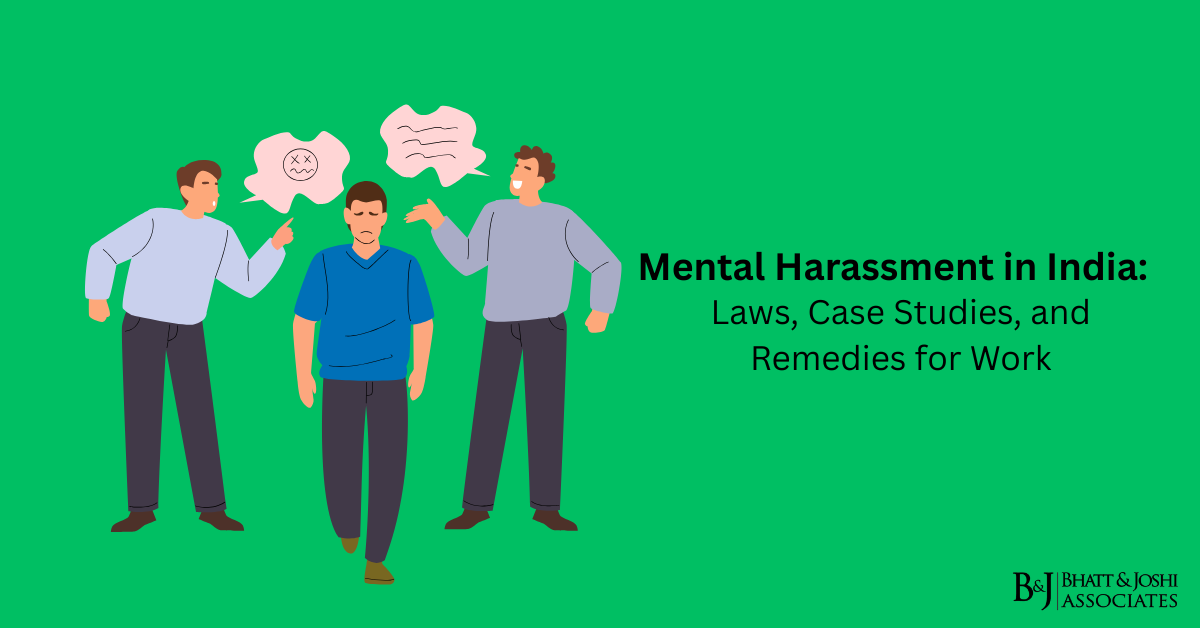
Mental harassment has emerged as one of the most pressing legal and social concerns in contemporary India. Unlike physical harm that leaves visible scars, psychological torment operates in shadows, inflicting deep wounds on the victim’s mental health, dignity, and overall well-being. The Indian legal system, while historically focused on tangible forms of violence, has progressively recognized the severity of mental harassment and developed mechanisms to address it. This article examines the legal framework governing mental harassment in India, analyzing statutory provisions, landmark judicial pronouncements, and practical remedies available to victims across workplace and social contexts.
The concept of mental harassment encompasses various forms of psychological abuse, including verbal aggression, intimidation, humiliation, isolation, threats, and persistent criticism that collectively create an environment of fear and distress. In the workplace, this might manifest as deliberate exclusion from meetings, constant belittling of contributions, or unrealistic work demands designed to break an employee’s confidence. In domestic settings, mental harassment often takes the form of emotional manipulation, threats of abandonment, financial control, or persistent derogatory comments about a spouse’s abilities or appearance.
Understanding Mental Harassment: Definition and Scope
Mental harassment, though not explicitly defined as a standalone offense in Indian criminal law, finds recognition through various statutory provisions addressing psychological cruelty, intimidation, and hostile behavior. The Indian legal system approaches mental harassment through a patchwork of civil and criminal laws that address different manifestations of psychological abuse. The judiciary has repeatedly emphasized that harm to mental health is as serious as physical injury, and the law must protect individuals from psychological trauma inflicted through deliberate acts of cruelty.
The absence of a singular, comprehensive definition has led courts to interpret mental harassment contextually, examining the nature, severity, and impact of the alleged conduct. This flexible approach allows judges to consider the unique circumstances of each case, recognizing that what constitutes harassment may vary based on the relationship between parties, the power dynamics involved, and the victim’s vulnerability. Courts have established that mental harassment must be assessed not merely by the perpetrator’s intent but by the reasonable impact of their actions on the victim’s psychological state.
Constitutional Foundations of Protection Against Mental Harassment in India
The protection against mental harassment finds its constitutional moorings in several fundamental rights guaranteed by the Constitution of India. Article 21, which guarantees the right to life and personal liberty, has been interpreted expansively by the Supreme Court to include the right to live with dignity, free from mental agony and psychological torture [1]. This constitutional provision forms the bedrock upon which all other legal protections against mental harassment rest. The judiciary has consistently held that life under Article 21 means more than mere animal existence; it encompasses the right to live with human dignity, which includes protection from mental torture and harassment.
Article 14 ensures equality before law and equal protection of laws, preventing discriminatory harassment based on gender, caste, religion, or other protected characteristics. Article 15 prohibits discrimination on grounds of religion, race, caste, sex, or place of birth, while Article 19(1)(a) protects freedom of speech and expression, which includes the freedom to work in an environment free from harassment. These constitutional provisions collectively create a framework that obligates the state and its instrumentalities to protect citizens from mental harassment and psychological abuse.
Legislative Framework Governing Mental Harassment
Bharatiya Nyaya Sanhita, 2023 (Replacing the Indian Penal Code)
The Bharatiya Nyaya Sanhita (BNS), which came into effect on July 1, 2024, replaced the Indian Penal Code and retained most provisions addressing mental harassment with modifications. Section 85 of the BNS corresponds to the erstwhile Section 498A of the IPC, dealing with cruelty by a husband or his relatives toward a married woman. This provision states: “Whoever, being the husband or the relative of the husband of a woman, subjects such woman to cruelty shall be punished with imprisonment for a term which may extend to three years and shall also be liable to fine.”
Section 86 of the BNS, which was previously part of Section 498A’s explanation, defines cruelty to include any willful conduct likely to drive a woman to suicide or cause grave injury to her life, limb, or health, whether mental or physical. It also encompasses harassment aimed at coercing the woman or her relatives to meet unlawful demands for property or arising from failure to meet such demands. The retention of these provisions in the new criminal code underscores the legislature’s continued recognition of mental cruelty as a serious criminal offense [2].
Section 78 of the BNS deals with criminal intimidation, making it an offense to threaten another person with injury to their person, reputation, or property, or to the person or reputation of anyone in whom that person is interested, with intent to cause alarm or to cause that person to do any act they are not legally bound to do. The punishment for criminal intimidation can extend to two years of imprisonment, or fine, or both. When the threat involves death or grievous hurt, the punishment can extend to seven years.
Section 356 addresses stalking, recognizing that persistent following, contact, or monitoring of a person’s activities can constitute a form of mental harassment. This provision, particularly significant in cases involving unwanted attention and psychological pressure, prescribes imprisonment up to three years for the first conviction and up to five years for subsequent convictions. Section 79 criminalizes insult intended to provoke breach of peace, recognizing that deliberate public humiliation can cause severe mental distress and social stigma.
The Sexual Harassment of Women at Workplace (Prevention, Prohibition and Redressal) Act, 2013
The Sexual Harassment of Women at Workplace Act, 2013, commonly known as the POSH Act, represents India’s primary legislative framework for addressing workplace harassment against women. This legislation emerged from the landmark Vishakha judgment delivered by the Supreme Court in 1997 [3]. The POSH Act defines sexual harassment broadly to include unwelcome acts or behavior, whether directly or by implication, such as physical contact and advances, demands for sexual favors, sexually colored remarks, showing pornography, or any other unwelcome physical, verbal, or non-verbal conduct of a sexual nature.
Significantly, the Act recognizes that sexual harassment creates a hostile work environment and acknowledges psychological harassment as a form of workplace abuse. The legislation mandates every organization with ten or more employees to constitute an Internal Complaints Committee to address complaints of harassment. The committee must be presided over by a senior woman employee and include at least two members committed to women’s causes, along with an external member from an NGO or association working on women’s rights.
The POSH Act provides protection to all women employees, whether permanent, temporary, contractual, or working in any other capacity, including trainees, apprentices, and those visiting the workplace. It prescribes strict penalties for non-compliance, including fines up to fifty thousand rupees for failing to constitute an ICC or comply with the Act’s provisions. Employers who fail to implement the provisions of the Act may face deregistration of their business or revocation of licenses required for carrying out business operations.
The Domestic Violence Act, 2005
The Protection of Women from Domestic Violence Act, 2005, provides civil remedies to women facing abuse in domestic relationships. This legislation defines domestic violence to include not only physical abuse but also emotional, verbal, sexual, and economic abuse [4]. Section 3 of the Act specifies that emotional abuse encompasses insults, ridicule, humiliation, name-calling, and insults for not bearing children or bearing children of a particular sex. The Act recognizes that mental harassment through verbal abuse and emotional manipulation can be as devastating as physical violence.
The definition of “domestic relationship” under the Act is broad, covering relationships between persons who live or have lived together in a shared household when they are related by consanguinity, marriage, adoption, or are family members living together as a joint family. This expansive definition ensures protection extends beyond just married women to include sisters, mothers, daughters, and other female relatives living in shared households.
The Act empowers Magistrates to pass protection orders restraining the respondent from committing acts of domestic violence, entering the aggrieved person’s residence or workplace, attempting to communicate with her, alienating assets, or causing violence to persons related to her. Magistrates can also issue residence orders, monetary relief orders, custody orders, and compensation orders to provide holistic relief to victims. The legislation establishes the position of Protection Officers in every district to assist victims in filing complaints and accessing legal remedies.
The Scheduled Castes and Scheduled Tribes (Prevention of Atrocities) Act, 1989
The SC/ST Act addresses harassment and atrocities committed against members of Scheduled Castes and Scheduled Tribes, recognizing that these communities face unique forms of psychological harassment rooted in caste-based discrimination. Section 3 of the Act lists specific offenses, including intentionally insulting or intimidating a member of a Scheduled Caste or Scheduled Triangle with intent to humiliate them in any place within public view. The Act also criminalizes forcing members of these communities to perform demeaning acts, denying them access to public places, or socially boycotting them.
The legislation recognizes that mental harassment through caste-based slurs, social exclusion, and public humiliation causes severe psychological trauma and perpetuates systemic discrimination. The Act provides for establishment of Special Courts to try offenses under its provisions, ensuring expedited justice for victims. It also mandates state governments to take measures to ensure that rights of Scheduled Castes and Scheduled Tribes are protected and atrocities against them are prevented.
Industrial Employment (Standing Orders) Act, 1946
Though primarily focused on defining conditions of employment, the Industrial Employment Act indirectly addresses workplace harassment by requiring employers to define and prohibit acts of misconduct, which courts have interpreted to include harassment and creating hostile work environments. Model Standing Orders under this Act typically include provisions against misbehavior with superiors, subordinates, or fellow employees, and creating disturbances or engaging in acts subversive of discipline.
Information Technology Act, 2000
The IT Act addresses cyberbullying and online harassment, which have become prevalent forms of mental harassment in the digital age. Section 66A, though struck down by the Supreme Court in 2015 for being unconstitutionally vague, attempted to criminalize sending offensive messages through communication services. Currently, Section 67 criminalizes publishing or transmitting obscene material in electronic form, while Section 67A addresses publishing or transmitting material containing sexually explicit acts in electronic form.
Victims of online harassment often invoke general provisions of the BNS along with the IT Act to address cyberbullying, trolling, morphing of photographs, creation of fake profiles, and other forms of digital abuse that cause mental distress. The intersection of technology and harassment law remains an evolving area requiring constant judicial interpretation and potential legislative intervention.
Landmark Judicial Pronouncements
Vishaka v. State of Rajasthan (1997)
The Vishaka case stands as a watershed moment in India’s legal history regarding workplace harassment. Following the brutal gang rape of Bhanwari Devi, a social worker in Rajasthan who was attacked for attempting to prevent a child marriage, various women’s organizations filed a Public Interest Litigation before the Supreme Court. The petition sought enforcement of fundamental rights of working women under Articles 14, 19, and 21 of the Constitution.
In its August 1997 judgment, a three-judge bench comprising Chief Justice J.S. Verma, Justice Sujata Manohar, and Justice B.N. Kirpal laid down comprehensive guidelines for preventing and addressing sexual harassment at workplaces, commonly known as the Vishaka Guidelines [3]. The Court held that international conventions and norms are significant for interpreting constitutional guarantees of gender equality and the right to work with human dignity. The judgment defined sexual harassment broadly to include unwelcome sexually determined behavior, whether directly or by implication, such as physical contact and advances, demands for sexual favors, sexually colored remarks, showing pornography, or any other unwelcome physical, verbal, or non-verbal conduct of sexual nature.
Critically, the Court recognized that sexual harassment need not involve physical contact and that creating a hostile work environment through lewd jokes, verbal abuse, or circulating rumors constitutes harassment. The guidelines mandated employers to establish complaints committees, conduct awareness programs, and ensure that victims could report harassment without fear of retaliation. These guidelines remained the primary legal framework for addressing workplace sexual harassment until the POSH Act was enacted in 2013.
Sushil Kumar Sharma v. Union of India (2005)
In this landmark judgment, the Supreme Court examined allegations of widespread misuse of Section 498A of the IPC while upholding its constitutional validity. The Court acknowledged that the provision was being invoked with oblique motives by some complainants and cautioned that misuse could unleash “a new legal terrorism.” The Court emphasized that Section 498A was intended to be used as a shield for women against dowry harassment and not as an assassin’s weapon.
Justice Arijit Pasayat, writing for the bench, observed that investigating authorities often approach such cases with preconceived notions of guilt, and stressed that authorities must ensure innocent persons do not suffer due to baseless allegations. The judgment noted that merely because a provision is constitutional and valid does not give license to unscrupulous persons to wreak personal vendetta or unleash harassment. The Court stated that the role of investigating agencies and courts should be that of a watchdog, not a bloodhound.
While refusing to strike down Section 498A, the Court called upon the legislature to find ways to appropriately deal with frivolous complaints and false allegations. This judgment marked the beginning of judicial scrutiny regarding the potential misuse of anti-cruelty laws and set the stage for subsequent judgments implementing safeguards against unwarranted arrests and prosecutions.
Arnesh Kumar v. State of Bihar (2014)
The Arnesh Kumar judgment represents a significant judicial intervention to prevent automatic arrests in cases registered under Section 498A and other similar provisions. The Supreme Court noted with concern that between 2007 and 2013, while cases registered under Section 498A increased by nearly 75 percent, conviction rates remained dismally low at around 15 percent. The Court observed that in numerous cases, bedridden grandparents and sisters living abroad for decades were being arrested on vague allegations of harassment.
To prevent unnecessary arrests and mechanical detentions, the Court issued comprehensive guidelines directing all state governments to instruct police officers not to automatically arrest accused persons when cases under Section 498A or other offenses punishable with imprisonment up to seven years are registered. Police officers must satisfy themselves about the necessity for arrest based on specified parameters under Section 41(1)(b) of the Code of Criminal Procedure, including whether the accused is likely to abscond, tamper with evidence, or commit similar offenses.
The judgment mandated that police officers must provide a checklist containing reasons and materials justifying arrest while producing the accused before a Magistrate. The Magistrate, before authorizing detention, must record satisfaction after examining the police officer’s report. These guidelines aimed to balance the need to investigate crimes with the constitutional right to personal liberty, recognizing that arrest causes immense social stigma and disruption to the accused’s life and family.
Rajesh Sharma v. State of UP (2017)
Building upon the Arnesh Kumar precedent, the Supreme Court in Rajesh Sharma issued additional directions to prevent misuse of Section 498A. The Court directed establishment of district-wise Family Welfare Committees comprising para-legal volunteers, social workers, retired persons, and wives of working officers. These committees would examine every complaint received under Section 498A, interact with parties, and submit reports within one month. No arrest could be made until such reports were received.
The judgment also opened avenues for settlement of marital disputes before District Sessions Judges or senior judicial officers nominated for this purpose. Proceedings arising from marital discord, including criminal cases, could be disposed of if settlements were reached. The Court emphasized that in bail applications arising from marital disputes, courts must consider individual roles, prima facie truth of allegations, requirements of further arrest or custody, and interests of justice.
However, in 2018, a three-judge bench in Social Action Forum for Manav Adhikar v. Union of India modified these directions, withdrawing the requirement for Family Welfare Committee scrutiny before police action. The bench held that while misuse of Section 498A existed and caused social unrest, courts could not fill legislative gaps or create parallel investigation mechanisms. Other directions issued in Rajesh Sharma regarding settlement and bail considerations were modified to align with existing legal frameworks.
Geeta Mehrotra v. State of UP (2012)
The Geeta Mehrotra judgment addressed the troubling tendency of over-implication in matrimonial disputes, where family members are routinely arraigned as accused without specific allegations of their involvement. The Supreme Court held that mere casual reference to names of family members without allegations of active involvement would not justify taking cognizance against them. The Court emphasized that the tendency to draw all household members into domestic quarrels should not be overlooked, especially when complaints are filed soon after marriage.
In this case, the unmarried sister-in-law and brother-in-law of the complainant-wife sought quashing of criminal proceedings initiated against them. Examining the FIR, the Court found only casual references to their names without specific allegations of harassment or cruelty committed by them. Rather than remitting the matter to the High Court and prolonging their ordeal, the Supreme Court exercised its extraordinary jurisdiction to quash the proceedings, recognizing that continued prosecution without prima facie evidence would cause irreparable harm to their reputation and liberty.
Payal Sharma v. State of Punjab (2024)
This recent judgment issued a stern warning to courts about ensuring that distant relatives of husbands are not unnecessarily implicated in criminal cases filed under Section 498A. The Supreme Court criticized a High Court’s refusal to quash proceedings against the husband’s cousin and his wife, who resided in a different city from the complainant’s daughter. The High Court had mechanically declined relief merely because a chargesheet had been filed, without examining whether the allegations constituted over-implication.
The Supreme Court held that courts are duty-bound to examine if implication of distant relatives represents over-implication or an exaggerated version of events. While the term “relative” is not defined in Section 498A, the Court held it should be understood in the common sense of the term to include persons related by blood, marriage, or adoption such as parents, siblings, children, grandchildren, nephews, and nieces. When allegations are raised against persons not clearly falling within this category, courts must scrutinize whether such allegations are exaggerated or made with oblique motives.
Workplace Mental Harassment: Regulatory Framework and Remedies
Mental harassment in workplace settings manifests through various behaviors that create hostile, intimidating, or humiliating environments. This includes unfair criticism, deliberate exclusion from professional opportunities, setting unrealistic targets designed to cause failure, spreading malicious rumors, taking credit for others’ work, or consistently belittling an employee’s contributions. Indian law addresses workplace mental harassment through multiple regulatory frameworks operating at central and state levels.
The POSH Act provides the primary framework for addressing harassment of women in workplaces. However, its scope is limited to sexual harassment, leaving gaps in addressing non-sexual forms of psychological harassment. Courts have interpreted the Act’s definition of hostile work environment broadly to encompass various forms of mental harassment that create an atmosphere of fear or discomfort. The Act’s requirement for employers to constitute Internal Complaints Committees and conduct awareness programs creates institutional mechanisms for addressing workplace harassment.
The Industrial Disputes Act, 1947, provides another avenue for addressing workplace harassment by allowing workers to raise industrial disputes regarding working conditions. Courts have held that persistent harassment by employers or supervisors that makes working conditions intolerable constitutes an industrial dispute. Workers subjected to mental harassment can approach labor courts and tribunals seeking reinstatement, compensation, or other relief.
State-specific shops and establishments laws also contain provisions regarding maintenance of discipline and prohibition of misconduct that can be invoked in cases of workplace harassment. These laws typically empower labor inspectors to investigate complaints and initiate action against employers who fail to maintain proper working conditions. Additionally, the Occupational Safety, Health and Working Conditions Code, 2020, though not yet fully implemented, aims to consolidate various labor laws and includes provisions regarding maintenance of healthy working conditions.
Employees facing mental harassment can also invoke tortious liability principles to claim damages for negligence by employers in maintaining safe working environments. Courts have recognized that employers owe a duty of care to employees to protect them from harassment by colleagues or superiors. Failure to take appropriate action after receiving complaints of harassment can constitute breach of this duty, making employers liable for compensation.
Domestic Mental Harassment: Legal Protections and Remedies
Mental harassment within domestic relationships takes various forms, including constant criticism, humiliation before family members or publicly, threats of divorce or abandonment, denial of financial support, forced isolation from family and friends, and emotional manipulation. The Domestic Violence Act provides the primary civil remedy for women facing such abuse in domestic relationships.
Under the Act, aggrieved persons can approach Magistrates seeking various forms of relief. Protection orders prohibit respondents from committing acts of domestic violence, entering the aggrieved person’s residence or workplace, or attempting to communicate with her. Residence orders grant women the right to reside in shared households and prohibit respondents from dispossessing them. Monetary relief orders direct respondents to pay maintenance, compensation for injuries, and losses suffered due to domestic violence.
Custody orders grant temporary or permanent custody of children to the aggrieved person, while compensation orders require respondents to pay for mental torture and emotional distress caused. The Act’s comprehensive approach recognizes that relief must address immediate safety concerns as well as long-term economic and emotional rehabilitation of victims.
Criminal remedies are available under Section 85 and 86 of the BNS for women subjected to cruelty by husbands or relatives. However, these provisions have generated considerable controversy due to allegations of misuse. Courts have attempted to balance protection of genuine victims with prevention of false prosecutions by implementing stringent scrutiny of complaints, requiring specific allegations rather than vague generalities, and examining circumstances suggesting oblique motives.
The intersection of civil and criminal remedies creates complex scenarios where parties may simultaneously pursue relief under multiple statutes. While the Domestic Violence Act provides expedited civil remedies including interim maintenance and protection orders, criminal prosecutions under Section 498A or its successor provisions in BNS can result in arrests and lengthy trials. Courts have emphasized the need for coordination between civil and criminal proceedings to prevent conflicting orders and ensure justice for all parties.
Challenges in Implementation and Enforcement
Despite comprehensive legal frameworks, implementation of mental harassment laws faces numerous challenges. The subjective nature of mental harassment makes proof difficult, as victims must establish the psychological impact of alleged conduct. Unlike physical violence that leaves tangible evidence, mental harassment operates through subtle behaviors that may appear innocuous individually but cumulatively create hostile environments.
Low awareness about legal rights and available remedies prevents many victims from seeking help. Social stigma attached to reporting harassment, particularly in workplace contexts, discourages complaints. Fear of retaliation, loss of employment, or social ostracism silences many victims. Women facing domestic harassment often hesitate to approach authorities due to family pressure, economic dependence, or concerns about children’s welfare.
The quality and sensitivity of investigating authorities significantly impacts outcomes. Police officers and labor inspectors often lack training in handling harassment complaints, leading to insensitive treatment of victims or inadequate investigation. Delayed justice compounds victims’ trauma, as cases drag on for years in overburdened courts. Witnesses become unavailable, evidence deteriorates, and parties lose faith in the legal system.
Allegations of misuse of anti-harassment laws, particularly Section 498A and its successor provisions, have led to judicial skepticism in examining complaints. While preventing false prosecutions is important, this must not result in genuine victims being denied justice. Striking this balance remains one of the most challenging aspects of administering harassment laws.
Inadequate penalties and poor enforcement of existing penalties fail to deter potential offenders. Organizations frequently ignore POSH Act requirements to constitute Internal Complaints Committees or conduct awareness programs, with minimal consequences. Even when cases result in convictions, sentencing often fails to reflect the gravity of psychological harm inflicted on victims.
The Way Forward: Reforms and Recommendations
Comprehensive legislative reform is needed to address gaps in existing frameworks. A dedicated statute dealing specifically with mental harassment across all contexts would provide clearer definitions, streamlined procedures, and comprehensive remedies. Such legislation should explicitly recognize various forms of psychological abuse, including gaslighting, isolation, financial control, and emotional manipulation.
Enhanced training for police, judicial officers, labor inspectors, and members of complaints committees would improve handling of harassment cases. Specialized training modules on psychology of trauma, techniques for trauma-informed investigation, and methods for assessing credibility without victim-blaming would enhance the quality of justice delivery.
Strengthening institutional mechanisms for prevention and redressal is crucial. Organizations must move beyond pro forma compliance with POSH Act requirements to create genuinely safe work environments. This includes regular awareness programs, clear reporting mechanisms, protection against retaliation, and swift action on complaints.
Alternative dispute resolution mechanisms, including mediation and counseling, can provide effective solutions in appropriate cases while avoiding the trauma and expense of prolonged litigation. However, such mechanisms must be implemented carefully to ensure they do not pressure victims into unwilling compromises or normalize harassment as acceptable behavior requiring mere mediation.
Robust support systems for victims, including counseling services, legal aid, and economic assistance, would enable them to effectively pursue remedies. Many victims abandon complaints due to inability to afford legal representation or lack of psychological support to withstand the stress of legal proceedings.
Public awareness campaigns highlighting legal rights and available remedies would empower potential victims to seek help early. Educational programs in schools, colleges, and workplaces would create cultural shifts recognizing mental harassment as unacceptable and promoting respectful interpersonal relationships.
Conclusion
Mental harassment represents a serious violation of human dignity and fundamental rights. Indian law has progressively recognized the gravity of psychological abuse and developed mechanisms to address it. From constitutional protections under Article 21 to specific statutory provisions in the BNS, POSH Act, and Domestic Violence Act, the legal framework provides multiple avenues for victims to seek justice.
Landmark judicial pronouncements have shaped the interpretation and application of these laws, balancing protection of victims with prevention of misuse. Cases like Vishaka established foundational principles of workplace dignity, while judgments like Arnesh Kumar and Rajesh Sharma implemented safeguards against arbitrary arrests. Courts continue to grapple with evolving manifestations of harassment, particularly in digital spaces, requiring constant adaptation of legal principles to contemporary challenges.
However, significant gaps remain in implementation and enforcement. The subjective nature of mental harassment, combined with inadequate institutional capacity and social barriers, prevents many victims from accessing justice. Allegations of misuse of certain provisions have created complications requiring careful balancing of competing interests.
Moving forward, India needs comprehensive reform addressing these challenges through updated legislation, enhanced institutional capacity, robust support systems for victims, and cultural shifts promoting dignity and respect in all relationships. Only through such multifaceted approaches can the law effectively protect individuals from mental harassment while ensuring fairness and justice for all parties involved.
References
[1] Constitution of India, Article 21. Available at: https://www.constitutofiindia.net
[2] Bharatiya Nyaya Sanhita, 2023. Ministry of Home Affairs, Government of India. Available at: https://www.mha.gov.in
[3] Vishaka and Ors. v. State of Rajasthan, AIR 1997 SC 3011. Available at: https://indiankanoon.org/doc/1031794
[4] The Protection of Women from Domestic Violence Act, 2005. Available at: https://www.indiacode.nic.in
[5] The Sexual Harassment of Women at Workplace (Prevention, Prohibition and Redressal) Act, 2013. Available at: https://www.indiacode.nic.in
[6] Arnesh Kumar v. State of Bihar, (2014) 8 SCC 273.
[7] Sushil Kumar Sharma v. Union of India, AIR 2005 SC 3100. A
[8] LiveLaw. (2024). S.498A IPC: How Supreme Court Raised Concerns About Misuse Of Anti-Dowry & Cruelty Laws Over Years. Available at: https://www.livelaw.in/top-stories/supreme-court-take-on-misuse-of-section-498a-ipc-cruelty-harassment-over-implication-of-husband-family-278393
[9] Supreme Court Cases Online. (2023). Landmark Judgments on Section 498A IPC. Available at: https://www.scconline.com
