 Whatsapp

Trust & Charity Lawyer Ahmedabad | 12A, 80G, Registration
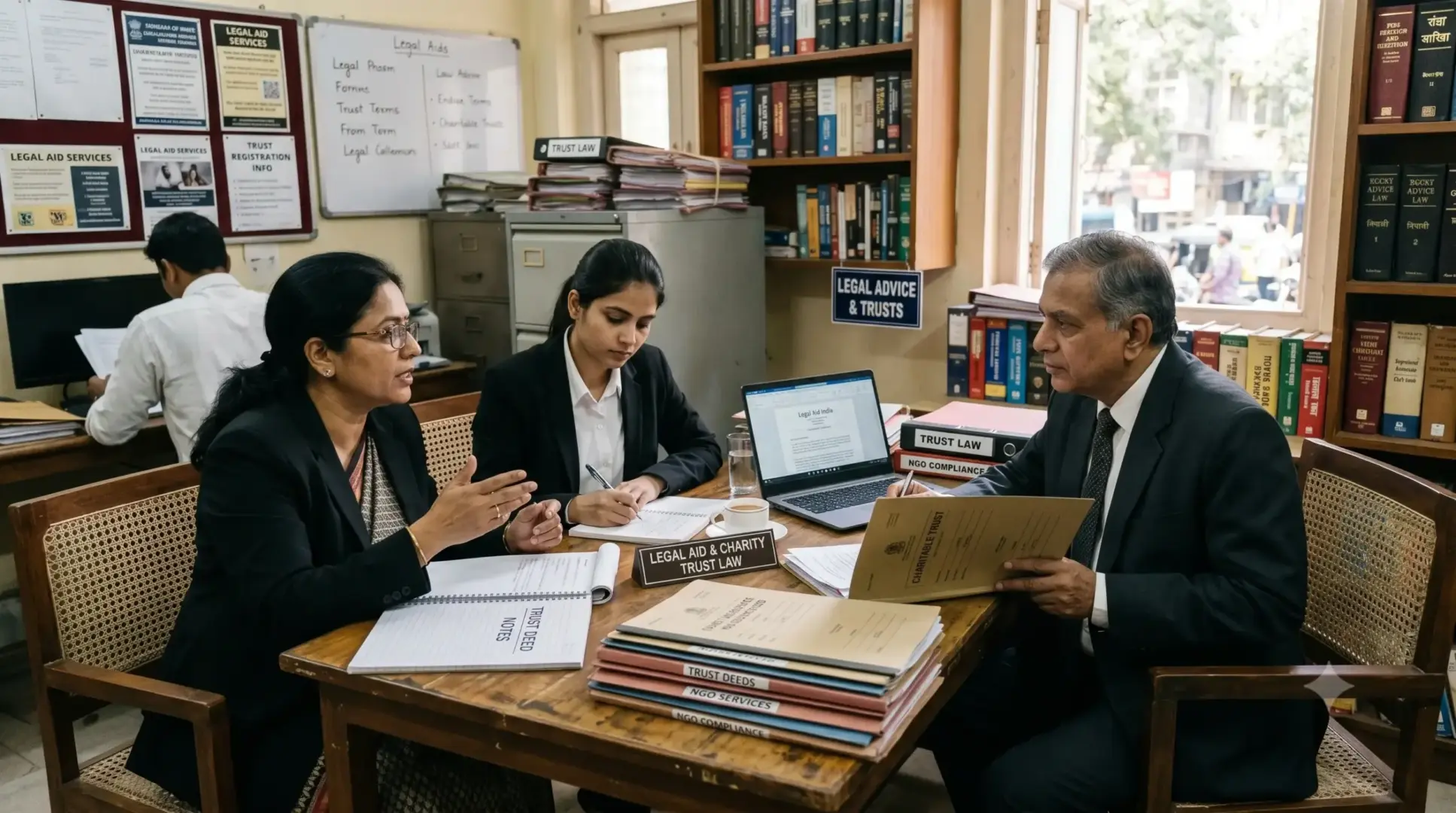
Bhatt & Joshi Associates, is a lawyer firm in Ahmedabad, Gujarat. At our firm we have a set of skilled, experienced, professional Charity and Trust lawyers (Legal Experts) to the matter of Charity and Trust Law. We have lawyers having in-depth knowledge of all Substantive Law like Bombay (Gujarat) Public Trust Act 1950, The Aministrators General Act, 1963, The Charitable Endowments Act, 1890, The Official Trustees Act, 1913 and the ancillary Civil procedures and knowledge of Statutory Interpretation with strong logical, analytical and persuasive abilities adept at pleadings, drafting of Trust Deeds, Applications before Charity Commissioner, challenge the legality and validity of the orders before High Court of Gujarat etc.
Gujarat Public Trust Act, 1950
In the State of Gujarat, Gujarat Public Trusts Act, 1950 governs the provisions pertaining to Administration and Management of a Public Trust. Originally the Act was passed in Bombay State, when Maharashtra and Gujarat were one; in the name and title of the Bombay Public Trust Act, 1950.
Thereafter the Gujarat State was separated in 1960 and the state has made various amendments to suit its charity and trust related ecosystem. However, by and large both the state of Gujarat and Maharashtra have nearly similar provisions. The main object of the Gujarat Public Trust Act, is to regulate and make better provision for the administration of public religious and charitable trusts in the State.
CHARITY COMMISSIONER BEING THE GUARDIAN OF THE TRUSTS
Under the Gujarat Public Trust Act, the Charity Commissioner is the guardian of the trusts. The Charity Commissioner in his office has been given the powers of supervision, regulation and administrative control over public trusts registered under office. It is mandatory as per the statutory requirement, that every public trust has to register with the charity commissioner so that its administration and Management is supervised by the Charity Commissioner;
Office Charity Commissioner
The office of Charity Commissioner functions under the Legal Department of Gujarat. The Bombay Public Trust Act, 1950 is implemented in the State of Gujarat by the Charity Organization. The Act applies to all communities and all public trusts defined in the Act, irrespective of the size of their income. It must be noted that the term “public trust” as defined in the act, is wide enough to cover societies registered under the Societies Registration Act, 1860. Under the Act it is mandatory to register every public trust and annual accounts to be audited. Trusts that may be registered under the Act are (A) Hindu (including Jains, Buddhists,Sikhs and other Hindus) (B) Muslims (C) Parsis (D) Others (E) Cosmopolitan (F) Societies registered under the Societies Registration Act, 1860. There are four regional offices under him at Ahmedabad, Rajkot, Vadodara and Surat headed by Joint Charity Commissioners. There are 24 field offices working at different places mostly at the district headquarters and such offices are headed by the Deputy Charity Commissioners or Assistant Charity Commissioners, as the case may be.
Duties, functions and powers of Charity Commissioner
- The general superintendence of the administration and carrying out the purposes of this Act under section 3;
- Power to entertain and dispose of appeals from the findings of a Deputy or Assistant Charity Commissioner under section 20, 22 or 28;
- Power to determine which of the Deputy or Assistant Charity Commissioners shall proceed with an inquiry relating to the registration of any public trust under section 25;
- power to direct a special audit of the accounts of a public trust under section 33;
- power to require an auditor to forward to him a copy of a balance sheet and income and expenditure account under section 34;
- power to permit a trustee to invest money of a public trust in any manner other than in public securities under section 35;
- power to sanction a sale, mortgage, exchange, gift or lease of immovable property belonging to a public trust under section 36;
- power to enter on and inspect any trust property, to call for and inspect any proceedings of a trustee, and to call for any return, statement books of account document or report from trustees or any person connected with a public trust under section 37;
- power to hold an inquiry in regard to any loss caused to a public trust under section 40 and to order a surcharge under section 41;
- power to the Charity Commissioner, Bombay, to act as the Treasurer of Charitable Endowments under the Charitable Endowments Act, 1890 (VI of 1890) under section 43;
- power to act as a trustee of a public trust;
- power to file a suit under section 50;
- power to frame, or modify scheme under section 50A;
- power to give or refuse consent to the institutions of a suit under section 51:
- power to give notice to trustees for the cypres application of the trust money and to make an application to the court under section 55;
- power to publish the lists of assessors under section 62;
- to exercise such other powers and perform such other duties and functions as may be prescribed.
Duties and functions to be performed and powers to be exercised by the Deputy or Assistant Charity Commissioner for the region or subregion for which he is appointed:
- to keep and maintain such books, entries and other documents as may be prescribed under section 17;
- to hold an inquiry under section 19 or 22 for any of the purposes mentioned in the said section;
- to record entries in the register kept under section 17 and to make amendments in the said entries under section 22; (cc) to send a memorandum under section 28-A;
- to enter on and inspect any trust property, to call for and inspect any proceedings of a trustee and to call for any return statement, account or report from trustees or any person connected with a public trust under section 37;
- to permit inspection of any statement, notice, intimation, account, audit note or any other document;
- to prepare a list of assessors under section 62 and to choose and summon them under sections 63 and 65 for the purpose of inquiries under this Act;
- to exercise such other powers and to perform such other duties and functions as may be prescribed by the Government by rules.
What should you search for in your Charity and Trust Lawyer?
- Combination of Experienced Lawyers and Young Lawyers: A Firm having the team of energetic, dynamic young blood with a combination of most experienced, specialist Charity and Trust Lawyers.
- Fact collection: Sometimes there are more than one conceivable arrangements or parcel of points of reference to help the argument. Thus, a Charity and Trust Lawyer ought to have that ability to assess every one of the potential outcomes before presenting the same.
- Research: Good legitimate research abilities are required to look into important case laws, points of reference, corrections to help the contentions.
- Representation: It is most important for a Charity and Trust lawyer to deeply understand facts and most aptly represent them before presiding Judge. It must be understood that any important evidence missed out at the stage of trial, affects the case at every stage of appeal.
- Detailed Knowledge of Diverse Areas of Law: It is equally important that your Charity and Trust lawyer has a grip over diverse areas of Law. Many times there are multiple remedies may be available and it will be upto your Charity and Trust lawyer, who will decide the most appropriate remedy in the given facts and circumstances of your case.
Success is not the key to happiness. Happiness is the key to success. If you love what you are doing, you will be successful.
Get in touch with Trust & Charity Lawyers
Frequently asked questions
1. Who are the best charity and trust lawyers in Ahmedabad?
Bhatt & Joshi Associates is a specialised charitable trust law firm in Ahmedabad handling trust registration, public charitable trust under Bombay Public Trusts Act 1950, Income Tax exemption under Sections 12A and 80G, FCRA 2010 compliance, trust disputes, removal of trustees, scheme suits under Section 92 CPC, and Charity Commissioner Gujarat matters. Comprehensive charity and NGO practice.
2. How to register a charitable trust in Gujarat?
Charitable trust registration in Gujarat under Bombay Public Trusts Act 1950: (1) draft trust deed with trust objects, trustees, properties, beneficiaries; (2) execute on stamp paper (typically ₹500-₹1,000); (3) register with Sub-Registrar within 4 months; (4) apply to Charity Commissioner Gujarat for registration (Form Schedule II); (5) inquiry by Inspector; (6) registration certificate issued in 3-6 months; (7) PAN, Section 12A and 80G applications. Bhatt & Joshi Associates handles end-to-end trust formation including subsequent compliances.
3. What is Section 12A and 80G Income Tax registration?
Section 12A registration (Income Tax Act 1961) provides tax exemption for charitable trusts on income applied for charitable purposes. Section 80G registration enables donors to claim 50% or 100% deduction on donations. Process: (1) apply to Commissioner of Income Tax (Exemption) in Form 10A (now 10AB after 2022 amendments); (2) revalidation required every 5 years under new regime; (3) Form 10BD/10BE for donor reporting; (4) annual ITR-7 filing required. Bhatt & Joshi Associates handles 12A/80G applications and revalidations under the new framework.
4. What is FCRA registration for NGOs?
FCRA (Foreign Contribution Regulation Act 2010) registration enables Indian NGOs to receive foreign contributions. Requirements: (1) entity operating 3+ years with FCRA-required minimum spending track record; (2) application to MHA in Form FC-3A; (3) NGO must not be of political nature; (4) FCRA bank account at SBI Main Branch New Delhi (since 2020 amendment); (5) annual FC-4 return filing. 2020 amendments significantly tightened. Sub-granting to other NGOs prohibited. Bhatt & Joshi Associates advises on FCRA compliance and registration.
5. Can trustees be removed in Gujarat?
Yes. Trustees can be removed under Bombay Public Trusts Act 1950 for: (1) misconduct or breach of trust; (2) misappropriation of funds; (3) failure to discharge duties; (4) personal interest conflict; (5) physical/mental incapacity. Procedure: (1) application to Charity Commissioner Gujarat; (2) inquiry; (3) opportunity to be heard; (4) reasoned removal order; (5) appeal to Gujarat HC. Alternative: scheme suit under Section 92 CPC for breach of trust. Bhatt & Joshi Associates handles trustee removal proceedings and scheme suits.
6. What is the difference between Section 8 company and trust?
Section 8 company (Companies Act 2013) — non-profit entity for charitable purposes; registered with ROC/MCA; corporate structure with directors; profits cannot be distributed; tax benefits with CSR eligibility. Public charitable trust (Bombay Public Trusts Act 1950) — registered with Charity Commissioner; trustee structure; perpetual; simpler corporate governance. Differences: (1) regulatory authority; (2) corporate governance; (3) credibility (Section 8 higher); (4) compliance burden; (5) tax structure similar with 12A/80G. Bhatt & Joshi Associates advises on optimal structure for charitable activities.
7. Are donations to charitable trusts tax deductible?
Yes. Donations to charitable trusts registered under Section 80G of Income Tax Act 1961 are tax deductible: (1) 50% deduction (most trusts); (2) 100% deduction for specific institutions (PM Relief Fund, National Defence Fund, scientific research institutions); (3) 50% subject to 10% AGI cap for general donations; (4) Form 10BE certificate required from trust (Form 10BD filing by trust to government). Donor must file ITR with donation details and Form 10BE. Bhatt & Joshi Associates assists charitable trusts with Form 10BD/10BE compliance.
The Sabarimala 9-Judge Bench Of April 2026: Rewriting The Essential Religious Practices Test For All Of India
Introduction: The Moment India’s Religion-Law Relationship Gets Renegotiated On February 17, 2
FCRA vs. FEMA: Key Differences and Legal Implications
Introduction The regulatory framework governing foreign inflows into India comprises two distinct le
Waqf (Amendment) Bill 2025: Key Changes and Legal Implications Explained
By Adv. Aaditya Bhatt Introduction The recent passage of the Waqf (Amendment) Bill, 2025 by both hou
Secularism in India: Constitutional Basis and Sharia Law Status
Introduction India, as a nation, is celebrated for its unparalleled diversity, where multiple religi
Hindu Religious Endowment Act: Temple Management Framework
Introduction Ancient Hindu temples occupy a unique and revered position in Indian society. Beyond th
Navigating the Complexities of Muslim Inheritance Law in India: The Intersection of Sharia Principles, Indian Legal System, and Gender Equality
Introduction Muslim inheritance law in India is a unique confluence of religious doctrine, customary
Temple Entry Fee Exempt: AAR Rajasthan Rules Collection of Entry Fee for Temple Hall Exempt from GST
Introduction: AAR Rajasthan Ruling on Temple Entry Fee GST Exemption In a recent ruling by the Autho
Public Charitable Trust: Navigating Legal Oversight in Asset Sales
Introduction In the intricate landscape of legal discourse, a contentious issue persists regarding t
