Whatsapp

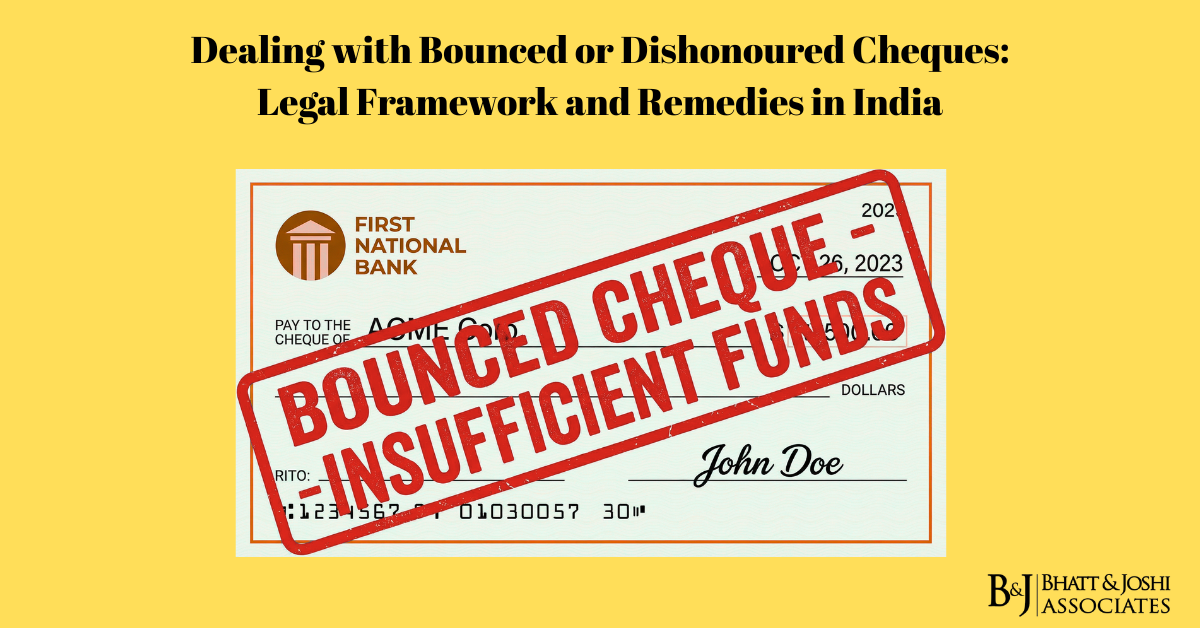
Dealing with Bounced or Dishonoured Cheques: Legal Framework and Remedies in India
Introduction
In contemporary business transactions, cheques remain a fundamental instrument of payment despite the rapid advancement of digital payment systems. A cheque represents not merely a piece of paper but embodies trust, financial obligation, and commercial credibility. When a cheque gets dishonoured or bounces upon presentation to the bank, the consequences extend far beyond simple financial inconvenience, entering the realm of criminal liability. Understanding the legal framework governing dishonoured cheques becomes essential for both creditors seeking recovery and drawers wanting to protect themselves from potential prosecution.
The dishonour of cheques created significant challenges in commercial transactions before legislative intervention. Payees found themselves with limited recourse when cheques bounced, often forced to pursue lengthy civil litigation with uncertain outcomes. Recognizing this gap, the Indian Parliament introduced stringent provisions to restore credibility to negotiable instruments and protect the interests of honest creditors.
Historical Context and Legislative Intent
Prior to 1988, when a cheque was dishonoured, the payee could only pursue civil remedies through recovery suits or alternative dispute resolution mechanisms like conciliation and arbitration. This proved inadequate to deter the misuse of cheques and failed to maintain commercial discipline. The Banking, Public Financial Institutions and Negotiable Instruments Laws (Amendment) Act, 1988 introduced Chapter XVII containing Sections 138 to 142 into the Negotiable Instruments Act, 1881, transforming cheque dishonour from a purely civil matter into a quasi-criminal offence.
The Supreme Court in Modi Cements Ltd v. Kuchil Kumar Nani [1] articulated the legislative objective behind introducing these provisions, stating that the object was to promote the efficacy of banking operations and ensure credibility in transacting business through cheques. The Court emphasized that once a cheque has been drawn and issued to the payee, if any instructions are issued to the bank for non-payment and the cheque is returned with such an endorsement, it amounts to dishonour and falls within the meaning of the provision.
This legislative intervention aimed to inculcate faith in the banking system and prevent cheques from being used as tools of dishonesty. The provisions established strict liability for dishonoured cheques, sending a clear message that financial commitments must be honoured. The dual nature of these provisions, being both punitive and compensatory, distinguishes them from ordinary criminal offences.
Legal Framework Under the Negotiable Instruments Act
The cornerstone of the legal framework addressing dishonoured cheques is Section 138 of the Negotiable Instruments Act, 1881. This provision stipulates that where any cheque drawn by a person on an account maintained by him with a banker for payment of any amount of money to another person from out of that account for the discharge, in whole or in part, of any debt or other liability, is returned by the bank unpaid either because the amount of money standing to the credit of that account is insufficient to honour the cheque or that it exceeds the amount arranged to be paid from that account by an agreement made with that bank, such person shall be deemed to have committed an offence.
The punishment prescribed includes imprisonment for a term which may be extended to two years, or with fine which may extend to twice the amount of the cheque, or with both. However, the provision does not operate blindly and incorporates several safeguards to ensure fairness. These conditions precedent must be satisfied before an offence under this provision can be established.
First, the cheque must be presented to the bank within a period of six months from the date on which it is drawn or within the period of its validity, whichever is earlier. Second, the payee or holder in due course must make a demand for payment by giving notice in writing to the drawer within thirty days of receiving information from the bank regarding the return of the cheque as unpaid. Third, the drawer must fail to make payment of the said amount within fifteen days of receiving the said notice.
These conditions ensure that the drawer receives adequate opportunity to rectify the default before facing criminal prosecution. The statutory notice requirement introduces an essential element of fairness and accountability, ensuring that honest individuals who may have faced inadvertent default are given a fair opportunity to make payment.
Statutory Presumptions and Burden of Proof
One of the most significant features of the legal framework governing dishonoured cheques is the statutory presumption established under Section 139 of the Negotiable Instruments Act. This provision states that unless the contrary is proved, it shall be presumed that the holder of a cheque received the cheque for the discharge, in whole or in part, of any debt or other liability. This presumption operates in favour of the complainant and shifts the burden of proof to the accused.
The landmark judgment in Rangappa v. Sri Mohan [2] clarified the scope and application of this presumption. The Supreme Court held that once the issuance of the cheque is admitted or proved, the trial court is duty bound to raise the presumption that the dishonoured cheque was indeed issued in discharge of a legally enforceable debt or liability. The Court emphasized that this presumption is a rebuttable one and it is for the accused to prove that the cheque in question was not issued for the discharge of any debt or liability.
The Court further explained that the offence made punishable by this provision can be better described as a regulatory offence since the bouncing of a cheque is largely in the nature of a civil wrong whose impact is usually confined to the private parties involved in commercial transactions. In such a scenario, the test of proportionality should guide the construction and interpretation of reverse onus clauses, and the accused cannot be expected to discharge an unduly high standard of proof.
In Kumar Exports v. Sharma Carpets [3], the Supreme Court elaborated on how the accused can rebut this presumption. The Court held that the accused has two options: he can either show that consideration and debt did not exist or that under the particular circumstances of the case, the non-existence of consideration and debt is so probable that a prudent man ought to suppose that no consideration and debt existed. The standard of proof required is preponderance of probabilities rather than proof beyond reasonable doubt.
Procedural Framework and Trial Process
The procedural framework for cases involving dishonoured cheques has been specifically designed to ensure speedy disposal while maintaining fairness. Section 142 of the Negotiable Instruments Act prescribes that the complaint must be made in writing by the payee or holder in due course within one month from the date on which the cause of action arises. The cause of action arises when the drawer fails to make payment within fifteen days of receiving the statutory notice.
The complaint must be filed before a Judicial Magistrate First Class. Section 143, as inserted by the Negotiable Instruments (Amendment and Miscellaneous Provisions) Act, 2002, mandates that all offences under Chapter XVII shall be tried summarily in accordance with the provisions of Sections 262 to 265 of the Code of Criminal Procedure, 1973. This provision empowers the magistrate to pass a sentence of imprisonment for a term not exceeding one year and a fine exceeding five thousand rupees.
Recognizing the burden that dishonoured cheque cases place on the judicial system, the Supreme Court in Indian Bank Association v. Union of India [4] issued comprehensive guidelines to streamline the trial process. The Court directed that the Metropolitan Magistrate or Judicial Magistrate should scrutinize the complaint on the day it is presented and, if accompanied by proper affidavit and documents, take cognizance and direct issuance of summons immediately. The Court emphasized that summons should be sent by post as well as by email to ensure effective service.
The Court further directed that examination of witnesses must be completed within three months and that courts have the option of accepting affidavits instead of oral testimony. These directions aim to reduce unnecessary adjournments and ensure that genuine creditors receive timely justice without prolonged litigation. The emphasis on summary trial reflects the legislative intent to provide swift remedies for what is essentially a commercial dispute with criminal consequences.
Defences Available to the Accused
While the legal framework establishes strict liability for dishonoured cheques, it does not operate blindly against the drawer. The accused has the right to rebut the statutory presumptions by raising credible defences based on the preponderance of probabilities. One commonly invoked defence is the absence of a legally enforceable debt or liability at the time of issuance of the cheque. The accused may argue that the cheque was issued as security or that there was no subsisting debt.
Courts have held that even a security cheque may fall within the scope of the provision if the liability had crystallised by the time the cheque was presented. However, the drawer can establish through evidence that the cheque was misused or presented contrary to the terms of the agreement. Another valid defence pertains to the lack of proper service of the statutory notice. Since the notice is a condition precedent to prosecution, any defect in its service or content may vitiate the proceedings.
The defence that a blank signed cheque was lost or misused has been examined in several cases. In Rangappa v. Sri Mohan, the Court observed that merely claiming that a blank cheque was lost would not suffice if the accused fails to provide credible evidence supporting this claim. The Court noted that if the defence raised by the accused was true, he would have issued instructions to stop payment of the cheque instead of allowing it to be presented and dishonoured.
Stop payment instructions do not absolve the drawer from liability. The Supreme Court in Modi Cements Ltd v. Kuchil Kumar Nandi clarified that once a cheque has been issued to the payee and subsequently the drawer issues stop payment instructions, the dishonour still attracts liability under the provision. The Court held that accepting any other interpretation would defeat the very object of introducing these provisions in the statute.
Jurisdiction and Territorial Considerations
The question of territorial jurisdiction in cases involving dishonoured cheques has evolved through judicial interpretation. The provision creates an offence that is completed only when all the conditions precedent are satisfied. This includes the presentation of the cheque, its dishonour, issuance of notice, and failure to pay within the stipulated period. Each of these acts may occur in different territorial jurisdictions, creating potential complexity.
Courts have held that jurisdiction can lie where the cheque was drawn, where it was delivered, where it was presented for payment, or where it was dishonoured. This interpretation ensures that complainants have reasonable options for filing their complaints without facing undue hardship. However, the Supreme Court has emphasized that jurisdiction must be established through proper pleading and evidence, and cannot be assumed.
Compounding and Settlement
Recognizing that these cases often involve commercial disputes between parties who may wish to settle, the provision makes the offence compoundable. This means that the complainant and the accused can mutually agree to resolve the matter, even after the trial has commenced. The court’s permission is required for compounding, and once compounding is allowed, the accused is discharged.
The compensatory nature of these provisions has been repeatedly emphasized by courts. While the criminal consequences serve as a deterrent, the ultimate objective is to ensure that the payee receives payment. Compounding facilitates this objective by allowing parties to reach settlements without prolonged litigation. Courts have been directed to encourage compounding at early stages to reduce the burden on the judicial system.
Recent Developments and Judicial Trends
Recent amendments and judicial pronouncements have further refined the legal framework. The introduction of interim compensation under Section 143A allows complainants to receive partial relief during the pendency of proceedings. Courts have also increasingly emphasized the use of alternative dispute resolution mechanisms and mediation to resolve these disputes efficiently.
The judiciary has maintained a balance between protecting creditors and ensuring that the provisions are not misused for harassment. Courts scrutinize cases to ensure that the complainant has established all the essential ingredients of the offence and that the statutory notice complies with the requirements. At the same time, courts have been strict in ensuring that accused persons do not take advantage of procedural technicalities to delay justice.
Conclusion
The legal framework governing dishonoured cheques in India represents a carefully calibrated balance between commercial discipline and procedural fairness. The provisions transform what would otherwise be a civil dispute into a criminal offence, thereby creating a strong deterrent against the misuse of cheques. The statutory presumptions favour honest creditors while ensuring that accused persons have adequate opportunity to defend themselves.
Understanding this framework is essential for anyone engaged in commercial transactions. Creditors must ensure strict compliance with procedural requirements, particularly regarding the issuance of statutory notices and timely filing of complaints. Drawers must recognize that issuing a cheque creates a serious legal obligation and that failure to honour it carries significant consequences. The emphasis on summary trials and speedy disposal ensures that genuine disputes are resolved efficiently without unnecessary delay.
As commercial transactions continue to evolve, the principles established by these provisions remain relevant. They reinforce the fundamental expectation that financial commitments must be honoured and that the legal system will intervene decisively when this trust is breached. The framework serves not merely to punish but to restore confidence in negotiable instruments and maintain the integrity of commercial relationships.
References
[1] Modi Cements Ltd v. Kuchil Kumar Nani, AIR 1998 SC 1057. Available at: https://indiankanoon.org/doc/975556/
[2] Rangappa v. Sri Mohan, (2010) 11 SCC 441. Available at: https://indiankanoon.org/doc/150051/
[3] Kumar Exports v. Sharma Carpets, (2009) 2 SCC 513. Available at: https://indiankanoon.org/doc/363129/
[4] Indian Bank Association v. Union of India, AIR 2014 SC 2528. Available at: https://indiankanoon.org/doc/164769777/
[5] Negotiable Instruments Act, 1881 (Act No. 26 of 1881), Section 138. Available at: https://www.indiacode.nic.in/show-data?actid=AC_CEN_2_33_00042_00042_1523271998701§ionId=45718§ionno=138&orderno=143
Published and Authorized by Rutvik Desai