Whatsapp

Chapter 11 Export Pricing and Costing in India: Legal Framework and Regulatory Compliance
Introduction
Export pricing and costing represent two distinct yet interconnected concepts that form the foundation of international trade operations. While pricing refers to the amount an exporter quotes to overseas customers for specific products, costing encompasses all expenditures incurred in manufacturing or procuring those same products. This fundamental distinction shapes how businesses approach international markets and determines their competitive positioning in global trade.
The significance of export pricing extends beyond mere profit calculations. It serves as a crucial determinant in promoting exports and maintaining competitiveness in international trade. Exporters must carefully balance their pricing strategies to remain attractive to foreign buyers while accounting for various export benefits, incentives, and associated expenses. However, there exists no universal formula for successful export pricing, as strategies vary considerably depending on whether the entity operates as a merchant exporter, manufacturer exporter, or through canalizing agencies.
India’s export sector operates within a complex legal and regulatory framework designed to facilitate international trade while ensuring compliance with domestic and international obligations. The regulatory landscape encompasses multiple statutes, rules, and guidelines that collectively govern how exports are priced, valued, and processed through customs authorities.
Legal and Regulatory Framework Governing Export Pricing
Foreign Trade (Development and Regulation) Act, 1992
The Foreign Trade (Development and Regulation) Act, 1992 (FTDR Act) [1] constitutes the primary legislative framework governing India’s export and import activities. Enacted on August 7, 1992, this legislation replaced the restrictive Imports and Exports (Control) Act of 1947, marking a significant shift from control-oriented policies to facilitation-focused approaches. The Act empowers the Central Government to formulate comprehensive foreign trade policies, issue necessary licenses, and implement mechanisms that facilitate smoother import and export activities across Indian borders.
Under the FTDR Act, the Directorate General of Foreign Trade (DGFT) functions as the principal authority responsible for implementing foreign trade policy and regulating export-import operations. Section 7 of the Act mandates that no person shall make any import or export except under an Importer-Exporter Code (IEC) number granted by the DGFT or such other authority as may be specified. This requirement establishes a fundamental compliance threshold for all entities engaged in international trade.
Section 11 of the FTDR Act prescribes penalties for violations, stating that contraventions may result in fines of at least Rs. 10,000 and up to five times the value of goods or services involved. These provisions ensure that exporters maintain accurate documentation and comply with established procedures when determining and declaring export values.
Customs Act, 1962 and Valuation Provisions
The Customs Act, 1962 [2] provides the legal framework for assessment, collection of duties, and clearance of exported goods. Section 14 of the Act specifically addresses valuation of goods for customs purposes, establishing the foundation for how export pricing is evaluated and verified by customs authorities.
Section 14(1) of the Customs Act defines the value of export goods as “the transaction value of such goods, that is to say, the price actually paid or payable for the goods when sold for export from India for delivery at the time and place of exportation, where the buyer and seller of the goods are not related and price is the sole consideration for the sale.” This transaction-based approach to valuation ensures that declared values reflect genuine commercial transactions rather than artificial or manipulated pricing.
The provision further specifies that customs authorities may examine whether relationships exist between buyers and sellers that could influence pricing. Where such relationships exist, or where the declared price appears questionable, customs officers possess authority under Section 17 to conduct examinations and testing to determine appropriate dutiable values. Section 14(2) empowers the Central Government to fix tariff values for any class of export goods, having regard to market trends, when deemed necessary for proper customs administration.
Foreign Exchange Management Act, 1999
The Foreign Exchange Management Act, 1999 (FEMA) [3] plays a crucial role in regulating the financial aspects of export transactions. Enacted to replace the restrictive Foreign Exchange Regulation Act (FERA) and facilitate external trade, FEMA establishes requirements for realization and repatriation of export proceeds.
Section 7 of FEMA requires every exporter to furnish a declaration containing true and correct material particulars, including the full export value or the expected realizable value based on prevailing market conditions. This provision ensures that export pricing reflects realistic commercial expectations and that foreign exchange earnings are properly accounted for.
Section 8 of FEMA mandates that where any amount of foreign exchange is due or has accrued to any person resident in India, such person shall take all reasonable steps to realize and repatriate to India such foreign exchange within the period specified by the Reserve Bank of India. These provisions directly impact export pricing strategies, as exporters must ensure that quoted prices will result in actual foreign exchange realization within prescribed timeframes, typically nine months from the date of export, with possible extensions granted by authorized dealers for sufficient reasons.
Determinants of Export Pricing
Export pricing decisions involve multiple factors beyond simple cost calculations. Successful exporters consider a range of commercial and strategic elements when establishing prices for international markets.
The range and variety of products offered significantly influences pricing power. Exporters with diverse product portfolios can adopt differential pricing strategies across products and markets, optimizing overall profitability while maintaining competitive positioning in specific segments. The ability to deliver promptly and maintain continuity in supply creates value for buyers, often justifying premium pricing compared to competitors who cannot guarantee consistent availability.
After-sales service capabilities, particularly for machine tools, consumer durables, and technical equipment, represent another pricing determinant. Buyers often pay higher prices to exporters who provide reliable warranty support, spare parts availability, and technical assistance. This service component becomes increasingly important as products grow more sophisticated and buyers require ongoing support for effective utilization.
Product differentiation and brand image enable exporters to command premium pricing. Established brands with recognized quality standards can charge higher prices than generic or unknown alternatives, even when underlying product characteristics remain similar. The frequency of purchase patterns also affects pricing strategies. Products purchased regularly face more price-sensitive demand than occasional or one-time purchases, requiring different pricing approaches.
The perceived relationship between quality and price influences buyer decision-making across markets. In many segments, buyers associate higher prices with superior quality, creating opportunities for premium positioning. Conversely, excessively low pricing may trigger quality concerns, potentially undermining market acceptance despite apparent cost advantages.
Specialty goods and gift items often support higher pricing due to their unique value propositions and limited availability. These products appeal to buyers seeking distinctive items rather than commodities, reducing price sensitivity. Credit terms offered to buyers represent another pricing element. Extended payment periods or favorable financing arrangements add value for buyers, potentially supporting higher quoted prices that account for associated financing costs and risks.
Market preferences or prejudices regarding products from particular sources affect pricing dynamics. Some markets prefer goods from specific countries or regions due to perceived quality advantages, cultural affiliations, or historical relationships. Exporters from favored sources can leverage these preferences for premium pricing, while those from less-preferred origins may need compensatory price reductions.
Aggressive marketing and sales promotion efforts create demand and support pricing strategies. Well-promoted products often achieve higher prices than competitors investing less in market development, as buyers become aware of product benefits and develop purchase intent. The exporter’s reputation for prompt acceptance and settlement of claims influences buyer confidence and willingness to pay. Exporters known for fair claim handling can maintain higher prices, as buyers value reduced risk and hassle in dispute resolution.
Export Costing Methodology
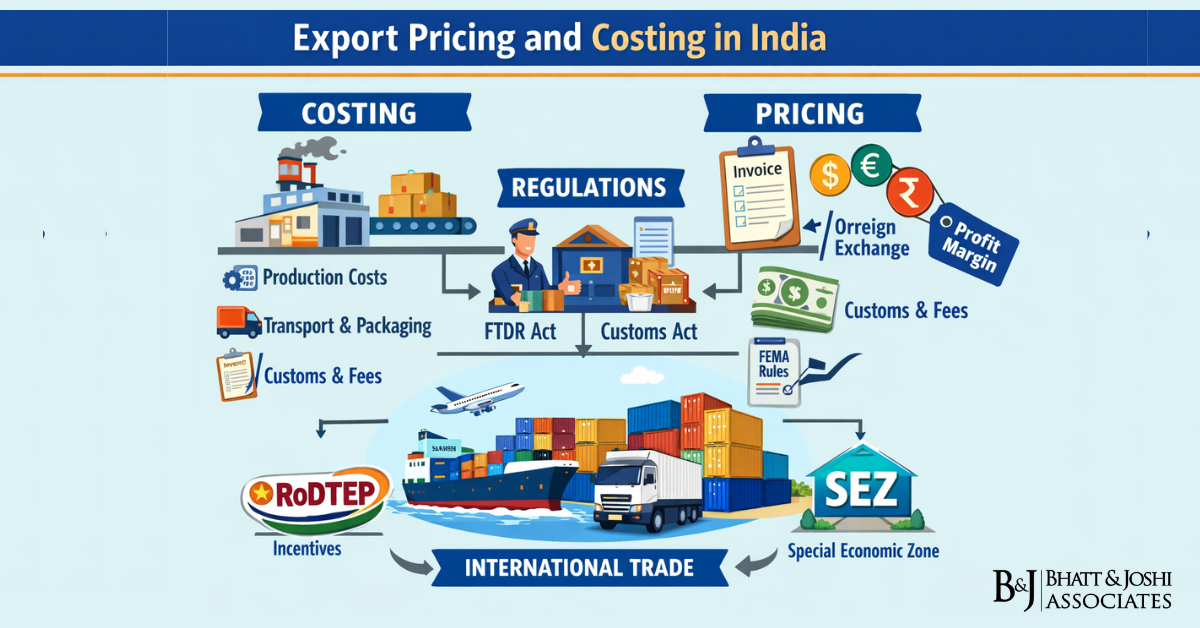
Export costing requires systematic calculation of all expenses involved in producing and delivering goods to foreign buyers. While pricing represents what customers pay, costing determines what exporters actually spend, establishing the foundation for profitable pricing decisions.
Fixed costs represent expenses that remain constant regardless of production volumes. These include factory rent, depreciation on plant and machinery, administrative salaries, and other overhead expenses that continue whether production is high or low. Variable costs fluctuate with production levels, encompassing raw materials, direct labor, power consumption, and other inputs that increase proportionally with output.
A comprehensive export costing sheet should capture all relevant expense categories. The ex-factory cost includes direct manufacturing costs plus applicable overheads, representing what products cost at the factory gate before any export-related expenses. Transportation costs from factory to port add to this base cost, including inland freight, insurance during domestic transit, and handling charges at origin points.
Export packaging expenses often exceed domestic requirements, as international shipments demand more robust protection against damage during extended transit and multiple handling events. These costs include materials, labor, and any specialized packaging required for specific markets or product types. Various pre-shipment expenses accumulate before goods leave India, including inspection fees, certification charges, documentation costs, and bank charges for processing export documents.
Port handling charges cover services at the port of export, including loading, storing, and preparing goods for shipment. Customs clearance expenses encompass payments for customs house agents, examination charges if applicable, and any export duties or cess levied on particular products. Freight costs from Indian ports to destination represent a significant expense component, varying substantially based on shipping routes, cargo volumes, and prevailing market conditions in international transportation.
Insurance premiums protect against loss or damage during international transit, with costs depending on product values, shipping routes, and applicable coverage levels. Commission payments to overseas agents or distributors, if applicable, reduce net realizations from export sales. The final selling price reflects all these cost elements plus desired profit margins, adjusted for competitive positioning and market conditions.
Preparing detailed costing sheets for each export product enables informed pricing decisions. Exporters can identify cost drivers, evaluate profitability across products and markets, and determine minimum viable prices that cover expenses while generating acceptable returns.
Internationally Accepted Pricing Terms (Incoterms)
When quoting prices to overseas buyers, exporters utilize standardized terms defined by the International Chamber of Commerce, commonly known as Incoterms [4]. These internationally recognized rules clarify responsibilities between sellers and buyers regarding transportation, insurance, documentation, and risk transfer during international trade transactions.
Incoterms 2020, the current version effective from January 1, 2020, defines eleven distinct terms applicable to various modes of transport. Four terms apply specifically to sea and inland waterway transport: FAS (Free Alongside Ship), FOB (Free on Board), CFR (Cost and Freight), and CIF (Cost, Insurance and Freight). The remaining seven terms apply to any mode of transport, including multimodal shipments.
Under FOB terms, the seller delivers goods by placing them on board the vessel at the named port of shipment. Risk transfers to the buyer once goods cross the ship’s rail, meaning the seller bears all costs and risks until that point. The buyer assumes responsibility for freight, insurance, and all subsequent costs. FOB remains widely used in international trade, particularly for bulk commodities and non-containerized cargo.
CIF terms require the seller to arrange and pay for both carriage and insurance to the named port of destination. However, risk still transfers when goods are loaded on board the vessel at the origin port, not upon arrival at destination. Under Incoterms 2020, CIF requires minimum insurance coverage equivalent to Institute Cargo Clauses (C), covering at least 110% of the invoice value. This term proves particularly useful when buyers lack established relationships with shipping and insurance providers or prefer sellers to handle these arrangements.
The distinction between CIF and CFR (Cost and Freight) lies solely in insurance obligations. CFR requires sellers to arrange and pay for carriage to the destination port but places no obligation to obtain insurance coverage. Both terms transfer risk at the origin port despite sellers paying freight to destination, creating a separation between cost responsibility and risk assumption that buyers and sellers must clearly understand.
In India, customs duty calculations for imports use CIF values, while some other jurisdictions calculate duties against FOB values. This variance affects pricing strategies when exporters compete in different markets with different valuation bases for duty assessment.
Regulatory Compliance and Documentation
Export transactions generate extensive documentation requirements mandated by various regulatory authorities. Compliance with these requirements proves essential for smooth processing and avoiding penalties or delays.
The Shipping Bill represents the principal document for export customs clearance, filed under Section 50 of the Customs Act. Exporters must declare accurate values, product descriptions, quantities, and destination details. Customs authorities verify these declarations through examination and testing procedures authorized under Section 17, ensuring declared values correspond with actual transaction values.
Commercial invoices issued to foreign buyers must accurately reflect agreed prices and terms. These documents serve multiple purposes, including customs clearance in destination countries, foreign exchange realization verification, and potential claim substantiation if disputes arise. The invoice value forms the basis for calculating any applicable export duties, determining drawback entitlements, and assessing compliance with foreign exchange regulations.
Under FEMA regulations, exporters file various declarations with authorized dealers, typically commercial banks. The Export Declaration Form captures details of export transactions, enabling banks to monitor foreign exchange realization within prescribed timeframes. Banks verify that export proceeds are received within nine months, or such extended period as may be permitted, triggering follow-up for overdue realizations.
For goods requiring pre-shipment inspection, certificates from Export Inspection Agencies must accompany shipping documentation. These inspections ensure that exported goods meet quality standards and specifications agreed with buyers, protecting India’s reputation in international markets and reducing potential claim situations.
Certificates of origin, when required, establish the national origin of exported goods. These certificates prove crucial for claiming preferential tariff treatment under various free trade agreements and for complying with importing country requirements. Authorized agencies like Export Promotion Councils and Chambers of Commerce issue these certificates based on prescribed criteria.
Packing lists detail the contents, quantities, weights, and dimensions of packages in each shipment. Customs authorities and buyers use these lists to verify shipment contents and facilitate proper handling. Accurate packing lists prevent confusion and reduce examination requirements at both origin and destination.
Insurance certificates or policies, required under CIF and CIP terms, provide evidence of cargo insurance coverage. These documents specify insured values, coverage scope, and claim procedures, protecting both sellers and buyers against transit losses.
Export Incentive Schemes and Their Impact on Pricing
The Government of India operates various export incentive schemes that reduce effective costs for exporters, enabling more competitive pricing in international markets. Understanding and effectively utilizing these schemes enhances export profitability and pricing flexibility.
Duty drawback provisions under Section 75 of the Customs Act allow exporters to claim refunds of customs and excise duties paid on imported inputs and domestically procured materials used in manufacturing export products. These refunds reduce effective production costs, allowing exporters to price more competitively while maintaining margins. The Directorate of Drawback determines industry-wise average drawback rates periodically, though exporters may claim actual duty amounts paid if higher and properly documented.
Merchandise Exports from India Scheme (MEIS) provided duty credit scrips to exporters based on product and destination combinations. Though this scheme has been replaced by the Remission of Duties and Taxes on Exported Products (RoDTEP) scheme, the underlying principle remains constant: reducing the incidence of indirect taxes on exported products through post-export refunds or remissions.
RoDTEP refunds various central, state, and local duties, taxes, and levies that are currently not being refunded under any other mechanism. By reducing embedded costs, RoDTEP enables exporters to price more competitively in international markets without sacrificing profitability.
Special Economic Zones (SEZs), established under the Special Economic Zones Act, 2005 [5], provide comprehensive tax benefits and duty exemptions. Manufacturers operating within SEZs obtain raw materials and capital goods without paying customs duties, subject to fulfilling export obligations. This duty-free procurement significantly reduces production costs, reflected in more competitive export pricing.
Export Oriented Units (EOUs) enjoy similar benefits, accessing duty-free imports of inputs and capital goods for producing export products. These units must maintain specified export to domestic sales ratios, typically 90% or higher, but benefit from reduced costs through duty exemptions on imported and domestic inputs.
Advance Authorization schemes allow duty-free import of inputs required for manufacturing export products, eliminating customs duty burden on imported raw materials and components. Exporters demonstrate input-output norms to establish quantities of duty-free imports permitted, with customs authorities monitoring fulfillment of export obligations.
These incentive schemes collectively reduce exporters’ effective costs, creating room for competitive pricing while maintaining adequate profit margins. Savvy exporters incorporate expected incentive benefits when calculating export costing sheets, enabling more aggressive pricing in competitive markets.
Conclusion
Export pricing and costing in India operate within a sophisticated legal and regulatory framework designed to facilitate international trade while ensuring compliance and transparency. The FTDR Act, Customs Act, and FEMA collectively establish requirements for proper pricing, valuation, documentation, and foreign exchange realization. Exporters must navigate these regulatory requirements while considering multiple commercial factors that influence pricing decisions.
Successful export pricing and costing balances cost recovery, profit objectives, competitive positioning, and regulatory compliance. A detailed costing analysis provides the foundation for sustainable pricing, while a clear understanding of Incoterms ensures effective communication with buyers regarding their respective responsibilities. Compliance with documentation and declaration requirements prevents penalties and delays, maintaining smooth export operations.
Export incentive schemes create opportunities for cost reduction and enhanced competitiveness. Exporters who effectively utilize available benefits can price more aggressively while maintaining profitability, gaining advantages in competitive international markets. As India’s export sector continues evolving, staying informed about regulatory changes, understanding cost structures, and adopting strategic pricing approaches remains essential for success in global trade.
References
[1] Foreign Trade (Development and Regulation) Act, 1992 – https://www.indiacode.nic.in/handle/123456789/1947
[2] Customs Act, 1962 – https://www.indiacode.nic.in/handle/123456789/2475
[3] Foreign Exchange Management Act, 1999 – https://www.indiacode.nic.in/handle/123456789/1988
[4] International Chamber of Commerce, Incoterms® 2020 – https://www.trade.gov/know-your-incoterms
[5] Nexdigm, India’s Trade Policy – Import-Export Controls, DGFT Regulations & Compliance – https://www.nexdigm.com/doing-business-in-india/trade-policy-and-import-export-control.php
[6] Directorate General of Valuation, Brief on Valuation – https://dov.gov.in/brief-valuation
[7] Ministry of Commerce and Industry, Foreign Trade (Development and Regulation) Act, 1992 – https://www.commerce.gov.in/wp-content/uploads/2021/06/Foreign_Trade_Development__Regulation_Act_1992.pdf
[8] Trade Finance Global, CIF (Cost, Insurance and Freight) Incoterms – https://www.tradefinanceglobal.com/incoterms/cif-price-cost-insurance-and-freight/
[9] India Code, The Customs Act, 1962 – https://www.indiacode.nic.in/bitstream/123456789/15359/1/the_custom