 Whatsapp

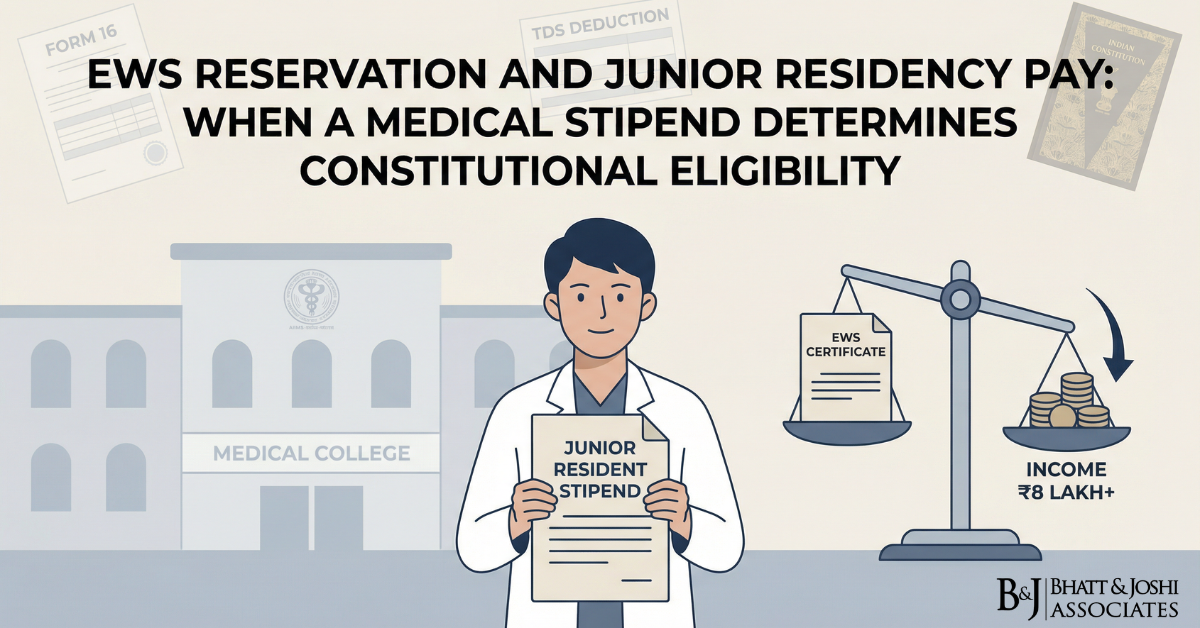
EWS Reservation and Junior Residency Pay: When a Medical Stipend Determines Constitutional Eligibility
Introduction
A quiet but constitutionally significant question has been building inside India’s medical education system for several years: what counts as ‘income’ when a doctor claims reservation under the Economically Weaker Section quota? The answer, settled recently by the Delhi High Court, carries consequences that go well beyond one doctor’s appointment at a premier institution. It goes to the very architecture of economic classification that sits at the centre of the 103rd Constitution Amendment Act, 2019 — the law that inserted Articles 15(6) and 16(6) into the Constitution of India and opened up a 10 percent reservation for citizens belonging to the Economically Weaker Section category. This case is a landmark in defining EWS reservation eligibility for medical postgraduate students. [1]
When the Delhi High Court decided Dr. Bahubali N. Shetti v. All India Institute of Medical Sciences & Anr. (W.P.(C) No. 1339/2026, decided on 7 February 2026), it placed a fine point on something the EWS framework had never explicitly resolved: can a medical postgraduate student who is simultaneously a Junior Resident, drawing a monthly salary-grade remuneration from a government hospital, still hold a valid EWS certificate? The Division Bench of Justices Anil Kshetrapal and Amit Mahajan answered with an unambiguous no. The doctor had received ₹13,59,032 from AIIMS in financial year 2023–24. His income, described institutionally as a ‘stipend’, was nonetheless subjected to Tax Deducted at Source and reflected on Form 16 as gross salary. That made all the difference. [2]
The case is best understood not as an isolated employment dispute but as the latest chapter in India’s evolving conversation about what economic backwardness means under the Constitution. That conversation began in earnest with the Indra Sawhney v. Union of India (AIR 1993 SC 477) judgment, was reopened violently by the 103rd Amendment, and has been refined through litigation ranging from NEET–PG admission disputes to the constitution bench verdict in Janhit Abhiyan v. Union of India (2023) 5 SCC 1. [3]
I. The Constitutional Framework: Articles 15(6) and 16(6)
The 103rd Constitution Amendment Act, 2019 received Presidential assent on 12 January 2019 and came into force on 14 January 2019. It amended two foundational articles of the Constitution. Article 15(6) now reads, in its operative portion, that nothing in Article 15 shall prevent the State from making any special provision for the advancement of any economically weaker sections of citizens other than the classes mentioned in clauses (4) and (5), and that such provision may extend to reservation in educational institutions including private institutions, whether or not aided by the State, subject to the existing reservations. The ceiling for this category is ten per cent of seats. Article 16(6), read alongside it, authorises the State to make provisions for reservation in appointments or posts in favour of economically weaker sections, again subject to a maximum of ten per cent. [4]
Both provisions operate independently of the 50 per cent ceiling that had governed SC, ST and OBC reservations ever since Indra Sawhney. The majority in Janhit Abhiyan v. Union of India confirmed this, holding that the 50 per cent ceiling ‘applies only to the reservations envisioned by Articles 15(4), 15(5) and 16(4) of the Constitution’ and does not restrain the newly inserted clauses. Justice Dinesh Maheshwari, writing for the majority, stated: “Reservation for economically weaker sections of citizens up to ten per cent in addition to the existing reservations does not result in violation of any essential feature of the Constitution of India and does not cause any damage to the basic structure of the Constitution of India on account of breach of the ceiling limit of fifty per cent because, that ceiling limit itself is not inflexible.” [3]
Critically, the Amendment introduces a category that differs structurally from the SC, ST and OBC frameworks. Those categories are identified by caste lists maintained under Articles 341, 342 and 340 of the Constitution and are tied to historical social discrimination. The EWS category, by contrast, targets families rather than communities, and rests purely on annual income and asset thresholds — criteria that must be freshly ascertained for each applicant at every stage of selection. This individualised, transactional character of economic assessment is what makes the junior residency pay question so legally potent.
II. The Regulatory Machinery: DoPT’s Office Memorandum and the ₹8 Lakh Ceiling
The operational definition of ‘economically weaker section’ was not left to the Constitution text alone. The Department of Personnel and Training (DoPT) issued Office Memorandum No. 36039/1/2019-Estt.(Res) dated 31 January 2019, which remains the governing document for EWS Reservation eligibility across central government recruitments and educational admissions. The OM specifies that persons whose family’s gross annual income is below ₹8 lakh per annum shall be identified as EWS. The term ‘family’ includes the applicant, his or her parents, spouse and dependent children below 18 years. The gross annual income must include income from all sources — salary, agriculture, business, profession, and any other source. Additionally, regardless of income, a family owning 5 acres or more of agricultural land is excluded from the EWS category. [5]
The ₹8 lakh threshold was borrowed, as the Supreme Court pointedly observed in Neil Aurelio Nunes & Ors. v. Union of India (W.P.(C) No. 961/2021, decided 20 January 2022), from the existing creamy layer exclusion criterion for OBC candidates. The bench of Justices D.Y. Chandrachud and A.S. Bopanna noted that the Union Government had initially set the EWS limit at ₹8 lakh to mirror the OBC creamy layer threshold, even though the two frameworks serve fundamentally different purposes: the creamy layer excludes OBCs who have economically progressed beyond backwardness, whereas the EWS limit is meant to positively identify those who remain economically deprived, directly influencing EWS reservation eligibility. [6]
The Union Government subsequently constituted a three-member expert committee comprising former Finance Secretary Ajay Bhushan Pandey, ICSSR Member Secretary V.K. Malhotra, and Principal Economic Adviser Sanjeev Sanyal. The Pandey Committee submitted its report on 31 December 2021, recommending that the ₹8 lakh annual family income ceiling be retained, though it suggested that the residential asset criterion be removed altogether. The Centre filed an affidavit before the Supreme Court on 1 January 2022 accepting the panel’s recommendation in full. The Supreme Court, in its 7 January 2022 order in Neil Aurelio Nunes, allowed the NEET–PG 2021 counselling to proceed on the existing criteria and confirmed: “We accept the recommendation of the Pandey Committee that the criteria which have been stipulated in OM 2019 be used for 2021–2022.” [6]
III. Janhit Abhiyan v. Union of India (2023) 5 SCC 1: The Constitutional Seal of Approval
The definitive constitutional reckoning arrived on 7 November 2022, when a five-judge Constitution Bench comprising Chief Justice U.U. Lalit and Justices Dinesh Maheshwari, S. Ravindra Bhat, Bela M. Trivedi and J.B. Pardiwala delivered its judgment in Janhit Abhiyan v. Union of India, reported as (2023) 5 SCC 1. The Bench upheld the 103rd Amendment by a 3:2 majority, with Justices Maheshwari, Trivedi and Pardiwala writing separately but concurrently for the majority, while Chief Justice Lalit and Justice Bhat dissented. [3]
The majority answered three central questions. On the question of whether economic criteria alone could found a constitutionally valid reservation, Justice Maheshwari held that reservation structured singularly on economic criteria does not violate any essential feature of the Constitution and provides a clear standard for determining EWS reservation eligibility. On the 50 per cent ceiling, the majority held that this was a rule fashioned for backward class reservations under Articles 15(4), 15(5) and 16(4), not an immovable constitutional boundary applicable to all forms of affirmative action. On the exclusion of OBCs, SCs and STs from EWS benefits, the majority held this to be a balancing measure rather than discrimination: those communities already benefit from their own reservation provisions, and there is no irrationality in creating a separate basket for those outside those categories.
The dissent by Justice Bhat (for himself and the Chief Justice) took a strikingly different view. He concluded that the exclusion of SCs, STs and OBCs from EWS benefits is constitutionally impermissible, because it creates a class of reservation that expressly benefits upper castes while excluding the most historically disadvantaged groups from an economic benefit they are equally entitled to claim. Justice Bhat also held that breaching the 50 per cent ceiling is not a matter of mere flexibility but constitutes damage to the basic structure: ‘Providing for 10% additional reservation directly breaches the 50% ceiling of reservations already settled by the decisions of the Supreme Court and hence, results in unacceptable abrogation of the Equality Code which, again, destroys the basic structure of the Constitution.’ [7]
A review petition was filed in December 2022, but a five-judge bench led by Chief Justice D.Y. Chandrachud dismissed it on 9 May 2023, confirming that there were no grounds to revisit the judgment. The constitutional validity of the EWS reservation framework is therefore settled, at least for the moment.
IV. Junior Residency in Indian Medical Education: Nature and Structure of the Appointment
To appreciate why the Shetti judgment matters, one must understand what a Junior Residency actually is. In the Indian medical education system, a candidate who qualifies through NEET–PG and secures admission to a postgraduate programme at an institution such as AIIMS is simultaneously enrolled as a student and appointed as a Junior Resident Doctor. The Junior Residency is a component of the postgraduate curriculum: JR doctors provide hands-on clinical services, discharge patient-care responsibilities, attend night duties on rotation, and assist in surgical procedures — all as part of their structured training. AIIMS, in the Shetti case, filed an affidavit confirming this dual character of the appointment. It explained that Junior Residents are selected through a competitive process, serve a fixed tenure, receive monthly remuneration governed by the applicable pay commission scales along with allowances, and are bound by service conditions including a penalty for mid-course resignation and forfeiture of the month’s salary upon voluntary exit. [8]
The question of whether this remuneration is a ‘stipend’ (as labelled by many institutions) or a ‘salary’ for purposes of the Income Tax Act, 1961 had previously been a zone of interpretive ambiguity. Section 10(16) of the Income Tax Act, 1961 exempts scholarships granted to meet the cost of education from income. Some Junior Residents argued, as reflected before the Delhi High Court, that their remuneration should not count toward EWS reservation eligibility, since it was classified as a scholarship. The Shetti court rejected this argument decisively, emphasizing the difference between tax treatment and the substantive determination of income for reservation purposes.
V. Dr. Bahubali N. Shetti v. AIIMS (2026:DHC:997-DB): Substance Over Nomenclature
The facts of the case are worth stating with precision. AIIMS published a prospectus on 5 June 2024 inviting applications for Senior Resident and Senior Demonstrator posts. Of the 16 seats in Ophthalmology, one was reserved for EWS candidates. The petitioner applied under the EWS category and was selected. A competing candidate from the unreserved category, who had performed better in overall merit but could not secure an unreserved seat, challenged the petitioner’s EWS claim. Using information obtained through an RTI application, she established that the petitioner had received ₹13,59,032 from AIIMS during the financial year 2023–24. AIIMS had subjected this amount to TDS and issued Form 16 describing it as taxable income. [9]
The matter first went before the Central Administrative Tribunal (CAT). On 13 January 2026, the Tribunal declared the petitioner’s EWS certificate invalid for recruitment purposes and directed AIIMS to terminate his appointment, either offering the seat to the next eligible EWS candidate or, if none were available, converting it to the Unreserved category and offering it to the rival candidate based on merit. The petitioner challenged this order before the Delhi High Court by way of a writ petition filed under Article 226. [2]
The Division Bench dismissed the petition on 7 February 2026, with the following key reasoning. First, the Court reaffirmed that the DoPT’s Office Memorandum dated 31 January 2019, as incorporated into the AIIMS prospectus, requires consideration of ‘gross annual income from all sources’. Second, the Court refused to allow the tax law classification of the payment to govern the reservation policy analysis. The exemption under Section 10(16) of the Income Tax Act, 1961 was enacted to ease the tax burden on scholarship recipients, not to define the boundaries of economic eligibility for affirmative action. The Bench observed: “The fact that the remuneration was reflected in the pay slips as ‘gross salary’, subjected to statutory tax deductions and reported through Form-16, fortifies the conclusion that the payment was compensatory in nature and not a scholarship granted solely to defray educational expenses.” [9]
Third, and most significantly, the Court invoked the principle of substance over nomenclature. A scholarship, it held, is a payment made solely to meet the cost of education, carrying no reciprocal obligation. The Junior Resident’s remuneration is nothing like that. It is paid monthly, is tied to the discharge of active clinical duties, is governed by contractual service conditions, and is treated by the paying institution as compensatory remuneration. The structure of the engagement, the Court said, betrays a quid pro quo relationship that is characteristic of employment, not education. The case has since been widely reported as settling, at least at the High Court level, the question of how post-graduate medical remuneration must be classified for EWS purposes. [8]
VI. The Indra Sawhney Foundation and the Evolution of the Economic Backwardness Test
The background against which this case sits cannot be appreciated without understanding Indra Sawhney v. Union of India (AIR 1993 SC 477), where a nine-judge bench of the Supreme Court conclusively held, by a 6:3 majority, that economic backwardness alone is an impermissible basis for reservation. The bench struck down the Office Memorandum dated 25 September 1991 which had attempted to reserve 10 per cent of central government posts for ‘economically backward sections’ not covered by existing schemes. The court held that the Constitution, in its original form, did not permit classification for reservation solely on the basis of economic criteria; social and educational backwardness were indispensable co-requisites. [4]
The 103rd Amendment, in a sense, was Parliament’s legislative answer to Indra Sawhney. By inserting Articles 15(6) and 16(6) directly into the constitutional text, Parliament effectively overrode the interpretive constraint that the nine-judge bench had placed on the scope of Articles 15 and 16. The majority in Janhit Abhiyan acknowledged this constitutional manoeuvre and found it valid, holding that the amendment does not alter the ‘identity’ of the Constitution because reservation based on economic criteria is a reasonable tool of affirmative action within the larger equality code. This is the constitutional foundation on which the EWS edifice stands, and it is the reason why the precision of economic assessment — including the treatment of a junior resident’s pay — carries such constitutional weight.
VII. Neil Aurelio Nunes and the NEET–PG Battlefield
The intersection of EWS reservation and medical education was litigated extensively in Neil Aurelio Nunes & Ors. v. Union of India. The immediate trigger was a notice dated 29 July 2021 by which the Directorate General of Health Services implemented 27 per cent OBC reservation and 10 per cent EWS reservation in the All India Quota seats for NEET–UG and NEET–PG, effective from the 2021–2022 academic year. This notice was challenged before the Supreme Court, and a bench of Justices D.Y. Chandrachud and A.S. Bopanna delivered its order on 7 January 2022, upholding the OBC reservation and permitting EWS reservation on the existing criteria for that academic year while leaving the validity of the ₹8 lakh ceiling for later adjudication. [6]
On 20 January 2022, the court issued a fuller reasoned judgment upholding OBC reservation in AIQ seats as constitutionally valid and elaborating on the principle of substantive equality: that formal equality — treating everyone identically — cannot be the measure of justice for communities that have faced structural disadvantage. The EWS question was not finally resolved in that round of litigation. The Supreme Court’s observation that the ₹8 lakh income criterion appeared ‘prima facie arbitrary’, given the wide variation in per capita income across states and the mechanical adoption of the OBC creamy layer threshold, represents one of the most striking moments in the entire EWS litigation saga. The Pandey Committee’s retention of the ₹8 lakh figure was defended on pragmatic grounds — it was a settled threshold in use since 2019, and changing it mid-stream would dislocate ongoing admissions.
VIII. The Legal Tension: Income Tax Law Versus Reservation Policy
One of the most technically interesting dimensions of the Shetti case is the argument that was made — and rejected — about the interplay between the Income Tax Act and the EWS policy. Section 10(16) of the Income Tax Act, 1961 exempts from tax computation ‘any payment made as scholarship to meet the cost of education’. Some courts and institutions had treated the junior residency remuneration as falling within this exemption when it was so labelled by the institution. The argument, simply stated, was: if the law exempts this payment from taxation as a scholarship, then it cannot simultaneously count as salary income for other legal purposes including EWS Reservation eligibility assessment.
The Delhi High Court dismantled this argument at its foundation. The Income Tax Act and the EWS reservation policy are addressed to different problems, carry different purposes, and should not be read as mutually controlling instruments. The exemption under Section 10(16) of the Income Tax Act, 1961 exists to reduce the financial burden on genuine students who receive educational grants, not to provide them with a constitutional advantage in claiming poverty-linked affirmative action benefits. The EWS policy looks at the actual economic capacity of the individual’s family. It asks: is this family genuinely unable to compete with economically stronger sections? Where a candidate draws over ₹13 lakh in a year from employment-like engagement at a public institution, the answer, the court held, must be no.
What the court established, in effect, is a ‘substance over nomenclature’ rule for EWS income assessment. The label attached to a payment by an employer — whether stipend, honorarium, scholarship or salary — is not determinative. The inquiry must go to the character of the payment: Is it conditional on service performance? Is it reflected in monthly pay slips? Is it subjected to TDS? Is it reported as gross salary in Form 16? If the answers are yes, the payment is income for EWS purposes, regardless of the label placed on it.
IX. Implications and Regulatory Outlook
The Delhi High Court’s ruling has immediate practical implications for a significant number of medical postgraduate students across central medical institutions. AIIMS, JIPMER, PGIMER Chandigarh, and other centrally administered hospitals collectively train thousands of Junior Residents every year. Many of those students, having entered their PG programmes under the EWS category, now face the prospect that their residency remuneration may retroactively render their EWS certificates invalid if challenged by a competing candidate with RTI access to pay records. The combination of Form 16 documentation, TDS records, and the mandatory policy requirement to declare gross income from all sources creates a verifiable paper trail that is now judicially confirmed as the decisive evidence.
The judgment also prompts a larger regulatory question that Parliament and the DoPT have not yet addressed: should the EWS income assessment for medical PG applicants account for the fact that the income arises from the very educational programme for which EWS reservation eligibility is being determined? A student who earns ₹13 lakh during a financial year in which they serve as a Junior Resident is drawing that income as a condition of their postgraduate medical training, not from independent employment. Whether the policy should carve out such training-linked remuneration for prospective assessments — as opposed to income from independent employment or family sources — is a question that courts have flagged but that legislative or executive clarification alone can authoritatively answer. Until that happens, the Shetti ruling stands as controlling authority at the High Court level, meaning any medical postgraduate who earned above ₹8 lakh during their Junior Residency in the reference financial year cannot validly claim EWS benefits for subsequent appointments.
It is worth noting that the judgment also reinforces the institutional reliance on RTI as a tool for verifying EWS reservation eligibility. A competing candidate who is denied a seat by reason of the EWS quota can now, following Shetti, file an RTI application seeking Form 16 and pay records of the EWS appointee, present those documents before the CAT or the relevant High Court, and seek cancellation of the appointment if the income figures disclose eligibility beyond the ₹8 lakh ceiling. This effectively deputises competing candidates as informal auditors of EWS certificate integrity, a dynamic that raises its own fairness questions but is for now legally sound.
Conclusion
The EWS reservation framework, introduced into the Constitution by the 103rd Amendment and validated by the Supreme Court in Janhit Abhiyan v. Union of India, rests on the premise that economic deprivation is a legitimate constitutional basis for affirmative action. The premise is now settled law. What is also now settled, at least in the Delhi High Court, is that the determination of economic deprivation for EWS reservation eligibility must look at the substance of a person’s financial life rather than the labels attached to their receipts. The Shetti judgment draws a clean line: a Junior Resident who draws a monthly salary-grade remuneration, has TDS deducted, and receives Form 16 from a premier national institution is not economically weaker within the meaning of the DoPT’s 2019 Office Memorandum, regardless of the word ‘stipend’ printed on the pay slip. [9]
This outcome is constitutionally coherent. The EWS category was created to capture those who are genuinely unable to compete with economically stronger sections of society. A doctor who earns ₹13 lakh in a year cannot credibly be placed in that category. The harder policy question — whether income earned during postgraduate training should be assessed differently from independent professional income — remains open for legislative resolution. But until Parliament or the DoPT recalibrates the framework, medical students and administrators alike must now treat the substance of residency remuneration as the decisive variable in EWS reservation eligibility, not the name on the payment slip.
References
[1] Article 15(6), Constitution of India – Indian Kanoon
[2] Bar & Bench – Stipend to junior resident doctor counts as income: Delhi High Court (February 2026)
[3] SCC Online Blog – 10% EWS Quota: Constitutionality upheld, 3:2 verdict (November 2022)
[4] Supreme Court Observer – Janhit Abhiyan v. Union of India – EWS Reservation Case Background
[5] Scroll.in – Is the 8 lakh income criteria for EWS too lenient? (January 2022)
[6] Indian Kanoon – Neil Aurelio Nunes v. Union of India (W.P.(C) No. 961/2021, 20 January 2022)
[7] The Quint – Supreme Court’s EWS Judgment Fundamentally Alters India’s Reservation Policy
[8] Legal Bites – Junior Resident Doctor’s Stipend Constitutes Income for Exclusion from EWS Quota
