Whatsapp

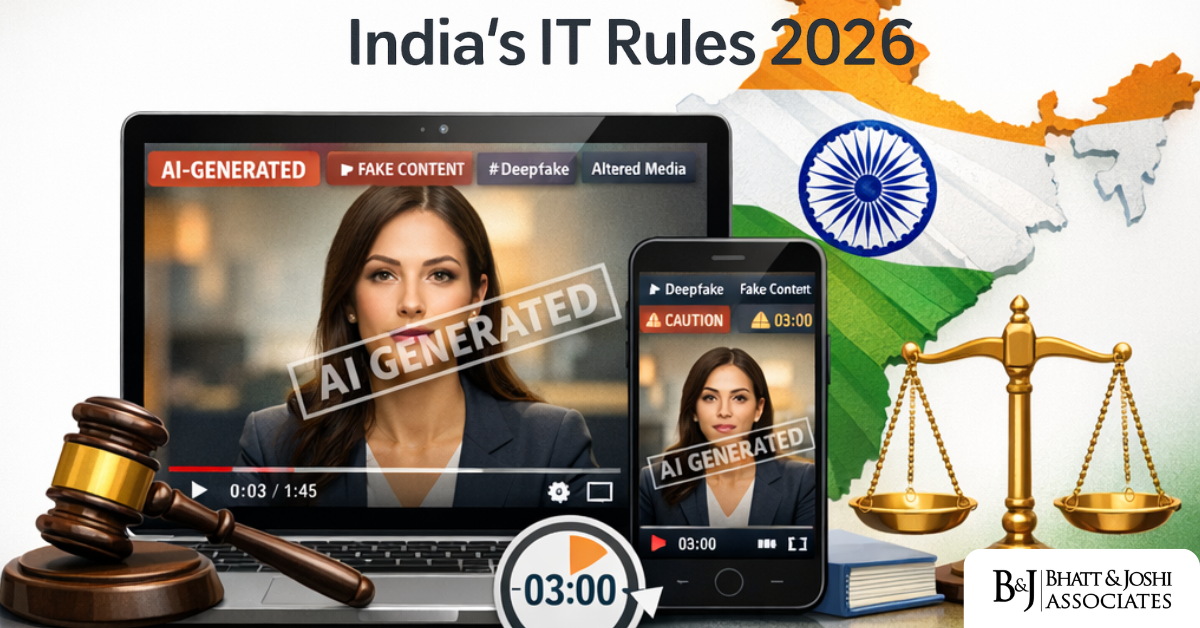
India’s 2026 IT Rules Amendment: The World’s First Binding Synthetic Content Provenance Mandate
Introduction
On 10 February 2026, India’s Ministry of Electronics and Information Technology (“MeitY”) notified the Information Technology (Intermediary Guidelines and Digital Media Ethics Code) Amendment Rules, 2026 (the “2026 Amendment”) bearing Gazette notification number G.S.R. 120(E), with effect from 20 February 2026. [1] This makes India the first jurisdiction in the world to enact a binding statutory framework that not only defines “synthetically generated information” (SGI) but mandates provenance metadata, visible watermarks, and compressed three-hour takedown windows for AI-created deepfakes. India’s 2026 IT rules operates as an amendment to the Information Technology (Intermediary Guidelines and Digital Media Ethics Code) Rules, 2021 (“IT Rules, 2021”), which were themselves framed under Section 87(1) and Section 87(2)(z) and (zg) of the Information Technology Act, 2000 (“IT Act”). [2] With nearly one billion internet users and more than 500 million active social media users, the market weight India brings to this mandate is substantial enough to set a global compliance benchmark.
The regulatory move did not emerge in isolation. Prime Minister Narendra Modi had publicly described the deepfake problem as a “crisis,” and the preceding years had witnessed viral deepfake incidents involving prominent businesspersons, actors, and political figures that exposed the inadequacy of voluntary platform action. The 2021 IT Rules, while imposing due-diligence obligations on intermediaries, contained no provision that specifically addressed the creation, labelling, or provenance of synthetically generated media. India’s 2026 IT Rules Amendment fills that void with a dedicated rule-set targeting every link in the synthetic content chain — from creation tools, through distribution platforms, to the embedded metadata that travels with the file itself.
The Statutory Architecture: What the 2026 IT Rules Amendment Actually Says
Defining Synthetically Generated Information
The most foundational contribution of the India’s 2026 IT Rules Amendment is the formal statutory definition of “synthetically generated information” inserted as Rule 2(1)(wa) of the IT Rules. [1] SGI is defined as “audio, visual or audio-visual information which is artificially or algorithmically created, generated, modified or altered using a computer resource, in a manner that such information appears to be real, authentic or true and depicts or portrays any individual or event in a manner that is, or is likely to be perceived as indistinguishable from a natural person or real-world event.” The accompanying definition of “audio, visual or audio-visual information” extends the scope to “any audio, image, photograph, graphic, video, moving visual recording, sound recording or any other audio, visual or audio-visual content, with or without accompanying audio, whether created, generated, modified or altered through any computer resource.”
Critically, the Amendment introduces a carve-out for routine or good-faith editing. Basic adjustments such as brightness correction, contrast sharpening, video compression for upload, transcription of an interview into text, accessibility features like text-to-speech for the visually impaired, and the preparation of documents, presentations, or educational material — so long as they do not result in a false document or materially misleading content — fall outside the definition of SGI. [3] This exclusion reflects a conscious effort not to accidentally criminalise the ordinary creative toolkit. Notably, pure text-only generative outputs — such as AI-written summaries or code — are also excluded unless they produce a false document, meaning the regulatory burden lands squarely on audio-visual synthetic media rather than text generation broadly.
Mandatory Labelling, Watermarking, and Provenance Metadata
Rule 3(3)(a)(ii) of the 2026 Amendment requires that SGI which is not independently unlawful must still be: (i) clearly and prominently labelled or displayed with a notice identifying the content as synthetically generated, with “prominent visibility” in the visual display or a “prominently fixed” audio disclosure; and (ii) embedded with permanent metadata or technical provenance mechanisms, to the extent technically feasible, including a unique identifier, to enable identification of such information as synthetically generated and identification of the device with which the content was generated. [4] Rule 3(3)(b) then expressly prohibits intermediaries from permitting the removal, suppression, or modification of these labels, metadata, or unique identifiers once applied. This makes the provenance chain legally irremovable, at least at the platform level.
For audio-only content that is synthetically generated, a spoken disclaimer must appear at the beginning. For video content, a visible on-screen watermark is required. Where a platform’s automated detection tools confirm that content uploaded by a user is SGI, the platform must itself apply the requisite label even if the user failed to declare it. [2] The implementation challenges here are real: C-DAC’s own deepfake detection tool reportedly achieves a maximum accuracy of 89%, and watermarks can be stripped by re-screenshotting or recompressing a file. The 2026 Amendment acknowledges this by qualifying the metadata obligation with the phrase “to the extent technically feasible,” but critics from the Internet Freedom Foundation have argued that the rules fail to specify accepted watermarking standards or approved detection models, leaving enforcement agencies broad discretion. [5]
User Self-Declaration and Platform Verification
Significant Social Media Intermediaries (“SSMIs”), defined under Rule 2(v) as intermediaries with over 50 lakh (five million) registered users in India, face an additional layer of obligation under Rule 4(1A). [1] SSMIs must collect user self-declarations during upload, confirming whether the content is AI-generated. Crucially, the platform is then legally required to cross-verify these declarations using “reasonable and appropriate” automated tools. A mere user statement that the content is “original” does not satisfy the platform’s compliance obligation if its own systems indicate otherwise. Failure to act on confirmed SGI without the requisite label, or failure to prevent unlawful SGI from appearing on the platform, constitutes a breach of due diligence and causes the intermediary to lose the safe-harbour immunity under Section 79 of the IT Act. [6]
The Takedown Architecture: Three-Hour Mandates and Grievance Compression
Perhaps the most operationally disruptive change in India’s 2026 IT Rules Amendment is the compressed takedown timeline. Rule 3(1)(d) reduces the earlier 36-hour window to just three hours for content that has been deemed illegal by a court order or a direction from the appropriate government. [7] A separate two-hour window applies to the most sensitive categories: non-consensual deepfake nudity and child sexual abuse material (CSAM). These timelines apply not just to proactive reports but also to complaints reaching platforms through the government’s Sahyog portal, managed by the Indian Cyber Crime Coordination Centre under the Ministry of Home Affairs. The previous grievance acknowledgment window of 15 days has been cut to seven days, with certain categories requiring same-day action.
Researchers at FutureShift Labs have noted that this reduction “fundamentally alters compliance architecture for large platforms such as Meta, Google, and X,” necessitating “continuous monitoring systems, high-confidence automated detection tools, multilingual review capacity, and round-the-clock legal escalation teams.” [8] Operational costs will rise sharply, with particular pressure on cross-format analysis of audio-visual deepfakes and provenance checks across billions of uploads. The compliance architecture needed to meet a three-hour window is qualitatively different from one designed for 36 hours: any meaningful human review at that cadence is essentially impossible for content spreading virally, pushing platforms toward automated over-removal and creating what the Internet Freedom Foundation has described as a “prior restraint regime incompatible with Article 19(1)(a) of the Constitution.”[5]
Safe Harbour, Criminal Law, and the Regulatory Ecosystem
Section 79 IT Act and the 2026 Amendment’s Safe Harbour Clarification
Section 79 of the Information Technology Act, 2000 provides conditional immunity to intermediaries for third-party content hosted on their platforms. Under the landmark judgment in Shreya Singhal v. Union of India, AIR 2015 SC 1523, the Supreme Court of India read down Section 79(3)(b) to hold that an intermediary loses safe-harbour protection only upon receiving “actual knowledge” in the form of a court order or government direction — not merely upon receiving private takedown requests. [9] The Court held that it must be interpreted to mean “knowledge received that a Court order has been passed asking it to take down the infringing material,” because otherwise Google, Facebook, and similar platforms would face an impossible task of adjudicating the legitimacy of millions of removal requests. The Court also upheld the secret blocking process under Section 69A as a “narrowly drawn provision with adequate safeguards.”
The 2026 Amendment engages directly with this framework through the newly inserted Rule 2(1B), which clarifies that an intermediary’s removal of or disabling access to SGI in compliance with the Amendment Rules — including through automated tools — will not be treated as a violation of the safe-harbour conditions under Section 79(2) of the IT Act. [4] This is the “carrot” side of the regulatory equation: platforms that act swiftly against deepfakes are not penalised for doing so. Conversely, if a platform “fails to act upon” confirmed SGI, it is deemed to have failed its due-diligence obligations and loses that immunity entirely, becoming liable as if it were the originator of the harmful content.
The Bharatiya Nyaya Sanhita, 2023 and Criminal Exposure
The 2026 Amendment replaces all references to the repealed Indian Penal Code, 1860 in Rule 7 of the IT Rules with corresponding provisions of the Bharatiya Nyaya Sanhita, 2023 (“BNS”), which came into force on 1 July 2024. [7] From a criminal liability standpoint, BNS Section 318 consolidates the prior Sections 415, 417, 418, and 420 of the IPC into a unified cheating offence, prescribing imprisonment up to seven years and a fine for fraudulently inducing delivery of property by deception. BNS Section 319 separately penalises cheating by personation — pretending to be another real or imaginary person with intent to deceive. Both provisions are directly applicable to deepfake-based financial fraud and identity-based impersonation. BNS Section 353 penalises incitement to public disorder through false statements, which may cover fabricated AI-generated political speech, while Section 356 codifies defamation. Forgery using electronic records is addressed under Section 336 of the BNS, carrying potential imprisonment for life or up to seven years in appropriate circumstances.
Intermediaries that enable SGI creation are now expressly required under Rule 3(1)(ca) to warn users that misusing AI tools to create unlawful SGI may attract criminal penalties under these BNS provisions as well as the Protection of Children from Sexual Offences Act, 2012 (“POCSO Act”). [4] POCSO Section 19 imposes a mandatory reporting obligation on any person who has knowledge of a sexual offence committed against a child, and the 2026 Amendment is explicit that platforms with knowledge of CSAM must report such offences to the appropriate authorities under this provision, alongside Section 33 and Section 173 of the Bharatiya Nagarik Suraksha Sanhita, 2023 (“BNSS”).
The Right to Privacy and the Puttaswamy Framework
The constitutional underpinning of India’s digital regulatory space rests significantly on Justice K.S. Puttaswamy (Retd.) v. Union of India, (2017) 10 SCC 1, in which a nine-judge bench of the Supreme Court unanimously held that the right to privacy is a fundamental right protected under Articles 14, 19, and 21 of the Constitution of India. The Court specifically recognised that “informational privacy is a facet of the right to privacy” and that “the dangers to privacy in an age of information can originate not only from the state but from non-state actors as well.” This recognition directly justifies regulatory intervention against the non-consensual creation and distribution of synthetic media — a form of informational harm that directly impinges on an individual’s dignity, autonomy, and control over their own image and voice.
The 2026 Amendment operationalises the Puttaswamy privacy mandate by requiring that victims of non-consensual AI-generated imagery receive a fast-track two-hour takedown remedy. It also requires platforms to disclose the identity of deepfake creators to victims and to law enforcement where a crime has been committed, balancing the right to privacy of the victim against the anonymity interest of the creator — a calculus that the courts will ultimately refine as litigation around the Amendment develops.
Regulatory Significance and Critical Challenges
India as a Global First Mover
No other jurisdiction has yet enacted a binding statutory instrument that simultaneously defines SGI, mandates permanent provenance metadata, and imposes sub-three-hour takedown timelines for synthetic content. The European Union’s AI Act classifies AI uses by risk level and regulates high-risk applications, but it does not mandate real-time provenance watermarking at the intermediary level for audio-visual synthetic content as a general matter. [5] The United States has enacted sector-specific deepfake bills at the state level and the DEFIANCE Act at the federal level targeting non-consensual intimate deepfakes, but no overarching provenance mandate exists. India’s approach — a binding rule embedded in an existing intermediary-liability framework, applicable to all platforms regardless of origin — is structurally different and, given India’s market weight, is likely to exert extraterritorial pressure on compliance standards worldwide.
The designation of India’s approach as “the world’s first binding synthetic content provenance mandate” rests on this combination: a statutory definition of SGI, legally irremovable metadata, mandatory labelling, user declaration requirements, platform verification obligations, and conditional safe-harbour loss — all contained in a single enforceable instrument rather than scattered across voluntary codes or guidance documents.
Implementation Gaps and Constitutional Concerns
The 2026 Amendment has drawn substantive criticism from digital rights organisations. The Internet Freedom Foundation has identified four structural problems. First, the definition of SGI does not distinguish between different risk categories, unlike the EU AI Act’s tiered approach, so benign creative content faces the same labelling burden as weaponised deepfakes. [5] Second, mandatory labelling amounts to compelled speech and may infringe the intermediary’s own freedom of expression under Article 19(1)(a). Third, the rules condition safe-harbour immunity on proactive monitoring, which the Supreme Court in Shreya Singhal specifically cautioned against, as it effectively pressures platforms to act as censors of user speech. Fourth, the framework overestimates the reliability of watermarking and AI detection tools: metadata can be stripped by screenshotting, watermarks can be recompressed away, and even the most sophisticated detection models operate with meaningful error rates.
The government has also left critical implementation questions unanswered. No accepted watermarking standard has been specified, no approved detection model list has been published, and the content of “prominent” labelling has not been defined across different display contexts. JSA Law has noted that while the narrowing of the SGI definition from the October 2025 draft — which applied to content that “reasonably appears to be authentic or true” without limiting to specific media formats — reflects incorporation of industry feedback, the absence of prescribed technical standards leaves platforms with significant legal uncertainty and enforcement agencies with correspondingly broad discretion. [3]
Compliance Obligations: A Summary for Practitioners
For legal practitioners advising digital platforms, India’s 2026 IT Rules Amendment creates a layered compliance matrix. All intermediaries that host user-generated audio-visual content must: embed irremovable provenance metadata on confirmed SGI to the extent technically feasible; clearly label such content as synthetically generated; prevent the generation or circulation of unlawful SGI — specifically CSAM, non-consensual intimate imagery, false government documents, and deceptive impersonation — using automated technical measures; act on court orders or government directions within three hours; and periodically (every three months) send advisory notices to users warning that unlawful SGI including deepfakes may result in account suspension, identity disclosure, and mandatory law enforcement referral. [4]
SSMIs with over five million users face the additional obligation of collecting upload-time self-declarations from users and verifying those declarations through automated tools. Where confirmed SGI lacks a label, the SSMI must apply one. Where confirmed SGI is unlawful, the SSMI must remove it within the applicable timeline, preserve evidence, and report to authorities as required. The practical cost of this compliance architecture is substantial: continuous monitoring infrastructure, multilingual moderation capacity, rapid legal escalation protocols, and round-the-clock engineering support are baseline requirements for any platform that wishes to retain safe-harbour protection in India. [8]
Conclusion
India’s 2026 IT Rules Amendment represents a structural inflection point in the global governance of AI-generated media. By creating the world’s first binding legal definition of synthetic content, mandating permanent provenance metadata and visible watermarks, compressing takedown timelines to three hours, aligning intermediary obligations with BNS criminal provisions, and conditioning safe-harbour protection under Section 79 of the IT Act on active compliance — all within a single enforceable instrument — the 2026 Amendment moves Indian digital law from a reactive framework to an anticipatory one. Whether courts will ultimately sustain the compelled-speech dimensions of the labelling requirements, or the three-hour timelines against Shreya Singhal’s prohibition on general monitoring, remains to be seen. What is certain is that the jurisprudential and compliance landscape for synthetic media in India has shifted irreversibly, and the rest of the world is watching.
References
[2] S.S. Rana & Co., “Government Notifies Information Technology Amendment Rules, 2026” (2026)
[3] JSA Law, “JSA Prism | Information Technology | February 2026” (2026)
[5] Internet Freedom Foundation, “IT Intermediary Amendment Rules, 2026 Contradict Their Purpose” (2026)
[8] Entrepreneur India, “India’s New IT Rules Clamp Down AI-Generated Content and Rampant Misuse” (2026)