Whatsapp

Multi-Level Marketing Regulations in India: Legal Framework and Compliance
Introduction
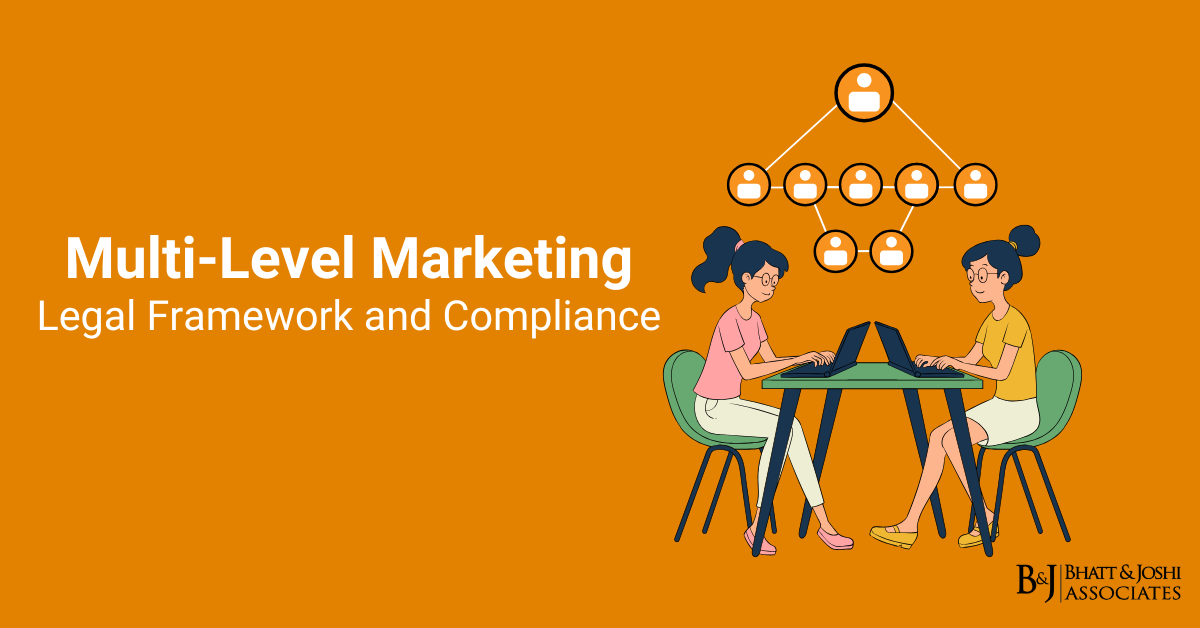
Multi-Level Marketing (MLM) represents a complex business model that has gained significant traction in India while simultaneously raising regulatory concerns. The term refers to a sales strategy employed by direct sales companies where existing members are encouraged to recruit new participants while selling products or services to consumers. This business model creates a hierarchical structure where distributors earn commissions not only from their direct sales but also from the sales made by their recruited downline members.
The regulatory landscape governing Multi-Level Marketing operations in India has evolved considerably over the years, primarily in response to numerous fraudulent schemes that masqueraded as legitimate MLM businesses. The distinction between legitimate direct selling and illegal pyramid schemes remains a critical concern for regulatory authorities, businesses, and consumers alike. Understanding this distinction requires a thorough examination of the existing legal framework, judicial precedents, and regulatory guidelines that govern MLM operations in India.
Historical Context and Legal Evolution
The regulation of Multi-Level Marketing and similar schemes in India began with the enactment of the Prize Chits and Money Circulation Schemes (Banning) Act, 1978 [1]. This legislation was introduced to combat fraudulent investment schemes that promised quick returns to participants. Initially, many MLM companies found themselves scrutinized under this Act, leading to significant legal challenges and the need for clearer regulatory guidelines.
The Prize Chits and Money Circulation Schemes (Banning) Act, 1978, was designed to protect consumers from schemes that primarily focused on money circulation rather than genuine product sales. Under Section 2(c) of this Act, a “money circulation scheme” is defined as “any scheme, by whatever name called, for the making of quick or easy money, or for the receipt of any money or valuable thing as the consideration for a promise to pay money, on any event or contingency relative or applicable to the enrolment of members into the scheme” [1].
The evolution of Multi-Level Marketing regulation gained momentum when the Department of Consumer Affairs, Ministry of Consumer Affairs, Food & Public Distribution, Government of India, issued comprehensive guidelines for Direct Selling in 2016 [2]. These guidelines were formulated to distinguish between legitimate direct selling operations and illegal money circulation schemes, providing much-needed clarity to the industry.
Regulatory Framework Under the Prize Chits and Money Circulation Schemes (Banning) Act, 1978
The Prize Chits and Money Circulation Schemes (Banning) Act, 1978, serves as the primary legislation governing schemes that involve money circulation. Section 2(c) of the Act provides the definition of money circulation schemes, which has been extensively interpreted by Indian courts in various judgments.
The Supreme Court of India, in State of West Bengal v. Swapan Kumar Guha [3], provided an authoritative interpretation of Section 2(c) of the Act. Justice A.N. Sen, who delivered the leading judgment, established four essential ingredients that must be present for a scheme to fall under the definition of a money circulation scheme:
First, there must be a scheme in existence. Second, the scheme must have members who participate in it. Third, the scheme must be designed for making quick or easy money based on events or contingencies related to member enrollment, or it must involve receiving money or valuable items as consideration for promises to pay money contingent on member enrollment. Fourth, the dependency on enrollment-related events or contingencies remains unaffected by whether the money comes from entrance fees or periodic subscriptions.
The Supreme Court emphasized that not every activity involving quick or easy money automatically falls under Section 2(c) of the Act. The critical factor is whether the money-making opportunity depends on events or contingencies specifically related to member enrollment into the scheme. This distinction has become fundamental in determining the legality of various business models, including MLM operations.
Judicial Interpretation and Landmark Cases
The Amway India Enterprises v. Union of India case [4] represents a significant judicial pronouncement on MLM operations in India. The Andhra Pradesh High Court, in this case, examined the Amway business model and concluded that it constituted a money circulation scheme under the Prize Chits and Money Circulation Schemes (Banning) Act, 1978.
The court observed that the scheme provided easy and quick money to distributors, with each member paying INR 4,400 upon enrollment. The judgment noted that this enrollment fee, combined with future earnings through marketing and recruiting other members, constituted events or contingencies related to enrollment. The court stated, “from the whole analysis of the scheme and the way in which it is structured it is quite apparent that once a person gets into this scheme he will find it difficult to come out of the web and it becomes a vicious circle for him” [4].
This judgment established important precedents for evaluating MLM schemes. The court emphasized that when a business model primarily relies on enrollment fees and recruitment-based earnings rather than genuine product sales to end consumers, it falls within the prohibited category of money circulation schemes.
Direct Selling Guidelines 2016: A Regulatory Milestone
The Department of Consumer Affairs issued comprehensive Direct Selling Guidelines in 2016 [2], marking a significant shift in the regulatory approach toward MLM and direct selling businesses. These guidelines were developed to provide clarity and establish standards for legitimate direct selling operations while preventing fraudulent schemes.
The guidelines mandate that direct selling companies must submit an undertaking to the Department of Consumer Affairs before commencing operations. This undertaking serves as a declaration of compliance with the established guidelines and provides regulatory authorities with oversight capabilities.
One of the fundamental principles established by these guidelines is that participation in direct selling must be entirely voluntary. Companies are prohibited from charging participation fees, including entry fees, registration fees, or any other charges for joining the business opportunity. This requirement directly addresses one of the key concerns identified in judicial pronouncements regarding money circulation schemes.
The guidelines also mandate that direct selling companies cannot compel consumers to purchase products or services in quantities exceeding what they can reasonably sell or consume. This provision ensures that the business model focuses on genuine product distribution rather than inventory loading, which has been a common practice in fraudulent schemes.
Written agreements complying with the Indian Contract Act, 1872, must be provided to all participants, clearly stating the terms and conditions of participation. These agreements must include comprehensive cancellation and refund policies, ensuring that participants have clear exit options if they choose to discontinue their involvement.
Product-Based vs. Enrollment-Based Revenue Models
The distinction between product-based and enrollment-based revenue models lies at the heart of MLM regulation in India. Legitimate MLM operations must demonstrate that their primary revenue source comes from actual product sales to end consumers rather than from recruitment activities or enrollment fees.
Product-based MLM models focus on distributing genuine products or services through a network of independent distributors. These distributors earn commissions based on their personal sales volume and may receive additional compensation based on the sales performance of their recruited team members. The key requirement is that products must have real market value and be sold to genuine consumers who are not part of the MLM network.
Enrollment-based models, which are prohibited under Indian law, primarily generate revenue from recruitment activities and enrollment fees. These schemes typically require participants to pay significant joining fees and emphasize recruitment over product sales. The compensation structure in such schemes is heavily weighted toward recruitment bonuses rather than retail sales commissions.
The regulatory framework requires MLM companies to maintain detailed records demonstrating that a significant portion of their revenue comes from product sales to non-participants. This requirement helps distinguish between legitimate business operations and illegal money circulation schemes.
Compliance Requirements for Multi-Level Marketing Companies
MLM companies operating in India must adhere to stringent compliance requirements established by the Direct Selling Guidelines 2016 [2]. These requirements encompass various aspects of business operations, from organizational structure to consumer protection measures.
Companies must establish a physical office in India to conduct their operations, ensuring local presence and accountability. This requirement facilitates regulatory oversight and provides consumers with accessible recourse mechanisms for addressing grievances.
Transparency in compensation structures represents another critical compliance requirement. MLM companies must provide clear and unambiguous information regarding how fees, remunerations, and salaries are calculated. This transparency enables participants to make informed decisions about their involvement and helps prevent misleading earnings claims.
The establishment of comprehensive buyback policies ensures that participants can return unsold products for refunds, typically within specified timeframes and under reasonable conditions. These policies protect distributors from inventory risks and demonstrate the company’s confidence in product marketability.
Consumer protection measures include detailed disclosure requirements regarding business opportunities, potential earnings, and associated risks. Companies must provide realistic earnings disclosures based on actual distributor performance data rather than theoretical projections or exceptional success stories.
Regulatory Challenges and Enforcement
The enforcement of Multi-Level Marketing regulations in India faces several challenges, primarily due to the sophisticated nature of modern MLM schemes and the global reach of many operations. Regulatory authorities must continuously adapt their oversight mechanisms to address evolving business models and technological platforms.
State-level enforcement agencies play a crucial role in investigating suspected violations and taking appropriate action against non-compliant operations. However, the interstate nature of many MLM businesses requires coordination between multiple regulatory authorities, which can complicate enforcement efforts.
Consumer awareness represents another significant challenge in MLM regulation. Many participants lack sufficient understanding of the legal distinctions between legitimate and illegal schemes, making them vulnerable to fraudulent operations. Educational initiatives and public awareness campaigns have become essential components of the regulatory framework.
International Perspectives and Best Practices
India’s approach to MLM regulation reflects international best practices while addressing specific domestic concerns. Many countries have implemented similar regulatory frameworks that distinguish between legitimate direct selling and illegal pyramid schemes.
The United States Federal Trade Commission has established guidelines that emphasize product sales to non-participants as the primary criterion for legitimate MLM operations. Similar approaches have been adopted by regulatory authorities in Australia, Canada, and European Union member states.
These international perspectives have influenced India’s regulatory development, particularly in areas such as earnings disclosure requirements, product return policies, and prohibition of enrollment fees. The adoption of globally recognized standards helps protect Indian consumers while facilitating legitimate international MLM operations.
Technology and Digital Platforms
The emergence of digital platforms and social media has transformed MLM operations, creating new regulatory challenges and opportunities. Modern MLM companies increasingly rely on online platforms for recruitment, training, and sales activities, requiring regulatory frameworks to address digital-specific concerns.
Online recruitment practices must comply with the same standards as traditional methods, including prohibition of misleading earnings claims and mandatory disclosure of risks. Social media promotions by MLM participants are subject to advertising regulations and must include appropriate disclaimers.
Digital payment systems and e-commerce platforms have simplified MLM operations while creating new compliance requirements. Companies must ensure that their digital infrastructure supports required record-keeping, reporting, and consumer protection measures.
Consumer Protection and Redressal Mechanisms
Consumer protection remains a central focus of MLM regulation in India. The regulatory framework provides multiple avenues for consumers to seek redress for grievances related to MLM operations.
The Consumer Protection Act, 2019 [5], provides consumers with comprehensive protection against unfair trade practices, including those related to MLM operations. Consumer forums at district, state, and national levels have jurisdiction to hear complaints related to deficient services or unfair practices by MLM companies.
The establishment of dedicated grievance redressal mechanisms within MLM companies ensures that consumer complaints are addressed promptly and effectively. These internal mechanisms must meet specific standards regarding response timeframes, escalation procedures, and resolution outcomes.
Economic Impact and Market Dynamics
The MLM industry in India has experienced significant growth, contributing to employment generation and economic development. Legitimate MLM operations provide income opportunities for millions of participants while facilitating product distribution across diverse geographic markets.
However, the economic impact of fraudulent schemes creates substantial negative consequences, including financial losses for participants and reduced consumer confidence in direct selling as a whole. Regulatory measures aim to maximize positive economic contributions while minimizing adverse effects from illegal operations.
Market dynamics in the MLM sector are influenced by regulatory changes, consumer awareness levels, and technological developments. Companies must continuously adapt their business models to remain compliant while maintaining competitive positions in evolving markets.
Future Regulatory Developments
The regulatory landscape for Multi-Level Marketing operations in India continues to evolve in response to changing market conditions and emerging challenges. Future developments may include enhanced digital compliance requirements, stricter enforcement mechanisms, and expanded consumer protection measures.
Regulatory authorities are considering amendments to existing guidelines to address issues such as cryptocurrency-based MLM schemes, international operations targeting Indian consumers, and sophisticated fraud techniques that exploit regulatory gaps.
The integration of technology in regulatory oversight, including data analytics and artificial intelligence, may enhance the ability to identify and investigate suspected violations. These technological tools could improve enforcement efficiency while reducing regulatory burden on compliant operations.
Conclusion
The regulation of Multi-Level Marketing in India represents a complex balance between protecting consumers from fraudulent schemes and allowing legitimate direct selling businesses to operate effectively. The legal framework, anchored by the Prize Chits and Money Circulation Schemes (Banning) Act, 1978, and supplemented by the Direct Selling Guidelines 2016, provides comprehensive standards for distinguishing between legal and illegal operations.
The distinction between product-based and enrollment-based revenue models remains fundamental to regulatory compliance. Companies must demonstrate that their primary focus is on genuine product sales rather than recruitment activities to avoid classification as prohibited money circulation schemes.
Compliance with regulatory requirements demands ongoing attention to multiple aspects of business operations, from organizational structure to consumer protection measures. Companies that prioritize transparency, product quality, and consumer welfare are more likely to achieve long-term success within the regulatory framework.
The evolving nature of MLM operations, particularly with the integration of digital platforms and global reach, requires continuous adaptation of regulatory approaches. Future developments will likely focus on enhancing enforcement capabilities while maintaining support for legitimate business operations that contribute positively to India’s economy.
Understanding and complying with MLM regulations in India requires careful consideration of legal requirements, judicial interpretations, and best practices. Companies, participants, and consumers all benefit from a clear understanding of the regulatory framework and their respective rights and responsibilities within it.
References
[1] The Prize Chits and Money Circulation Schemes (Banning) Act, 1978. Available at: https://www.indiacode.nic.in/handle/123456789/1628
[2] Direct Selling Guidelines 2016, Department of Consumer Affairs, Ministry of Consumer Affairs, Food & Public Distribution, Government of India. Available at: https://consumeraffairs.nic.in/
[3] State of West Bengal v. Swapan Kumar Guha, (1982) 1 SCC 561.
[4] Amway India Enterprises v. Union of India, 2007, Andhra Pradesh High Court.
[5] The Consumer Protection Act, 2019.
[6] Reserve Bank of India – Guidelines on Money Circulation Schemes.
[7] Ministry of Consumer Affairs – Consumer Protection Guidelines. Available at: https://consumeraffairs.nic.in/
[8] Indian Kanoon Database – Legal Judgments and Acts. Available at: https://indiankanoon.org/
[9] Direct Selling Association of India – Industry Guidelines. Available at: https://www.indiandsa.in/