 Whatsapp

Registration of a Private Limited Company in India: Legal Framework, Regulatory Compliance and Procedural Requirements
Introduction
The registration of a private limited company in India is a meticulously regulated process governed primarily by the Companies Act, 2013, which replaced the earlier Companies Act, 1956. This legislative framework establishes a distinct corporate structure that enables entrepreneurs and businesses to operate with limited liability protection while maintaining regulatory compliance. The private limited company structure has emerged as the preferred choice for startups, small and medium enterprises, and foreign investors seeking to establish their presence in India. The regulatory mechanism ensures that companies maintain transparency, accountability and adherence to corporate governance standards throughout their lifecycle.
The Ministry of Corporate Affairs oversees company registration through the Registrar of Companies, which operates across different jurisdictions throughout India. The digitization of the registration of a private limited company process through the introduction of the SPICe+ form has significantly streamlined incorporation procedures, making India an attractive destination for business establishment. Understanding the legal framework, procedural requirements, and compliance obligations is essential for anyone seeking to incorporate a private limited company in India.
Legal Definition and Statutory Framework
A private limited company is defined under the Companies Act, 2013 as a company which by its articles restricts the right to transfer its shares, limits the number of its members to two hundred, and prohibits any invitation to the public to subscribe for any securities of the company [1]. The statutory definition provided in Section 2(68) of the Companies Act, 2013, establishes clear parameters that distinguish private companies from public companies and other corporate entities.
The Companies Act, 2013 came into force progressively, with different sections being notified at different times. The provisions relating to incorporation of companies under Section 7 were enforced from April 1, 2014, marking a significant shift in India’s corporate law regime. The Act introduced several innovative concepts including the One Person Company, enhanced corporate social responsibility provisions, and strengthened governance requirements. The legislative intent behind these provisions is to create a robust framework that balances business facilitation with investor protection and regulatory oversight.
Regulatory Framework for Private Limited Company Registration
The process of private limited company registration in India is governed by Chapter II of the Companies Act, 2013, which deals with “Incorporation of Company and Matters Incidental Thereto.” Section 7 of the Act outlines the procedure, requiring documents and information to be filed with the Registrar of the company’s registered office jurisdiction. [2].
The regulatory framework encompasses multiple aspects of company formation including name approval, capital structure requirements, director qualifications, and registered office maintenance. The Ministry of Corporate Affairs has issued numerous rules under the Companies (Incorporation) Rules, 2014, which provide detailed procedural guidelines for implementing the statutory provisions. These rules address matters ranging from the format of incorporation documents to the procedure for name reservation and verification of registered office address.
Essential Requirements for Private Limited Company Registration
Minimum Number of Members and Directors
According to Section 149 of the Companies Act, 2013, every private company must have a minimum of two directors and two members [3]. This requirement ensures adequate representation in the management structure while maintaining the private nature of the company. The Act permits a maximum of fifteen directors, though this number can be increased by passing a special resolution in the general meeting. The members and directors can be the same individuals, allowing for simplified ownership and management structures in small private companies.
The composition of directors must satisfy specific criteria. At least one director must be a person who has stayed in India for a total period of not less than one hundred and eighty-two days in the previous calendar year, as mandated by Section 149(3) of the Act [4]. This resident director requirement ensures that companies maintain a local point of contact for regulatory authorities and cannot be managed entirely from outside India. For newly incorporated companies, this requirement is applied proportionately for the financial year of incorporation. The Ministry of Corporate Affairs clarified through General Circular No. 25/2014 dated June 26, 2014, that the residency requirement would be reckoned from the date of commencement of Section 149, which was April 1, 2014.
Capital Requirements
Unlike the previous Companies Act of 1956, which mandated minimum paid-up capital requirements, the Companies Act, 2013 does not prescribe any minimum capital requirement for private limited companies. This amendment, introduced through the Companies (Amendment) Act, 2015, removed the earlier requirement of one lakh rupees as minimum paid-up share capital for private companies. The elimination of minimum capital requirements has made company formation more accessible to small entrepreneurs and startups, allowing them to incorporate with nominal capital and scale up as their business grows.
The capital structure of a private limited company comprises authorized capital and paid-up capital. Authorized capital represents the maximum amount of share capital that the company can issue, as stated in the memorandum of association. Paid-up capital refers to the actual amount that has been subscribed and paid by the shareholders. While there is no minimum requirement, companies must ensure that subscribers pay the value of shares agreed to be taken by them at the time of incorporation.
Director Identification Number and Digital Signature Certificate
Every individual proposed to be appointed as a director must obtain a Director Identification Number prior to incorporation. The DIN is a unique identification number allotted by the Ministry of Corporate Affairs to individuals who are directors or intend to become directors of companies. Section 153 of the Companies Act, 2013 mandates the application for DIN, and Section 154 provides for its allotment by the Central Government [5]. The DIN remains valid for the lifetime of the individual and need not be renewed. Once allotted, it must be quoted in all documents filed with the Registrar.
Additionally, all proposed directors and subscribers must obtain a Digital Signature Certificate from certifying authorities recognized by the Controller of Certifications. The DSC is essential for signing electronic forms and documents that need to be submitted to the Ministry of Corporate Affairs portal. The requirement of DSC ensures the authenticity and integrity of documents filed electronically and helps prevent fraudulent incorporations.
The SPICe+ Form: Integrated Incorporation Process
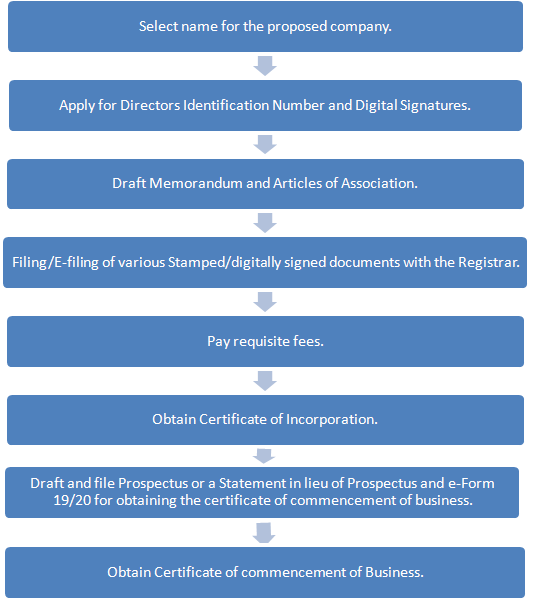
The Ministry of Corporate Affairs introduced the SPICe+ form on February 23, 2020, replacing the earlier SPICe form. SPICe stands for Simplified Proforma for Incorporating Company electronically Plus, and it represents a significant step toward ease of doing business in India. The SPICe+ form integrates multiple services from three Central Government Ministries and one State Government, allowing entrepreneurs to complete incorporation and obtain various registrations through a single application [6].
The SPICe+ form is divided into two parts. Part A is used for name reservation, allowing applicants to reserve a proposed company name for a period of twenty days from the date of approval. Part B covers the actual incorporation process and includes applications for allotment of Director Identification Number, issuance of Permanent Account Number, Tax Deduction and Collection Account Number, Goods and Services Tax Identification Number, Employee Provident Fund Organization registration, Employees’ State Insurance Corporation registration, opening of company bank account, and profession tax registration for certain states including Maharashtra, Karnataka and West Bengal.
This integrated approach eliminates the need for multiple applications to different government departments, significantly reducing the time and effort required for company incorporation. What previously took several weeks and multiple visits to different offices can now be accomplished through a single online application, typically within five to seven working days if all documents are in order.
Mandatory Documents for Incorporation
Memorandum and Articles of Association
The memorandum of association is the fundamental document that defines the scope and objectives of the company. Section 4 of the Companies Act, 2013 specifies the contents of the memorandum, which must include the company name, the state in which the registered office is to be situated, the objects of the company, the liability clause, and the capital clause detailing the authorized share capital [7]. For private limited companies, the memorandum must clearly indicate restrictions on share transferability and prohibitions on public subscription.
The articles of association constitute the internal regulations governing the management of the company. Section 5 of the Act mandates that articles shall contain regulations for the management of the company. The articles define the powers, duties, rights and obligations of directors, shareholders and other stakeholders. They also outline procedures for conducting meetings, voting rights, dividend distribution, and other operational matters. Companies may adopt the model articles prescribed in Table F of Schedule I to the Companies Act, 2013, or draft their own articles tailored to specific business requirements.
Both the memorandum and articles must be duly signed by all subscribers to the memorandum in the presence of at least one witness who shall attest the signature. The documents must be printed, divided into paragraphs numbered consecutively, and signed by each subscriber who shall add his name, address, description and occupation.
Declaration and Affidavits
Section 7(1)(b) of the Companies Act requires a declaration from a professional (advocate, chartered accountant, cost accountant or company secretary in practice) engaged in the formation of the company, and from a person named in the articles as a director, manager or secretary. This declaration confirms that all requirements of the Act and rules regarding registration have been complied with. The professional declaration serves as a certification mechanism ensuring that the incorporation documents are in order and comply with statutory requirements.
Additionally, Section 7(1)(c) mandates that each subscriber to the memorandum and each person named as a first director must submit a declaration stating that he has not been convicted of any offence in connection with the promotion, formation or management of any company during the preceding five years [8]. This declaration also confirms that all documents filed contain correct, complete and true information to the best of the declarant’s knowledge and belief. These safeguards help prevent individuals with a history of corporate fraud or malpractice from being involved in new company formations.
The Registered Office: A Statutory Necessity
Section 12 of the Companies Act, 2013 mandates that every company must have a registered office from the date of its incorporation, capable of receiving and acknowledging all communications and notices. Within thirty days of incorporation, the company must furnish verification of its registered office to the Registrar in the prescribed manner [9]. The registered office serves as the official address for all correspondence with the company and government authorities.
The requirement for a physical registered office ensures that companies cannot operate in a completely virtual manner without any territorial connection to India. The office address must be genuine and accessible during business hours. Companies must display their name and registered office address conspicuously on the outside of the office premises. Any change in the registered office address must be communicated to the Registrar within thirty days of the change.
For companies changing their registered office from one state to another, additional procedures apply. Such changes require approval from the Central Government under Section 13 of the Act. The company must obtain consent of creditors, debenture-holders and other stakeholders, or provide sufficient security for discharge of obligations before the transfer is approved.
Penal Provisions and Compliance Requirements
The Companies Act, 2013 contains stringent penal provisions to ensure compliance with incorporation requirements. Section 7(5) of the Act states that if any person furnishes false or incorrect particulars or suppresses material information in documents filed with the Registrar, he shall be liable for action under Section 447, which deals with punishment for fraud. Section 447 prescribes severe penalties including imprisonment extending up to ten years and fines extending to three times the amount involved in the fraud.
Section 7(6) provides that where a company has been incorporated by furnishing false information or suppressing material facts, the promoters, first directors and persons making declarations shall each be liable for action under Section 447. Furthermore, Section 7(7) empowers the Tribunal to pass various orders including regulation of company management, making liability of members unlimited, removal of company name from the register, or ordering winding up of the company in cases involving fraudulent incorporation.
These strict provisions demonstrate the legislative intent to maintain the integrity of private limited company registration and deter fraudulent incorporations. The consequences of non-compliance extend beyond mere financial penalties to potential criminal prosecution and dissolution of the company.
Post-Incorporation Compliance Obligations
Once a company is incorporated and receives its Certificate of Incorporation containing the Corporate Identity Number, several post-incorporation compliances become mandatory. Within thirty days of incorporation, the company must conduct its first Board meeting. The agenda typically includes appointment of auditors, opening of bank accounts, approval of common seal if any, and other organizational matters.
Companies must file various forms with the Registrar to intimate changes in directors, registered office, commencement of business and other statutory matters. Annual compliance requirements include preparation and filing of financial statements, conducting annual general meetings, filing annual returns, and maintaining statutory registers. The failure to comply with these ongoing obligations attracts penalties under various sections of the Companies Act.
The regulatory framework ensures continuous monitoring of company activities and maintains up-to-date information in the public domain. This transparency regime protects stakeholders and enables informed decision-making by creditors, investors and other parties dealing with the company.
Conclusion
The registration of a private limited company in India operates under a well-defined legal and regulatory framework designed to balance business facilitation with investor protection and corporate governance. The Companies Act, 2013 has modernized the incorporation process through digitization and integration of services, while maintaining robust safeguards against fraud and malpractice. The mandatory requirements including minimum directors, resident director provisions, documentation standards, and compliance obligations ensure that companies operate transparently and accountably.
The streamlined SPICe+ process has significantly reduced the time and complexity involved in company formation, making India an attractive destination for entrepreneurs and investors. However, the stringent penal provisions and ongoing compliance requirements underscore the importance of understanding and adhering to statutory obligations throughout the company’s existence. Professional assistance from chartered accountants, company secretaries or legal advisors is advisable to navigate the incorporation process and ensure full compliance with all applicable laws and regulations.
References
[1] The Companies Act, 2013. Ministry of Law and Justice, Government of India. https://www.indiacode.nic.in/bitstream/123456789/2114/5/A2013-18.pdf
[2] India Code. Companies Act, 2013 – Section 7: Incorporation of Company. https://www.indiacode.nic.in/show-data?actid=AC_CEN_22_29_00008_201318_1517807327856§ionId=190§ionno=7&orderno=8
[3] ClearTax. Company Registration in India: Process, Documents, Fees. https://cleartax.in/s/company-registration
[4] CorporateLawReporter. Section 149 of Companies Act, 2013 – Company to have Board of Directors. https://corporatelawreporter.com/companies_act/section-149-of-companies-act-2013-company-to-have-board-of-directors/
[5] TaxGuru. Incorporation Under Section 7 of Companies Act 2013. https://taxguru.in/company-law/incorporation-section-7-companies-act-2013-form-spice.html
[6] EbizFiling. MCA SPICe+ Form for Company Registration in India. https://ebizfiling.com/blog/new-mca-form-for-company-registration-spice-plus/
[7] Companies Act Integrated Ready Reckoner. Section 7: Incorporation of Company. https://ca2013.com/incorporation-of-company/
[8] IBC Laws. Section 7 of Companies Act, 2013: Incorporation of Company. https://ibclaw.in/section-7-of-the-companies-act-2013-incorporation-of-company/
[9] ClearTax. Company Incorporation Under Companies Act, 2013. https://cleartax.in/s/company-incorporation-under-companies-act-2013
