 Whatsapp

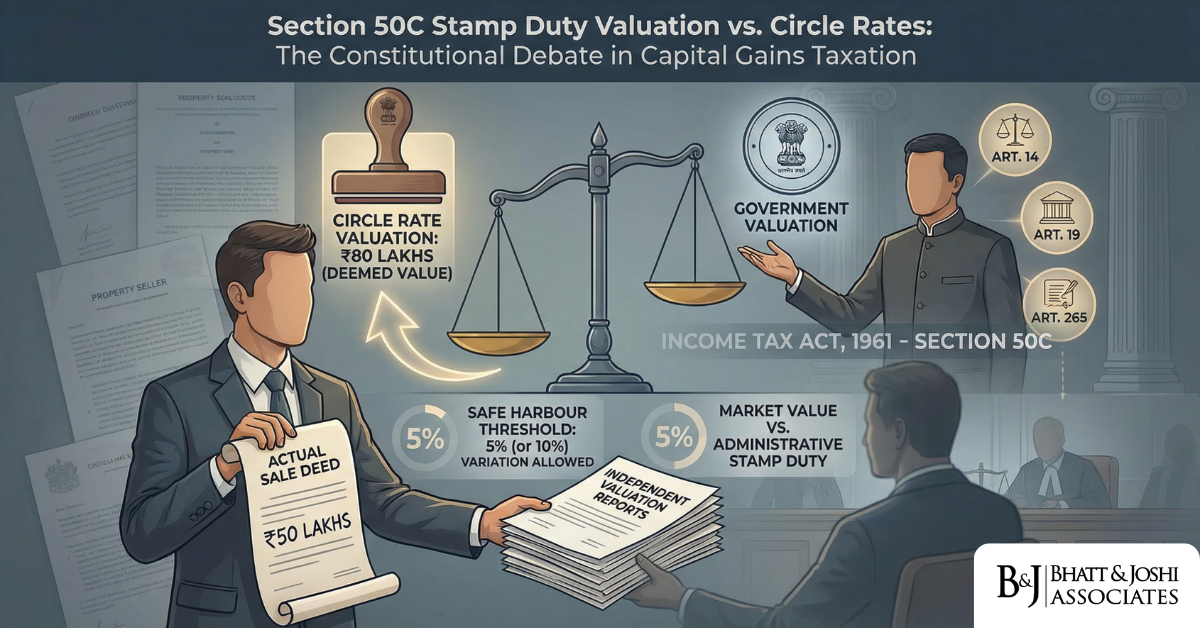
Section 50C of the Income Tax Act, 1961 Stamp Duty Valuation vs. Circle Rates: The Constitutional Validity of Deeming Fictions in Capital Gains
Introduction
Few provisions in Indian income tax law generate as much sustained controversy, litigation, and legislative amendment as Section 50C of the Income Tax Act, 1961. At its core, it does something constitutionally arresting: it replaces what a seller actually received for their land or building with what the state government’s Stamp Valuation Authority (SVA) says it ought to be worth, and then taxes the seller on that notional figure. This is the classic structure of a deeming fiction — a legislative device that treats something as legally true regardless of factual reality. The question that has occupied taxpayers, assessing officers, tribunals, and High Courts for over two decades is whether such a fiction, when it inflates a seller’s capital gains liability beyond what they actually earned, can survive constitutional scrutiny under Articles 14, 19, and 265 of the Constitution of India. This article examines that question in depth, tracing the legislative history, the mechanics of the provision, the regulatory architecture around circle rates, and the key judicial pronouncements that have shaped its application [1].
Legislative History and the Problem Section 50C Was Designed to Solve
The Finance Act, 2002 inserted Section 50C into the Income Tax Act, 1961, operative from Assessment Year 2003-04. The Explanatory Memorandum to the Finance Bill, 2002 candidly stated the problem: sellers of land and buildings were systematically understating the sale consideration recorded in the sale deed, pocketing a large portion of the actual price in unaccounted cash, and thereby evading capital gains tax on the real profit. This practice not only eroded the tax base but was a major conduit for the generation and circulation of black money in the real estate sector [1].
The legislature’s solution was elegant in design if contentious in application. Under the pre-2003 regime, the Assessing Officer could compute capital gains only on the consideration actually declared in the sale deed, unless they had independent evidence to disturb it. This created a verification vacuum. Section 50C filled that vacuum by making the Stamp Valuation Authority’s assessed value the statutory floor for computing capital gains — a deemed full value of consideration — wherever the declared consideration was lower [2]. The provision interacts with Section 48 of the Income Tax Act, 1961, which is the general formula for computing capital gains: the full value of consideration received minus the cost of acquisition and improvement, with indexation in long-term cases. Section 50C intervenes at the “full value of consideration” stage, substituting the SVA’s value for the declared sale price when the latter falls below the circle rate benchmark.
Understanding the Statutory Text and the Regulatory Mechanism
Section 50C of the Income Tax Act, 1961, in its material portion, provides as follows:
“Where the consideration received or accruing as a result of the transfer by an assessee of a capital asset, being land or building or both, is less than the value adopted or assessed or assessable by any authority of a State Government for the purpose of payment of stamp duty in respect of such transfer, the value so adopted or assessed or assessable shall, for the purposes of section 48, be deemed to be the full value of the consideration received or accruing as a result of such transfer.”
The second and third sub-sections build in a safeguard. If the assessee claims that the SVA’s value exceeds the fair market value of the property on the date of transfer, the Assessing Officer may refer the property’s valuation to a Valuation Officer (VO). If the VO’s determination is lower than the stamp duty value, the VO’s figure is adopted for capital gains computation. However — and this is critical — if the VO’s figure is higher than the stamp duty value, the stamp duty value remains the ceiling. The AO cannot use the VO’s higher figure to further inflate the deemed consideration beyond what the SVA assessed [3].
The Stamp Valuation Authority is a state government body whose valuations are based on what are commonly called “circle rates” or “ready reckoner rates” or “guidance values” — area-specific per-unit rates for land and buildings periodically notified by state governments. These rates represent the state’s administrative estimate of prevailing market values in a given locality and form the basis on which stamp duty is charged on property registrations. They feed directly into the Section 50C calculus, making a creature of state administrative action the trigger for a central income tax liability [8].
Amendments: The Safe Harbour and the Evolution of the Provision
The original provision contained no tolerance band — any shortfall below the stamp duty value, however marginal, activated the deeming fiction. This produced genuine hardship in markets where circle rates lagged actual market declines and in transactions involving tenanted or encumbered properties. The Finance Act, 2018 introduced the first safe harbour: where the difference between the stamp duty value and the declared consideration did not exceed 5% of the declared consideration, the declared consideration would be treated as the full value of consideration for Section 48 purposes. The Finance Act, 2020 widened this tolerance to 10%, meaning that as the law stands today, Section 50C is triggered only where the stamp duty value exceeds 110% of the declared sale consideration [2].
A further amendment addressed the temporal mismatch problem: where the date of the agreement and the date of registration differ — a common feature of India’s real estate market, where sale agreements are frequently executed months or even years before the formal registration of the conveyance deed — the stamp duty value on the date of the agreement may be adopted for capital gains computation, provided the consideration or part thereof was paid through account payee cheque, bank draft, or prescribed electronic mode on or before the agreement date [10]. This amendment, introduced by the Finance Act, 2016, addressed the evident inequity of taxing a seller on the stamp duty value prevailing at the time of registration when the price was contractually fixed at the time of agreement under very different market conditions.
The Constitutional Challenge: K.R. Palaniswamy v. Union of India
The landmark constitutional test of Section 50C came before the Madras High Court in K.R. Palaniswamy v. Union of India, Writ Petition No. 4387 of 2003, decided on 5 August, 2008. The petitioner had sold plots of land in 2002 at a consideration of Rs. 3 lakhs each, but the guideline value for stamp duty purposes stood at approximately Rs. 9.89 lakhs and Rs. 9.90 lakhs respectively — more than three times the actual sale consideration, a disparity the petitioner attributed to a market recession in the relevant locality. The constitutional challenge was multi-pronged: the petitioner argued legislative incompetence of Parliament, violation of Article 14 of the Constitution of India on grounds of arbitrariness and discriminatory classification, violation of Article 265 on the ground that no tax may be levied except by authority of law, and the substantive argument that circle rates are arbitrary because they do not account for location-specific attributes of individual plots within the same survey number or area [5].
The Division Bench of the Madras High Court rejected each ground with detailed reasoning. On legislative competence, the Court held that Parliament’s power to levy tax on income other than agricultural income under Entry 82, List I, Schedule VII of the Constitution of India squarely encompasses the power to make provisions preventing the undervaluation of sale consideration in immovable property transactions. Citing the Supreme Court’s judgment in R.K. Garg v. Union of India, (1981) 4 SCC 675, the Court held that “laws relating to economic activities should be viewed with greater latitude than laws touching civil rights such as freedom of speech, religion etc. … the legislature should be allowed some play in the joints, because it has to deal with complex problems which do not admit of solution through any doctrinaire or strait-jacket formula.” [5]
On Article 14, the Court held that Section 50C embodies a valid and intelligible differentia: it applies to transfers of capital assets being land or buildings, and not to trading assets or stock-in-trade, reflecting a rational legislative policy distinction that runs through the entire framework of the Income Tax Act, 1961. This is not arbitrary discrimination but a classification grounded in the fundamentally different character of capital transactions and business transactions. Most importantly, the Court rejected the argument that Section 50C creates an irrebuttable and therefore arbitrary presumption. Sub-sections (2) and (3) of Section 50C together provide the assessee with a statutory opportunity to rebut the presumption by claiming and establishing a lower fair market value through the VO reference mechanism, after hearing by the AO. As the Court observed: “Thus, a complete full proof safeguard has been given to the assessee to establish before the authorities concerned the real value. Thus, what is stated in Section 50C as a real value cannot be regarded as a notional or artificial value and such real value is determinable only after hearing the assessee as per the statutory provisions stated supra.” [5]
The Rebuttability of the Deeming Fiction: Judicial Refinement
The constitutional question does not begin and end with Palaniswamy. The Allahabad High Court, in CIT v. Chandra Narain Chaudhary (ITAT No. 287 of 2011, decided 29 August, 2013), took the jurisprudence a step further by explicitly characterizing Section 50C as “a rule of evidence in assessing the valuation of property for calculating capital gains” and holding that “the deeming provision under Section 50C(1) of the Act is rebuttable.” The Court observed that an SVA is mandated to fix circle rates uniformly for survey numbers or entire localities and in doing so structurally cannot account for the full range of attributes, charges, encumbrances, limitations, and physical conditions affecting any specific property — tenancy, access constraints, litigation encumbrances, or locational disadvantages within the same zone [6].
The practical implications of this characterization are significant. An AO cannot simply apply the stamp duty value mechanically and close the assessment without engaging with the assessee’s objection. Where the assessee raises an objection to the stamp duty value and produces a valuation report from an approved valuer, the AO is legally bound to apply their mind to the objection. If the AO does not accept the assessee’s valuation, they must refer the matter to the Valuation Officer under Section 55A of the Income Tax Act, 1961, recording valid and legally defensible reasons for the reference. The adoption of the deeming provision as an automatic substitute for proper valuation, without engaging with the assessee’s case, is not permissible and will not survive appellate scrutiny [6].
The Bombay High Court, in its line of decisions, similarly upheld the constitutional validity of the provision while reinforcing that the legal fiction of Section 50C is bounded and cannot be stretched beyond capital gains computation. Courts have consistently held that the deemed consideration under Section 50C cannot be treated as generating actual funds in the assessee’s hands for the purpose of Sections 69, 69A, or 69B of the Income Tax Act, 1961, which create presumptions regarding unexplained investments and expenditures. The legal fiction ends at the boundary of Section 48; it cannot generate a further fiction that the deemed amount was actually received in cash [7].
The Double Taxation Problem and Section 56(2)(x)
A structural tension inherent in the deeming fiction regime becomes apparent when one examines Section 56(2)(x) of the Income Tax Act, 1961 alongside Section 50C. Where property is sold below the circle rate, Section 50C deems the stamp duty value to be the seller’s full consideration for capital gains purposes. Simultaneously, Section 56(2)(x) — introduced by the Finance Act, 2017, replacing the earlier Section 56(2)(vii) — deems the shortfall between the stamp duty value and the declared purchase price as income from other sources in the hands of the buyer, taxable in the year of purchase [4]. The result is that the same notional differential — the gap between the declared consideration and the circle rate — is taxed twice: once as deemed capital gains in the seller’s hands under Section 50C, and once as deemed income from other sources in the buyer’s hands under Section 56(2)(x).
Critics have argued, with considerable force, that this amounts to double taxation of income that neither party actually received, in direct contradiction of the foundational real income theory that underlies Indian income tax jurisprudence — the principle that income tax attaches to income that has actually accrued, arisen, or been received, not to a figure manufactured by administrative valuation. In a sluggish or distressed real estate market, where properties genuinely transact below circle rates, this double taxation falls on honest parties engaged in arms-length transactions. While this argument has found resonance in academic commentary and before some Income Tax Appellate Tribunals, courts have thus far sustained the framework on the ground that Parliament, exercising its anti-avoidance mandate under Article 246 and Entry 82, is entitled to make such structural choices in economic regulation [4].
Regulatory Framework: Circle Rates, Their Setting, and Their Limitations
Circle rates are notified by state governments through their revenue and registration departments following periodic surveys of property transaction data. The process varies significantly between states but typically involves the District Collector conducting market surveys, collating data from registered sale deeds, and proposing area-specific rates for government notification. The fundamental structural limitation of circle rates is that they are backward-looking administrative aggregates: they reflect historical transaction data, are revised at irregular intervals — sometimes years apart — and cannot possibly capture the micro-level characteristics of individual plots, including their access to arterial roads, width of the approach road, whether the plot is a corner plot or an interior one, legal encumbrances, tenancy status, or physical condition.
Under the Indian Stamp Act, 1899 and its state-level analogues, the SVA has an independent authority to challenge undervaluation in sale deeds. Section 47A of the Indian Stamp Act, 1899 empowers the Collector to reassess the market value of property for stamp duty purposes where the consideration stated in the instrument appears to be understated. The interaction between Section 47A proceedings and Section 50C proceedings creates a further layer of legal complexity: if the assessee successfully challenges the stamp duty valuation before the stamp authorities on appeal and it is revised downward, Section 50C(2) of the Income Tax Act, 1961 provides that the capital gains computation shall be amended accordingly by way of rectification under Section 154 to reflect the revised, lower stamp duty value [9]. This cross-referencing between the stamp law framework and the income tax framework is one of the more nuanced and operationally significant aspects of the regulatory architecture surrounding Section 50C.
Conclusion: A Constitutionally Valid but Structurally Imperfect Instrument
Section 50C of the Income Tax Act, 1961 survives constitutional scrutiny, and the Madras and Bombay High Courts have confirmed this in clear terms. Its legislative competence rests squarely on Parliament’s Entry 82 power, and its Article 14 challenges fail because the VO reference mechanism and the statutory hearing process convert the statutory presumption from irrebuttable to rebuttable. In the judicial framing, it is “a rule of evidence” rather than a conclusive deeming of the actual consideration, and the safeguards in sub-sections (2) and (3) provide sufficient procedural fairness.
But constitutionality is not the same as structural soundness or equitable application. Section 50C imposes on honest taxpayers who genuinely sold at distressed or arms-length prices below circle rates the burden of litigation, the cost of approved valuer reports, and the delay of VO references — merely to establish what they actually received. The progressive widening of the safe harbour from nil, to 5%, to 10%, and the date-of-agreement amendment, are Parliament’s own acknowledgements that the raw circle rate is an imperfect proxy for market value. The Income Tax Bill, 2025, proposing to carry forward the substance of Section 50C under Clause 78 with the existing safe harbour framework, confirms that Parliament is not yet ready to depart from the circle rate as the reference point for capital gains in property transactions [1]. The debate around real income theory, the double taxation problem under Section 56(2)(x), and the constitutional limits of deeming fictions in direct taxation will continue to animate Indian tax jurisprudence.
References
[1] ClearTax, Taxability of Sale of Land or Building – Section 50C of Income Tax Act, https://cleartax.in/s/taxability-sale-land-building-section-50c
[2] TaxTMI, Scope and Impact of Provisions of Section 50C of the Act, https://www.taxtmi.com/article/detailed?id=5271
[3] Tax2Win, Section 50C of Income Tax Act – Taxability of Sale of Land or Building, https://tax2win.in/guide/section-50c-of-income-tax-act
[4] TaxGuru, Time to Revisit Section 50C/43CA/56(2) – Adoption of Circle Rates, https://taxguru.in/income-tax/time-revisit-section-50c-43ca-562-adoption-circle-rates.html
[5] Indian Kanoon, K.R. Palanisamy v. Union of India, Writ Petition No. 4387 of 2003, Madras High Court, 5 August 2008, https://indiankanoon.org/doc/1382725/
[6] ITAT Online, CIT v. Chandra Narain Chaudhri (Allahabad High Court), https://itatonline.org/archives/cit-vs-chandra-narain-chaudhri-allahabad-high-court-s-50-c-extent-to-which-reliance-can-be-placed-by-ao-on-stamp-duty-valuation-explained/
[7] ITAT Online Digest, Section 50C: A Step Forward in Curbing Black Money – Digest of Case Laws, https://itatonline.org/digest/articles/section-50c-a-step-forward-in-curbing-black-money/
[8] Indian Kanoon, Shanmuga Sundaram Govindaraj v. The PCIT, 22 July 2022, https://indiankanoon.org/doc/31865560/
[9] Sapr Law, Section 50C: An In-Depth Analysis, https://saprlaw.com/taxblog/Article_50C_V2.pdf
[10] Chartered Club, Tax on Property Transaction Below Circle Rate: Sec 50C, Sec 56, https://www.charteredclub.com/tax-on-property-transaction-below-circle-rate-section-50c-sec-56/
