Whatsapp

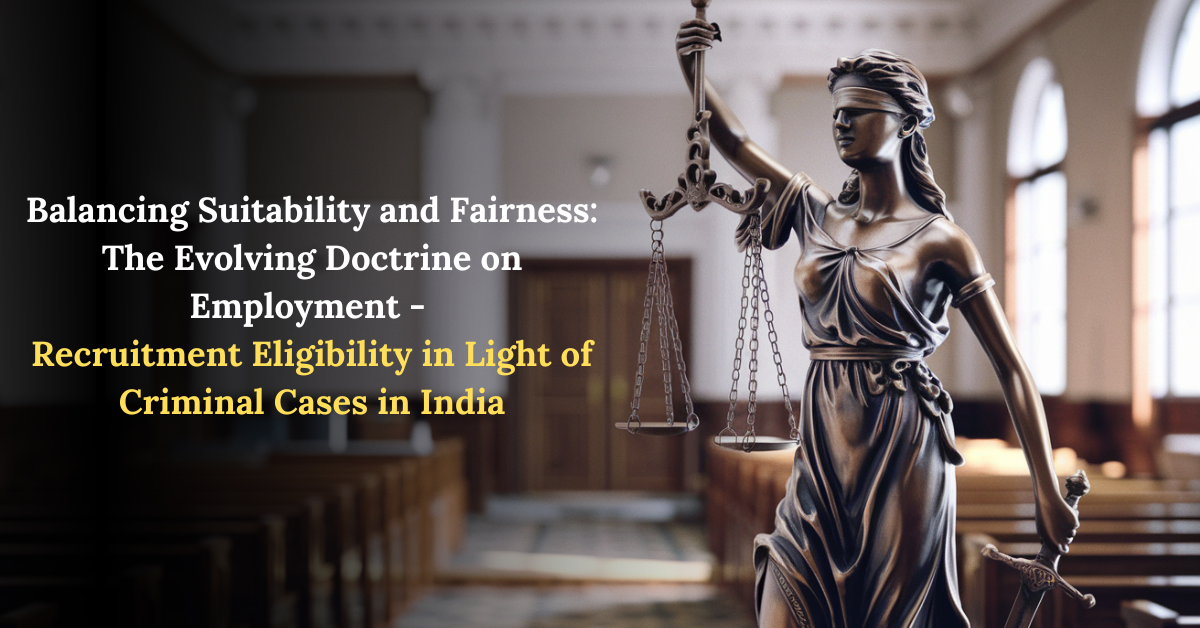
Balancing Suitability and Fairness: The Evolving Doctrine on Employment – Recruitment Eligibility for Candidates with Criminal Cases
An Examination of Judicial Trends and Guidelines Concerning Candidates with Pending or Past Criminal Charges
Introduction
The right to employment is a fundamental aspect of an individual’s livelihood and dignity. However, in the context of public service and sensitive positions, employers have a legitimate interest in ensuring that candidates possess the necessary character and integrity to fulfill their duties. This creates a complex challenge when evaluating recruitment eligibility for candidates with criminal cases, as it necessitates balancing fairness to the candidate with the need to safeguard public trust and maintain the integrity of institutions.
This article analyses the evolving jurisprudence surrounding the ‘suitability doctrine in the backdrop of criminal cases’ in Indian employment law. Examining landmark judgments and highlighting key factors considered by the courts, the article traces the shift from a strict disqualification approach to a more nuanced, case-by-case assessment.
Early Judgments: A Strict Approach Favouring Impeccable Character
Early judgments, particularly in sensitive fields like law enforcement, adopted a strict approach toward recruitment eligibility for candidates with criminal cases, emphasizing the need for impeccable character and integrity in roles dedicated to upholding the law and public order.
- In Delhi Administration v. Sushil Kumar, [(1996) 11 SCC 605], the Supreme Court upheld the denial of appointment to a Constable despite the candidate’s acquittal in a criminal case. The Court emphasised that employment in a disciplined force demands a higher level of integrity, and even an acquittal does not necessarily eliminate concerns about suitability.
- Similarly, in R. Radhakrishnan v. Director General of Police & Ors. [(2008) 1 SCC 660], the Court upheld the removal of a police officer who suppressed information about a pending criminal case.
These early judgments reflected a cautious approach, prioritising the perceived need to maintain the reputation and trustworthiness of public institutions.
Transition to a Nuanced Approach: Emergence of Multi-Factor Consideration
Over time, a more nuanced approach emerged, acknowledging the need to consider individual circumstances in evaluating recruitment eligibility for candidates with criminal cases. Several factors began to influence the Court’s assessment of suitability
1. Nature and Gravity of the Offence
The seriousness of the alleged offence became a crucial consideration.
- In T.S. Vasudavan Nair v. Director of Vikram Sarabhai Space Centre & Ors. [(1988) Supp SCC 795], the Court held that non-disclosure of a conviction for shouting slogans under the Defence of India Rules was not material enough to deny employment.
This distinction between trivial offences and those involving moral turpitude or a serious nature marked a departure from the earlier emphasis on absolute impeccability.
2. Applicant’s Age at the Time of the Offence
The Court recognized that youthful indiscretions should not permanently bar individuals from employment opportunities.
- In Commissioner of Police & Ors. v. Sandeep Kumar [(2011) 4 SCC 644], the Court showed leniency towards a candidate who suppressed an offence committed at the age of 20, reasoning that young people are more prone to errors in judgement and deserve a chance at rehabilitation.
3. Truthful Disclosure vs. Suppression
The Court distinguished between cases where candidates voluntarily disclosed information, even if belatedly, and those involving deliberate suppression.
- Commissioner of Police, Delhi & Anr. v. Dhaval Singh [(1999) 1 SCC 246] exemplifies this distinction. The Court set aside the cancellation of a candidate’s selection because he had voluntarily disclosed the pendency of a criminal case before the final decision. This suggested a more forgiving approach towards those who demonstrate a willingness to be transparent.
4. Impact on Job Requirements
The Court acknowledged that the relevance of a past offence should be evaluated in the context of the specific job requirements.
- In Kendriya Vidyalaya Sangathan & Ors. v. Ram Ratan Yadav [(2003) 3 SCC 437], the Court upheld the dismissal of a teacher who suppressed a pending criminal case, reasoning that a teacher’s conduct and antecedents could have a significant impact on students.
This highlights the importance of a contextual analysis, considering the nature of the position and the potential consequences of a candidate’s past actions.
Landmark Judgment in Avtar Singh: Clear Guidelines for Assessing Suitability
The Supreme Court’s decision in Avtar Singh v. Union of India & Ors. [(2016) 8 SCC 471] marked a watershed moment in clarifying and consolidating the law on suppression of information in employment applications. The Court, drawing upon a review of previous judgments, formulated a comprehensive set of guidelines that continue to shape judicial decisions in this area.
Paragraph 38 of the Avtar Singh judgement sets out the following principles:
- Truthful and Complete Disclosure: Candidates are obligated to provide accurate and comprehensive information regarding criminal cases.
- Consideration of Special Circumstances: Employers should take into account any extenuating circumstances when deciding on termination or cancellation of candidature.
- Employer Discretion for Trivial Convictions: Employers have the discretion to overlook minor convictions that do not raise significant concerns about suitability.
- Potential Consequences for Non-Trivial Convictions: More serious convictions may justify cancellation of candidature or termination of employment.
- Acquittals and Moral Turpitude: Even acquittals in cases involving moral turpitude or serious offences can be grounds for denying appointment.
- No Automatic Entitlement to Appointment: Truthful declaration of a concluded criminal case does not automatically entitle a candidate to appointment.
- Employer Discretion for Pending Trivial Cases: Employers have the discretion to appoint candidates with pending trivial cases, after careful assessment.
- Suppression of Multiple Pending Cases: Deliberate suppression of information about multiple pending cases raises serious concerns about a candidate’s integrity.
- Pending Cases Unknown to the Candidate: Even pending cases unknown to the candidate at the time of application may have an adverse impact on their suitability.
- Departmental Inquiry for Confirmed Employees: Confirmed employees are entitled to a departmental inquiry before termination based on suppression of information.
- Clarity and Specificity of Verification Forms: Verification forms must be clear, specific, and unambiguous in their questions to avoid misunderstandings.
Post-Avtar Singh Judgments: Applying the Guidelines and Addressing Specific Scenarios
Subsequent judgments have generally adhered to the principles laid down in Avtar Singh, demonstrating their enduring relevance in shaping the ‘suitability doctrine’.
- In Joginder Singh vs. Union Territory of Chandigarh & Ors. [(2015) 2 SCC 377], the Court applied the Avtar Singh guidelines and held that an “honourable” acquittal should not disqualify a candidate from appointment, particularly when they have been transparent about the case.
- State of West Bengal & Ors. Vs. Mitul Kumar Jana emphasized the need to consider the nature of the offence and the specific requirements of the job, especially when dealing with acquittals. It also reaffirmed that employers retain the discretion to assess suitability even when information is truthfully declared.
The Anil Bhardwaj Case: An Exception Highlighting Contextual Factors
A notable exception to the general trend is the case of Anil Bhardwaj Vs. The Hon’ble High Court Of Madhya Pradesh & Ors. (Hon’ble Justice M. R. Shah Judgment). The Court upheld the decision to deem the candidate unsuitable for a judicial position despite his acquittal in a criminal case. This decision can be attributed to several contextual factors:
- High Standard for Judicial Service: The Court stressed the paramount importance of integrity and impeccable character for those serving in the judiciary.
- Timing of the Acquittal: Crucially, Bhardwaj’s acquittal occurred after the recruitment process had concluded, making it difficult to revisit the decision without disrupting the entire selection process.
Conclusion: A Balanced Approach Emphasising Fairness and Informed Decision-Making
The Avtar Singh judgement provides a robust framework for navigating the complexities of this area, balancing the interests of fairness to candidates with the legitimate concerns of employers. The guidelines emphasise the importance of truthful disclosure, contextual analysis, and a thorough assessment of all relevant factors. Subsequent judgments, while affirming these principles, have also highlighted the need for flexibility and the avoidance of overly mechanical application of rules.
The evolution of this jurisprudence reflects a growing awareness of the need to ensure that past conduct, particularly in the realm of criminal charges, is evaluated fairly and with due consideration for individual circumstances. The objective is to promote a system that affords opportunities for rehabilitation and reform while ensuring that public institutions are staffed by individuals who meet the requisite standards of integrity and character.
References:
- Delhi Administration v. Sushil Kumar, [(1996) 11 SCC 605]
- R. Radhakrishnan v. Director General of Police & Ors. [(2008) 1 SCC 660]
- T.S. Vasudavan Nair v. Director of Vikram Sarabhai Space Centre & Ors. [(1988) Supp SCC 795]
- Commissioner of Police & Ors. v. Sandeep Kumar [(2011) 4 SCC 644]
- Commissioner of Police, Delhi & Anr. v. Dhaval Singh [(1999) 1 SCC 246]
- Kendriya Vidyalaya Sangathan & Ors. v. Ram Ratan Yadav [(2003) 3 SCC 437]
- Avtar Singh v. Union of India & Ors. [(2016) 8 SCC 471]
- Joginder Singh vs. Union Territory of Chandigarh & Ors. [(2015) 2 SCC 377]
- State of West Bengal & Ors. Vs. Mitul Kumar Jana
- Anil Bhardwaj Vs. The Hon’ble High Court Of Madhya Pradesh & Ors [CIVIL APPEAL NO(S).3419 of 2020] (OCTOBER 13, 2020)
- Mohammed Imran vs. State of Maharashtra and others (C.A.No.10571 of 2018) decided on 12.10.2018.