 Whatsapp

Sheikh Hasina’s Extradition Request: Legal Implications Under Indian Law
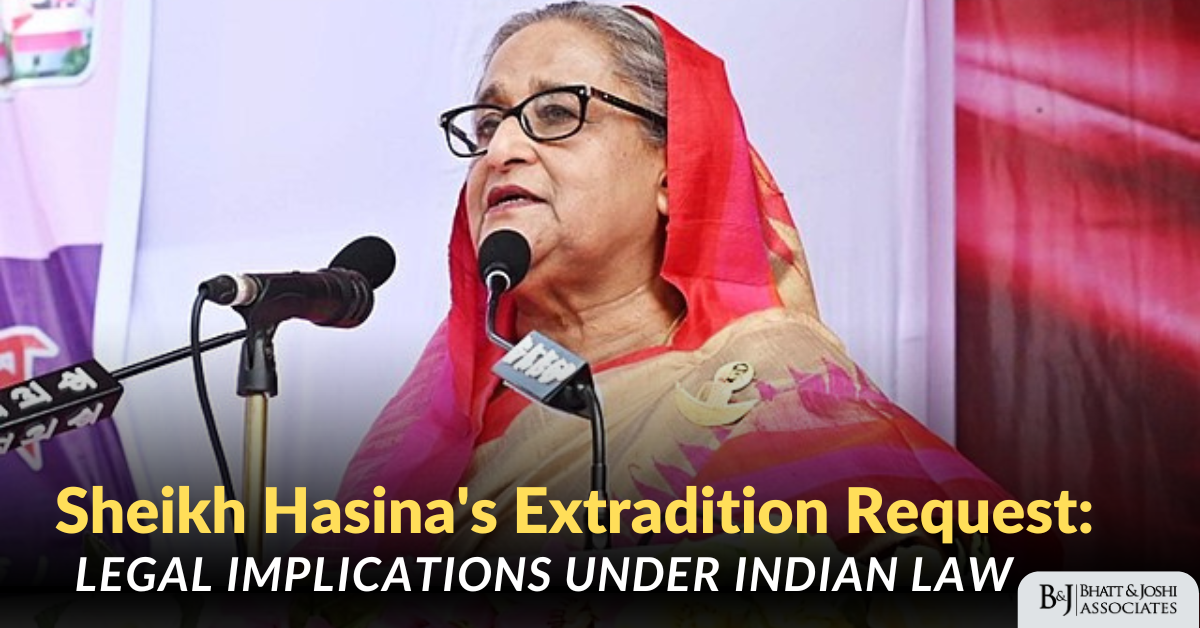
Introduction: A Landmark Case at the Intersection of Law and Diplomacy
On November 17, 2025, Bangladesh’s International Crimes Tribunal (ICT) sentenced former Prime Minister Sheikh Hasina to death in absentia for crimes against humanity committed during the violent suppression of student-led protests in July-August 2024. This verdict has thrust India into a complex legal and diplomatic predicament, as Hasina has been residing in Delhi since fleeing Bangladesh on August 5, 2024. Bangladesh’s interim government, led by Nobel laureate Muhammad Yunus, has formally submitted Sheikh Hasina’s Extradition Request, characterizing it as India’s “obligatory duty” under the bilateral extradition treaty and warning that sheltering her would constitute “a grave unfriendly act and a contempt of justice”. [1]
India’s response has been measured and non-committal, with the Ministry of External Affairs stating it remains “committed to the best interests of the people of Bangladesh, including in peace, democracy, inclusion and stability” while notably avoiding any reference to the extradition demand. Foreign Secretary Vikram Misri has described the matter as requiring “engagement and consultations between the two governments”, signaling that India is carefully weighing its legal obligations against diplomatic, humanitarian, and strategic considerations. [2]
This article provides a comprehensive, fact-checked analysis of the legal framework governing Sheikh Hasina’s Extradition Request, examining the India-Bangladesh Extradition Treaty of 2013 (amended 2016), India’s Extradition Act of 1962, constitutional protections under Article 21, landmark judicial precedents, and the diplomatic implications for bilateral relations. The analysis incorporates current developments, including the November 2025 death sentence, the UN Office of the High Commissioner for Human Rights (OHCHR) fact-finding report, and international concerns about the credibility of Bangladesh’s International Crimes Tribunal.
Recent Developments: Death Sentence and Renewed Extradition Pressure
The International Crimes Tribunal Verdict
The ICT’s 453-page verdict found Sheikh Hasina and former Home Minister Asaduzzaman Khan Kamal guilty of crimes against humanity for their roles in orchestrating a systematic and violent crackdown on anti-government protesters between July 1 and August 15, 2024. The tribunal concluded that Hasina had authorized the use of live ammunition, drones, and helicopters against largely unarmed demonstrators and failed to prevent or punish widespread abuses by security forces.[3]
According to the UN Human Rights Office’s independent fact-finding report released in February 2025, as many as 1,400 people were killed during this period, with approximately 12-13% being children. The report found “reasonable grounds to believe” that these violations were carried out “with the knowledge, coordination and direction of the political leadership and senior security sector officials” and may constitute crimes against humanity requiring further criminal investigation.[4]
The tribunal’s decision to impose the death penalty has drawn criticism from international human rights organizations. The UN High Commissioner for Human Rights expressed regret over the death sentence, noting the trial was conducted in absentia. Human Rights Watch stated that while accountability is necessary, “the prosecution failed to meet international fair trial standards, including for a full opportunity to present a defense and question witnesses,” with concerns exacerbated by the death sentences.
Bangladesh’s Formal Sheikh Hasina’s Extradition Request
Bangladesh first formally request Sheikh Hasina’s extradition on December 23, 2024, through a diplomatic note verbale sent to Indian authorities. Following the November 17, 2025 death sentence, Bangladesh’s Foreign Ministry renewed its demand with greater urgency, citing the bilateral extradition treaty and characterizing India’s compliance as an “obligatory responsibility”.
The statement from Dhaka’s Foreign Ministry warned that “providing refuge to these individuals, who have been convicted of crimes against humanity, by any other country would be a highly unfriendly act and a disregard for justice”. Law Adviser to Bangladesh’s interim government stated bluntly, “If India continues to shelter this criminal,” it would severely strain bilateral relations. [5]
India’s Diplomatic Response to Sheikh Hasina’s Extradition Request
India has maintained a careful diplomatic posture, acknowledging the verdict while avoiding commitment to extradition. The Ministry of External Affairs issued a statement noting it had “taken note of the verdict announced by the ‘International Crimes Tribunal of Bangladesh'” (notably placing the tribunal’s name in quotation marks, perhaps suggesting reservations about its legitimacy) and affirming India’s commitment to “peace, democracy, inclusion and stability” in Bangladesh. [6]
Crucially, India has not responded substantively to the Sheikh Hasina’s extradition request despite receiving it in December 2024. Foreign Secretary Misri’s characterization of the matter as requiring “engagement and consultations” suggests India views this as a complex issue involving legal, political, and diplomatic dimensions rather than a straightforward treaty obligation.[2]
India’s Extradition Legal Framework: The Extradition Act, 1962
India’s extradition process is governed by the Extradition Act, 1962, which provides the legislative basis for extraditing fugitive criminals to and from India. The Act permits extradition based on bilateral treaties or, in their absence, through special arrangements or conventions to which both India and the requesting state are parties. [7]
Core Principles of Indian Extradition Law
Dual Criminality Requirement: The alleged offense must be punishable in both India and the requesting state. This principle, recognized in Section 2 of the Extradition Act and incorporated into most bilateral treaties, ensures that individuals are not extradited for conduct that is not criminal under Indian law.
Political Offense Exception: Section 31(1)(a) of the Extradition Act explicitly provides:
“A fugitive criminal shall not be surrendered or returned to a foreign State if the offence in respect of which his surrender is sought is of a political character or if he proves to the satisfaction of the magistrate or court before whom he may be produced or of the Central Government that the requisition or warrant for his surrender has, in fact, been made with a view to try or punish him for an offence of a political character”. [8]
This provision reflects a fundamental principle of international extradition law: states generally refuse to extradite individuals for political offenses, recognizing that such prosecutions may constitute persecution rather than legitimate criminal proceedings.
Doctrine of Specialty: Section 21 of the Extradition Act, as amended in 1993, embodies the internationally recognized doctrine of specialty, which restricts the requesting state to prosecuting the extradited person only for the crimes specified in the extradition order. The section provides:
“Whenever any person accused or convicted of an offence, which, if committed in India would be an extradition offence, is surrendered or returned by a foreign State, such person shall not, until he has been restored or has had an opportunity of returning to that State, be tried in India for an offence other than (a) the extradition offence in relation to which he was surrendered or returned; or (b) any lesser offence disclosed by the facts proved for the purposes of securing his surrender or return other than an offence in relation to which an order for his surrender or return could not be lawfully made; or (c) the offence in respect of which the foreign State has given its consent”. [8]
In Daya Singh Lahoria v. Union of India (2001) 4 SCC 516, the Supreme Court explained the specialty principle as “a universally recognised principle of international law” that ensures an extradited person can only be tried for the specific crime for which extradition was granted. The Court held that if the requesting state wishes to try the fugitive for other crimes, it must first return the person to the extraditing state and request fresh extradition.
Restrictions on Surrender: Section 31 provides multiple grounds for refusing extradition, including where prosecution is time-barred, the offense is of a political character, or there is no provision ensuring the person will not be tried for offenses other than those for which extradition is sought.
Executive and Judicial Discretion
The Extradition Act vests significant discretion in the Central Government. Section 29 empowers the government to refuse extradition if:
- The request is trivial or not made in good faith
- The request is politically motivated
- Extradition is not in the interests of justice
The government may “at any time” stay proceedings, cancel warrants, or discharge the individual sought for extradition. This discretionary power reflects the reality that extradition involves not merely legal but also political and diplomatic considerations.
The India-Bangladesh Extradition Treaty: Provisions and Exceptions
India and Bangladesh signed their bilateral Treaty Relating to Extradition on January 28, 2013, which entered into force and was subsequently amended in 2016 to streamline the extradition process. The treaty represents both countries’ commitment to cooperating in the suppression of crime while incorporating safeguards to protect against abuse. [9]
Key Treaty Provisions
Article 1 – Obligation to Extradite: The Contracting States agree to extradite to each other, subject to the provisions of the treaty, persons found in the territory of one state who are accused or convicted of extraditable offenses in the other.
Article 2 – Extraditable Offenses: An offense is extraditable if it is punishable under the laws of both states by imprisonment for a minimum of one year or by a more severe penalty. The treaty applies to offenses committed before or after its entry into force, provided the conduct constitutes an offense in both jurisdictions at the time the request is made.
Article 3 – Composite Offenses: Extradition is available even if the conduct occurred wholly or partly in the requested state, if under that state’s law the conduct and its effects would constitute an extradition offense in the requesting state’s territory.
Article 6 – Political Offense Exception: This provision is central to Hasina’s case. The treaty states:
“Extradition may be refused if the offence for which extradition is requested is an offence of a political character”.
However, Article 6 includes a significant qualification: it specifies a long list of offenses that shall NOT be regarded as political offenses, including murder, culpable homicide, assault, explosions, use of firearms, property damage intending to endanger life, kidnapping, hostage-taking, and incitement to murder. This exclusion appears designed to prevent violent crimes from being shielded under the political offense exception.
The interplay between the general political offense exception and the specific exclusions creates interpretive complexity. While the charges against Hasina include murder (since the crackdown resulted in approximately 1,400 deaths), the context matters: were these acts committed in a purely criminal capacity, or were they political acts committed as part of her role as head of government responding to political opposition? Courts have recognized that the same act may be characterized differently depending on its context and motivation.
Article 8 – Additional Grounds for Refusal: This provision gives the requested state substantial discretion, stating:
“A person may not be extradited if the accusation against him or her has not been made in good faith in the interests of justice”.
Article 8 also permits refusal for military offenses that are not offenses under general criminal law, or where there is insufficient evidence. The “good faith” requirement is particularly relevant when the requesting government is a political adversary of the person sought and where questions exist about the fairness and independence of the judicial proceedings.
Article 10 – Extradition Procedures: Requests must be made through diplomatic channels and accompanied by an accurate description of the person sought, a statement of facts, and the text of relevant laws defining the offense and prescribing punishment.
Article 13 – Evidence Requirements: This article addresses the evidentiary standards for extradition requests. As originally drafted, the treaty required evidence sufficient to establish a prima facie case. However, the 2016 amendment significantly altered this requirement.
The 2016 Amendment: Simplified Procedure
The 2016 amendment to the India-Bangladesh Extradition Treaty removed the requirement to provide evidence of the alleged crime, stipulating that only an arrest warrant from a competent court is now needed to support an extradition request. This simplification was intended to expedite the extradition process and enhance bilateral cooperation in combating cross-border crime. [10]
For Hasina’s case, Bangladesh has issued multiple arrest warrants, making her technically eligible for extradition under the amended treaty’s procedural requirements. However, procedural eligibility does not preclude India from invoking substantive exceptions under Articles 6 and 8 or under its domestic Extradition Act.
Legal Grounds for India to Refuse Extradition
Despite Bangladesh’s assertion that extradition is India’s “obligatory duty,” both the bilateral treaty and Indian domestic law provide multiple substantive grounds for refusal. These grounds reflect the principle that while states generally cooperate on extradition matters, such cooperation is not absolute and must be balanced against considerations of justice, human rights, and the integrity of legal proceedings.
Political Offense Exception: The Central Issue
The political offense exception, enshrined in both Article 6 of the India-Bangladesh Treaty and Section 31(1)(a) of India’s Extradition Act, is likely the most viable ground for India to refuse extradition.
The concept of “political offense” has evolved through international law and practice but generally encompasses two categories:
- Pure political offenses: Acts directed against the state itself, such as treason, sedition, or espionage, which have no common criminal character.
- Relative political offenses: Common crimes (like murder or assault) committed in connection with political uprisings, civil wars, or political struggles.
In In re Castioni 1 QB 149, an English court established the test for relative political offenses: there must be (1) a political uprising or disturbance, and (2) the charged offense must have been committed in furtherance of that uprising. Courts worldwide have applied variations of this test.
Hasina’s case presents a complex scenario. She is charged with crimes against humanity for ordering security forces to violently suppress political protests that sought her removal from power. While the underlying acts (killings by security forces) would ordinarily constitute murder, these occurred in the context of:
A mass political uprising demanding the government’s ouster
- Hasina’s position as Prime Minister making decisions about state security response
- The protests being fundamentally political in nature (challenging government legitimacy)
- Her subsequent removal from power by the protest movement
- The current prosecution being initiated by an interim government composed of her political opponents
These circumstances strongly suggest the charges are of a political character, despite involving deaths. As one legal expert noted, “Since Hasina’s removal, trial, and conviction are embedded within domestic political upheaval, India can easily categorise the accusation as political”.
The Murder Exception Complication: Article 6 of the treaty explicitly excludes murder from being considered a political offense. At first glance, this appears to preclude India from invoking the political offense exception, since the charges involve deaths resulting from the crackdown. [10]
However, legal scholarship and jurisprudence suggest this exclusion is not absolute when the alleged murders occurred in a political context. The exclusion primarily aims to prevent violent terrorists and common criminals from escaping justice by claiming political motivation. When the alleged offense involves governmental decision-making during political unrest rather than individual criminal acts, courts have recognized that the political character may still predominate.
Moreover, India’s Section 31(1)(a) permits refusal if the extradition request was “made with a view to try or punish [the person] for an offence of a political character”. This focuses on the requesting state’s motivation rather than solely on the technical categorization of the offense. If India concludes that Bangladesh’s request is fundamentally aimed at punishing Hasina for her political role and decisions rather than prosecuting genuine criminal conduct, refusal would be justified. [8]
Good Faith Requirement: Questioning the ICT’s Credibility
Article 8’s provision allowing refusal if the accusation is “not made in good faith in the interests of justice” provides India with another robust ground for declining Sheikh Hasina’s Extradition Request. [10]
Several factors support an argument that Bangladesh’s extradition request may not meet the good faith standard:
Political Vendetta Concerns: The interim government led by Muhammad Yunus represents the political opposition that ousted Hasina. Yunus himself has publicly expressed dissatisfaction with Hasina, particularly her criticisms of his government from exile. The appearance of victor’s justice—where those who overthrew a government subsequently prosecute its leaders—raises legitimate questions about whether the proceedings are motivated by a genuine pursuit of justice or political retribution.
Credibility of the International Crimes Tribunal: The ICT faces serious credibility problems that undermine the “good faith” foundation of the extradition request. Ironically, the same tribunal that Hasina established in 2010 to prosecute 1971 war crimes is now being used against her. Human Rights Watch, which initially supported the tribunal’s establishment, has issued extensive criticism:
“The trials against the alleged war criminals are deeply problematic, riddled with questions about the independence and impartiality of the judges and fairness of the process”. [3]
In its reports, Human Rights Watch documented “glaring violations of fair trial standards,” including:
- Arbitrary limitation of defense witnesses and evidence
- Denial of the right to challenge credibility of prosecution witnesses
- Prohibited communications between prosecution and judges
- Constitutional provisions (Article 47A) stripping ICT defendants of fundamental rights
- Lack of independent judicial review
Amnesty International has similarly criticized the ICT for not following international standards and identified “many flaws in the trial from the beginning”. The organization opposes the death penalty in all circumstances and has expressed particular concern about its use in trials that fail to meet fair trial standards.
Trial in Absentia Concerns: Hasina was tried and sentenced without being present or represented by counsel of her choosing. While trials in absentia are not per se violations of international law, they raise heightened due process concerns, particularly when combined with other procedural deficiencies. The UN expressed regret specifically over “the imposition of the death penalty” in trials conducted in absentia. [1]
Political Amendments to ICT Legislation: In 2025, the interim government amended the ICT Act to give the tribunal broad authority to prosecute and dismantle political organizations. Experts have characterized these amendments as potentially violating “international standards of due process and freedom of association” and enabling the tribunal to be used “as a tool for political vendetta rather than genuine justice”. [3]
These factors collectively support India’s invocation of Article 8 to refuse extradition on grounds that the request was not made in good faith or in the interests of justice.
Constitutional Protection Under Article 21
India’s Constitution provides an additional layer of protection that may influence the extradition decision. Article 21 of the Constitution states:
“No person shall be deprived of his life or personal liberty except according to procedure established by law”. [11]
Indian courts have consistently held that the word “person” in Article 21 encompasses not only citizens but also non-citizens, including foreigners within India’s territory. This principle has been reaffirmed in numerous cases:
Rajubala Das v. Union of India (2020): The Supreme Court ruled that prolonged and indefinite detention of non-citizens, in the absence of any real possibility of deportation, constitutes “a gross violation of his fundamental right to life and personal liberty under Article 21”.
Punjab and Haryana High Court (2025): In granting bail to a Bangladeshi woman accused of staying in India without valid documents, the Court held that “the right to personal liberty under Article 21 applies to foreigners too” and that prolonged pre-trial custody would amount to “irreversible injustice”.
Rohingya Deportation Case (2021): Although the Supreme Court ultimately permitted deportation, it acknowledged that “rights guaranteed under Articles 14 and 21 are available to all persons who may or may not be citizens”. Legal scholars have criticized the decision for insufficiently recognizing that Article 21 should protect refugees from deportation to countries where they face danger to life or freedom. [12]
In Sheikh Hasina’s Extradition Request context, Article 21’s protection is relevant in multiple ways:
Right to Fair Trial: If extradition would result in Hasina facing a manifestly unfair trial that denies her fundamental procedural rights, Indian courts could find this violates Article 21’s guarantee of procedural fairness. The documented deficiencies in the ICT’s procedures—denial of adequate defense, lack of independent judicial review, and constitutional exclusion of fundamental rights—create serious fair trial concerns.
Death Penalty Consideration: Hasina faces a death sentence if extradited. While India retains capital punishment and therefore cannot refuse extradition solely on this ground, the combination of death penalty with fair trial concerns heightens the Article 21 analysis. Courts may be more reluctant to extradite when the penalty is irreversible and the trial process is questionable.
Principle of Non-Refoulement: While India has not ratified the 1951 Refugee Convention, at least two High Court judgments have held that the principle of non-refoulement (not returning individuals to places where they face persecution or serious harm) is part of Article 21’s guarantee. If Hasina can establish that returning to Bangladesh would expose her to persecution, torture, or other treatment violating fundamental rights, Article 21 may preclude extradition. [12]
Indian courts could judicially review an extradition decision, ensuring it comports with Article 21’s protections. As the Delhi High Court stated, “Article 21 of the Constitution of India, which encompasses Right to Life, is available not merely to citizens but to all persons”.
Landmark Judicial Precedents: Lessons from Indian Extradition Jurisprudence
India’s courts have developed a substantial body of extradition jurisprudence that provides guidance for Hasina’s case. Several landmark judgments establish principles that could influence India’s decision.
Abu Salem v. State of Maharashtra: Binding Nature of Sovereign Assurances
The case of Abu Salem Abdul Kayyum Ansari v. State of Maharashtra is among the most significant Indian extradition precedents, establishing that sovereign assurances given to secure extradition are absolutely binding on the Government of India and its courts.
Background: Abu Salem, wanted for involvement in the 1993 Mumbai bombings, was extradited from Portugal to India in 2005. To secure extradition, the Government of India gave Portugal a solemn sovereign assurance on December 17, 2002, that Salem would not be given the death penalty nor subjected to imprisonment exceeding 25 years.
Key Holdings: In its September 10, 2010 judgment, the Supreme Court held that Portugal had imposed certain conditions on Salem’s extradition and that India was bound by these conditions. When a TADA court subsequently sentenced Salem to life imprisonment (which in India can extend beyond 25 years), Salem challenged the sentence as violating the sovereign assurance.
In its July 11, 2022 judgment, a Supreme Court bench of Justices S.K. Kaul and M.M. Sundresh held:
“On the appellant completing 25 years of sentence, the Central Government is bound to advise the President of India for exercise of his powers under Article 72 of the Constitution, and to release the appellant in terms of the national commitment as well as the principle based on comity of courts”.
The Court emphasized that while judicial independence prevents the executive from dictating sentences to courts, the government must exercise its constitutional powers to ensure compliance with international commitments:
“The sovereign assurance could not have been construed as an assurance of the Courts of India and, in fact, had not been so construed by the Courts at Portugal. The objective of incorporating Article 72 of the Constitution and Sections 432 and 433 of the Cr.P.C. was to assure that the Union of India would ensure that while executing the sentence or punishment imposed by the Court in India, the Union of India would exercise its powers and bring down the punishment consistent with the solemn sovereign assurance given to the Government of Portugal”.
Doctrine of Specialty Reaffirmed: The Abu Salem judgments also reaffirmed the doctrine of specialty, holding that Salem could only be tried for offenses for which he was extradited, not for additional offenses. The Court noted that violating this principle would breach “the principle of speciality” and India’s international obligations.
Relevance to Hasina’s Case: Abu Salem establishes that India takes treaty obligations and international assurances seriously. However, it also demonstrates that India’s sovereignty includes the power to impose conditions on extradition and to refuse extradition when doing so would violate fundamental principles. If India were to extradite Hasina, it would likely seek assurances regarding her treatment, trial fairness, and sentencing—assurances that Bangladesh’s current ICT framework may be unable to credibly provide.
Daya Singh Lahoria v. Union of India: The Specialty Principle
In Daya Singh Lahoria v. Union of India (2001) 4 SCC 516, the Supreme Court comprehensively addressed the doctrine of specialty in extradition.
The Case: Daya Singh Lahoria was extradited from the United States to India for specific offenses listed in the extradition order. After arriving in India, he was charged with additional offenses not covered by the extradition decree. Lahoria challenged these additional prosecutions as violating Section 21 of the Extradition Act and the principle of specialty in international law.
Supreme Court’s Analysis: The Court, in a judgment by Justice G.B. Pattanaik, held:
“The doctrine of specialty is yet another established rule of international law relating to extradition. Thus, when a person is extradited for a particular crime, he can be tried for only that crime. If the requesting State deems it desirable to try the extradited fugitive for some other crime committed before his extradition, the fugitive has to be brought to the status quo ante, in the sense that he has to be returned first to the State which granted the extradition and a fresh extradition has to be requested for the latter crime”.
The Court emphasized that this principle is embedded in Section 21 of the Extradition Act, which prohibits trial for offenses other than those specified in the extradition order unless the person has been restored to the extraditing state or given an opportunity to return.
International Law Foundation: The judgment quoted extensively from international law authorities, noting:
“There is no general duty of extradition in international law. Extradition is carried out under conditions determined by the extraditing State. The requesting State must respect these conditions. The principle of specialty prohibits prosecution of an extradited person for any charge not contained within the extradition order”.
Relevance: This precedent reinforces that extradition is conditional and that the requesting state must strictly comply with the limitations imposed. For Hasina, this means that if India were to extradite her, Bangladesh would be bound to try her only for the specific offenses outlined in the extradition request, under the conditions India might impose.
The Savarkar Case (1910-1911): Procedural Irregularities and Sovereignty
The Savarkar Case, adjudicated by the Permanent Court of Arbitration at The Hague, is one of the earliest international arbitration cases addressing extradition disputes and remains instructive despite its age.
Facts: Vinayak Damodar Savarkar, an Indian revolutionary, was being transported by British authorities from England to India aboard a ship that stopped at Marseilles, France. Savarkar escaped while the ship was harbored in French waters. French police apprehended him, but instead of following formal extradition procedures, the French officer handed Savarkar directly to British officers aboard the ship without seeking authorization from French authorities. France later demanded Savarkar’s return, arguing that Britain had violated France’s sovereignty and international law by taking custody without due process.
The Arbitral Tribunal’s Decision: The Tribunal ruled in favor of Britain on February 24, 1911, based on procedural grounds:
- Waiver Doctrine: Since French authorities had voluntarily handed over Savarkar without immediate protest, France had effectively waived its right to challenge the act later.
- No Malafide Intent: The Tribunal found no conclusive evidence that Britain had conspired to violate France’s sovereignty or acted in bad faith.
- Procedural Formality Over Substantive Justice: The ruling prioritized the procedural lapse (France’s failure to protest immediately) over the substantive issue of sovereignty violation.
Criticism and Legacy: The decision was widely criticized for allowing procedural technicalities to override fundamental principles of state sovereignty and due process. Modern extradition treaties and international law have evolved to require strict adherence to formal diplomatic processes precisely to prevent such abuses.
Relevance: The Savarkar Case underscores the importance of procedural compliance in extradition and the sovereignty concerns implicated when one state seeks to obtain custody of an individual from another. It also demonstrates that international law recognizes states’ rights to insist on proper procedures and to refuse irregular transfers. For Sheikh Hasina, India could rightfully insist that Bangladesh’s extradition request comply fully with all procedural requirements of the treaty and that any deficiencies justify refusal.
Other Relevant Precedents
Rajubala Das v. Union of India (2020): This case established that prolonged detention of non-citizens without realistic prospect of deportation violates Article 21. While factually distinct from extradition, it reinforces the principle that non-citizens enjoy constitutional protections against arbitrary deprivation of liberty.
Marie Emmanuelle Verhoeven Case (2015): The Delhi High Court examined the validity of an extradition order to Chile and highlighted errors in the order, including incorrect legal references and improper exercise of powers under the Extradition Act. The case demonstrates that Indian courts carefully scrutinize extradition proceedings for legal compliance and will set aside orders that contain substantive errors.
Vijay Mallya Extradition: In the extradition of businessman Vijay Mallya to the UK, Indian authorities carefully addressed concerns about prison conditions and treatment, demonstrating that even when seeking extradition, India recognizes the importance of human rights safeguards. Conversely, when requested to extradite, India can legitimately impose similar conditions or refuse if adequate protections cannot be assured.
The International Crimes Tribunal: Serious Credibility Deficits
Understanding the International Crimes Tribunal of Bangladesh is essential to evaluating whether India’s extradition of Sheikh Hasina, would serve the interests of justice or facilitate a flawed prosecution. [13]
Origins and Evolution of the ICT
The ICT was established by Sheikh Hasina’s government in 2010 under the International Crimes (Tribunals) Act of 1973 to prosecute individuals accused of genocide, crimes against humanity, and war crimes during Bangladesh’s 1971 Liberation War. Initially, the tribunal focused on trying individuals associated with opposition political parties, particularly Jamaat-e-Islami, who allegedly collaborated with Pakistani forces during the independence conflict.
The irony of the current situation is stark: the tribunal Hasina created and controlled for 15 years is now being used by her political opponents to prosecute her for alleged crimes committed during her rule. This reversal raises fundamental questions about the tribunal’s institutional independence and its susceptibility to political manipulation. [1]
Systematic Fair Trial Violations
International human rights organizations have consistently documented serious deficiencies in the ICT’s proceedings:
Denial of Fundamental Rights: Article 47(3) of Bangladesh’s Constitution, as amended, specifically excludes fundamental rights for individuals accused under the ICT Act. This constitutional provision strips ICT defendants of rights to: [13]
- Expeditious trial by an independent and impartial tribunal
- Challenge the constitutionality of the law under which they are prosecuted
- Seek remedies from the Supreme Court
This constitutional exclusion is unprecedented in modern criminal justice and fundamentally incompatible with international fair trial standards.
Arbitrary Limitations on Defense: Human Rights Watch documented that in multiple ICT trials, “the defense was arbitrarily limited in its ability to submit evidence, including witnesses and documents”. In one case, defense lawyers were allowed to produce only three witnesses to counter 14 separate charges. When lawyers asked judges to review this limitation, they were threatened with a 50 lakh taka (approximately US$64,000) fine. [14]
The ICT has also “denied the defense the opportunity to challenge the credibility of prosecution witnesses by rejecting witnesses’ earlier statements that were inconsistent with their trial testimony”. The refusal to permit cross-examination using prior inconsistent statements is a fundamental denial of the right to test prosecution evidence.
Judicial Bias and Prohibited Communications: Evidence emerged in 2012 of intercepted communications between the prosecution and judges, revealing prohibited and biased communications. Rather than address these revelations substantively, the ICT filed contempt charges against those who raised the concerns, “in an apparent attempt to silence criticism”.
Lack of International Observer Access: During Hasina’s tenure, the ICT “prohibited open access to foreign observers and journalists”. Transparency, particularly in high-profile political prosecutions, is essential to ensuring public confidence and detecting potential abuses. The exclusion of international observers reinforced perceptions that the tribunal was serving political rather than judicial purposes.
The 2025 Amendments: Expanding Political Power
In 2025, after Hasina’s ouster, the interim government amended the ICT Act to grant the tribunal authority to prosecute and dismantle political organizations. Legal experts have warned that this expansion “could be used to violate international standards of due process and freedom of association”. [3]
The tribunal used this new power in its verdict against Hasina, stating that the government should confiscate her properties to compensate victims, though it stopped short of ordering the Awami League’s dissolution. These provisions transform the tribunal from a purely criminal court into an instrument with quasi-political powers to reorganize the country’s political landscape.
International Condemnation
Human Rights Watch: Brad Adams, Asia Director of Human Rights Watch, stated: “The Bangladeshi government wants these trials to be taken seriously it must ensure that the rights of the accused are fully respected”. The organization has emphasized that while justice and accountability for the 1971 war crimes and the 2024 protest crackdown are necessary, “this must be done through trials which meet international standards, particularly since the death penalty is at stake”.
Amnesty International: Amnesty has “strongly criticized” the ICT, stating the tribunal “is not fully following international standards” and that “there have been many flaws in the trial from the beginning, some of which have been corrected, but many problems remain”. The organization opposes the death penalty in all circumstances and expressed particular concern about its imposition following flawed trials.
United Nations: The UN High Commissioner for Human Rights issued a statement expressing regret over “the imposition of the death penalty” in trials conducted in absentia. While the OHCHR’s fact-finding report confirmed that serious human rights violations occurred during the 2024 protests and that accountability is necessary, it also called for “a comprehensive process of truth-telling, healing and accountability” through mechanisms that respect due process.
The UN report diplomatically noted that “additional criminal investigations are warranted to determine the extent to which [the violations] may also amount to crimes against humanity,” implicitly suggesting that the ICT may not be the appropriate venue for such investigations.
Implications for Extradition
The ICT’s documented fair trial deficiencies directly bear on India’s extradition decision. Extraditing Hasina to face a tribunal that:
- Constitutionally excludes fundamental rights for defendants
- Arbitrarily limits defense evidence and witnesses
- Has a history of judicial bias and prohibited communications
- Conducts trials in absentia without adequate defense representation
- Has been criticized by every major international human rights organization
would arguably make India complicit in a manifestly unfair judicial process. This consideration strengthens India’s legal and moral basis for invoking the “good faith” exception under Article 8 of the treaty and for protecting Hasina’s Article 21 rights under Indian constitutional law.
Diplomatic and Strategic Implications for India-Bangladesh Relations
Beyond the legal technicalities, India’s decision on Sheikh Hasina’s Extradition Request carries profound diplomatic and strategic implications for bilateral relations with Bangladesh, regional stability, and India’s broader foreign policy interests.
Historical Context and Strategic Partnership
India and Bangladesh share deep historical ties, with India playing a crucial role in Bangladesh’s independence in 1971. The relationship has traditionally been characterized by extensive economic cooperation, security coordination, border management, water-sharing arrangements, and people-to-people connections. [15]
During Hasina’s 15-year tenure (2009-2024), India-Bangladesh relations reached their zenith. Hasina’s government:
- Cooperated extensively on counter-terrorism and security
- Denied safe haven to anti-India insurgent groups operating in India’s northeast
- Facilitated connectivity projects linking India’s mainland with the northeast through Bangladeshi territory
- Pursued economic integration through trade and investment
- Coordinated on regional platforms like BIMSTEC
Hasina was widely viewed as India’s most reliable partner in Dhaka, making her ouster and exile a significant setback for Indian interests.
Current Tensions and Friction Points
Since Hasina’s departure in August 2024, India-Bangladesh relations have deteriorated significantly:
Minority Rights Concerns: India has repeatedly expressed concerns about attacks on religious minorities, particularly Hindus, in Bangladesh following Hasina’s ouster. The arrest and denial of bail to Chinmoy Krishna Das, a Hindu religious leader, sparked a diplomatic exchange, with India’s Ministry of External Affairs calling it “unfortunate” and expressing concern over attacks on minorities.
Bangladesh’s interim government responded sharply, accusing India of “misrepresenting facts” and stating the remarks were “contrary to the friendly relations between the two nations”. Dhaka has asserted that minority protection is an internal matter and rejected what it perceives as external interference. [15]
Hasina’s Asylum and Public Statements: Bangladesh has criticized India for sheltering Hasina and allowing her to make public statements criticizing the interim government from exile. Bangladesh views these statements as interference and has demanded India either silence her or hand her over.
Foreign Affairs Adviser Mohammed Touhid Hossain accused Hasina of “orchestrating plots from her stay in India to undermine the ongoing revolution in Bangladesh”. Bangladesh’s BNP General Secretary directly addressed India, stating: “It is our call to you that you should hand her over to the Government of Bangladesh in a legal way. The people of this country have given the decision for her trial, let her face the trial”.
India-Backed Projects Under Review: The interim government has placed India-backed initiatives, including the Adani Group’s Godda power plant project, under review, planning to hire consultancy agencies to assess feasibility. This review has raised concerns about the future of bilateral economic cooperation.
China’s Growing Influence: Bangladesh’s deepening ties with China, particularly in infrastructure and defense sectors, is a strategic concern for India. India perceives Bangladesh’s pivot toward China as potentially diluting India’s strategic space in its immediate neighborhood. The interim government’s apparent willingness to diversify Bangladesh’s foreign relations away from over-dependence on India represents a significant shift.
Cross-Border Migration and Demographic Anxieties: Historical and undocumented migration from Bangladesh to Indian states like Assam and West Bengal remains politically sensitive. India’s implementation of the National Register of Citizens (NRC) in Assam and the Citizenship Amendment Act (CAA) has fueled diplomatic sensitivities, with Bangladesh fearing these policies could lead to attempted deportations of Bengali-speaking Muslims.
India’s Strategic Calculations
India faces a complex calculus in deciding Hasina’s fate:
Regional Stability: Refusing extradition may strain relations with Bangladesh’s current government, but extraditing a former friendly leader who sought refuge could create regional instability and send troubling signals to other partners about India’s reliability as a refuge.
Precedent for Future Cases: How India handles Hasina’s case will establish a precedent for how it treats foreign political leaders seeking asylum. Readily extraditing someone facing politically motivated charges could deter future leaders from seeking refuge in India when facing persecution.
Minority Protection Leverage: Hasina’s presence in India provides some leverage in pressing Bangladesh to protect minorities. If India extradites her, this leverage diminishes.
Domestic Political Considerations: India’s ruling government faces domestic political pressures regarding Bangladesh’s treatment of Hindus. Extraditing Hasina, who is viewed as having protected minorities, could generate domestic political backlash.
Legal and Moral Standing: Refusing extradition on principled legal and human rights grounds can enhance India’s international reputation as a country that respects due process and rejects politically motivated prosecutions. Conversely, extraditing someone to face a manifestly unfair tribunal could damage India’s moral authority.
Long-term Relationship: The Yunus-led interim government is temporary. Bangladesh’s political future remains uncertain. Maintaining a balanced approach that preserves the possibility of improved relations with whatever government eventually emerges may be prudent.
Diplomatic Management Strategies
Rather than making a categorical yes-or-no decision on extradition, India appears to be employing a strategy of diplomatic management:
Prolonged Process: By characterizing the matter as requiring “engagement and consultations” and treating it as a “legal and judicial process,” India signals this will be a lengthy consideration, not an immediate response. This buys time for political dynamics to evolve. [2]
Non-Committal Language: India’s carefully worded statements acknowledge Bangladesh’s request and affirm commitment to Bangladesh’s stability without committing to extradition. This diplomatic language maintains dialogue while preserving India’s options. [6]
Quiet Diplomacy: Behind-the-scenes consultations, such as Foreign Secretary Misri’s visit to Dhaka, allow India to communicate its position and concerns without public confrontation.
Legal Process as Shield: By emphasizing that extradition involves judicial and legal processes (not merely executive decision), India can deflect political pressure by pointing to legal complexities and requirements.
Potential Outcomes and Future Scenarios
Several scenarios could unfold regarding Sheikh Hasina’s extradition request:
Scenario 1: Refusal Based on Political Offense Exception
India could formally refuse extradition, citing Article 6 of the treaty and Section 31(1)(a) of the Extradition Act, on grounds that the charges are of a political character. This would be the most legally defensible approach, given:
- The context of political uprising and governmental decision-making
- The political nature of both the protests and the response
- The fact that the requesting government represents the political opposition that ousted Hasina
Likelihood: Moderate to high. This provides a clear legal basis consistent with international norms and precedent.
Consequences: Bangladesh would likely protest strongly, potentially straining bilateral relations. However, India could argue it is adhering to treaty provisions and legal principles rather than making a political choice.
Scenario 2: Refusal Based on Lack of Good Faith
India could invoke Article 8, refusing extradition on grounds that the request was not made in good faith in the interests of justice, citing:
- The ICT’s documented fair trial violations
- International condemnation from UN, HRW, and Amnesty
- Constitutional exclusion of fundamental rights for ICT defendants
- Political character of the prosecution by the interim government
Likelihood: Moderate to high. This approach emphasizes concern for justice and due process rather than politics.
Consequences: Similar to Scenario 1, but with potentially greater international support given the documented ICT deficiencies.
Scenario 3: Prolonged Legal Process Without Resolution
India could allow the matter to remain in a prolonged legal and diplomatic process, neither approving nor denying extradition, while:
- Conducting consultations with Bangladesh
- Awaiting further legal submissions
- Seeking clarifications or assurances from Dhaka
- Allowing judicial review if Hasina petitions Indian courts
Likelihood: High. This reflects India’s apparent current strategy.
Consequences: Maintains status quo while avoiding definitive confrontation. However, prolonged limbo could itself become a source of bilateral tension.
Scenario 4: Third Country Transfer
India could facilitate Hasina’s transfer to a third country willing to grant asylum, such as in Europe or elsewhere. This would:
- Remove the extradition question from India-Bangladesh relations
- Address Bangladesh’s concern about India sheltering her
- Provide Hasina with safe refuge
Likelihood: Low to moderate. Depends on willingness of third countries to accept Hasina. Previous reports indicated she sought asylum in the UK or other European nations without success.
Consequences: Could improve India-Bangladesh relations while addressing humanitarian concerns, but requires willing third-party cooperation.
Scenario 5: Conditional Extradition
Theoretically, India could agree to extradition subject to conditions such as:
- Guarantee of a fair trial meeting international standards
- Commutation of death sentence
- International observers allowed
- Opportunity for meaningful defense
Likelihood: Very low. Bangladesh’s ICT framework constitutionally excludes such guarantees, and the interim government would likely reject conditions as interference. Moreover, India may question whether any assurances from the current government would be reliable given the tribunal’s track record.
Consequences: If Bangladesh accepted stringent conditions, it could provide a face-saving compromise. However, this scenario appears practically infeasible.
Conclusion: Balancing Law, Justice, and Diplomacy
Sheikh Hasina’s extradition request presents India with one of its most complex foreign policy challenges, sitting at the intersection of international law, constitutional rights, diplomatic relations, and regional stability. This analysis demonstrates that India possesses substantial legal grounds to refuse extradition:
Legal Foundations for Refusal:
- The political offense exception under Article 6 of the India-Bangladesh Treaty and Section 31(1)(a) of India’s Extradition Act applies given the political context of the charges
- Article 8’s good faith requirement permits refusal when the request appears politically motivated and the judicial process lacks credibility
- Article 21 of India’s Constitution extends fundamental rights protections to non-citizens, potentially precluding extradition to manifestly unfair proceedings
- The doctrine of specialty and India’s respect for treaty conditions (as demonstrated in Abu Salem) support insistence on proper procedures and meaningful protections
Factual Basis for Refusal:
- The International Crimes Tribunal has been extensively criticized by Human Rights Watch, Amnesty International, and the UN for systematic fair trial violations
- The tribunal constitutionally excludes fundamental rights for defendants, a feature incompatible with international standards
- The trial was conducted in absentia with a death sentence imposed without opportunity for meaningful defense
- The prosecution is being conducted by an interim government composed of Hasina’s political opponents
- The same tribunal was established and controlled by Hasina for political purposes and is now being used against her, demonstrating its susceptibility to political manipulation
Diplomatic Considerations:
- Extraditing Hasina could establish a troubling precedent, potentially deterring future leaders from seeking refuge in India
- Refusal based on principled legal and human rights grounds can enhance rather than damage India’s international standing
- The interim government in Bangladesh is temporary, and India’s long-term interests may be better served by avoiding actions that irreversibly damage relationships with major Bangladeshi political actors
- Minority protection concerns and India’s leverage on this issue may be affected by the extradition decision
Likely Outcome:
Based on the legal analysis, judicial precedents, and diplomatic considerations examined in this article, India is most likely to refuse extradition or allow the process to remain indefinitely pending without resolution. The refusal would likely be grounded in the political offense exception and/or lack of good faith, with potential reference to fair trial concerns.
India’s careful, non-committal diplomatic language since receiving the December 2024 extradition request suggests the government recognizes the complexity of the situation and is unwilling to rush to a decision that could have far-reaching consequences. By treating this as a matter requiring “engagement and consultations” and emphasizing its legal and judicial dimensions, India signals it will thoroughly consider all aspects before making a final determination.
Whatever decision India ultimately makes will require balancing treaty obligations with sovereignty, legal principles with diplomatic realities, and immediate bilateral concerns with long-term strategic interests. The fundamental question is not merely whether Bangladesh’s extradition request is technically procedurally valid, but whether extraditing Hasina would serve the interests of justice—a question to which the answer, given the documented deficiencies in the ICT’s processes and the political context of the prosecution, appears to be no.
As the Supreme Court emphasized in Abu Salem, India honors its international commitments and treaty obligations. However, those same principles require that extradition requests be made in good faith, respect fundamental procedural fairness, and serve genuine justice rather than political vendetta. When these prerequisites are absent, refusal of extradition is not merely legally permissible but may be legally and morally required to uphold the rule of law and human rights principles that form the foundation of India’s constitutional democracy.
PRESS STATEMENT
Aaditya Bhatt
Advocate, Bhatt & Joshi Associates
November 17, 2025
Re: Sheikh Hasina Extradition Request – Legal Analysis and India’s Likely Position
Section 31 of the Extradition Act, 1962, read with Articles 1, 6, and 8 of the India-Bangladesh Extradition Treaty (2013, amended 2016), provides India with substantial legal grounds to decline Bangladesh’s extradition request. While Article 1 establishes a general obligation to extradite for crimes punishable by at least one year imprisonment in both jurisdictions, this obligation is not absolute and is subject to critical exceptions embedded in the treaty framework itself.
Article 6(2) explicitly excludes certain offenses from the political offense exception, including crimes against humanity and murder; however, this textual exclusion does not preclude consideration of whether the prosecution itself is politically motivated—a question addressed by Article 8. Article 8 permits refusal if the request is not made “in good faith in the interests of justice” or if the accused would be subjected to torture, cruel treatment, or a trial falling below international standards as contemplated by the International Covenant on Civil and Political Rights. The hasty tribunal proceedings, trial in absentia, absence of independent legal representation, and death sentence imposed following a regime change create credible concerns regarding fair trial guarantees and judicial independence.
Section 31(1)(a) of the Extradition Act independently permits refusal if the offense is “of a political character” or if the requisition has been made “with a view to try or punish him for an offence of a political character.” The prosecution of a former head of government within 15 months of ouster, coupled with the interim administration’s explicit characterization of accountability as integral to its political mandate, warrants scrutiny as to whether the underlying motivation is justice or political retribution. These considerations are not mere legal technicalities but reflect international human rights jurisprudence established in precedents such as Soering v. UK, which mandates refusal when there is a real risk of flagrant denial of justice.
Furthermore, India’s strategic cooperation with Sheikh Hasina’s administration yielded unprecedented bilateral gains—including critical counterinsurgency assistance in the Northeast, restoration of trans-border connectivity, enhanced trade relations reaching $13 billion annually, and coordinated security frameworks addressing mutual terrorism concerns. The precedent of extraditing a former ally to an uncertain trial process would fundamentally undermine India’s credibility as a reliable strategic partner in South Asia, with cascading implications for bilateral relations and regional stability.
India’s constitutional jurisprudence, grounded in Article 21 of the Constitution (applicable to all “persons” including foreign nationals), mandates that deprivation of liberty occur only through fair procedure. Indian courts have consistently held that individuals facing extradition retain constitutional protections requiring independent judicial scrutiny of whether the foreign proceedings meet fundamental standards of fairness—a threshold the Bangladesh proceedings appear not to satisfy given the political context, procedural deficiencies, and proportionality concerns surrounding capital punishment.
Legal Position: India will most likely refuse the extradition request on grounds combining Article 8 (good faith and human rights concerns) with Section 31 (political motivation in prosecution), while maintaining that the decision rests exclusively on legal principles concerning fair trial, judicial independence, and proportionality—thereby distinguishing between legal grounds for refusal and the complex diplomatic and strategic dimensions that inevitably accompany such decisions.
References
[1] Sheikh Hasina’s Death Sentence, the International Crimes Tribunal, and Justice in Bangladesh Available at : https://www.hindusforhumanrights.org/news/what-happened-to-sheikh-hasina-on-17-november-2025
[2] Bangladesh Court Sentences Hasina to Death, Govt Seeks Her Return; India Stays Circumspect Available at : https://thewire.in/south-asia/bangladesh-court-hands-sheikh-hasina-death-penalty-over-protest-killings
[3] Bangladesh: Hasina Found Guilty of Crimes Against Humanity Available at : https://www.hrw.org/news/2025/11/17/bangladesh-hasina-found-guilty-of-crimes-against-humanity
[4] Bangladesh: UN report finds brutal, systematic repression of protests, calls for justice for serious rights violations Available at: https://bangladesh.un.org/en/289108-bangladesh-un-report-finds-brutal-systematic-repression-protests-calls-justice-serious
[5] Bangladesh demands extradition of convicted former PM Hasina; ‘committed to best interests of people,’ reacts India Available at: https://www.newindianexpress.com/world/2025/Nov/17/bangladesh-demands-india-extradite-convicted-former-pm-sheikh-hasina
[6] Sheikh Hasina sentenced to death Available at : https://timesofindia.indiatimes.com/world/south-asia/death-penalty-for-hasina-dhaka-wants-her-back/articleshow/125398370.cms
[7] Indian Extradition Act, 1962 Available at: https://byjus.com/free-ias-prep/extradition/
[8] THE EXTRADITION ACT, 1962 Available at: https://www.indiacode.nic.in/bitstream/123456789/1440/1/196234.pdf
[9] India and Bangladesh Treaty: Available at: https://www.satp.org/Docs/Document/83.pdf
[10] Sheikh Hasina Extradition: India’s Options Available at: https://compass.rauias.com/current-affairs/sheikh-hasina-extradition/
[11] Article 21 and Indefinite Detention of Non-Citizens in India Available at: https://compass.rauias.com/current-affairs/article-21-indefinite-detention-of-non-citizens-in-india/
[12] The Indian Supreme Court’s Approval to Deport Rohingyas: Turning a Blind Eye? Available at: https://jindalforinteconlaws.in/2021/07/06/indian-supreme-courts-approval-to-deport-rohingyas-turning-a-blind-eye-utkarsh-krishna/
[13] The International Crimes Tribunals of Bangladesh: Past, Present and Future Available at: https://www.toaep.org/pbs-pdf/160-hosain/
[14] Bangladesh: War Crimes Verdict Based on Flawed Trial Available at: https://www.hrw.org/news/2016/03/23/bangladesh-war-crimes-verdict-based-flawed-trial
[15] The Fallout of Bangladesh Events… Read more at: https://vajiramandravi.com/current-affairs/the-fallout-of-bangladesh-events-minority-rights-and-india-bangladesh-relations/
[16] Can India Refuse Bangladesh’s Request To Extradite Sheikh Hasina? What The Treaty Says Available at: https://www.news18.com/india/can-india-refuse-bangladeshs-request-to-extradite-sheikh-hasina-what-the-treaty-says-9714454.html

Advocate Aaditya Bhatt
Senior Standing Counsel Income Tax Department, Advocate Gujarat High Court. Aaditya combines his technical and legal expertise to deliver strategic counsel in litigation, constitutional, and regulatory matters. He represents clients before High Courts and Tribunals with a technology-driven approach.
