 Whatsapp

U.S. Imposes Additional 25% Tariff on India Over Russian Oil Purchases: An Analysis of Legal Framework, International Trade Regulations, and Economic Implications
Introduction
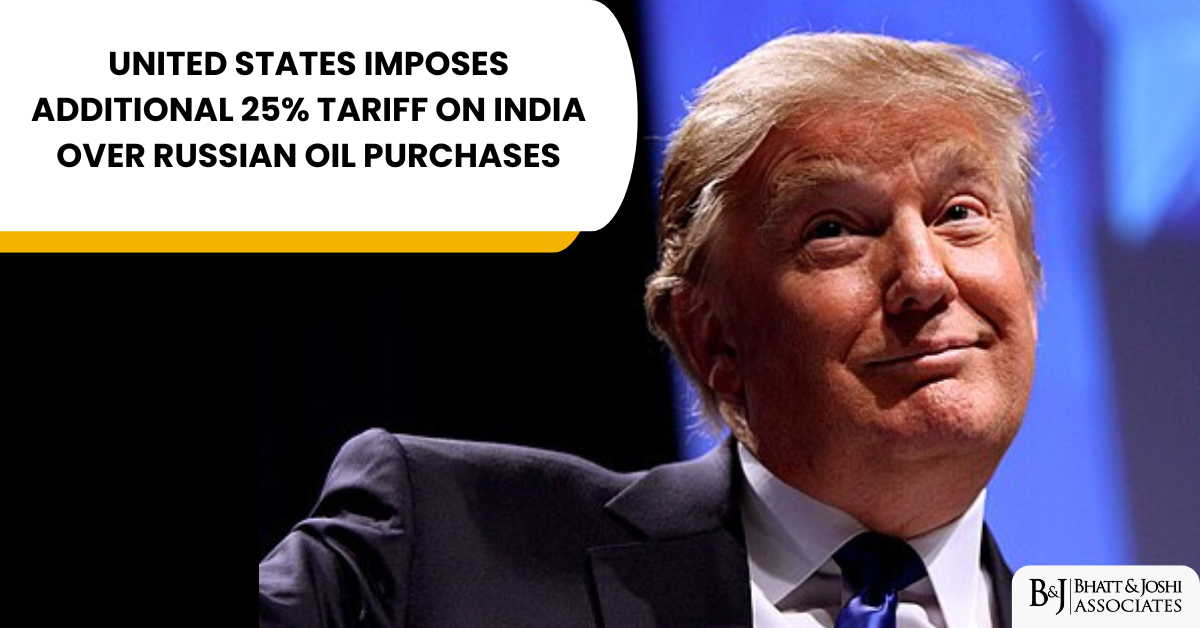
In a significant escalation of trade tensions between two major democratic nations, President Donald Trump announced on August 6, 2025, the imposition of an additional 25% tariff on imports from India, effectively doubling the total tariff burden to 50%. This unprecedented trade measure stems from India’s continued procurement and resale of Russian oil despite ongoing geopolitical tensions surrounding the Russia-Ukraine conflict. The decision marks one of the most substantial trade penalties imposed by the United States on a strategic partner and represents a critical juncture in US-India relations, which have historically been characterized by growing economic cooperation and shared democratic values.
The tariff implementation, which became effective on August 27, 2025, has sent shockwaves through international trade circles and raised fundamental questions about the intersection of national security concerns, economic diplomacy, and the legal frameworks governing international commerce. With bilateral trade between the United States and India valued at approximately USD 212.3 billion in 2024, including USD 87.3 billion in US imports from India [1], the ramifications of this decision extend far beyond mere economic calculations, touching upon issues of sovereignty, strategic autonomy, and the evolving architecture of global trade governance.
Legal Foundation of the Tariff Imposition
The International Emergency Economic Powers Act
The legal basis for President Trump’s tariff imposition rests primarily on the International Emergency Economic Powers Act (IEEPA), codified at 50 U.S.C. §§ 1701-1707. This statute, enacted in 1977, grants the President expansive authority to regulate international commerce and financial transactions when facing what the legislation terms an “unusual and extraordinary threat” to national security, foreign policy, or the American economy [2]. The IEEPA represents a carefully calibrated Congressional delegation of power, allowing the executive branch to respond swiftly to emerging international crises while maintaining certain procedural safeguards and reporting requirements.
Under Section 1701(a) of the IEEPA, the President may exercise this authority only after declaring a national emergency pursuant to the National Emergencies Act. The statute specifically empowers the executive to “investigate, regulate, or prohibit” any transactions in foreign exchange, transfers of credit or payments between financial institutions, and the importation or exportation of currency or securities. Most relevant to the current situation, subsection 1702(a)(1)(B) explicitly authorizes the President to “regulate or prohibit” imports when such action is deemed necessary to address the declared emergency.
Executive Order 14257 and the Reciprocal Tariff Framework
The immediate legal instrument implementing the tariff on India derives from Executive Order 14257, titled “Regulating Imports With a Reciprocal Tariff To Rectify Trade Practices That Contribute to Large and Persistent Annual United States Goods Trade Deficits,” issued on April 2, 2025 [3]. This executive order established a comprehensive framework for what the administration termed “reciprocal tariffs,” designed to address what it characterized as unfair trade practices and persistent trade imbalances that, in the President’s determination, constituted a national emergency.
Executive Order 14257 declared that conditions reflected in large and persistent annual United States goods trade deficits constitute an unusual and extraordinary threat to the national security and economy of the United States. The order established a baseline 10% tariff on imports from most trading partners, with provisions for higher country-specific rates based on various economic and security considerations. Critically, the order included Annex II, which specified certain exempt categories of goods deemed essential to American pharmaceutical production, electronics manufacturing, and critical mineral supply chains.
The August 2025 Presidential Determination on India
On August 6, 2025, President Trump issued a separate executive determination specifically addressing India’s role in the Russian oil trade. Titled “Addressing Threats to the United States by the Government of the Russian Federation,” the order invoked both the IEEPA and the framework established under Executive Order 14257 to justify the additional 25% tariff on Indian imports. The White House fact sheet accompanying the decision stated that the measure was necessary because India’s “direct or indirect importation of Russian Federation oil” enables funding of Russia’s military operations in Ukraine, thereby undermining U.S. efforts to counter these activities and presenting a threat to American national security interests.
The determination emphasized that India’s practice of purchasing Russian crude oil at discounted rates and subsequently refining and reselling petroleum products to international markets, including potentially to American consumers, created what the administration characterized as a sanctions evasion mechanism. This characterization proved controversial, as India’s oil trade with Russia remained technically legal under existing international law, even as it complicated Western efforts to economically isolate Moscow.
Regulatory Framework Governing International Tariffs
Harmonized Tariff Schedule and Classification
The implementation of tariffs on Indian goods operates within the broader framework of the Harmonized Tariff Schedule of the United States (HTSUS), which provides the nomenclature and classification system for all goods entering American commerce. As part of this policy, the U.S. imposes an additional 25% tariff on India, applied as an ad valorem duty calculated as a percentage of the declared customs value of imported merchandise. This duty supplements, rather than replaces, any existing tariffs already applicable to specific product categories under normal trade relations.
The United States Customs and Border Protection (CBP), operating under the authority of Title 19 of the United States Code, bears responsibility for collecting these duties and enforcing compliance. Section 1500 of Title 19 establishes the procedures for appraising imported merchandise and determining the appropriate tariff classification. The CBP’s implementing regulations, found in Title 19 of the Code of Federal Regulations, provide detailed guidance on valuation methods, country of origin determinations, and the application of special tariff programs.
Exemptions and Excluded Categories
Recognizing that certain imports serve critical national interests despite broader trade tensions, the tariff order incorporates specific exemptions for goods listed in Annex II of Executive Order 14257. These exemptions reflect a pragmatic acknowledgment that American manufacturing and pharmaceutical sectors depend on certain mineral and energy resources that would be difficult or prohibitively expensive to source from alternative suppliers in the short term.
The exempt categories include various rare earth elements, critical minerals used in semiconductor manufacturing, certain pharmaceutical active ingredients, and specific energy resources. The Department of Commerce, in consultation with other agencies, maintains the authority to modify this exemption list through periodic reviews. This mechanism allows the administration to balance punitive trade measures against the practical realities of global supply chain dependencies.
The World Trade Organization Framework and International Trade Law
General Agreement on Tariffs and Trade Obligations
The imposition of country-specific tariffs by the United States raises complex questions under the World Trade Organization (WTO) legal framework, particularly regarding the General Agreement on Tariffs and Trade (GATT). Article I of the GATT enshrines the principle of Most Favored Nation (MFN) treatment, requiring WTO members to accord products from any member nation treatment no less favorable than that given to products from any other country. This fundamental principle aims to prevent discriminatory trade practices and ensure a level playing field in international commerce [5].
However, the GATT includes several exceptions that potentially provide legal cover for the American tariff measures. Article XXI, known as the security exception, permits members to take actions they consider “necessary for the protection of its essential security interests” relating to fissionable materials, traffic in arms, or actions “taken in time of war or other emergency in international relations.” The interpretation and application of Article XXI has generated considerable controversy within the WTO, with members disagreeing about whether such determinations are self-judging or subject to review by dispute settlement panels.
Previous WTO Disputes Involving Security Exceptions
The WTO dispute settlement mechanism has only recently begun to grapple seriously with security exception claims. In the landmark case of Russia – Measures Concerning Traffic in Transit (DS512), a panel established in 2019 determined that Article XXI’s security exception is not entirely self-judging, though panels should exercise restraint in reviewing a member’s characterization of its essential security interests [6]. The panel held that certain objective requirements must be met, particularly that the disputed measures must relate to one of the enumerated circumstances in Article XXI(b) and that the nexus between the measure and the stated security concern must be plausible.
This precedent suggests that while the United States enjoys considerable discretion in defining its security interests, India could potentially challenge the tariffs at the WTO by arguing that the connection between oil trade and American security interests fails to meet even this deferential standard. However, the practical utility of such a challenge remains uncertain given the WTO’s ongoing crisis surrounding its Appellate Body, which has been non-functional since December 2019 due to American blocking of new appointments.
India’s Legal Position and Response Options
Sovereignty and Non-Alignment Principles
India’s response to the U.S. Imposes Additional 25% Tariff on India must be understood within the country’s longstanding commitment to strategic autonomy and non-alignment in international affairs. Unlike the Cold War-era doctrine of non-alignment between competing power blocs, contemporary Indian foreign policy emphasizes multi-alignment: maintaining productive relationships with diverse international partners while preserving freedom of action on matters of national interest. This approach reflects India’s emergence as a major global economy that seeks to maximize its options rather than subordinate its interests to any single power’s preferences.
From India’s perspective, its oil trade with Russia represents a legitimate exercise of sovereign economic decision-making. Indian officials have consistently argued that Western nations, including the United States and European Union members, continue to import significant quantities of Russian natural gas and other commodities despite sanctions regimes. The Indian government has characterized the selective targeting of its oil purchases as reflecting a double standard that fails to acknowledge the practical energy security needs of developing economies.
Potential Retaliatory Measures
Under Indian law, the government possesses authority to impose retaliatory tariffs through provisions of the Customs Tariff Act, 1975, particularly Section 8A, which empowers the central government to levy safeguard duties when imports threaten domestic industry, and Section 9A, which addresses anti-dumping measures [7]. Additionally, India could invoke provisions allowing countervailing duties or take recourse to its commitments under various international trade agreements.
The Indian Ministry of Commerce and Industry, through the Directorate General of Trade Remedies (DGTR), conducts investigations into trade remedy cases and makes recommendations to the Department of Revenue regarding appropriate tariff responses. However, India faces a delicate balancing act: while retaliatory tariffs might satisfy domestic political pressures and signal resolve, they would also harm Indian consumers and industries dependent on American imports, potentially triggering a destructive spiral of escalating trade restrictions.
Economic Analysis and Trade Impact
Sectoral Effects on Indian Exports
The 50% total tariff rate represents a severe impediment to Indian exporters across multiple sectors. India’s export basket to the United States encompasses diverse categories including textiles and apparel, pharmaceuticals and medical devices, information technology services, automotive components, jewelry, and agricultural products. The pharmaceutical sector appears particularly vulnerable given that India supplies approximately 40% of generic drugs consumed in the American market, making affordable medication access a potential domestic political issue within the United States itself.
The textile and apparel industry, which employs millions of workers across India and contributes significantly to export revenues, faces immediate competitive disadvantage against producers from countries not subject to similar tariffs. Bangladesh, Vietnam, and other Asian manufacturing hubs stand to benefit from trade diversion effects as American importers seek alternative suppliers. This shift could prove difficult to reverse even if tariffs are eventually reduced, as supply chain relationships, once disrupted, require substantial time and investment to reconstruct.
Implications for American Consumers and Industries
The U.S. Imposes additional 25% tariff on India aims to punish India for its Russian oil trade, but the immediate economic burden falls largely on American consumers and businesses that rely on Indian imports. Basic principles of tax incidence suggest that when demand for imported goods remains relatively inelastic, tariff costs are passed forward to consumers through higher prices. Generic pharmaceutical prices, for example, may rise significantly if Indian manufacturers reduce exports to the American market or demand higher prices to offset the tariff burden.
American manufacturers depending on Indian intermediate goods and components face a deterioration in their competitive position globally. The information technology sector, characterized by significant integration between American and Indian companies through outsourcing relationships and supply chain partnerships, confronts increased costs and potential disruption to established business models. These effects illustrate the fundamental reality that contemporary international trade relationships create mutual dependencies that cannot be easily severed without imposing costs on both parties.
International Precedents and Comparative Analysis
Historical Use of Trade Measures for Political Objectives
The instrumentalization of trade policy to achieve foreign policy objectives has deep historical roots in American practice. Section 301 of the Trade Act of 1974 grants the United States Trade Representative authority to investigate and respond to foreign trade practices deemed unfair or burdensome to American commerce. This provision has been employed in numerous disputes, though typically focused on issues like intellectual property protection, market access barriers, or subsidies rather than geopolitical alignment on security matters [8].
The Trump administration’s first term saw extensive use of Section 232 of the Trade Expansion Act of 1962, which permits tariffs on imports threatening national security. Steel and aluminum tariffs imposed in 2018 on multiple countries, including traditional allies, generated significant controversy and legal challenges. The European Union, Canada, and Mexico all filed WTO disputes challenging these measures, arguing that commercial steel and aluminum trade did not genuinely implicate national security concerns.
Sanctions and Secondary Boycotts
The current tariff action against India bears certain similarities to secondary sanctions, which target third-party countries or entities for conducting business with sanctioned states. The United States has employed secondary sanctions extensively in contexts such as Iranian oil trade, where American legislation penalized foreign companies purchasing Iranian petroleum. The Iran Sanctions Act and subsequent measures created global compliance challenges, as companies faced the choice between accessing the American market or continuing business with Iran.
However, the India tariffs differ in crucial respects from traditional secondary sanctions. Rather than prohibiting specific transactions or freezing assets, the measure imposes additional costs through the tariff mechanism. This approach potentially proves less legally vulnerable to challenges based on extraterritorial overreach, as tariffs represent a sovereign state’s control over access to its own market rather than an attempt to regulate conduct occurring entirely outside its jurisdiction.
Future Outlook and Potential Resolutions
Diplomatic Negotiations and Trade Agreements
Despite the severity of the current trade dispute, diplomatic channels remain open for potential resolution. The United States and India maintain high-level dialogues through various bilateral mechanisms, including the US-India Trade Policy Forum and strategic dialogues addressing defense and security cooperation. These forums could provide venues for negotiating a face-saving resolution that addresses American concerns about Russian oil trade while acknowledging Indian energy security needs.
One potential pathway involves India agreeing to gradually reduce its Russian oil imports while the United States phases down the tariff over a corresponding timeline. Alternative arrangements might include India providing greater market access for American energy exports, thereby reducing its overall dependence on Russian supplies while creating commercial opportunities for American producers. Such an agreement would require careful diplomatic calibration to avoid either side appearing to capitulate to external pressure.
Long-term Implications for Global Trade Architecture
The India tariff episode underscores broader challenges facing the international trade system. The increasing willingness of major powers to subordinate trade relationships to security and geopolitical considerations threatens the rules-based order that has governed international commerce since World War II. If trade measures become routine instruments of foreign policy coercion, the predictability and stability that facilitated global economic integration over recent decades may erode significantly [9].
Developing countries, in particular, may reconsider their commitments to trade liberalization and WTO disciplines if they perceive the system as permitting powerful nations to impose arbitrary restrictions while invoking capacious security exceptions. This could accelerate existing trends toward regionalization of trade relationships and the fragmentation of global commerce into competing economic blocs aligned with major powers.
Conclusion
The U.S. imposes an additional 25% tariff on India, marking a major escalation in trade policy as a tool of geopolitical statecraft. While the legal foundation under the International Emergency Economic Powers Act grants the U.S. President broad discretion to address national security threats, the move raises questions about the limits of economic regulation and foreign policy coercion. Its effectiveness in influencing India’s Russian oil purchases remains uncertain, as New Delhi’s energy security priorities and commitment to strategic autonomy may outweigh the economic impact of reduced access to the American market.
From a legal perspective, the measure occupies an ambiguous space within international trade law. While the GATT’s security exception potentially provides cover for such actions, the connection between India’s oil trade and genuine threats to American security appears attenuated at best. The precedent established by this tariff could encourage other nations to invoke similarly broad interpretations of security exceptions, ultimately undermining the rule-based international trading system that has promoted global prosperity and economic development for decades.
The ultimate resolution of this dispute will likely depend less on strict legal analysis than on pragmatic diplomatic negotiation and mutual accommodation of interests. Both the United States and India benefit substantially from their economic relationship, and both face domestic political pressures regarding their response to the Russia-Ukraine conflict. Finding a path forward that allows both nations to claim success while preserving the broader bilateral partnership represents the paramount challenge for policymakers in both capitals.
References
[1] Office of the United States Trade Representative. “India.” https://ustr.gov/countries-regions/south-central-asia/india
[2] International Emergency Economic Powers Act, 50 U.S.C. §§ 1701-1707 (1977). Available at: https://uscode.house.gov/view.xhtml?path=/prelim@title50/chapter35&edition=prelim
[3] The White House. “Executive Order 14257: Regulating Imports With a Reciprocal Tariff To Rectify Trade Practices That Contribute to Large and Persistent Annual United States Goods Trade Deficits.” April 2, 2025.
[4] The White House. “Fact Sheet: President Donald J. Trump Addresses Threats to the United States by the Government of the Russian Federation.” August 6, 2025. https://www.whitehouse.gov/fact-sheets/2025/08/fact-sheet-president-donald-j-trump-addresses-threats-to-the-united-states-by-the-government-of-the-russian-federation/
[5] General Agreement on Tariffs and Trade, Oct. 30, 1947, 61 Stat. A-11, 55 U.N.T.S. 194. Available at: https://www.wto.org/english/docs_e/legal_e/gatt47_01_e.htm
[6] World Trade Organization. “Russia – Measures Concerning Traffic in Transit,” WT/DS512/R (April 5, 2019). https://www.wto.org/english/tratop_e/dispu_e/cases_e/ds512_e.htm
[7] Customs Tariff Act, 1975 (India), No. 51 of 1975.
[8] Trade Act of 1974, Pub. L. No. 93-618, 88 Stat. 1978 (codified as amended at 19 U.S.C. § 2411). Available at: https://ustr.gov/issue-areas/enforcement/section-301-investigations
[9] Congressional Research Service. “Court Decisions Regarding Tariffs Imposed Under the International Emergency Economic Powers Act (IEEPA).” Updated September 2025. https://www.congress.gov/crs-product/LSB11332

Advocate Chandni Joshi
Advocate at Gujarat High Court and CoFounder at Bhatt and Joshi Associates. As Co-Founder, Chandni leads firm operations and client advisory functions. Her dual background in technology and law enables her to handle corporate, cyber, and IP matters with precision and insight.
