 Whatsapp

Evolution of Indian Banking System: From 1770 to RBI to Digital Banking
The Indian banking sector has traveled a remarkable journey spanning more than two centuries, transforming from modest trading operations into a sophisticated financial ecosystem that serves over a billion people. This evolution reflects not just economic progress but also the changing regulatory landscape that has shaped how banks operate, who controls them, and whom they serve. To fully appreciate the evolution of the Indian banking industry, it is essential to examine the legal frameworks, landmark judicial decisions, and policy shifts that have defined the sector over time.
The Foundation: Early Banking and Pre-Independence Era
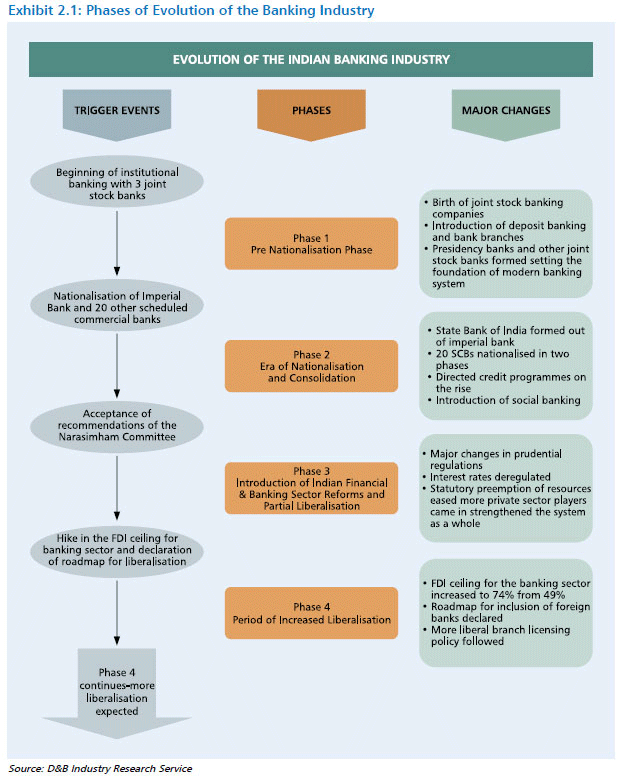
The roots of Indian banking stretch back to the late eighteenth century when traders established the first banking institutions primarily to facilitate commerce. The Bank of Calcutta, established in 1806 and later renamed the Bank of Bengal in 1809, marked the beginning of organized banking in India. This institution, along with the Bank of Bombay (1840) and the Bank of Madras (1843), formed the presidency banks that dominated the pre-independence banking landscape. These three institutions merged in 1921 to create the Imperial Bank of India, which would eventually become the State Bank of India after independence an important milestone in the broader evolution of the Indian banking industry.
During this early phase, banking remained largely unregulated and concentrated in urban centers, serving primarily the commercial interests of the British Empire and a small segment of Indian society. The absence of a central regulatory authority meant that banks operated with minimal oversight, leading to frequent failures and instability. The volatility of this period underscored the need for stronger regulation and a central banking institution to maintain monetary stability.
Establishing Regulatory Control: The RBI and Banking Regulation Acts
The modern regulatory framework for Indian banking began taking shape with the Reserve Bank of India Act, 1934 [1]. This legislation, passed by the British Indian Legislature on March 6, 1934, and effective from April 1, 1935, established the Reserve Bank of India as the nation’s central bank. The Act defined the RBI’s mandate as regulating currency issuance and maintaining monetary stability across India, making it one of the earliest milestones in the evolution of the Indian banking industry. Section 3 of the Act specifically provided for the constitution of a bank to manage the country’s currency and credit system.
The RBI Act introduced the concept of “scheduled banks” in its Second Schedule. According to the Act, scheduled banks must maintain paid-up capital and reserves of at least five lakh rupees and satisfy the RBI that their affairs are not being conducted in a manner detrimental to depositors’ interests. Section 42(1) of the RBI Act mandates that every scheduled bank maintain an average daily balance with the RBI, establishing the cash reserve requirement that remains fundamental to banking operations today.
However, the RBI Act alone proved insufficient to regulate the complex business of banking. Banks continued to operate under the Companies Act, which lacked provisions specific to banking operations. This gap was addressed with the Banking Regulation Act, 1949 [2]. Originally enacted as the Banking Companies Act on March 16, 1949, it was renamed the Banking Regulation Act in 1966 when its scope expanded to include cooperative banks. This Act provided the detailed regulatory framework that governs banking operations to this day.
The Banking Regulation Act established clear definitions and operational boundaries for banks. Section 5(b) defines banking as “accepting for the purpose of lending or investment, of deposits of money from the public, repayable on demand or otherwise and withdrawal by cheques, drafts, order or otherwise.” The Act supplements the Companies Act rather than replacing it, creating a dual regulatory structure. Section 6(1) enumerates the specific business activities that banking companies can undertake, while Section 16 addresses governance by prohibiting common directors across different banking companies to prevent conflicts of interest.
Crucially, the Act empowered the RBI with extensive supervisory authority. Banks must obtain licenses from the RBI to commence operations, and the RBI maintains the authority to cancel these licenses if banks fail to comply with regulatory requirements. The Act also mandates that banks maintain specific liquid asset ratios, with Section 24 requiring banks to maintain cash, gold, or approved securities equal to 23 percent of their time and demand liabilities as Statutory Liquidity Ratio. Additionally, Section 18 establishes the Cash Reserve Ratio requirement, currently mandating that banks maintain 4.25 percent of their total deposits with the RBI.
The Nationalization Era: Transforming Banking’s Purpose
The most dramatic shift in Indian banking came with the nationalization waves of 1969 and 1980. On July 19, 1969, Prime Minister Indira Gandhi announced the nationalization of fourteen major commercial banks with deposits exceeding fifty crore rupees through the Banking Companies (Acquisition and Transfer of Undertakings) Ordinance, 1969. The stated objectives included removing control from a few industrial houses, expanding credit to priority sectors like agriculture and small industries, and achieving balanced regional development.
The ordinance nationalized the Central Bank of India, Bank of India, Punjab National Bank, Bank of Baroda, United Commercial Bank, Canara Bank, United Bank of India, Dena Bank, Syndicate Bank, Union Bank of India, Allahabad Bank, Indian Bank, Bank of Maharashtra, and Indian Overseas Bank. The government justified this action by citing the need to direct banking resources toward national economic objectives and social welfare rather than private profit.
However, this bold move immediately faced constitutional scrutiny in the landmark case of Rustom Cavasjee Cooper v. Union of India (1970) [3]. R.C. Cooper, a shareholder and director of the Central Bank of India, challenged the ordinance and subsequent Act before the Supreme Court, arguing that it violated fundamental rights under Articles 14, 19(1)(f), 19(1)(g), and 31 of the Constitution. The case raised fundamental questions about the balance between state power to pursue economic policy and individual property rights.
The Supreme Court, in a judgment delivered by a bench of eleven judges on February 10, 1970, struck down the Banking Companies (Acquisition and Transfer of Undertakings) Act, 1969, as unconstitutional. The Court held that the compensation provisions were inadequate and arbitrary, violating Article 31(2) which guarantees compensation for property acquisition. The compensation structure, which provided payment in government securities maturing over ten years, was deemed neither just nor fair. The Court also found the Act violated Article 14 by discriminating against the fourteen nationalized banks through prohibiting them from conducting banking business while allowing other banks to continue operations.
Significantly, the Court rejected the doctrine of mutual exclusivity between Article 19 and Article 31, establishing that these fundamental rights are interconnected. The judgment introduced the “effects test,” holding that courts must examine the actual effect of legislation on fundamental rights rather than merely its stated objectives. This ruling expanded the scope of judicial review over economic legislation and affirmed that shareholders could challenge laws affecting their rights even when directed at corporate entities.
Following this setback, the government enacted a revised Banking Companies (Acquisition and Transfer of Undertakings) Act, 1970, addressing the constitutional deficiencies identified by the Court. This Act successfully accomplished the nationalization by providing more adequate compensation mechanisms and removing the discriminatory provisions. Encouraged by this success, the government conducted a second round of nationalization on April 15, 1980, bringing six more banks with deposits exceeding two hundred crore rupees into public ownership. These included Punjab and Sind Bank, Vijaya Bank, Oriental Bank of Commerce, New Bank of India, Corporation Bank, and Andhra Bank.
Diversification: Regional Rural Banks and Cooperative Banking
Parallel to nationalization, the government addressed the needs of rural India by establishing Regional Rural Banks (RRBs) in September 1975 [4]. RRBs were created with a unique ownership structure: fifty percent equity held by the central government, fifteen percent by concerned state governments, and thirty-five percent by sponsor banks. This structure combined the local orientation of cooperative institutions with the financial strength and management expertise of commercial banks. Between 1975 and 1987, 196 RRBs were established, eventually covering 585 out of 622 districts across India. Through subsequent consolidation, the number reduced to 86 by March 2009 as state-wise amalgamations occurred among RRBs sponsored by the same bank.
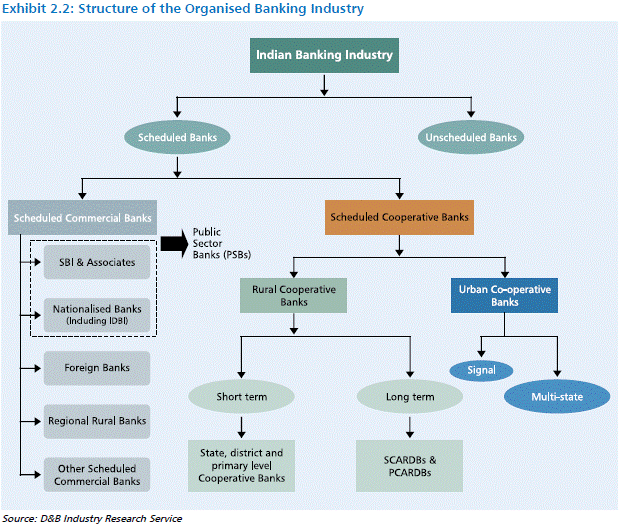
The cooperative banking sector also received statutory recognition through amendments to the Banking Regulation Act. The 1965 amendment incorporated Section 56, bringing cooperative banks under the Act’s regulatory framework while recognizing their distinct cooperative character. Cooperative banks operate according to principles of mutual assistance and are registered under the Cooperative Societies Act. The sector comprises urban and rural cooperative credit institutions, with rural cooperatives organized in a three-tier structure spanning primary, district, and state levels. A significant reform came with the Banking Regulation (Amendment) Act, 2020, which brought 1,482 urban and 58 multi-state cooperative banks under direct RBI supervision [5], strengthening regulatory oversight and depositor protection.
Liberalization and Modern Banking Structure
The 1990s ushered in a new phase of banking sector reforms responding to economic liberalization. The Narasimham Committee recommendations led to the entry of new private sector banks licensed by the RBI from 1993 onwards. These new-generation private banks brought technological innovation, customer service focus, and operational efficiency that transformed the competitive landscape. Banks like ICICI Bank, HDFC Bank, and Axis Bank emerged as significant players, challenging the dominance of public sector banks.
The current structure of Indian banking reflects this evolutionary journey. Scheduled Commercial Banks (SCBs) form the backbone of the system, categorized into State Bank of India and its associates, nationalized banks, private sector banks (old and new), foreign banks, and Regional Rural Banks. As of 2009, eighty SCBs operated across India, with public sector banks controlling approximately seventy percent of total credit and deposits. Foreign banks, numbering thirty-two with 293 branches by June 2009, brought international practices and specialized services, operating either through complete branch presence or representative offices.
The product offerings have evolved far beyond simple deposit and lending functions. Banks now provide retail banking services including housing loans, auto loans, personal loans, and credit cards, with retail portfolios accounting for around 21.3 percent of total loans and advances by March 2009. Wholesale banking serves large and mid-corporate clients with project finance, working capital, syndication services, and merchant banking. Treasury operations encompass investments in debt and equity markets, mutual funds, derivatives, and forex trading, generating significant non-interest income. Fee-based services have become increasingly important, including cash management, trade finance, wealth management, and custodial services.
Ongoing Challenges and Regulatory Evolution
Despite these advances, the Indian banking sector faces ongoing challenges that continue to shape regulatory policy. Non-performing assets remain a persistent concern, requiring stricter provisioning norms and resolution mechanisms. The Banking Regulation Act has been criticized for providing insufficient leverage over public sector banks, where government ownership constrains management autonomy. The Insolvency and Bankruptcy Code, 2016, has been integrated with banking regulations to address corporate defaults more effectively.
The framework continues evolving through amendments and regulatory circulars from the RBI. Recent initiatives focus on financial inclusion, promoting digital payments, addressing cybersecurity risks, and ensuring climate-related financial stability. The Payment and Settlement Systems Act, 2007, has provided the legal basis for regulating digital payment systems, while Know Your Customer (KYC) norms under the Prevention of Money Laundering Act, 2002, have strengthened the fight against financial crimes.
Conclusion
The evolution of banking In India represents a carefully orchestrated balance between market forces and regulatory oversight, between public welfare objectives and operational efficiency, between financial stability and innovation. From the unregulated trading banks of the eighteenth century to the sophisticated, technology-driven institutions of today, the journey reflects India’s broader economic and social transformation. The legal and regulatory framework built around the RBI Act, Banking Regulation Act, and subsequent legislation has created a resilient system capable of serving diverse needs while maintaining stability. As India continues its economic growth trajectory, the banking sector and its regulatory architecture will undoubtedly evolve further, guided by the lessons of this remarkable two-century journey.
References
[1] Reserve Bank of India Act, 1934. Available at: https://www.indiacode.nic.in/handle/123456789/2398
[2] Banking Regulation Act, 1949. Available at: https://www.indiacode.nic.in/handle/123456789/1885
[3] Rustom Cavasjee Cooper v. Union of India, AIR 1970 SC 564. Available at: https://indiankanoon.org/doc/513801/
[4] Banking in India – Historical Overview. Wikipedia. Available at: https://en.wikipedia.org/wiki/Banking_in_India
[5] Banking Regulation Act, 1949 (Overview). iPleaders. Available at: https://blog.ipleaders.in/banking-regulation-act-1949/
[6] Nationalization of Banks in India: Key Phases & Impact. NextIAS. Available at: https://www.nextias.com/blog/nationalisation-of-banks/
[7] Reserve Bank of India Act, 1934 – Explanatory Notes. RBI Official Website. Available at: https://www.rbi.org.in/annualdata/explanatorynotes.html
[8] R.C. Cooper v. Union of India Case Analysis. LawBhoomi. Available at: https://lawbhoomi.com/rustom-cavasjee-cooper-ors-rc-cooper-v-union-of-india/
[9] Banking Regulation Act, 1949: An Overview. LawBhoomi. Available at: https://lawbhoomi.com/banking-regulation-act-1949/

Advocate Aaditya Bhatt
Senior Standing Counsel Income Tax Department, Advocate Gujarat High Court. Aaditya combines his technical and legal expertise to deliver strategic counsel in litigation, constitutional, and regulatory matters. He represents clients before High Courts and Tribunals with a technology-driven approach.
