Whatsapp

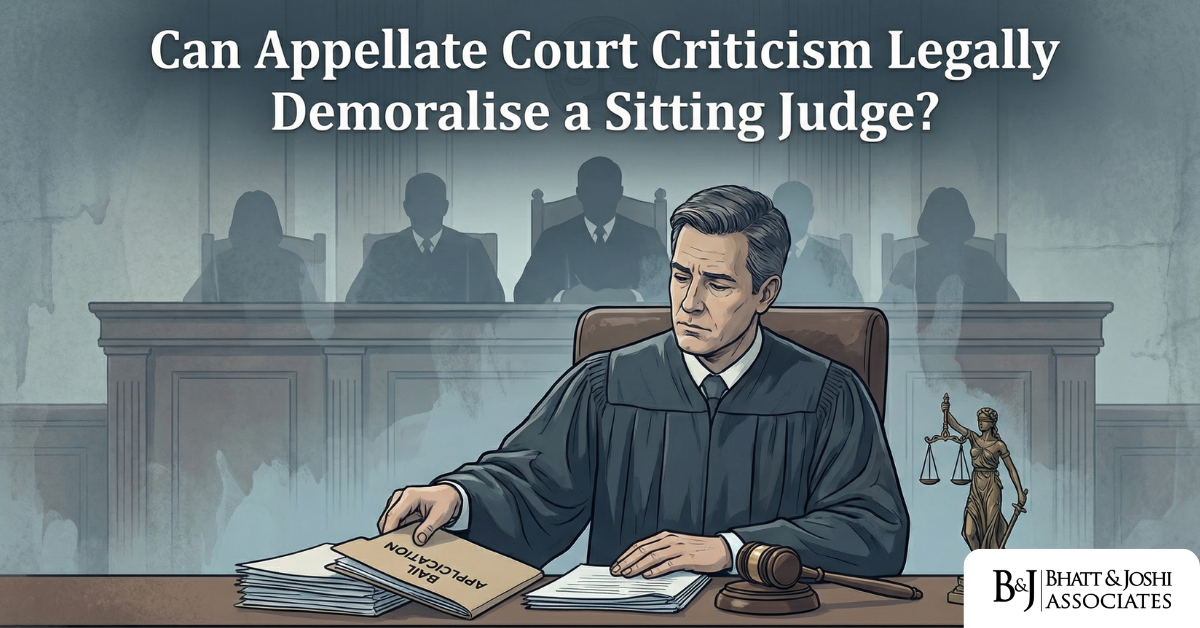
Can Appellate Court Criticism Demoralise Judges? Judicial Independence and the Chilling Effect
Introduction
On 13 February 2026, Justice Pankaj Bhatia of the Allahabad High Court made a remarkable decision that sent ripples through India’s judicial system. While hearing a second bail application in Rakesh Tiwari v. State of U.P. — a case involving Sections 103(1) of the Bharatiya Nyaya Sanhita, 2023 and Sections 4/25 of the Arms Act — Justice Bhatia declined to proceed. His reason was unprecedented: Supreme Court remarks in an earlier case had created what he described as a “demoralising and chilling effect” on his judicial function. In response, he not only recused himself from the matter but explicitly requested the Chief Justice remove him from the bail roster entirely. [1]
The earlier Supreme Court order that prompted this was Chetram Verma v. State of U.P., Criminal Appeal No. 770/2026 (arising out of SLP (Crl.) No. 19237/2025), decided on 9 February 2026 by a bench of Justices J.B. Pardiwala and K.V. Viswanathan. In that case, the Supreme Court set aside a bail order that Justice Bhatia had passed for the accused husband in a dowry death case and described it as “one of the most shocking and disappointing orders that we have come across over a period of time.” [2] The Bench observed, in terms that left little to interpretation: “We fail to understand on plain reading of the impugned order as to what the High Court is trying to convey.”
This episode highlights the chilling effect on judicial independence when appellate criticism crosses into personal censure. It raises key questions: How far can a higher court publicly criticise a sitting judge? What protections exist for judicial officers facing such remarks? And how might such criticism influence judicial discretion and the fairness of India’s bail system?
The Factual Matrix
The Dowry Death and the Bail Grant
The facts in Chetram Verma are disturbing in their simplicity. Sushma, aged 22, was married to Devraj alias Golu on 1 March 2025. Within three months of the marriage, she died under suspicious circumstances at her matrimonial home in the early hours of 25 April 2025. The postmortem examination identified the cause of death as “asphyxia due to strangulation.” Her father, Chetram Verma, lodged FIR No. 188/2025 at Kotwali Bhinga Police Station, Shrawasti, Uttar Pradesh, alleging persistent dowry demands — including for a four-wheeler — despite having already paid Rs. 3.5 lakh in cash at the time of marriage. Charges were framed under Sections 85 and 80(2) of the Bharatiya Nyaya Sanhita, 2023 — which correspond to dowry death and cruelty by husband or relatives — and Sections 3 and 4 of the Dowry Prohibition Act, 1961. [2]
In October 2025, the Allahabad High Court, through Justice Bhatia, granted bail. The order was brief. It recorded the defence counsel’s submission, noted that the accused had been in custody since 27 July 2025, and concluded that since there was no criminal history, bail was granted. One prosecution witness — the father of the deceased — had already been examined. No analysis of flight risk, likelihood of tampering with evidence, or the gravity of the offence appeared in the order.
The Supreme Court’s Response
The father of the deceased approached the Supreme Court. The bench of Justices Pardiwala and Viswanathan, in paras 4 and 29 of the Chetram Verma order, described the High Court’s reasoning as both shocking and as having led to a “travesty of justice.” The Court cancelled the bail and directed the accused to immediately surrender to judicial custody. Four days later, Justice Bhatia, confronted with a second bail application in a separate but connected matter, chose to recuse himself entirely from bail matters. [1]
The Legal Framework Governing Bail Decisions
Statutory Basis and Judicial Discretion
The power to grant bail in non-bailable offences is governed by Section 480 of the Bharatiya Nagarik Suraksha Sanhita, 2023 (BNSS), which corresponds to the erstwhile Section 439 of the Code of Criminal Procedure, 1973 (CrPC). These provisions vest wide discretionary powers in Sessions Courts and High Courts, while Section 478 BNSS (formerly Section 437 CrPC) governs the grant of bail before courts other than the High Court. The exercise of this discretion is not unfettered — it must be informed by the nature and gravity of the accusation, the antecedents of the accused, the possibility of the accused absconding, the interests of the victims, and wider considerations of justice. [3]
The Supreme Court in Satender Kumar Antil v. Central Bureau of Investigation, decided on 11 July 2022, comprehensively restated the governing principles, directing that bail applications be disposed of within two weeks and setting out the foundational doctrine that “bail is the rule, jail is the exception.” [4] The judgment categorised offences for the purpose of bail consideration and reiterated that courts must not exercise bail discretion in a casual or mechanical manner — but equally, that they must not allow the seriousness of an offence alone to substitute for genuine judicial reasoning.
What a Bail Order Must Contain
What Chetram Verma exposed is the recurring failure of courts to write reasoned bail orders in cases involving serious offences like dowry death. The Supreme Court has, across numerous decisions, expected bail orders in cases involving potential sentences of life imprisonment to grapple, at minimum, with: the nature and gravity of the accusation; the antecedents and prior criminal history of the accused; the danger of the accused absconding if released; any likelihood of tampering with evidence or influencing witnesses; and the broader impact on the victim’s family and society. A bail order that simply records period of custody and absence of criminal history, without engaging with the facts of the case and the strength of the prosecution evidence — particularly in a dowry death case where one prosecution witness had already deposed — does leave itself legitimately vulnerable to appellate interference.
The Law on Appellate Strictures Against Judicial Officers
The Three-Pronged Test from Mohammad Naim
The governing law on when an appellate court may make adverse remarks against a judicial officer was settled by the Supreme Court in State of Uttar Pradesh v. Mohammad Naim, AIR 1964 SC 703. In that case, the Court identified three tests that must be satisfied before such remarks can be legitimately sustained in a judicial order: (a) whether the party whose conduct is in question was before the court or had an opportunity of explaining or defending himself; (b) whether there was evidence on record bearing on that conduct justifying the remarks; and (c) whether it was necessary for the decision of the case, as an integral part thereof, to animadvert on that conduct. The Court added that judicial pronouncements must be judicial in nature and “should not normally depart from sobriety, moderation and reserve.” [5]
These tests apply with heightened force when the target of the criticism is a fellow judicial officer — someone exercising the same constitutional function, albeit at a different tier of the hierarchy. In the Allahabad High Court context, the sharpness of the language used by the Supreme Court in Chetram Verma — specifically the word “shocking” — raises the question whether the remarks crossed from permissible appellate correction into something that operates more like a public sanction.
The Doctrine in Re: “K”, A Judicial Officer
The most articulate statement of why appellate strictures against judges require special caution appears in the Supreme Court’s decision in Re: “K”, A Judicial Officer, (2001) 3 SCC 54. The Court catalogued the specific harms that flow from a superior court publicly condemning a subordinate judge in a judicial order. First, the judicial officer is condemned unheard, which is itself a violation of natural justice — a particularly uncomfortable outcome for someone whose daily function is to protect that very principle. Second, the criticism of a judge in a higher court’s order gives the litigating party a sense of victory not only over the opponent but also over the judge who decided against them — which is, the Court observed, “subversive of judicial authority.” Third, seeking expungement of such remarks through an appeal or petition reduces the judicial officer to the status of a litigant before a court where lawyers who appear before him or her regularly would argue the case. Fourth — and this is what the Chetram Verma episode demonstrates directly — “the possibility of a single or casual aberration of an otherwise honest, upright and righteous Judge being caught unawares in the net of adverse observations… would have a seriously demoralising effect not only on him but also on his colleagues,” creating a tangible chilling effect on judicial independence.[6]
Kaushal Singh and the 2025 Restatement
As recently as July 2025, in Kaushal Singh v. State of Rajasthan, 2025 INSC 871, a three-judge bench comprising Justices Vikram Nath, Sanjay Karol and Sandeep Mehta expunged strictures passed by the Rajasthan High Court against a District Judge-cadre officer over a bail order that did not mention the accused’s criminal antecedents. The High Court had described the bail order as “grossly inappropriate and cavalier.” The Supreme Court held that the strictures were uncalled for, were passed without providing the officer an opportunity to explain, and were expunged. The Court reiterated that “the law is well-settled by a catena of decisions rendered by this Court that High Courts should ordinarily refrain from passing strictures against the judicial officers while deciding matters on the judicial side.” [7]
What the Kaushal Singh decision also confirms is the importance of the administrative channel — the Supreme Court noted explicitly that the High Court can always communicate concerns about a judicial officer’s conduct through a confidential letter or note to the Chief Justice, who may then act on the administrative side. That channel preserves natural justice, prevents public condemnation, and gives the officer an opportunity to explain.
The “Chilling Effect” on Judicial Function
What the Doctrine Means in This Context
In its most familiar form, the “chilling effect” describes how overly broad laws or the threat of legal consequences can suppress conduct that would otherwise be lawful or protected. While it is often discussed in free speech contexts, the same dynamic applies within the judiciary. When judges anticipate that certain decisions may trigger personal, public, or career-threatening criticism from a superior court, they may step back from those decisions altogether. Justice Pankaj Bhatia’s recusal from bail matters is a striking example of this phenomenon, showing how such pressures can create a chilling effect on judicial independence without any external interference. [8]
The concern here is not that the Supreme Court was wrong to set aside the bail order. The concern is systemic. If High Court judges infer from such public censures that bail matters — particularly in serious crimes like dowry death — are a professional minefield, the institutional consequence may be a gradual withdrawal from genuine engagement with bail applications: either through excessive bail refusals (to stay safe from the “too lenient” charge) or, as here, a refusal to hear bail matters at all.
The Asymmetry of Judicial Accountability
There is a structural asymmetry in the way judicial accountability operates in India. A High Court judge who grants bail that the Supreme Court views as insufficiently reasoned will have that error broadcast publicly in the language of the appellate order. Yet that same judge has no real-time forum to explain the pressures under which bail orders are written — the backlog, the brevity of hearing time, the absence of comprehensive criminal antecedent records in the court file, and the ambiguity of appellate precedent on what exactly bail reasoning must contain. The Chetram Verma order notes that the Supreme Court “failed to understand on plain reading of the impugned order as to what the High Court is trying to convey.” But the judge who wrote that order had no ability to respond, explain, or even be heard before the language became part of a reported judgment accessible to every litigant who appears before him.
Remedies Available to an Aggrieved Judicial Officer
Expungement Through Courts
The law does provide remedies, though they are imperfect. A judicial officer against whom adverse remarks have been made in a High Court order may approach the Supreme Court under Article 136 or Article 142 of the Constitution of India to seek expungement of those remarks. If the remarks appear in a Supreme Court order — as in the present case — the officer would need to seek expungement through a review petition or a separate petition, a path that is procedurally difficult and practically uncomfortable. The Court in Mohammad Naim and “K”, A Judicial Officer both acknowledged that the passage complained of may be expunged if three conditions are met: (i) it is wholly irrelevant and unjustifiable; (ii) its retention will cause serious harm to the person to whom it refers; and (iii) its expunction will not affect the reasons for the judgment or order. [5] The threshold is not low, and any petition for expungement would necessarily require arguing that the Supreme Court’s characterisation was itself unwarranted — a position that is both legally and professionally fraught.
The Administrative Channel and the Role of the Chief Justice
What Justice Bhatia did — requesting the Chief Justice to remove him from the bail roster — is itself a form of institutional self-preservation. It is not a legal remedy but an administrative one. It signals to the judicial hierarchy that the professional environment has become uncomfortable enough to affect judicial function. Whether it will trigger an administrative response, a conversation, or simply be noted and filed, depends entirely on how the Chief Justice of the Allahabad High Court exercises his administrative discretion.
The Supreme Court has repeatedly said that when a higher court has concerns about a judicial officer’s conduct, the appropriate response is an administrative communication — a confidential note to the Chief Justice, not a public broadside in a judicial order. The alternative channel is not just procedurally cleaner: it allows the officer to be heard, to explain, and to be corrected without being publicly condemned in terms that will follow every future litigant who looks the judge up. That this option exists but was not taken in Chetram Verma is the heart of the constitutional disquiet raised by this episode.
Judicial Independence and the Architecture of Appellate Correction
Article 50 of the Constitution of India mandates the separation of the judiciary from the executive. The independence of the judiciary — including its subordinate tiers — is part of the basic structure of the Constitution as affirmed in S.P. Gupta v. Union of India, AIR 1982 SC 149. Judicial independence is not merely the freedom from external interference; it also means the freedom to decide without internal hierarchical pressure of a kind that distorts judicial reasoning. When a judge declines to hear an entire category of case because he fears that any error will attract public, reported condemnation from a superior court, the independence of that judge’s decision-making has been compromised — not by a litigant, not by the government, but by the appellate hierarchy itself. [9]
The appellate structure exists to correct errors, not to deter them through public shaming. The Supreme Court has the widest power of superintendence over all courts in India under Articles 136 and 142, and High Courts exercise similar superintendence over subordinate courts under Article 227. These powers are meant to ensure correctness and consistency in the law. They are not — and the Supreme Court has said this repeatedly, even while exercising those very powers — meant to be used to publicly destroy the professional standing of a judge whose order is found wanting.
The episode in the Allahabad High Court does not suggest that Justice Bhatia lacked competence or integrity. It suggests that the accumulation of public, reported, and specifically personal criticism has reached a threshold where a sitting judge finds it more prudent — and more protective of litigants before him — to simply exit a field of adjudication than to continue in circumstances where any error may again attract disproportionate public condemnation.
Conclusion
The resignation of Justice Pankaj Bhatia from the bail roster represents, in constitutional terms, a stress point in the architecture of judicial independence. This outcome did not result from improper external pressure, but from internal dynamics within the hierarchical judicial system, where the language of appellate correction crossed from legitimate error-identification into territory the judge could not absorb without professional injury. The law — from Mohammad Naim (1964) to Kaushal Singh (2025) — is clear: superior courts may correct errors, criticise orders, and even use strong language. However, personal condemnation of a judicial officer in publicly accessible terms, with reputational permanence, should be avoided unless the tests of justifiability, necessity, and relevance are met. When those limits are exceeded, the chilling effect on judicial independence becomes real — not merely a legal doctrine, but a practical and institutional reality.
The larger question that this episode pushes to the forefront is whether India’s bail adjudication system can sustain itself if judges at one tier withdraw from it to protect themselves from the consequences of getting it wrong. The answer cannot come only from more rigorous bail orders; it must also come from a more calibrated and restrained appellate voice — one that corrects firmly, but does not condemn in terms that hollow out the confidence of the very judges it supervises.
References
[1] Live Law, “‘Demoralising’: Allahabad HC Judge Requests Removal From Bail Roster Following Supreme Court’s Criticism Of His Order” (13 February 2026) https://www.livelaw.in/top-stories/demoralising-supreme-court-criticism-allahabad-hc-judge-requests-removal-from-bail-roster-523097
[2] Indian Kanoon, Chet Ram Verma v. State of U.P., Criminal Appeal No. 770/2026 (arising out of SLP (Crl.) No. 19237/2025), Supreme Court of India, 9 February 2026 https://indiankanoon.org/doc/180152220/
[3] iPleaders, “Satender Kumar Antil vs CBI (2022)” — Discussion of Sections 436, 437, 438 and 439 CrPC bail framework https://blog.ipleaders.in/satender-kumar-antil-vs-cbi-2022/
[4] Live Law, Satender Kumar Antil v. Central Bureau of Investigation, 2022 LiveLaw (SC) 577, MA 1849 of 2021, 11 July 2022 https://www.livelaw.in/top-stories/supreme-court-41a-crpc-non-compliance-bail-satender-kumar-antil-vs-central-bureau-of-investigation-2022-livelaw-sc-577-203486
[5] Indian Kanoon, State of Uttar Pradesh v. Mohammad Naim, AIR 1964 SC 703 (15 March 1963) https://indiankanoon.org/doc/1498181/
[6] Law Trend, “High Courts Should Ordinarily Refrain From Passing Strictures Against Judicial Officers: Supreme Court” (Kaushal Singh, 18 July 2025) https://lawtrend.in/high-courts-should-ordinarily-refrain-from-passing-strictures-against-judicial-officers-supreme-court/
[7] Supreme Court Observer, Strictures and Remarks Against Judicial Officers in Judgements — Kaushal Singh v. State of Rajasthan, 2025 INSC 871 https://www.scobserver.in/supreme-court-observer-law-reports-scolr/strictures-and-remarks-against-judicial-officers-in-judgementskaushal-singh-v-state-of-rajasthan/
[8] Bar and Bench, “Most shocking: Supreme Court censures Allahabad HC again for bail in dowry death case sans reasoning” (11 February 2026) https://www.barandbench.com/amp/story/news/most-shocking-supreme-court-censures-allahabad-hc-again-for-bail-in-dowry-death-case-sans-reasoning
[9] SCC Online Blog, “Criticising Judicial Officer should be avoided”: SC directs expunging of adverse remarks (Sonu Agnihotri v. Chandra Shekhar, November 2024) https://www.scconline.com/blog/post/2024/11/23/criticism-judicial-officer-to-be-avoided-expunging-adverse-remarks-asj-delhi-hc-sc-legal-news/